
Northern Lights in Iceland: Best Time, Places and Planning Tips
Seeing the Northern Lights in Iceland is less about finding one secret viewpoint ↗ and more about getting three conditions to work together: darkness, enough clear sky, and aurora activity. Iceland sits in a very good position for aurora viewing, but no location, month, tour, or forecast can guarantee that the lights will appear on a particular night.
That uncertainty is the part first-time visitors need to plan around. You may have strong aurora activity but thick cloud. You may have perfectly clear skies while the lights remain weak. You may also see an excellent display on a night when the forecast looked ordinary. The best strategy is to give yourself several possible nights, watch cloud conditions closely, and stay flexible about where and when you go outside.
For most first-time visitors, I would treat the Northern Lights as an evening opportunity built into an Iceland trip, rather than making every day depend on seeing them. Plan a good Iceland itinerary for daylight hours, then use suitable nights for aurora watching when the conditions line up.
Northern Lights in Iceland at a Glance
| Question | Practical Answer |
|---|---|
| M ain viewing season | Late August to late April |
| Strong practical period | September through March |
| Can you see them in summer? | Normally not during the bright summer nights |
| Useful viewing hours | Often around 10 PM–1 AM, but aurora can appear outside this window |
| Most important conditions | Darkness, clear or partly clear sky, aurora activity |
| Can you see them from Reykjavík? | Yes sometimes, but darker areas usually give better viewing |
| Is a high Kp number required? | No |
| Does a tour guarantee them? | No |
| How many nights should you allow? | Several nights improve your chances of finding suitable conditions |
| Best approach | Check cloud cover, stay flexible, and be patient |
The most important point is:
Northern Lights season does not mean Northern Lights guarantee.
You are planning around a natural event.
What Are the Northern Lights?
The Northern Lights are also called:
Aurora Borealis.
They form when charged particles connected with solar activity interact with Earth's magnetic field and upper atmosphere.
That interaction can create visible light in the sky.
The most common color many visitors associate with the aurora is:
green.
But stronger or more complex displays may also show:
- ✓Purple
- ✓Pink
- ✓Red
- ✓Blue tones
What you see depends on the type of atmospheric interaction, altitude, aurora strength, darkness, and how your eyes respond to the light.
Why Can You See the Northern Lights in Iceland?
Iceland sits at a high northern latitude close to the region where aurora activity is commonly visible.
This makes it one of the easier countries to combine aurora watching with a normal sightseeing trip.
You can potentially see the Northern Lights from:
- ✓Reykjavík
- ✓South Iceland
- ✓West Iceland
- ✓North Iceland
- ✓East Iceland
- ✓Rural areas around the country
when conditions work.
There is no single Icelandic region where the aurora exists while the rest of the country has none.
The better location on a particular night is often the place with:
- ✓Darker sky
- ✓Less cloud
- ✓Safe access
rather than the most famous photograph location.
What Actually Needs to Happen Before You Can See Them?
Three main things need to line up.
1. It Must Be Dark Enough
Aurora can be occurring above Iceland while daylight makes it impossible to see.
This is why summer is poor for normal Northern Lights watching.
2. You Need Enough Clear Sky
Cloud can block the aurora completely.
This is one of the biggest factors visitors underestimate.
3. There Must Be Aurora Activity
You still need activity strong enough to become visible from your location.
You cannot control any of these conditions.
You can only improve your chance of being in the right place when they happen.
When Is Northern Lights Season in Iceland?
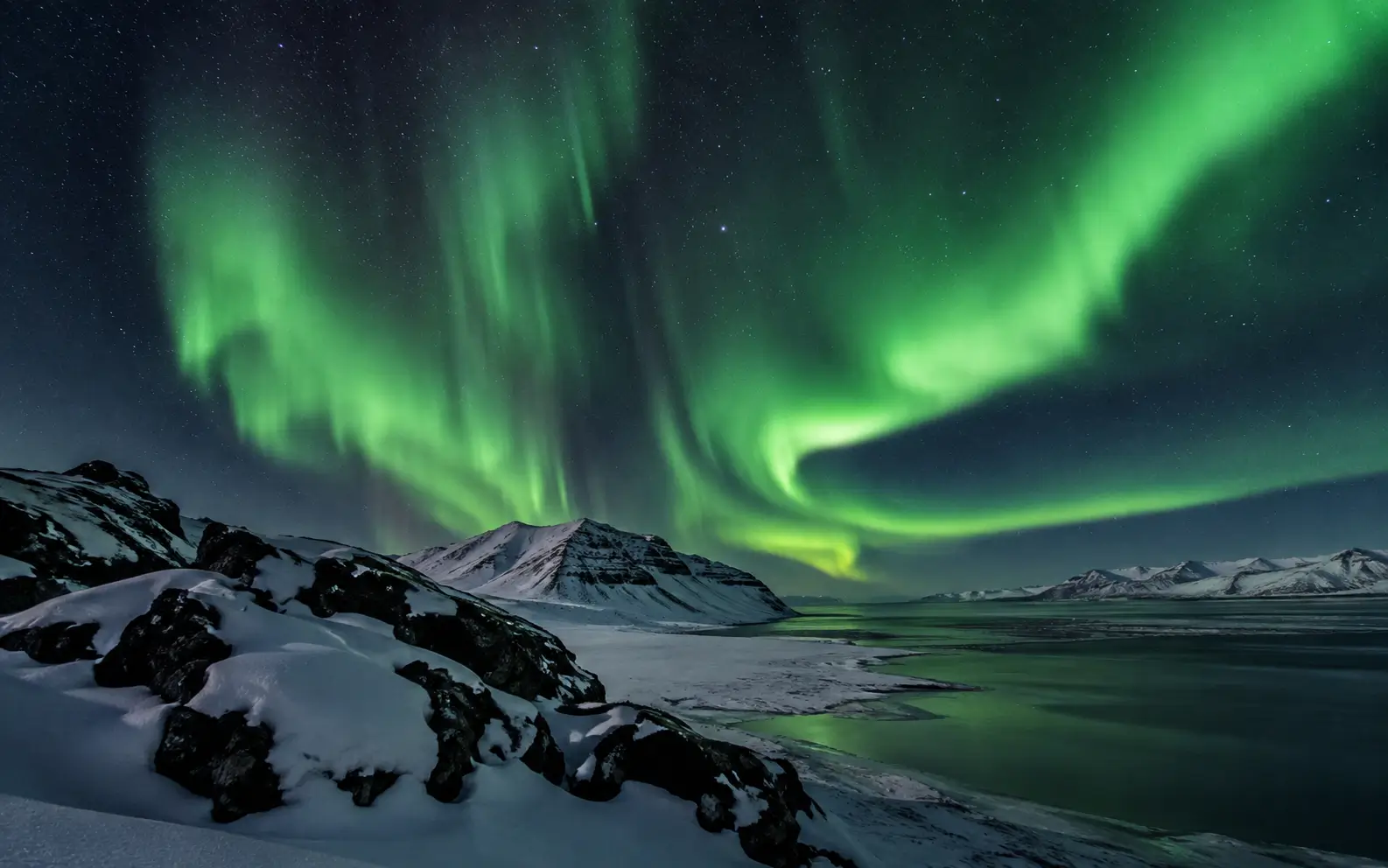
The broad practical season runs from:
late August until late April.
This does not mean every night within those months is equally good.
At the edges of the season, darkness is more limited.
In the middle of winter, darkness lasts much longer.
That affects how large your nightly viewing window can be.
For most travelers planning specifically around Northern Lights opportunities, the easiest months to think about are:
September through March.
Why Is There a Northern Lights Season?
Aurora activity is not simply:
turned off during summer.
The problem is light.
During Iceland's brightest summer period, the sky stays too bright for normal aurora viewing.
You need a dark enough sky for the light to become visible.
So the practical viewing season is controlled partly by:
nighttime darkness.
Can You See the Northern Lights in August?
Potentially:
yes, toward the end of the month.
By late August, real darkness starts returning to Iceland.
This can create the first useful aurora opportunities of the season.
The advantage is that you may combine:
- ✓Relatively mild conditions
- ✓Long sightseeing days
- ✓Some dark nighttime hours
The disadvantage is that your viewing window is still shorter than later in autumn.
Is Late August a Good Time to Plan a Trip Only for the Aurora?
I would not choose late August if the Northern Lights were:
the only reason for the trip.
Choose it if you also value:
- ✓Daylight
- ✓Road trips
- ✓Hiking
- ✓Late-summer travel
and would consider the aurora an excellent extra.
For a more aurora-focused trip, later months give you more darkness.
Northern Lights in September
September is one of the most interesting months for first-time visitors.
By this point:
- ✓Darkness has returned
- ✓Nights continue getting longer
- ✓Full winter has not yet arrived
That creates a useful balance between:
aurora opportunities and easier road-trip conditions.
You can still have:
- ✓Rain
- ✓Wind
- ✓Cold nights
so September should not be treated like summer.
But it can work very well for travelers who want to combine:
- ✓Daytime road trips
- ✓Evening aurora watching
without planning a deep-winter holiday.
Is September One of the Best Months?
It can be.
But I would avoid saying:
September guarantees better Northern Lights than every other month.
Weather still decides whether you have clear sky.
A cloudy September night can give you nothing.
A clear night in another part of the season may give you an excellent display.
Think of September as:
a strong planning month, not a guarantee.
Northern Lights in October
October gives you noticeably longer nights.
This makes it easier to build Northern Lights watching into a trip.
You may spend the day sightseeing and still have a useful dark period later.
October also sits before the deepest part of winter.
For many visitors, this creates another good balance between:
- ✓Darkness
- ✓Driving
- ✓Daytime sightseeing
But autumn weather can be very changeable.
Do not choose October expecting calm conditions every day.
Northern Lights in November
By November, darkness becomes a much larger part of the day.
That increases the amount of time when the aurora could potentially be visible.
But the trade-off is that your daytime sightseeing window becomes shorter.
This matters if you also want to visit:
- ✓Golden Circle
- ✓South Coast
- ✓Snæfellsnes
- ✓Other road-trip areas
Your trip needs to work for both:
daylight sightseeing and nighttime aurora watching.
Northern Lights in December
December gives you very long dark periods.
That may sound perfect for the Northern Lights.
But more darkness does not automatically mean:
better weather.
You still need enough clear sky.
December also brings:
- ✓Short sightseeing days
- ✓Winter roads
- ✓Cold
- ✓Possible snow and ice
- ✓Strong wind
This is why I would not choose December only because it has the most darkness.
The entire trip needs to suit winter travel.
Northern Lights in January
January remains deeply wintery.
You have long hours of darkness and therefore a large potential viewing window.
But the practical issues remain similar to December:
- ✓Winter weather
- ✓Road conditions
- ✓Short daylight
- ✓Cold nights
For a Reykjavík-based trip with guided tours, this can work well.
For a first Iceland self-drive, be realistic about your winter-driving confidence.
Northern Lights in February
February starts giving you more useful daylight again while retaining properly dark nights.
That makes it one of the stronger months for travelers who want both:
- ✓Winter Iceland
- ✓Aurora opportunities
You can use the day for sightseeing and still have darkness in the evening.
As always:
cloud matters.
Do not choose February and assume the lights will appear simply because the month is considered good.
Northern Lights in March
March can be another very practical month.
The days are longer than midwinter, but the nights are still dark enough for aurora watching.
That can create a good balance for first-time visitors who want to combine:
- ✓Road travel
- ✓Outdoor sightseeing
- ✓Northern Lights attempts
without the very short daylight of December.
Northern Lights in April
Aurora viewing becomes harder as April progresses because the nights become brighter.
Early April can still offer useful darkness.
Later in the month, your nighttime window shrinks.
This makes April similar to late August in one important way:
you are near the edge of the practical aurora season.
I would choose April primarily for the overall Iceland trip and treat the Northern Lights as a possible extra.
Can You See the Northern Lights in May?
For normal travel planning:
do not count on it.
The nights are becoming too bright.
Even if aurora activity occurs in the upper atmosphere, you need enough darkness to actually see it.
If seeing the Northern Lights matters to your trip:
May is the wrong season to build around them.
Can You See the Northern Lights in June or July?
For normal visitors:
no, not as a practical activity.
Iceland's summer nights remain very bright.
Around the brightest part of summer, you get the opposite experience:
Midnight Sun rather than Northern Lights.
This is a basic but important planning distinction.
You cannot reasonably plan a classic:
- ✓Midnight Sun trip
and:
- ✓Northern Lights trip
for the same summer dates.
Northern Lights by Month
| Month | Aurora Planning Value | Main Trade-Off |
|---|---|---|
| Late August | Possible | Limited darkness |
| September | Very useful | Changeable autumn weather |
| October | Very useful | Colder, changing weather |
| November | Strong darkness | Shorter sightseeing days |
| December | Very long darkness | Deep winter conditions |
| January | Very long darkness | Deep winter conditions |
| February | Very useful | Still winter |
| March | Very useful | Nights getting shorter |
| Early April | Possible to useful | Darkness decreasing |
| Late April | Limited | Bright nights returning |
| May–July | Poor for normal aurora travel | Too much daylight |
This table should help with:
trip planning, not prediction.
The sky does not follow a monthly tourist calendar.
What Is the Best Month to See the Northern Lights in Iceland?
There is no honest answer that guarantees one month.
If I were planning for a first-time visitor who also wants to explore Iceland during the day, I would look especially at:
September, October, February, or March.
Why?
They can offer a good balance between:
- ✓Dark nights
- ✓Daytime sightseeing
- ✓Road-trip possibilities
That does not mean:
- ✓November
- ✓December
- ✓January
are poor.
Those months may provide plenty of darkness.
They simply create a more winter-focused trip.
The Best Month Depends on the Rest of Your Trip
Ask yourself:
What do I want to do during daylight?
If your trip is mainly:
- ✓Reykjavík
- ✓Guided tours
- ✓Winter scenery
deep winter may suit you.
If you also want:
- ✓Self-drive
- ✓Longer daylight
- ✓More road-trip flexibility
the shoulder parts of the aurora season may suit you better.
Choose the month for the:
whole Iceland trip, not just one possible night in the sky.
What Is the Best Time of Night?
There is no fixed nightly showtime.
The Northern Lights can appear at different times.
However, for practical planning, the period around:
10 PM to 1 AM
is often useful.
Aurora activity is commonly seen around:
11 PM.
That does not mean you should go indoors at:
1:01 AM.
Nor does it mean nothing can happen earlier.
Natural activity does not follow a tour schedule.
Can the Northern Lights Appear at 7 PM?
Yes, if:
- ✓It is dark enough
- ✓Sky is clear enough
- ✓Aurora activity is present
This becomes more realistic during the darker part of winter.
Do not wait for 10 PM just because a guide says that is the best viewing window.
If the aurora is already visible:
go outside.
Can They Appear After Midnight?
Yes.
Displays can happen:
- ✓Before midnight
- ✓Around midnight
- ✓After midnight
The problem is that staying outside all night every night is not a good travel strategy.
You also need:
- ✓Sleep
- ✓Safe driving
- ✓Energy for daytime activities
This is why forecast-based planning helps.
Should You Stay Awake All Night?
Usually:
no.
You may improve your total hours outside, but you can damage the next day of your trip.
That becomes especially risky if you are:
- ✓Driving
- ✓Hiking
- ✓Doing winter activities
the following morning.
Plan a realistic viewing window.
Do not turn every Iceland night into an all-night watch.
Darkness Is More Important Than a Specific Clock Time
Suppose two travelers go outside at:
9 PM.
One visits in September.
The other visits in December.
Their sky conditions may be completely different because:
- ✓Sunset
- ✓Twilight
- ✓Darkness
change across the season.
Think about:
how dark the sky is, not just what your watch says.
How Many Nights Do You Need in Iceland?
The more suitable nights you have available, the better your chance of finding:
- ✓Clear sky
- ✓Aurora activity
at the same time.
This is why I would avoid planning:
one night in Iceland specifically for the Northern Lights.
A single night gives weather complete control over the result.
Is Three Nights Enough?
Three nights can give you several opportunities.
But:
nothing is guaranteed.
All three nights could be cloudy.
Or your first night could produce an excellent display.
The benefit of several nights is simply that you are giving the conditions more chances to line up.
Is Five Nights Better?
From an aurora-planning point of view:
yes.
Five nights give you more flexibility if:
- ✓One night is cloudy
- ✓One night is stormy
- ✓You are too tired one evening
- ✓Clear sky appears later in the stay
This is one reason a normal multi-day Iceland holiday works better for aurora watching than a very short stopover built entirely around one forecast.
Should You Book Your Trip Based on a Long-Range Aurora Forecast?
No.
Do not choose an Iceland trip several months in advance because a website claims it knows the exact aurora conditions for a particular night.
Aurora and cloud forecasts become useful:
close to the actual date.
Your long-range decision should be based on:
- ✓Season
- ✓Darkness
- ✓Trip length
- ✓Activities you want to do
Then use short-range conditions once you are in Iceland.
Clear Sky Is One of the Biggest Factors
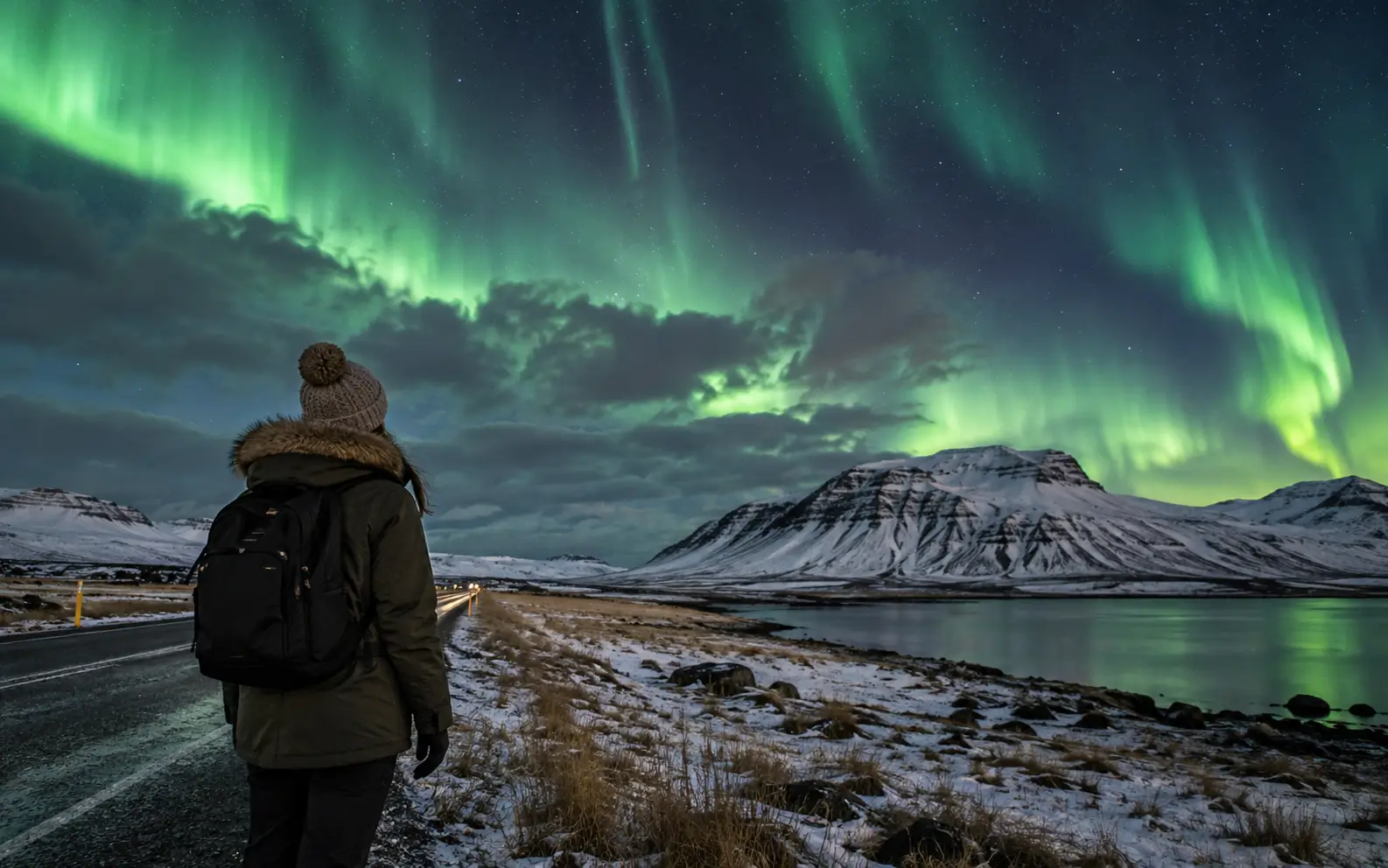
This point deserves extra attention.
You can have:
excellent aurora activity above a solid cloud layer
and see:
nothing.
Cloud sits between you and the aurora.
That means cloud cover can matter more to your actual viewing experience than an exciting activity number on an app.
Do You Need a Completely Clear Sky?
No.
A partly clear sky can be enough.
You may only need:
a large enough gap in the cloud
in the correct part of the sky.
This is why an evening forecast showing some cloud should not automatically make you give up.
The question is:
where are the clear areas?
Why Flexibility Matters
Suppose Reykjavík is cloudy.
Thirty or forty kilometres away may have:
- ✓Clearer sky
- ✓Broken cloud
A guided aurora tour may change its route to search for those conditions.
A self-drive traveler can sometimes do the same when:
- ✓Roads are safe
- ✓Weather is suitable
- ✓The destination is known
- ✓Night driving conditions are manageable
This is one reason there is no single permanent:
best Northern Lights spot in Iceland.
Does Light Pollution Matter?
Yes.
Streetlights and buildings make faint aurora harder to see.
Darker surroundings can improve:
- ✓Visibility
- ✓Contrast
- ✓Photography
This is why rural areas are popular for Northern Lights watching.
But light pollution is not the first condition I would check.
A perfectly dark location under thick cloud gives you:
nothing.
A partly clear location closer to a town may give you a display.
Can You See the Northern Lights From Reykjavík?
Yes.
Strong enough displays can be visible from the city.
But city lights reduce contrast.
You will usually improve your viewing conditions by finding:
- ✓Darker surroundings
- ✓Open sky
when it is safe and practical.
This does not mean you always need to drive two hours from Reykjavík.
Sometimes the aurora appears strongly enough that people see it from:
- ✓Streets
- ✓Hotel areas
- ✓Waterfront locations
inside or near the city.
Should You Leave Reykjavík Every Night?
No.
First check:
- ✓Cloud
- ✓Aurora conditions
- ✓Weather
- ✓Roads
If the entire region is covered by thick cloud, driving into darkness simply because:
rural is better
does not solve the problem.
Use conditions to decide whether leaving the city makes sense.
Do You Need a High Kp Index?
No.
This is one of the most common misunderstandings.
Travelers sometimes see:
Kp 2
and decide there is no reason to go outside.
That can be a mistake.
Aurora can still be visible in Iceland during relatively low activity.
The Kp number is one piece of information.
It is not a:
yes/no Northern Lights switch.
What Does the Kp Index Tell You?
In simple terms, the Kp index describes geomagnetic activity on a scale.
A higher number generally indicates a stronger disturbance.
But Iceland is already located at a latitude where aurora can be visible without the very high values that might be needed much farther south.
That is why you should not wait only for:
Kp 5, 6, or 7.
You may miss good displays.
Why the Kp Index Can Mislead First-Time Visitors
Imagine this:
Night A
High activity forecast.
But:
100% cloud.
Night B
Lower activity.
But:
- ✓Clear sky
- ✓Dark location
Which night might actually give you the better experience?
Often:
Night B.
What matters is the combination of conditions.
Do Aurora Apps Guarantee Anything?
No.
Apps can help organize information.
They may show:
- ✓Activity
- ✓Cloud cover
- ✓Alerts
- ✓Solar data
But an app cannot promise:
you will see the Northern Lights at 10:43 PM from this car park.
Use apps as:
planning tools, not guarantees.
What About Bz and Other Space-Weather Data?
Travelers who become more interested in aurora forecasting may start watching:
- ✓Solar wind
- ✓Magnetic field
- ✓Bz
These can give more detail about whether solar conditions are favorable.
For a first-time visitor:
you do not need to become a space-weather expert.
Start with:
- ✓Is it dark?
- ✓Is there enough clear sky?
- ✓Is there reasonable aurora activity?
That is enough to make a practical decision.
Does the Full Moon Ruin the Northern Lights?
No.
Moonlight can make a faint aurora less easy to distinguish.
But a bright moon does not automatically destroy the experience.
A strong display can still be visible.
Moonlight can also light:
- ✓Mountains
- ✓Snow
- ✓Foreground landscape
which may make the scene more interesting.
Do not cancel an Iceland trip simply because your dates include a full moon.
New Moon vs Full Moon
New Moon
Can give you:
- ✓Darker sky
- ✓Better contrast for faint aurora
Full Moon
Can give you:
- ✓More foreground light
- ✓Brighter snowy landscapes
Neither phase guarantees:
better aurora activity.
The moon affects viewing conditions.
It does not control the aurora itself.
What Do the Northern Lights Look Like to Your Eyes?
This can surprise first-time visitors.
The aurora may not always look like the extremely bright green photographs you have seen online.
A weaker display can appear to your eyes as:
- ✓Pale green
- ✓White-green
- ✓Greyish band
- ✓Faint moving cloud-like shape
A camera may record much more color.
Why Does the Camera Sometimes See More?
Modern phone and camera sensors can collect light over a longer exposure.
Your eyes work differently.
This is why your phone may show:
bright green
while you see:
a much softer color.
That does not mean the photograph is fake.
It means the camera is recording low light differently from your eyes.
How Do You Know It Is Aurora and Not Cloud?
This can be difficult during a weak display.
Aurora may:
- ✓Form arcs
- ✓Stretch across the sky
- ✓Move
- ✓Change shape
- ✓Develop vertical structures
Cloud usually behaves differently.
One easy first-time trick is to take a night-mode phone photograph.
A faint green color that appears in the image may help confirm what you are seeing.
Does the Aurora Always Dance?
No.
Sometimes you may see a quiet arc that changes slowly.
Other times the display may:
- ✓Ripple
- ✓Brighten
- ✓Move quickly
- ✓Form curtains
- ✓Spread overhead
Do not assume that a Northern Lights sighting only counts if the entire sky is moving.
Aurora displays vary enormously.
How Long Does a Northern Lights Display Last?
There is no fixed duration.
A display might:
- ✓Appear briefly
- ✓Remain visible for a long period
- ✓Fade
- ✓Return later
- ✓Become stronger after looking weak
This is why patience matters.
Seeing a faint band for five minutes does not mean:
the night is finished.
Conditions can change.
Should You Wait After the Aurora Disappears?
If:
- ✓Sky remains clear
- ✓Forecast still looks reasonable
- ✓You are warm enough
- ✓It is safe to remain
waiting can make sense.
Aurora activity may return.
But set a realistic limit.
There is little value in becoming exhausted before the next day's trip.
The Biggest Northern Lights Planning Mistake
The biggest mistake is designing the trip around:
one perfect night.
Instead, build an Iceland trip you would enjoy even if:
- ✓Clouds appear
- ✓Aurora remains weak
- ✓Your preferred night does not work
Then give yourself several opportunities to go outside.
That approach removes much of the pressure.
The Northern Lights become:
one of the best possible experiences of the trip
rather than the single event deciding whether the entire holiday was successful.
A Better First-Time Northern Lights Strategy
For a multi-night Iceland trip:
Night 1
Check conditions.
Go out if they are useful.
Do not say:
“We will try later in the week.”
Weather may be worse later.
Each Following Night
Check again.
If conditions are good:
try again.
After You See Them
You can still go out again.
Aurora displays are different every night.
Your second experience may be completely different from the first.
Do Not Save the Northern Lights for Your Last Night
If the first night has:
- ✓Clear sky
- ✓Good conditions
use it.
Do not assume:
the final night will be better.
It might be cloudy.
Aurora planning rewards flexibility.
Take a good opportunity when it appears.
What Matters More Than Choosing the Perfect Month?
For most first-time visitors, these things matter more than trying to identify one magical month:
- ✓Travel during the dark season
- ✓Stay several nights
- ✓Watch cloud conditions
- ✓Use safe dark locations
- ✓Try on every suitable night
- ✓Do not depend only on Kp
- ✓Be patient
That gives you a much better planning framework than:
“Which exact date guarantees the Northern Lights?”
No such date exists.
What Comes Next?
Once you understand:
- ✓Season
- ✓Darkness
- ✓Cloud
- ✓Timing
- ✓Activity
the next question becomes:
Where should you actually go?
Iceland has good aurora opportunities in many regions, but different places suit different trips.
Some work well from:
- ✓Reykjavík
while others make more sense during:
- ✓Golden Circle
- ✓South Coast
- ✓Snæfellsnes
- ✓North Iceland
- ✓Longer Ring Road trips
Where Is the Best Place to See the Northern Lights in Iceland?
There is no single best Northern Lights location in Iceland.
That is one of the most useful things to understand before your trip.
A famous viewpoint may have:
- ✓Beautiful mountains
- ✓Dark surroundings
- ✓Perfect photography potential
but if it sits under thick cloud, it may be useless that night.
Meanwhile, a much less famous location 40 minutes away may have:
- ✓Clear sky
- ✓Strong visibility
- ✓Easy parking
and give you an excellent display.
For Northern Lights planning, I would choose locations in this order:
- ✓Clear enough sky
- ✓Safe access
- ✓Dark surroundings
- ✓Reasonable driving distance
- ✓Good foreground for photographs
The famous view should come last.
The Best Northern Lights Location Changes Every Night
This is why planning one exact aurora viewpoint months before your trip is rarely useful.
You can choose a general region in advance.
For example:
- ✓Reykjavík area
- ✓Golden Circle
- ✓South Coast
- ✓Snæfellsnes
- ✓North Iceland
But the exact viewing location should often be decided:
on the day or evening itself.
Cloud can cover one region while another stays clear.
The goal is not to reach Iceland's most famous aurora photograph.
The goal is to stand under:
the clearest safe sky available to you.
Best Northern Lights Areas at a Glance
| Area | Best For | Main Advantag e | Main Limitation |
|---|---|---|---|
| Reykjavík | Short stays, no car | Easy and convenient | More light pollution |
| Þingvellir /Golden Circle region | Reykjavík self-drive | Darker open areas | Winter road conditions |
| Reykjanes Peninsula | Reykjavík/ Keflavík trips | Dark coastal areas | Wind and exposed roads |
| South Coast countryside | Multi-day road trips | Dark rural sky | Cloud and coastal weather |
| Snæfellsnes Peninsula | Photography | Strong foregrounds | Longer drive from Reykjavík |
| North Iceland | Multi-day trips | Large dark rural areas | Requires northern itinerary |
| East Iceland | Road trips | Low light pollution | Far from Reykjavík |
| Westfjords | Remote travel | Very dark surroundings | Winter access can be harder |
You do not need to visit a remote region just for the Northern Lights.
A clear night near your existing accommodation can be better than a long drive to a famous location.
Can You See the Northern Lights in Reykjavík?
Yes.
You do not always need to leave Reykjavík.
During a strong display, the Northern Lights can be visible even with:
- ✓Streetlights
- ✓Buildings
- ✓City glow
The main disadvantage is:
light pollution.
Artificial light makes weaker aurora harder to see.
The brighter the surroundings, the less contrast you have in the sky.
Should You Stay in Reykjavík if the Aurora Is Strong?
Sometimes:
yes.
If the sky above Reykjavík is clear and the aurora is already visible, you do not automatically need to get into a car.
A common mistake is seeing the lights from the city and thinking:
“We need to drive somewhere better.”
By the time you:
- ✓Get dressed
- ✓Collect the car
- ✓Drive
- ✓Park
the display may have weakened.
If the aurora is already active:
go outside and look first.
Where Should You Look in Reykjavík?
Choose places with:
- ✓Less direct lighting
- ✓Open sky
- ✓Safe pedestrian access
Waterfront and outer residential areas can sometimes work better than brightly lit central streets.
The goal is not necessarily complete darkness.
It is simply to reduce:
- ✓Streetlight glare
- ✓Building light
enough that your eyes can adjust.
Grótta Area
The Grótta area on the western side of Reykjavík is often considered for aurora viewing because it offers:
- ✓More open sky
- ✓Less city light than central Reykjavík
- ✓Coastal surroundings
It can work well when the Reykjavík sky itself is clear.
But treat it as:
one option, not a guaranteed aurora location.
Weather and cloud still decide the night.
Do Not Drive Across Reykjavík Just Because Someone Says Grótta Is Best
If you already have a clear, dark enough location closer to your hotel:
use it.
Northern Lights displays can change quickly.
The extra driving time may not improve the experience.
This is a good example of why:
conditions matter more than famous location names.
Reykjavík Is Best for Travelers Without a Car
If you are staying in the capital and do not want to:
- ✓Rent a vehicle
- ✓Drive at night
you have two practical choices:
Try From Reykjavík
when conditions are good.
or:
Join a Northern Lights Tour
that searches for clearer and darker areas outside the city.
Both can work.
Þingvellir and the Golden Circle Region
The wider Golden Circle region can offer very good aurora conditions because you move away from much of Reykjavík's artificial light.
Þingvellir and surrounding rural areas give you:
- ✓Open sky
- ✓Darker surroundings
- ✓Natural foregrounds
This can work especially well if you are already:
- ✓Staying in the region
- ✓Finishing a Golden Circle day nearby
Should You Drive From Reykjavík to Þingvellir Just for the Aurora?
Only if:
- ✓Forecast conditions support it
- ✓Roads are safe
- ✓Weather is suitable
- ✓You are comfortable driving at night
Do not automatically drive there simply because:
Þingvellir is famous.
If Reykjavík has clear sky and Þingvellir has cloud:
stay closer to Reykjavík.
Northern Lights After a Golden Circle Day
This can work very well if you are staying:
- ✓Around the Golden Circle
- ✓In regional accommodation
You are already outside the strongest city light.
That means you may be able to:
- ✓Check the sky from your accommodation
- ✓Step outside quickly
- ✓Avoid another long evening drive
This is one reason rural accommodation can be useful during aurora season.
Do Not Turn a Long Sightseeing Day Into a Dangerous Night Drive
A Golden Circle day can already involve:
- ✓Driving
- ✓Walking
- ✓Cold weather
- ✓Several attractions
If you are exhausted by evening:
do not automatically add three more hours of night driving.
The Northern Lights are never worth driving while:
- ✓Sleepy
- ✓Unfocused
- ✓Uncomfortable with conditions
You may have another opportunity the next night.
Reykjanes Peninsula
The Reykjanes Peninsula can be useful for travelers based around:
- ✓Reykjavík
- ✓Keflavík
- ✓Airport-area accommodation
The peninsula has:
- ✓Open coastal areas
- ✓Darker sections
- ✓Volcanic terrain
which can make a strong foreground for aurora viewing.
Why Reykjanes Can Work Well
The main advantage is location.
You may not need to drive deep into South Iceland or the Golden Circle just to escape much of the city glow.
This can be useful:
- ✓On your first night
- ✓Before an airport hotel stay
- ✓During a Reykjavík-based trip
when the forecast favors the southwest.
Reykjanes Weather Matters
The peninsula is exposed.
Wind can become a major issue.
A location that looks simple on a map may feel very different at night in:
- ✓Strong wind
- ✓Rain
- ✓Snow
- ✓Poor visibility
Do not choose an exposed coastal stop purely for photography.
Safe access comes first.
South Coast
The South Coast can be excellent for Northern Lights viewing during a multi-day trip.
Outside the towns, you can find:
- ✓Dark countryside
- ✓Mountains
- ✓Waterfalls
- ✓Glacier scenery
for the background.
But I would usually experience the aurora:
near where I am already staying
rather than driving long distances after a full South Coast sightseeing day.
Vík and the South Coast Countryside
Staying around Vík can give you access to much darker surroundings than central Reykjavík.
If skies clear after dinner, you may be able to watch from:
- ✓Rural accommodation
- ✓Safe open areas
- ✓Established parking locations
without turning the evening into another long road trip.
This is one of the best approaches for first-time visitors:
let your accommodation become your aurora base.
Do You Need to Drive to Reynisfjara at Night?
I would not make Reynisfjara my first recommendation for night aurora viewing.
The beach is already known for dangerous ocean waves during daylight.
At night:
- ✓The water is harder to judge
- ✓Distance is harder to estimate
- ✓Other visitors may not see approaching waves clearly
There are safer places to watch the sky.
You do not need a black-sand beach under your feet to have a successful Northern Lights night.
Choose Safety Over the Perfect Photograph
This rule applies across Iceland.
A famous foreground is not worth:
- ✓Standing near dangerous waves
- ✓Walking onto ice
- ✓Parking on a road
- ✓Crossing barriers
- ✓Approaching cliff edges in darkness
The aurora is above you.
You can photograph it from many safe locations.
Waterfalls at Night
Some travelers want Northern Lights photographs above:
- ✓Waterfalls
- ✓Rivers
- ✓Cliffs
This can look beautiful.
But remember that waterfall areas may contain:
- ✓Wet paths
- ✓Ice
- ✓Spray
- ✓Unlit ground
A route that felt easy at 2 PM may feel very different at:
11 PM in winter.
Use only areas that are:
- ✓Open
- ✓Safe
- ✓Familiar enough to walk
in the conditions you have.
Snæfellsnes Peninsula
Snæfellsnes is one of Iceland's strongest areas for Northern Lights photography.
The peninsula combines dark skies with landscapes such as:
- ✓Mountains
- ✓Coastline
- ✓Lava fields
- ✓Small settlements
It can work especially well if Snæfellsnes is already part of your Iceland itinerary.
Kirkjufell and Northern Lights
Kirkjufell is one of Iceland's most photographed mountains.
Aurora photographs here are famous because the mountain creates a recognizable foreground.
But that popularity can create the wrong expectation.
Do not drive across Iceland simply because you want:
the Kirkjufell Northern Lights photograph.
You still need:
- ✓Clear sky
- ✓Aurora activity
- ✓Safe road conditions
A cloudy Kirkjufell gives you no aurora.
Snæfellsnes Works Best as Part of a Wider Trip
A better approach is:
- ✓Explore Snæfellsnes during daylight
- ✓Stay overnight in the region
- ✓Check conditions after dark
- ✓Go outside if the sky clears
This removes the pressure of:
driving there only for the aurora.
If the lights do not appear, you still had a worthwhile Snæfellsnes trip.
North Iceland
North Iceland can be very good for Northern Lights viewing.
Areas outside towns offer:
- ✓Low artificial light
- ✓Wide open sky
- ✓Mountain scenery
If your itinerary already includes:
- ✓Akureyri
- ✓Mývatn
- ✓Northern road-trip areas
you may have several strong aurora opportunities.
Do You Need to Travel North for Better Northern Lights?
No.
This is another common misunderstanding.
You do not need to travel to North Iceland simply because:
north sounds better for Northern Lights.
Iceland as a whole sits in a good aurora-viewing latitude.
Weather may actually favor:
- ✓South Iceland
- ✓West Iceland
- ✓Reykjavík
on your specific night.
Travel north because you want to see North Iceland.
Then use its dark nights for aurora attempts.
Akureyri
Akureyri has artificial lighting, like Reykjavík.
But you can reach darker surroundings outside town relatively quickly.
This makes it a useful base for travelers who want:
- ✓Normal town services
- ✓Rural aurora opportunities nearby
Again, cloud cover should decide how far you travel.
Lake Mývatn Region
The Mývatn region can work very well because it has:
- ✓Dark surroundings
- ✓Open areas
- ✓Distinctive volcanic scenery
It can be an excellent part of a winter or shoulder-season North Iceland trip.
But do not assume dark surroundings automatically mean easy driving.
Winter conditions in North Iceland can be serious.
East Iceland
East Iceland receives fewer first-time visitors than Reykjavík and the South Coast.
That can mean:
- ✓Less artificial light
- ✓Quiet rural viewing areas
if the sky is clear.
For travelers completing a longer Ring Road trip, the east can provide excellent opportunities simply because you are already staying in:
small towns or countryside accommodation.
Westfjords
The Westfjords can offer very dark skies.
But I would not recommend traveling there only for Northern Lights.
The region deserves its own trip.
In colder months, road and weather conditions can also require more care.
If you are already staying there:
use clear nights.
If you are based in Reykjavík:
do not treat the Westfjords as a simple evening aurora drive.
The Best Aurora Area Is Often Where You Are Already Sleeping
This is one of my strongest recommendations.
If your accommodation is already in:
- ✓Rural South Iceland
- ✓Golden Circle countryside
- ✓Snæfellsnes
- ✓North Iceland
- ✓East Iceland
check outside before driving anywhere.
You may already have:
- ✓Dark sky
- ✓Open view
- ✓Safe parking
- ✓Warm room nearby
That combination is difficult to beat.
Choose Aurora-Friendly Accommodation
If Northern Lights matter to you, location can influence where you stay.
Rural accommodation may give you:
- ✓Less light pollution
- ✓Immediate outdoor access
- ✓No extra night driving
Some properties may also offer:
- ✓Wake-up systems
- ✓Aurora alerts
but these services vary.
Do not choose a hotel only because it advertises:
Northern Lights views.
The property cannot control:
- ✓Cloud
- ✓Aurora activity
Is a Glass Cabin Necessary?
No.
Glass cabins and panoramic rooms can be attractive.
But they do not increase aurora activity.
Their real benefit is convenience.
You may be able to:
- ✓Watch the sky comfortably
- ✓Stay warm
- ✓Step outside quickly
But clear sky matters far more than room design.
A normal countryside guesthouse under a clear sky can give you the same aurora above your head.
Self-Drive vs Northern Lights Tour
This is one of the biggest practical decisions for first-time visitors.
Both approaches work.
The better choice depends on:
- ✓Driving confidence
- ✓Winter conditions
- ✓Budget
- ✓Flexibility
- ✓How much research you want to do yourself
Self-Drive Is Better If You Want:
- ✓Full timing control
- ✓Your own photography pace
- ✓Ability to leave immediately
- ✓Flexibility to change viewing location
- ✓Privacy
- ✓To combine aurora viewing with rural accommodation
But you also become responsible for:
- ✓Forecast interpretation
- ✓Night driving
- ✓Parking
- ✓Road safety
- ✓Knowing when to turn around
Guided Tour Is Better If You Want:
- ✓No night driving
- ✓Local decision-making
- ✓Transport from Reykjavík
- ✓Help interpreting conditions
- ✓A simpler first attempt
The operator chooses where to look based on:
- ✓Cloud
- ✓Weather
- ✓Road conditions
- ✓Experience
This can remove a lot of decision-making from the evening.
Does a Northern Lights Tour Guarantee a Sighting?
No.
No responsible tour can control:
- ✓Cloud
- ✓Solar activity
- ✓Visibility
A tour improves your logistics.
It does not control nature.
If a company advertises an absolute guarantee that the aurora will appear in the sky:
treat that claim carefully.
What Happens if Conditions Are Poor?
Policies vary by tour company.
Depending on the operator, a tour may:
- ✓Be cancelled before departure
- ✓Be moved
- ✓Still operate and search for clear sky
- ✓Offer another attempt under its own rebooking policy
Read the current policy before booking.
Do not assume every company handles unsuccessful nights in the same way.
Should You Book the Tour for Your First Night?
If the first night has suitable timing:
yes, this can be a smart strategy.
Why?
If the first attempt fails, you may still have later nights available.
Booking your only attempt on the final night removes that flexibility.
The same rule from Part 1 applies:
do not save every aurora attempt for later.
Large Bus Northern Lights Tour
A large coach tour is usually the simplest lower-cost option.
It can work well for travelers who want:
- ✓Transport
- ✓Basic guidance
- ✓No driving
The trade-off is:
- ✓Larger group
- ✓Less personal control
- ✓More people photographing from the same area
For a first attempt, it can still be perfectly suitable.
Small-Group Northern Lights Tour
A smaller group may offer:
- ✓Smaller vehicle
- ✓Easier movement
- ✓More interaction with the guide
- ✓More flexible atmosphere
It usually costs more.
The aurora itself does not become better because your group is smaller.
You are paying for:
the experience and logistics.
Private Northern Lights Tour
A private tour can make sense for:
- ✓Families
- ✓Small groups
- ✓Serious photographers
- ✓Travelers with specific mobility needs
- ✓People wanting more control
It is the most expensive option.
For several travelers sharing the price, it may become easier to justify.
Northern Lights Photography Tours
A photography-focused tour can help if you want to learn:
- ✓Camera settings
- ✓Tripod use
- ✓Night composition
It can be useful for travelers using:
- ✓DSLR
- ✓Mirrorless camera
who have little experience with night photography.
If you mainly want to see the aurora with your eyes:
you do not need a photography-specific tour.
Self-Drive or Tour for Your First Attempt?
If you are:
- ✓Comfortable driving Icelandic roads
- ✓Already in rural accommodation
- ✓Checking forecasts confidently
self-drive can work very well.
If you are:
- ✓Staying in Reykjavík
- ✓Nervous about winter roads
- ✓Unfamiliar with forecasts
a guided tour may be easier.
There is no special achievement in:
finding the aurora alone.
Choose the option that makes the night more enjoyable and safer.
How to Read Iceland's Aurora Forecast
Do not begin with:
the highest activity number.
Start with:
cloud cover.
You need to see the sky before aurora activity matters to you.
A practical order is:
Step 1: Check Darkness
Is it dark enough during the period you plan to watch?
Step 2: Check Cloud Cover
Where are the clearest areas?
Step 3: Check Aurora Activity
Is there useful activity forecast?
Step 4: Check Weather and Roads
Can you reach the clearer area safely?
Step 5: Choose the Shortest Sensible Viewing Location
Do not drive farther than necessary.
Understanding the Cloud Map
On Iceland's official aurora forecast, the cloud map can look slightly confusing at first.
The key idea is:
clearer areas are what you want.
Do not simply look at the whole country and think:
“Iceland is cloudy tonight.”
Cloud can vary by region.
You may find:
- ✓Cloud over Reykjavík
- ✓Clearer sky in another nearby area
or the reverse.
Do You Need Zero Cloud?
No.
You need:
enough clear sky.
Broken cloud can still give you a good aurora experience.
In fact, moving cloud can create dramatic scenes when aurora appears through the gaps.
Do not reject a night just because the forecast does not show completely clear conditions.
Check How the Cloud Changes by Hour
This matters.
Suppose your area is cloudy at:
9 PM
but much clearer at:
11 PM.
You may not need to drive anywhere.
You may simply need:
patience.
Likewise, an area that looks clear at 8 PM may become cloudy later.
Check the forecast across several hours.
Do Not Chase Every Small Clear Patch
Forecast maps are not perfect enough to justify:
- ✓Constant route changes
- ✓Long winter drives
- ✓Driving into unfamiliar roads at midnight
because one tiny area appears clear on the map.
Look for:
- ✓Reasonable clear region
- ✓Safe road
- ✓Sensible distance
The Northern Lights should not turn into a high-speed cloud chase.
Check the Weather Separately
Cloud is only one issue.
You also need to think about:
- ✓Wind
- ✓Snow
- ✓Ice
- ✓Visibility
- ✓Road condition
A clear sky does not automatically mean:
good driving conditions.
For example, you may have:
- ✓Clear patches
- ✓Strong wind
- ✓Icy roads
That may still make a long chase a poor choice.
How Far Should You Drive for Clear Sky?
There is no fixed distance.
I would think about:
risk versus improvement.
Driving 20–30 minutes to a clearly better area may make sense.
Driving several hours through winter conditions because one forecast patch looks slightly clearer may not.
Ask:
Is the improvement worth the drive?
A Simple Northern Lights Decision Example
Imagine you are staying in Reykjavík.
At 8 PM:
- ✓Reykjavík is mostly cloudy
- ✓A nearby rural area looks clearer
- ✓Roads are good
- ✓Wind is manageable
- ✓Aurora activity looks useful
That may be a reasonable night to:
- ✓Join a tour
- ✓Self-drive to a safe darker location
Now change one factor.
Suppose roads are:
- ✓Icy
- ✓Windy
- ✓Difficult
The correct decision may become:
stay in Reykjavík and wait for a gap.
The aurora forecast should never overrule road safety.
Another Example: Staying on the South Coast
Suppose you are sleeping near Vík.
The sky above the hotel is:
- ✓Clear
- ✓Dark
Aurora activity is possible.
There is no reason to drive back toward Reykjavík.
Step outside.
Your best Northern Lights location may be:
the field beside your accommodation.
Do Not Assume North Is Always the Correct Direction
The name:
Northern Lights
can make first-time visitors think they must stare north.
Aurora can appear:
- ✓North
- ✓East
- ✓West
- ✓Overhead
- ✓Across a large part of the sky
depending on the display.
Keep looking around.
A strong aurora may eventually move across much of the sky.
Give Your Eyes Time to Adjust
When you first step out of a bright:
- ✓Hotel
- ✓Car
- ✓Restaurant
your eyes need time to adapt to darkness.
Avoid staring at a bright phone screen constantly.
Lower the screen brightness.
Give yourself several minutes outside.
You may start noticing:
- ✓Stars
- ✓Faint aurora
- ✓More structure
that was difficult to see at first.
Car Headlights Can Ruin Your Night Vision
This is another reason to choose a proper viewing area.
If cars constantly arrive with:
- ✓Headlights
- ✓Interior lights
your eyes keep readjusting.
A quieter safe viewing location can make a weak aurora easier to notice.
Never Stop Suddenly When You See the Aurora
This is one of the most practical self-drive rules.
If the Northern Lights suddenly appear while you are driving:
keep driving until you find a legal, safe place to stop.
Do not:
- ✓Brake in the road
- ✓Stop on a blind corner
- ✓Park partly in a traffic lane
- ✓Block an entrance
The aurora does not make normal road safety disappear.
Do Not Park on the Road Shoulder Unless It Is Clearly Safe
Icelandic roads can be:
- ✓Narrow
- ✓Dark
- ✓Icy
A vehicle stopped badly can create danger for:
- ✓You
- ✓Other drivers
Use:
- ✓Proper parking areas
- ✓Safe pull-offs
- ✓Established viewpoints
when possible.
Watch for Other People
Popular aurora nights can create unusual behavior.
Some visitors may:
- ✓Step into roads
- ✓Cross car parks without looking
- ✓Set tripods near traffic
- ✓Turn lights on suddenly
Drive slowly around known viewing areas.
Do not assume other people can see your vehicle clearly.
Best Type of Location for First-Time Visitors
For a first attempt, I would rather choose:
- ✓Safe parking
- ✓Open sky
- ✓Dark surroundings
- ✓Easy route back
than:
- ✓Remote cliff
- ✓Beach at night
- ✓Difficult mountain road
- ✓Famous but risky photography location
The Northern Lights are impressive enough without making the viewing location difficult.
Open Sky Matters
A location surrounded by tall:
- ✓Buildings
- ✓Mountains
- ✓Trees
can block parts of your view.
An open area gives you more sky to watch.
This becomes especially useful during weaker activity when aurora may remain:
- ✓Low on the horizon
- ✓In one section of the sky
rather than appearing overhead.
Landscape Foreground Matters Mainly for Photography
For simply seeing the aurora:
open clear sky is enough.
For photography, you may want:
- ✓Mountain
- ✓Church
- ✓Water
- ✓Snow
- ✓Small building
in the foreground.
These elements can make a stronger photograph.
But photography should never cause you to choose a worse or unsafe viewing location.
Reflections on Water
Calm water can produce beautiful aurora reflections.
But do not assume every:
- ✓Lake
- ✓River
- ✓Coastline
is safe to approach at night.
Stay on:
- ✓Established areas
- ✓Stable ground
and keep distance from moving water.
The reflection is an extra.
It is not worth taking a risk.
Snow Can Improve the Scene
Snow reflects light.
During an aurora display, a snowy landscape may appear brighter and more detailed than bare dark ground.
This can be excellent for:
- ✓Photography
- ✓Seeing the surrounding landscape
The trade-off is that snow can also mean:
- ✓More difficult driving
- ✓Ice
- ✓Cold
- ✓Slippery paths
A beautiful foreground does not remove winter risk.
Clouds Can Sometimes Improve Photographs
Not every cloud is bad.
Thin or broken cloud can add:
- ✓Shape
- ✓Depth
- ✓Movement
to a photograph.
The problem is:
thick cloud covering the aurora completely.
Do not confuse:
some cloud
with:
no chance.
Should You Use Social Media to Find the Aurora?
Real-time local posts can sometimes help confirm that aurora is visible.
But do not drive somewhere only because a photograph was uploaded:
20 minutes ago.
The display may have:
- ✓Moved
- ✓Faded
- ✓Become cloudy
Use real-time reports as:
extra information, not a guarantee.
Do Not Crowd a Location Because It Went Viral
A location does not become better because hundreds of people posted it online.
Heavy crowds can create:
- ✓Parking problems
- ✓Headlight glare
- ✓Safety issues
- ✓Tripod congestion
If another safe dark area has the same clear sky:
it may give you a better experience.
The Best Northern Lights Plan for a Reykjavík Stay
If I were planning a first visit based in Reykjavík, I would use this approach:
Each Afternoon or Evening
Check:
- ✓Cloud
- ✓Weather
- ✓Aurora activity
If Reykjavík Is Clear
Try a darker area in or near the city first.
If Reykjavík Is Cloudy but Nearby Areas Are Clear
Consider:
- ✓Tour
- ✓Safe self-drive
If Conditions Are Poor Across the Region
Do not force the night.
Try again later in the trip.
This is much more useful than choosing one permanent viewpoint before arriving.
The Best Northern Lights Plan for a Road Trip
If you are already driving around Iceland:
your accommodation route becomes your advantage.
At each overnight stop:
- ✓Check conditions
- ✓Step outside if the sky is clear
- ✓Drive only if a nearby location gives a meaningful improvement
- ✓Keep the trip short enough that you can still rest
You do not need to turn every evening into a separate excursion.
The Best Northern Lights Plan for a Rural Stay
This is often the easiest setup.
If your accommodation has:
- ✓Dark surroundings
- ✓Open sky
you can check conditions repeatedly without:
- ✓Driving
- ✓Tour pickup
- ✓Long waiting in a car
You may go outside at 9 PM, see nothing, then look again later.
That flexibility is one of the main benefits of rural accommodation.
The Main Rule for Choosing an Aurora Location
Do not ask:
“What is Iceland's best Northern Lights spot?”
Ask:
“Where is the clearest, darkest, safest, reasonable place for me tonight?”
That question produces much better decisions.
A famous location can give you an excellent photograph when conditions work.
But the Northern Lights do not care whether the place appears on a travel list.
Clear sky wins.
What Should You Wear for Northern Lights Watching?
Northern Lights watching feels colder than normal sightseeing.
The reason is simple.
During the day, you are often:
- ✓Walking
- ✓Moving between attractions
- ✓Getting in and out of a warm car
At night, you may stand in one place for:
30 minutes, one hour, or longer.
Your body produces less heat when you are standing still.
That means the same temperature can feel much colder during an aurora wait.
Dress Warmer Than You Think You Need
A good clothing system starts with layers.
Think about:
Base Layer
Wear something warm and comfortable next to your skin.
Thermal clothing can work well in colder months.
Middle Layer
Add insulation such as:
- ✓Fleece
- ✓Wool
- ✓Warm synthetic clothing
Outer Layer
Your outer layer should protect you from:
- ✓Wind
- ✓Rain
- ✓Snow
A warm coat that does not block wind can still leave you uncomfortable on an exposed Icelandic night.
Do Not Forget Your Legs
Visitors often wear several warm layers on top and normal trousers on the bottom.
Then their legs become cold first.
Depending on the season, consider:
- ✓Thermal leggings
- ✓Warm trousers
- ✓Waterproof outer trousers
This matters even more if you are standing in:
- ✓Snow
- ✓Wind
- ✓Open countryside
for a long period.
Warm Boots Matter
Your feet can become cold quickly when you are standing still.
Choose footwear that is:
- ✓Warm
- ✓Comfortable
- ✓Stable
- ✓Suitable for wet or icy ground
Thick socks can help.
But do not wear so many socks that your boots become tight.
Tight footwear can reduce comfort and make cold feet worse.
Hat, Gloves and Neck Protection
Bring:
- ✓Warm hat
- ✓Gloves
- ✓Neck warmer or scarf
These items take very little space.
They can make a major difference when you are outside late at night.
Gloves are especially useful for photographers.
Choose a pair that still lets you operate:
- ✓Phone
- ✓Camera controls
without removing them every few minutes.
Bring an Extra Layer in the Car
Even if you feel warm when leaving the hotel, keep one additional layer with you.
You may stay outside longer than planned if:
- ✓Aurora becomes stronger
- ✓Clouds begin clearing
- ✓The display returns after fading
An extra layer lets you wait comfortably instead of giving up because you are cold.
Hand Warmers Can Be Useful
Disposable or reusable hand warmers are optional.
They can help on:
- ✓Cold winter nights
- ✓Long photography sessions
- ✓Tours with extended outdoor waiting
They are especially useful for people whose hands or feet become cold quickly.
They should support good clothing rather than replace it.
How Long Should You Wait for the Northern Lights?
There is no fixed answer.
If the sky is:
- ✓Clear
- ✓Dark
and aurora conditions remain possible, waiting can make sense.
A practical first attempt might involve watching for:
30–60 minutes
before deciding what to do next.
But the correct decision depends on what is happening in the sky.
Do Not Expect Immediate Results
You may arrive at a dark location and see:
nothing.
Then 20 minutes later, a faint arc appears.
Later it may become:
- ✓Brighter
- ✓Wider
- ✓More active
Aurora watching often includes waiting.
That is normal.
When Should You Keep Waiting?
Keep waiting when:
- ✓Sky remains clear
- ✓Conditions still look useful
- ✓You are warm enough
- ✓You are in a safe place
- ✓You are not too tired
A quiet sky does not mean nothing will happen later.
When Should You Stop Waiting?
Consider leaving when:
- ✓Thick cloud has moved in
- ✓Weather is worsening
- ✓You are becoming too cold
- ✓The driver is tired
- ✓Roads may become harder
- ✓You have an early morning activity
Seeing the Northern Lights is never more valuable than:
rest and safe travel.
Use the Car as a Warm-Up Space
If you are at a safe parking area, you do not need to stand outside continuously for several hours.
You can:
- ✓Spend time outside
- ✓Warm up in the vehicle
- ✓Check the sky again
- ✓Go back outside if conditions improve
Just be considerate with:
- ✓Headlights
- ✓Interior lighting
around other people watching or taking photographs.
Reduce Bright Light Around You
Your eyes adjust better when you spend time in darkness.
Bright light from:
- ✓Phone screen
- ✓Car headlights
- ✓Flashlight
can make faint aurora harder to see for several minutes afterward.
Lower your phone brightness.
Use only as much light as you need to move safely.
Give Your Eyes Time
When you step out of a bright car or building, do not judge the sky immediately.
Spend several minutes outside.
As your eyes adapt, you may begin to see:
- ✓More stars
- ✓Faint green
- ✓Pale arcs
- ✓More detail in the sky
A weak aurora can be easy to miss during the first few seconds.
Can You Photograph the Northern Lights With a Phone?
Yes.
Modern smartphones can photograph the Northern Lights surprisingly well.
You do not need an expensive camera to return home with a useful aurora photograph.
Phones work especially well when:
- ✓Aurora is reasonably bright
- ✓Night mode is available
- ✓You can hold the phone steady
The result may show stronger colors than you saw with your eyes.
That is normal for low-light photography.
How to Photograph the Northern Lights With a Phone
Start with the simplest setup.
Turn On Night Mode
Most newer phones automatically suggest night mode in dark conditions.
Use it.
Hold the Phone Still
The phone needs time to collect light.
Movement can make the photograph blurry.
Use:
- ✓Tripod
- ✓Stable surface
- ✓Both hands
when possible.
Keep the Lens Clean
Water, fingerprints, or condensation can make lights look:
- ✓Soft
- ✓Blurry
- ✓Streaked
Clean the lens before you start.
Should You Use a Phone Tripod?
A tripod is very useful.
It becomes more helpful when:
- ✓Aurora is faint
- ✓Exposure is longer
- ✓You want a sharp foreground
A small travel tripod is usually enough for a phone.
You do not need a large professional setup.
Use the Timer
If your phone is on a tripod, use:
- ✓Two-second timer
- ✓Short self-timer
This prevents the phone from moving when you tap the shutter.
Some phones also reduce movement automatically.
Still, a timer is an easy extra step.
Do Not Use Flash for the Aurora
Your phone flash cannot light the sky.
It may instead:
- ✓Distract other viewers
- ✓Affect nearby photographers
- ✓Reduce your own night vision
Turn it off.
Flash only becomes useful in specific planned portrait setups where you want to light a nearby person.
That is different from photographing the aurora itself.
Phone Exposure Time
Many phones choose exposure automatically.
Let night mode handle the first attempt.
Then check the image.
If the aurora is:
- ✓Faint and slow
a longer exposure may help.
If the aurora is:
- ✓Bright
- ✓Moving quickly
a shorter exposure can preserve more shape.
The goal is not always to make the sky as bright as possible.
Avoid Overprocessing the Image
It is easy to push:
- ✓Green
- ✓Saturation
- ✓Brightness
too far.
A good edit should still look like a night scene.
You do not need to turn a soft aurora into a fluorescent green sky.
A more natural photograph often looks better.
Can You Photograph the Northern Lights With a Camera?
Yes.
A camera gives you more control over:
- ✓Shutter speed
- ✓ISO
- ✓Aperture
- ✓Focus
This makes it easier to adjust as aurora activity changes.
A DSLR or mirrorless camera can produce excellent results.
Basic Camera Setup
A simple starting setup is:
Tripod
Use a stable tripod.
Wide Lens
A wide lens lets you include more of:
- ✓Sky
- ✓Foreground
Wide Aperture
If your lens allows it, use a wide aperture such as:
f/1.8 to f/2.8
to collect more light.
Manual Focus
Autofocus may struggle in darkness.
Focus carefully on:
- ✓Distant light
- ✓Bright star
then check the result.
Starting ISO
A useful starting ISO can be around:
800–3200
depending on:
- ✓Camera
- ✓Lens
- ✓Aurora brightness
- ✓Available foreground light
Do not treat one ISO value as mandatory.
Take a test image and adjust.
Starting Shutter Speed
Aurora movement should decide the exposure.
For a brighter, faster display, try a shorter exposure such as:
1–3 seconds.
For a fainter, slower display, you may need:
5–10 seconds
or another suitable setting.
Long exposures collect more light.
But they can also turn moving aurora into a soft green blur.
Faster Aurora Needs Faster Settings
This is one of the biggest differences between photographing:
stars
and:
active aurora.
If the lights are moving quickly, you want to preserve:
- ✓Curtains
- ✓Vertical lines
- ✓Fine structure
A very long exposure can erase that detail.
Increase ISO if needed and shorten the shutter.
Faint Aurora May Need More Exposure
If the aurora is weak, you can try:
- ✓Longer shutter speed
- ✓Higher ISO
- ✓Wider aperture
Take several test images.
Night photography is easier when you adjust based on what is actually happening rather than memorizing one setting before the trip.
Shoot RAW if You Know How to Edit
RAW files preserve more image information.
They give you more control over:
- ✓Exposure
- ✓White balance
- ✓Shadows
- ✓Color
later.
If you do not normally edit RAW files:
JPEG is still fine.
Do not make your first aurora night harder by learning an entirely new photography system in the dark.
White Balance
Automatic white balance can work.
If you prefer manual control, many photographers start somewhere around:
3000K–4000K
and adjust later.
The exact setting depends on:
- ✓Moonlight
- ✓Snow
- ✓Artificial light
- ✓Aurora color
There is no one required number.
Check Focus Often
A photograph can look fine on a small camera screen while the stars are actually soft.
Zoom into a test image.
Check that:
- ✓Stars
- ✓Distant lights
- ✓Foreground
look as sharp as you expect.
After that, avoid moving the focus ring accidentally.
Lens Fog and Condensation
Cold nights create another photography problem:
condensation.
Your camera may be very cold outside.
If you bring it directly into a warm, humid room, moisture can form on or inside equipment.
A simple method is to place the cold camera inside:
- ✓Camera bag
- ✓Sealed bag
before bringing it into a warm room.
Let it warm gradually.
Keep Spare Batteries Warm
Cold weather can reduce battery performance.
If you are using:
- ✓Camera
- ✓Phone
- ✓Drone equipment where legal
carry spare batteries.
Keep unused batteries somewhere warmer, such as an inside pocket.
A battery that appears weak in the cold may recover some performance after warming.
Bring a Power Bank
A power bank is useful even if you only use a phone.
Aurora nights can involve heavy use of:
- ✓Camera
- ✓Night mode
- ✓Forecast apps
- ✓Maps
- ✓Messaging
Do not begin a long night with a nearly empty battery.
Photography Should Not Replace Watching
This happens easily.
The aurora appears.
You spend the entire display:
- ✓Changing settings
- ✓Looking at screen
- ✓Moving tripod
Then the lights fade.
Take your photographs.
But also stop.
Look up.
You traveled to Iceland to see the Northern Lights, not only to create a file on your phone.
Should You Take Video?
Yes, especially during a strong display.
Modern phones can record aurora video when the lights are bright enough.
For weaker displays, still photographs may work better because the camera can collect light over a longer period.
If the aurora becomes very bright and fast:
try video.
Time-Lapse Photography
Time-lapse can show how much the aurora moves.
But it requires:
- ✓Stable camera
- ✓Enough battery
- ✓Enough storage
- ✓Time
This is better for travelers already comfortable with their camera.
For a first aurora experience, normal photographs are enough.
Can You Photograph People With the Northern Lights?
Yes.
The challenge is that:
- ✓Person is close
- ✓Aurora is very far away
and both need different lighting.
One simple method is to keep the person still during a short night exposure.
Another is to use a small amount of controlled light.
Avoid repeated bright flash around a large group of aurora watchers.
Northern Lights Tours: When Should You Book?
If you plan to take a guided tour, book it for:
early in your stay
rather than your final evening.
That gives you more room if:
- ✓Weather cancels the tour
- ✓Operator offers another attempt
- ✓Conditions fail to produce a sighting
Your first available night is often a smart choice.
Do Not Book a Tour Every Night in Advance
You may not need to.
One guided attempt can teach you:
- ✓What faint aurora looks like
- ✓How guides read the sky
- ✓How long waiting feels
- ✓How your phone photographs it
After that, you may decide to:
- ✓Try independently
- ✓Take another tour
- ✓Watch from rural accommodation
Booking every night before seeing the conditions removes flexibility.
Land Tour vs Northern Lights Boat Tour
Reykjavík visitors may also find Northern Lights tours by boat.
These give you a different experience.
Instead of driving into rural Iceland, you leave:
city lights by sea.
Northern Lights Boat Tour: Advantages
A boat tour can offer:
- ✓Open horizon
- ✓Different view of Reykjavík
- ✓No road driving
- ✓Indoor area on some boats
- ✓Easy departure from the city
It can be a good choice if you enjoy being on the water.
Northern Lights Boat Tour: Disadvantages
Boat trips depend heavily on:
- ✓Wind
- ✓Sea conditions
- ✓Cloud
Some travelers may also experience:
- ✓Seasickness
A boat cannot simply drive across Iceland to find a clear patch of sky.
A land tour usually has more freedom to move between different areas.
Land Tour or Boat Tour?
Choose a land tour if you value:
- ✓Greater route flexibility
- ✓Ability to search different cloud conditions
- ✓Rural viewing areas
Choose a boat tour if you value:
- ✓Sea experience
- ✓Open horizon
- ✓Easy Reykjavík departure
Neither can guarantee the aurora.
Can You Combine a Northern Lights Tour With a Full Day Tour?
Yes.
Many visitors spend the day on:
- ✓Golden Circle
- ✓South Coast
- ✓Reykjavík activities
then take an evening aurora tour.
The real issue is:
energy.
A long day followed by several hours outside at night can be tiring.
This matters even more if the next morning begins early.
Give Yourself Recovery Time
If seeing the Northern Lights is a major goal, do not fill every day with:
- ✓Early start
- ✓Ten-hour sightseeing
- ✓Late aurora hunt
- ✓Four hours of sleep
then repeat it.
A good Iceland itinerary needs enough rest for:
- ✓Driving
- ✓Winter walking
- ✓Daytime activities
You will enjoy the aurora more if you are not completely exhausted.
Northern Lights With Children
Children can enjoy the Northern Lights.
The hardest part is often:
waiting in the cold.
Families should plan for:
- ✓Extra warm clothing
- ✓Snacks
- ✓Warm drinks
- ✓Shorter outdoor sessions
- ✓Easy access to a warm vehicle or building
A child may become bored long before the aurora begins.
Keep expectations realistic.
Are Northern Lights Tours Good for Children?
Some are.
But check the individual operator's rules.
Consider:
- ✓Tour length
- ✓Departure time
- ✓Minimum age
- ✓Amount of outdoor waiting
- ✓Return time
A midnight return may be easy for adults and difficult for a young child.
Older Travelers and Aurora Watching
Older travelers can also have an excellent experience.
The main planning issue is comfort.
Choose options with:
- ✓Easy walking
- ✓Safe ground
- ✓Warm vehicle
- ✓Short distance from accommodation
You do not need to stand in a remote snowy field for three hours to see the Northern Lights properly.
Travelers With Limited Mobility
Aurora viewing itself does not require a hike.
A good location may simply have:
- ✓Safe parking
- ✓Open sky
- ✓Short walk
If you are booking a tour, ask about:
- ✓Vehicle access
- ✓Walking distance
- ✓Toilet stops
- ✓Seating
- ✓Assistance
before paying.
Common Mistake: Not Dressing for Standing Still
You may feel fine walking around Reykjavík at:
7 PM.
That does not mean you will feel fine standing outside at:
11 PM.
Bring warmer clothing than you would for a short evening walk.
Cold is one of the most common reasons people stop watching before the sky improves.
Common Mistake: Spending the Whole Time on Your Phone
Checking the forecast every two minutes does not make the aurora appear faster.
Once you are under:
- ✓Clear sky
- ✓Suitable conditions
put the phone down for a while.
Watch.
You may notice a weak display with your eyes before an alert tells you anything useful.
Common Mistake: Making Every Photo Too Bright
A bright green sky may look dramatic on a screen.
But if:
- ✓Stars disappear
- ✓Snow becomes white like daytime
- ✓Sky loses its dark feeling
the image may be overexposed.
Keep some sense of night in the photograph.
Common Mistake: Forgetting to Clean the Phone Lens
This sounds small.
But a greasy lens can turn:
- ✓Stars
- ✓Streetlights
- ✓Aurora
into blurry glowing shapes.
Clean the lens before starting.
It takes seconds.
Common Mistake: Leaving Your Tripod Behind
If photography matters, a tripod gives you much more control.
You may manage without one during a strong display.
But during weaker aurora, holding the phone or camera still for several seconds becomes difficult.
A small tripod can solve that problem.
Common Mistake: Letting Your Battery Die
Cold nights and repeated night photography can drain batteries faster than expected.
Start with:
- ✓Full phone
- ✓Full camera battery
and bring:
- ✓Charger
- ✓Power bank
- ✓Spare battery
if possible.
Common Mistake: Giving Up After the First Weak Aurora
Your first sight may be:
- ✓Pale
- ✓Small
- ✓Slow
Then the sky may change.
If conditions remain good, stay a little longer.
A weak beginning does not tell you how the entire night will behave.
Common Mistake: Watching Only Through the Camera
A camera can reveal stronger colors than your eyes.
That makes it tempting to spend the whole night photographing.
Take your shots.
Then stop for a few minutes.
Watch how the light:
- ✓Moves
- ✓Changes
- ✓Fades
- ✓Returns
The memory matters too.
Common Mistake: Expecting the Sky to Look Like Edited Social Media Photos
Some aurora nights really are spectacular.
Others are more subtle.
Your eyes may see:
- ✓Soft green
- ✓Pale arc
- ✓Gentle movement
while the camera records much stronger color.
Do not decide that you:
did not really see the Northern Lights
because they looked softer than an edited photograph online.
- ↗
- ↗
- ↗
FAQ
Do I Need a Professional Camera?
No.
Modern smartphones can photograph the Northern Lights.
Do I Need a Tripod?
For a camera:
strongly recommended.
For a phone:
very useful, especially during weaker displays.
What Camera Lens Is Best?
A wide lens with a wide maximum aperture is useful.
It lets you include more sky while collecting more light.
You do not need to buy a new lens if photography is not a major part of the trip.
Should I Use Flash?
Not for photographing the aurora itself.
Flash cannot light something happening high in the atmosphere.
It may also disturb other people watching nearby.
Can My Phone See Aurora Before My Eyes Can?
Sometimes.
A phone in night mode may record faint green that your eyes see as:
Grey
White
Very pale green
This can help you identify a weak display.
Can You See Northern Lights From a Hotel?
Yes, if:
Sky is clear
It is dark enough
Aurora activity is visible
Rural hotels can be especially convenient because you may only need to step outside.
Do I Need a Northern Lights Hotel?
No.
A hotel cannot produce aurora.
Choose accommodation based on your trip first.
Dark rural surroundings are useful, but they do not guarantee clear sky.
Can You See the Northern Lights From a Hot Spring?
Potentially, yes.
If:
Facility is open after dark
Sky is clear
Aurora appears
you may see it while bathing.
Bright facility lighting can make weaker aurora harder to see.
Can You See the Northern Lights From an Airplane?
On a night flight at northern latitudes, passengers may see aurora through the window when conditions line up.
Cabin lights and window position affect visibility.
It should be treated as a lucky extra rather than your main viewing plan.
Does Snow Mean Better Northern Lights?
No.
Snow does not create aurora.
It can make the ground brighter and produce a beautiful scene.
Aurora activity still depends on space-weather conditions.
Does Cold Weather Create the Northern Lights?
No.
Cold weather and aurora season happen together because Iceland's darker months are also colder.
Temperature itself does not create the Northern Lights.
Is a Clear Night Enough?
No.
Clear sky gives you the ability to see what is above the clouds.
You still need aurora activity.
But a clear sky gives you a reason to keep checking.
Can Northern Lights Be Predicted Exactly?
No.
Forecasts help estimate:
Cloud
Activity
Timing
but they cannot promise an exact display at an exact location and minute.
Use them to improve your chances rather than expecting certainty.
How Long Should I Stay Outside?
There is no fixed amount.
A first watch of:
30–60 minutes
can be reasonable when conditions remain promising.
You may stay much longer during an active display.
Should I Keep Looking After Seeing Them Once?
If you want to.
Every display can be different.
One night may show:
Quiet arc
while another gives:
Fast movement
Stronger color
Wider coverage
Seeing the aurora once does not mean there is nothing new to see later.
What if I Never See the Northern Lights?
That is possible.
Natural events cannot be guaranteed.
This is why your Iceland trip should still include daytime experiences you genuinely want.
A trip with:
Waterfalls
Glaciers
Geothermal areas
Reykjavík
Black-sand coast
is still a successful Iceland trip even if cloud hides the aurora.
Final Northern Lights Packing Checklist
Before going out, check that you have:
Clothing
- ✓Warm base layer
- ✓Insulating middle layer
- ✓Windproof and waterproof outer layer
- ✓Warm trousers
- ✓Suitable boots
- ✓Thick socks
- ✓Hat
- ✓Gloves
- ✓Neck warmer
Viewing Gear
- ✓Charged phone
- ✓Power bank
- ✓Forecast access
- ✓Navigation
- ✓Flashlight used carefully
- ✓Water
- ✓Snacks
- ✓Warm drink if useful
Photography Gear
- ✓Camera or phone
- ✓Clean lens
- ✓Tripod
- ✓Spare battery
- ✓Memory card
- ✓Lens cloth
Before Leaving
Confirm:
- ✓Sky conditions
- ✓Weather
- ✓Road conditions
- ✓Safe parking location
- ✓Driver is rested
- ✓Return route is clear
You do not need every photography item if your main goal is simply:
seeing the aurora.
Warm clothing and safe planning matter more.
A Simple Northern Lights Plan for First-Time Visitors
If this is your first Iceland trip, I would keep the strategy simple.
Before the Trip
Travel during the dark season and stay several nights if possible.
Each Day
Check the evening:
- ✓Cloud
- ✓Weather
- ✓Aurora conditions
If Conditions Look Good
Go outside.
Do not wait for a supposedly better night.
If You Are Staying in Reykjavík
Use:
- ✓A safe darker area
- ✓Guided tour
depending on conditions and your comfort with night driving.
If You Are Staying in the Countryside
Check the sky from your accommodation first.
You may already be in an excellent viewing area.
Once Outside
Stay warm.
Give your eyes time.
Take a few photographs.
Then put the camera down and watch.
My Recommended Northern Lights Strategy
For a first-time visitor, I would not plan the entire Iceland holiday around chasing the aurora every night.
Instead:
build a good Iceland trip and create several aurora opportunities inside it.
Choose travel dates during the dark season.
Give yourself several nights.
Stay somewhere rural for part of the trip if it fits your route.
Use the forecast close to the actual night.
Go out when conditions are promising.
And if you see the lights on your first night:
do not assume the experience is finished.
Try again later if another good opportunity appears.
Final Thoughts
Seeing the Northern Lights in Iceland requires more patience than perfect planning. Choose the dark season, give yourself several possible nights, look for clear sky, and stay flexible about where you watch from. Dress warmer than you expect to need, keep photography simple at first, and do not let the search for the perfect photo distract you from the sky above you. No forecast can guarantee an aurora display, but a flexible trip gives you far better chances without allowing one natural event to decide whether your Iceland visit was worthwhile.

Adnan Ahmed
RoamPlans AuthorTravel Planning Researcher & Editor
Adnan Ahmed is the travel planning researcher and editor behind RoamPlans. He creates clear, practical guides to help travelers compare destinations, plan routes, estimate costs, and avoid common trip-planning mistakes. His work combines careful source research, official travel information, and regular content reviews to keep each guide useful and current.
- ✓Destination Research
- ✓Budget Planning
- ✓Route Planning
- ✓Beginner Travel Guides



Turn This Guide into a Practical Trip Plan
Use the recommended Weather Planner or explore more free RoamPlans tools.