Common Tourist Scams and How to Avoid Them
Tourist scams work because travelers are often making quick decisions ↗ in unfamiliar places. You may not know the normal taxi fare, how local tickets are sold, what official uniforms look like, or whether someone offering help is genuine. Add luggage, jet lag, language differences, and a busy station or airport, and even a simple trick can become harder to spot.
When I prepare for a trip, I do not try to memorize every scam reported online. I look for the patterns that repeat: unexpected urgency, pressure to pay immediately, someone taking control of my money or belongings, a price that changes after I agree, or a stranger insisting that the normal service is closed or unavailable. Learning these patterns is more useful because the exact story can change from one destination to another.
This guide explains common tourist scams and how to avoid them before and during a trip. Some scams involve only a few dollars, while others can involve stolen cards, fake accommodation, expensive taxi rides, or loss of personal information. The aim is not to make you suspicious of every local person you meet. It is to help you recognize situations where stopping for a few seconds and checking the facts can protect you.
Safety Note: Scams vary by destination and can change over time. Check current government travel guidance and recent information for the specific places you plan to visit.
Key Takeaways
Research common scams at your destination before leaving home.
Slow down when someone creates urgency or pressure.
Verify travel companies, websites, phone numbers, and booking details independently.
Agree on taxi fares or use a clear meter or app-based price where appropriate.
Keep control of your card, cash, phone, passport, and luggage.
Be cautious when a stranger creates a distraction while another person moves close to your belongings.
Do not assume someone is official just because they wear a uniform or show identification.
Use payment methods that give you a reasonable way to challenge fraudulent charges.
Walk away when a deal, request, or explanation does not make sense.
Why Are Tourists Common Targets for Scams?
Travelers often have three things scammers can use against them:
money, limited local knowledge, and time pressure.
You may be trying to catch a train, find your hotel, change money, buy a ticket, or understand directions. A scammer may know that you do not yet understand the normal process.
Tourists also commonly carry phones, bank cards, passports, luggage, cameras, and cash.
Some scams target those valuables directly. Others try to convince you to pay willingly.
The exact method changes, but many tourist scams rely on a few basic ideas:
Distract you
Confuse you
Rush you
Gain your trust
Pretend to have authority
Make you feel guilty
Offer something that appears unusually cheap
Tell you there is an urgent problem
Stop you from checking the information yourself
Recognizing the method can be more useful than recognizing one exact scam.
Learn the Red Flags Before You Travel

A situation deserves more attention when several warning signs appear together.
Be careful if someone:
Pressures you to decide immediately
Refuses to let you verify information
Wants an unusual payment method
Changes the price after you agree
Insists that your hotel, attraction, or transport service is closed
Tries to take your card away from you
Asks you to withdraw cash for them
Wants to handle your wallet or money
Offers help you did not request and then demands payment
Says you will get in trouble unless you pay immediately
Tries to move you away from a busy public place
Asks for sensitive personal or banking information
One of these signs does not always mean there is a scam.
But when a situation feels rushed and the other person does not want you to check anything yourself, stop and verify what is happening.
Tourist Scams Can Start Before You Leave Home
Many people think travel scams begin after arriving at the destination.
They can begin while you are still booking the trip.
The Federal Trade Commission warned U.S. travelers again in June 2026 that scammers may appear while people search online for hotels and flights. Some use paid advertisements, fake phone numbers, or websites made to look like legitimate airlines or hotel brands.
That means your first anti-scam habit should start during trip planning.
Fake Hotel and Airline Websites

A scammer can create a website that looks similar to a real hotel, airline, or travel company.
The logo, photos, and colors may look convincing.
The difference may be hidden in:
The web address
Contact number
Payment page
Email address
Booking confirmation
Refund policy
The FTC advises travelers to verify that they are using the correct website or contact information for the company instead of trusting a search advertisement automatically.
Before paying:
Check the website address carefully.
Make sure you are dealing with the company you intended to contact.
Be suspicious of unexpected requests to move payment outside the normal booking process.
Check the booking details before entering card information.
Save the confirmation once payment is complete.
If you already know the company’s official website, entering it directly can reduce the chance of clicking an imitation site. The FTC specifically recommends verifying the real site or contact information rather than relying on an ad that appears beside a known brand name.
Fake Vacation Rental Scams
Vacation rentals can be another target.
A fake listing may use real photos copied from another property. In other cases, the accommodation may not exist or may not actually be available for rent.
The FTC warns that scammers sometimes copy legitimate rental listings, replace the original contact details, or create listings for properties that are not available at all.
Be extra careful if:
The price is far below similar properties
The owner wants payment outside the booking platform
You are pressured to send money quickly
The person refuses reasonable questions
The property address cannot be confirmed
Payment is requested through a method that is difficult to recover
The photos or description appear on several unrelated listings
Before sending a deposit, verify that the property exists and that the person requesting payment is connected to the booking. The FTC also recommends getting the rental agreement before sending deposit money and confirming property details.
A low price is not automatically fraudulent.
But if a rental is dramatically cheaper than comparable accommodation, find out why before paying.
Fake Travel Deals and Limited-Time Offers
Scammers often try to stop you from thinking.
You may hear:
Book now or lose the deal.
Only one room left at this price.
You have won a free vacation.
Pay the fee today to confirm.
Real travel prices can change, and legitimate sales do have deadlines. The warning sign is pressure combined with unclear details or an unusual payment request.
The FTC advises travelers to research companies before paying and to be cautious about deals that do not provide clear information about what is included.
Before buying, ask:
What exactly am I paying for?
Who is the company?
Can I verify the company independently?
What is the cancellation policy?
Are there extra fees?
Why does the payment need to happen immediately?
If the seller becomes aggressive when you ask basic questions, that is useful information.
Fake Toll and Travel Payment Messages
Travel-related scams can also arrive by text or email.
The FTC’s June 2026 travel-scam warning highlights fake unpaid toll messages that demand immediate payment. It advises people to verify any claimed toll debt directly with the legitimate toll agency rather than using the phone number or link in the suspicious message.
This same principle works for many unexpected travel messages.
If you receive a message saying you owe money to:
A toll authority
Airline
Hotel
Rental company
Transport service
Government agency
do not automatically use the link inside the message.
Open the official app or website yourself, or contact the organization through contact information you independently verify.
Taxi Scams

Taxi scams are one of the most useful types to learn before arriving because they can happen during the first hour of a trip.
The exact scam varies by destination.
Possible problems include:
Refusing to use the meter
Using a manipulated meter
Quoting an inflated tourist price
Taking an unnecessarily long route
Claiming there are extra fees that were never mentioned
Saying your hotel is closed
Taking you to a different hotel for a commission
Switching legitimate cash for counterfeit money
Demanding payment twice
Pretending the original taxi has broken down
Current State Department destination guidance shows that taxi scams are not just a travel-blog story. For Argentina, for example, U.S. officials warn about airport taxi scams involving cash switching, double payment, and staged vehicle problems.
The exact risks differ by country, so check your destination before traveling.
How to Avoid Taxi Scams?
Before arriving, learn how legitimate taxis operate at the destination.
Check:
Whether taxis use meters
Whether airport fares are fixed
Where the official taxi stand is
Which ride apps operate legally
Whether hotel-arranged transportation is common
What a normal trip to your accommodation should cost
Where possible, use an official taxi desk, recognized taxi stand, established ride app, or accommodation-arranged service.
Some current State Department destination guidance specifically advises travelers to use reputable dispatched or hotel taxis instead of unverified street vehicles where local conditions require extra care.
If a taxi should use a meter, check that it starts correctly.
If the destination normally uses negotiated fares, agree on the amount before leaving.
Keep your map available so you have a general idea of the route.
A different route does not automatically mean the driver is scamming you. Road closures, traffic, and local routing can explain changes. Ask calmly if something does not make sense.
Be Careful When Someone Says Your Hotel or Attraction Is Closed
One old scam pattern works because the traveler cannot easily verify local information.
A driver or stranger may tell you:
Your hotel has closed
The attraction is closed today
Your train has been canceled
The ticket office has moved
The road is blocked
Your booking is invalid
They then offer an alternative that earns them a commission or payment.
Do not argue.
Check the information yourself.
Call the hotel using the number from your original booking.
Check the attraction’s official website.
Ask official station staff.
Use your booking app.
The key is simple:
Do not let the person who benefits from changing your plan be your only source of information.
Fake Police or Fake Officials

A person may claim to be a police officer, transport inspector, security worker, or another official.
They may ask to:
See your wallet
Inspect your cash
Check your bank card
Collect an immediate fine
See your passport
Take you somewhere
Search your belongings
Real identification checks and fines do exist in many countries, so the answer is not to automatically refuse every official request.
The safer approach is verification.
If you are unsure:
Ask to see official identification.
Stay in a public place.
Ask whether you can verify the situation at a police station or official office.
Do not casually hand over your wallet or PIN.
Contact local police through a known official number if the situation seems suspicious.
Destination-specific rules matter here.
Check local government or embassy guidance before traveling so you know whether visitors are required to carry original identification and how legitimate police interactions normally work.
Money-Switching Scams
A money-switching scam happens when someone handles your cash and replaces a genuine note with a counterfeit or lower-value one.
For example, you hand over a legitimate bill.
The person quickly switches it and tells you:
This note is fake. Give me another one.
Taxi scam guidance for Argentina currently describes this exact type of cash-switching problem.
To reduce the risk:
Learn what the local currency looks like.
Count money before handing it over.
Avoid letting someone unnecessarily handle several notes from your wallet.
Pay attention when change is returned.
Use small denominations when practical.
Do not allow a stranger to take your entire wallet to help you find the right note.
If you are confused by unfamiliar money, step aside and work it out yourself.
Currency Exchange Scams
Currency exchange problems can include poor rates, hidden fees, counterfeit notes, incorrect change, or someone offering an unofficial exchange that appears far better than the normal rate.
Before exchanging money:
Check the approximate current exchange rate.
Ask about fees.
Count the money before leaving.
Use established banks or exchange services where possible.
Keep the receipt when appropriate.
A rate that looks unbelievably good deserves extra checking.
The goal is not always to find the absolute best exchange rate. It is to know what you are agreeing to before handing over your money.
ATM and Card Scams

ATM and credit-card problems vary widely by destination.
State Department guidance for some countries specifically warns about credit-card fraud and ATM scams, including Brazil, where current destination information advises travelers to use caution around cards and ATMs.
Basic precautions include:
Prefer ATMs at established banks or secure locations.
Check the machine for anything unusual before inserting your card.
Cover the keypad when entering your PIN.
Do not accept unnecessary help from strangers.
Keep your card within sight when practical.
Review transactions during the trip.
Freeze a card quickly if it disappears.
Be cautious if someone nearby insists that the ATM is broken and directs you to another machine.
If you need help, go inside the bank or ask an identified employee rather than handing your card to a stranger.
The Most Useful Scam Rule: Slow the Situation Down
Many scams become harder to carry out when the traveler stops reacting immediately.
If someone tells you:
Pay now.
Come with me.
Give me your card.
Your hotel is closed.
You are in trouble.
create a little time.
Check your phone.
Ask another source.
Move somewhere public.
Call the company yourself.
Speak to official staff.
A genuine service can usually survive a few moments of verification.
A scam often depends on preventing you from doing exactly that.
Distraction Scams and Pickpocketing

Some scams do not begin by asking you for money.
They begin by making you look somewhere else.
One person may distract you while another takes your phone, wallet, or bag. The State Department warns that thieves sometimes work together this way, and destination guidance for Bolivia specifically notes teams distracting travelers before pickpocketing them.
Distractions may involve:
Someone spilling something on your clothes
A stranger pointing out a supposed stain
Someone asking for directions
A sudden argument nearby
Someone bumping into you
Several people crowding around you
A stranger offering unnecessary help
The State Department describes one version where a person tells a traveler that something such as mustard or bird droppings is on their clothing while another person steals belongings during the distraction.
If something strange suddenly happens around you, check your belongings before giving the situation your full attention.
Crowded Places Need Extra Attention
Pickpocketing is often reported around places where travelers are already distracted.
Current State Department guidance for France, for example, warns about frequent pickpocketing and phone theft in airports, subways, train cars, tourist attractions, and train stations.
You do not need to hold your bag tightly every second of the day.
Just pay more attention when:
Boarding public transport
Standing near train doors
Moving through a crowd
Watching street entertainment
Looking at your phone
Taking photos
Carrying luggage
Using ticket machines
Keep bags closed and avoid placing a phone or wallet somewhere another person can easily reach without you noticing.
The Helpful Stranger Scam
Most people who offer directions or help are simply being helpful.
The problem begins when someone insists on helping after you have declined or tries to take control of your money, ticket, card, luggage, or transportation.
Be careful if a stranger:
Wants to operate an ATM for you
Tries to take your bank card
Insists on buying your ticket for you
Tells you an official machine does not work
Wants to carry your bag somewhere
Takes you away from official staff
Says only they can solve your problem
You can accept useful information without handing over control of your belongings.
If you need help with a ticket machine, ATM, airport problem, or train, ask an identified employee where possible.
A good rule is:
Accept directions. Be more careful about giving a stranger control of your money or property.
Wallet and Money-Drop Scams
Not every wallet or pile of cash lying on the ground is simply lost property.
The State Department describes a scam where someone draws a traveler into handling apparently lost money or a wallet. Another person then appears, claims ownership, and threatens to involve police unless the traveler pays. In another version, the scammers ask to inspect the traveler’s money and then steal it.
If you see money or a wallet on the ground:
Do not let a stranger pressure you into handling it.
Do not show them your own cash.
Do not hand over your wallet to prove anything.
Move toward official staff or local police if the situation becomes threatening.
The scam works by turning an ordinary-looking situation into confusion and pressure.
Again, slowing things down helps.
Restaurant, Bar, and Teahouse Scams
A friendly invitation can sometimes be part of a financial scam.
The State Department describes a restaurant or bar scam where a traveler meets a friendly stranger, accepts an invitation for food or drinks, and later receives an extremely high bill. Pressure or threats may then be used to force payment.
This does not mean you should refuse every invitation from someone you meet while traveling.
Before entering an unfamiliar venue with someone you just met:
Check the venue yourself.
Look at the menu and prices.
Make sure you know what you are ordering.
Avoid letting another person order expensive items without your agreement.
Keep control of your drink.
Leave early if the situation starts feeling planned or pressured.
Be especially careful if someone is unusually determined to take you to one specific bar, restaurant, tea shop, or club.
You can suggest another place.
If they immediately lose interest or become angry, that tells you something.
Keep Control of Your Drink
Some scams cross into much more serious safety risks.
State Department scam guidance notes that drinks may be drugged during certain restaurant or bar schemes, and current Guatemala travel guidance tells travelers not to leave drinks unattended or accept food or drinks from strangers.
When going out:
Keep your drink with you.
Avoid leaving it unattended.
Be careful about drinks from strangers.
Pay attention if you suddenly feel much more impaired than expected.
Seek help from someone you trust or venue staff if something feels wrong.
If you suddenly become confused, extremely tired, dizzy, or far more intoxicated than expected, treat it as a safety issue rather than simply assuming you drank too much.
Street Games Are Usually Not an Easy Way to Win Money
Shell games, card games, and similar street games can look simple.
You watch someone move an object between cups or cards and believe you know the correct answer.
Other people nearby may appear to win easily.
The State Department warns that some of these people may actually be working with the scammer. Their early wins make the game appear genuine before tourists are encouraged to place larger bets and lose.
Do not assume you have found an easy opportunity because several people around you seem to be winning.
The audience itself can be part of the setup.
The easiest way to avoid this scam is not to gamble on unofficial street games.
High-Pressure Art, Rug, or Souvenir Sales
Some scams start with hospitality rather than aggression.
The State Department describes situations where someone claiming to be an art student invites visitors to a gallery or studio. Food, conversation, or a demonstration may come first, followed by strong pressure to buy expensive artwork. Similar tactics can occur around rug sales.
This type of pressure can work because the traveler feels guilty saying no after someone has spent time with them.
Keep one thing clear:
A free drink, conversation, demonstration, or invitation does not create an obligation to buy something.
If you are interested in an expensive purchase:
Ask for the full price.
Do not let someone rush you.
Check what you are buying.
Understand shipping or return terms.
Leave and think before making a large purchase.
A legitimate purchase should still make sense after you have had time to think about it.
The Bag-Watching Scam
Airports and stations are places where travelers naturally help each other.
But avoid taking responsibility for an unknown person’s bag.
The State Department describes a scam where a stranger asks a traveler to watch luggage and then leaves. Someone posing as police may later appear, claim that the bag contains illegal items, and demand money to avoid arrest.
There is also a more basic safety reason not to accept unknown luggage:
You do not know what is inside it.
If someone you do not know asks you to carry, transport, or watch a bag, direct them to airport, station, hotel, or security staff instead.
Never agree to take an unknown person’s package across an international border.
Never Carry a Stranger’s Package Across a Border
A friendly person may ask you to:
Take a suitcase
Carry a package
Deliver medicine
Transport a gift
Pick something up during a stopover
Bring an item home for someone
The State Department warns that some scams attempt to get travelers to unknowingly transport illegal goods, including drugs.
Do not carry items across a border unless you know exactly what they are and are personally responsible for them.
Someone offering free travel, money, or another reward does not make the request safer.
At immigration and customs, you may be the person responsible for what is inside your luggage.
Fake Tickets and Unofficial Sellers
Busy tourist attractions, stations, and event areas sometimes attract people offering tickets outside official channels.
The ticket may be:
Fake
Already used
For the wrong date
For the wrong attraction
Sold at a much higher price
Unnecessary because entry is actually free
Before buying, check how the attraction or transportation provider officially sells tickets.
Look for:
Official ticket offices
Official websites
Authorized sellers
Official apps
Clearly marked machines
If someone standing outside an attraction tells you the official ticket office is closed or that they have a special way to enter, verify it independently.
Do not let the person selling the alternative become your only source of information.
QR Code Scams Can Target Travelers Too

QR codes are now common in parking, restaurants, transport, attractions, and ticketing.
Most are legitimate.
But a QR code can also direct you somewhere you did not intend to go.
The FTC warns that scammers may place their own QR codes over legitimate ones, including on parking meters, or send QR codes that lead to fake websites designed to collect login or payment information.
Before entering sensitive information after scanning a QR code:
Look at the website address.
Check for misspellings.
Confirm that the site belongs to the organization you expected.
Be suspicious if the page suddenly asks for unusual information.
Avoid scanning unexpected codes sent through texts or emails.
If you are paying for parking, transport, or another local service and the page looks strange, open the organization’s official website or app yourself instead.
Fake Parking and Toll Payments
Drivers can also encounter payment scams during a trip.
Fake toll texts are a common example. The FTC warns that scammers impersonate toll agencies and demand payment through links sent by text.
If you receive an unexpected message about:
Unpaid tolls
Parking fines
Rental-car fees
Traffic penalties
do not assume the message is real simply because you recently drove somewhere.
Check through the official toll, rental, or local government service instead of using the link provided in the message.
The timing of a scam can make it convincing.
A fake toll message arriving while you are on a road trip feels believable because you have actually been using toll roads.
Verification still matters.
International Driving Permit Scams
Travelers planning to drive abroad may search online for an International Driving Permit, or IDP.
That creates another opportunity for fake websites.
The State Department warns that scammers sell invalid IDPs online and states that, for U.S.-issued permits, AAA and AATA are the authorized issuers meeting the applicable convention standards.
Do not assume a website is legitimate simply because it appears high in search results or uses words such as:
official, international, global, authorized, or government approved.
Check the State Department’s current guidance before applying.
This is also why official sources matter for travel documents. A professional-looking website does not make a document valid.
Romance and Friendship Scams
Some scams take much longer than a taxi ride or street distraction.
The scammer may first build trust.
The State Department warns about romance scams where someone quickly develops an online relationship and later asks for money for medical bills, visas, legal problems, or another claimed emergency.
Be careful when someone you barely know:
Forms an intense relationship very quickly
Repeatedly has emergencies requiring money
Wants money transferred internationally
Claims they cannot access their own funds
Says an embassy refuses to help them
Asks you to keep the situation secret
Wants you to transport something for them
Travel can make people more open to meeting new friends.
That is one of its best parts.
You do not need to become suspicious of every friendship.
The warning sign is when the relationship begins creating financial requests, secrecy, pressure, or requests to carry something.
Dating Apps Can Also Be Used for Theft or Fraud
Dating scams do not always remain online.
Current State Department guidance for destinations including Hungary and Guatemala warns that criminals may use dating apps to target people for robbery or assault. The guidance recommends public first meetings, sharing details with friends or family, and avoiding isolated locations.
If meeting someone from an app while traveling:
Meet publicly.
Arrange your own transportation.
Tell someone where you are going.
Avoid taking a stranger directly to a private room.
Keep control of your phone and payment methods.
Leave if the situation starts changing from what you agreed.
This applies to travelers of any gender.
A Scam Can Look Different From What You Read Online
One mistake beginners make is expecting a scam to happen exactly like the example they read.
Real situations may use:
Different clothing
Different stories
Different amounts of money
Different locations
Different technology
The useful part is learning the pattern.
Ask yourself:
Am I being distracted?
Am I being rushed?
Is someone trying to control my money or belongings?
Am I being prevented from checking the facts?
Does this person benefit if I believe what they are telling me?
Those questions still work even when the story changes.
Do Not Let Fear Stop You From Accepting Genuine Help
There is another side to scam awareness.
If you read hundreds of scam stories before traveling, you may start treating every taxi driver, shop owner, local resident, or friendly stranger as a threat.
That is not the goal.
Most normal travel interactions do not become scams.
Use reasonable boundaries:
Accept directions without handing over your wallet.
Talk to people without sharing sensitive financial information.
Enjoy local restaurants while checking prices.
Use taxis after learning how legitimate services work.
Meet people while keeping control of your transport and belongings.
Good scam awareness should make you harder to pressure, not afraid to interact with people.
If You Think Something Is a Scam, Stop Before Paying
When you still have control of your money, you still have options.
If something suddenly feels wrong:
Stop the transaction.
Keep your card, cash, phone, and documents with you.
Move somewhere public if needed.
Verify the claim using an independent source.
Contact official staff when appropriate.
Walk away if you are free to do so.
Do not let embarrassment push you into paying.
It is better to say:
I need to check this first.
than to pay simply because several people are watching or someone is becoming impatient.
The State Department’s general scam guidance also stresses protecting personal information and being cautious with situations that appear too good to be true.
If You Already Paid a Scammer

Act quickly, but do not panic.
What you do depends on how you paid and what information you gave away.
You may need to:
Contact your bank or card issuer
Freeze a card
Dispute an unauthorized charge
Change affected passwords
Secure an online account
Contact the booking platform
Report the incident locally
Save screenshots, receipts, messages, and transaction details
For U.S. consumers, the FTC explains that credit-card users have rights for disputing certain billing errors, although the exact process depends on the situation.
If money has already been transferred, contact the payment provider quickly. Recovery is not guaranteed, but waiting usually does not improve your options.
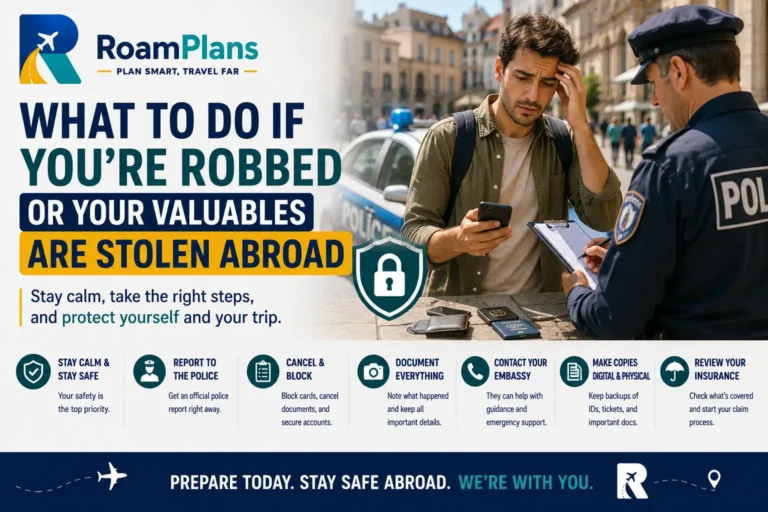
If the incident involved physical theft, threats, robbery, or stolen valuables, the next steps go beyond a simple scam dispute. That response is covered separately in What to Do If You’re Robbed or Your Valuables Are Stolen Abroad↗.
Common Mistakes That Make Tourist Scams Easier
Scammers do not need a traveler to make a huge mistake.
Often, they need only a few seconds of confusion or pressure.
Not Researching Scams Before Arrival
Spend a few minutes checking current scams reported at your destination.
Focus on patterns linked to:
Airports
Taxis
Public transport
Tourist attractions
ATMs
Nightlife
Accommodation
Online bookings
The State Department publishes general scam guidance as well as destination-specific warnings, so the risks worth checking can differ between countries.
Clicking the First Travel Ad You See
A professional-looking search advertisement does not prove that a website or phone number belongs to the real company.
The FTC warned travelers in June 2026 that scammers can place paid ads beside well-known hotel and airline names and direct people to imitation websites or false contact numbers.
When possible, verify the company’s official website yourself before entering payment details.
Paying Because You Feel Embarrassed
Some scams depend on social pressure.
A person may make a scene, accuse you of something, surround you with other people, or act angry when you question the bill.
Do not pay simply because you want an uncomfortable interaction to end.
If you can do so safely, move somewhere public and ask official staff or local authorities for help.
Letting a Stranger Handle Your Money
You may genuinely need help with unfamiliar currency.
That does not require handing your whole wallet to someone.
Count cash yourself and keep control of your cards.
Assuming a Uniform Means Someone Is Official
Uniforms, badges, signs, and printed identification can be copied.
If someone claiming to be an official asks for money or sensitive information and the situation seems unusual, verify who they are through a proper office or official contact method.
Using the Same Card for Everything
If possible, keep a backup payment option separate from the card you use most often.
If the primary card is lost, stolen, or blocked, you still have another way to pay for essential needs.
Carrying Too Much Cash
Large amounts of cash can be difficult to replace after theft.
Carry what makes sense for the destination and keep additional money or payment options somewhere separate.
Accepting Help Because You Are in a Hurry
A rushed traveler is easier to pressure.
Missing a train or spending five extra minutes checking information is often better than handing money or property to someone you cannot verify.
Use the Pause, Check, Decide Rule
If you take one anti-scam habit from this guide, use this one.
Pause
Do not immediately hand over money, documents, or your phone.
Check
Ask yourself:
Who is this person?
Why do they need this information?
Can I verify what they are telling me?
Does this person benefit if I believe them?
Why am I being rushed?
Can I check another source?
Decide
Continue only when the situation makes sense.
This small delay removes one of the main advantages many scammers depend on: getting you to act before you have time to think.
How to Check Whether Something Is Legitimate
Verification does not need to take long.
Hotel Problem
Use the contact details in your original booking rather than a number given by a stranger.
Flight Problem
Check your airline’s official app or website.
Attraction Closure
Check the attraction’s official site, ticket office, or verified staff.
Toll or Parking Fine
Go directly to the official agency instead of using an unexpected text-message link. The FTC continues to warn consumers about fake toll-payment texts.
Taxi Question
Check the airport, hotel, tourism authority, or other reliable local guidance about authorized taxis.
Police or Official Request
Ask for identification and verify through the appropriate office when circumstances allow.
Rental Offer
Confirm the property, agreement, booking platform, and payment method before sending money.
The FTC continues to warn that travel scammers may use fake websites, copied listings, false contact information, and unexpected payment requests.
What to Do If a Stranger Pressures You for Money
Pressure can make a small disagreement feel more serious than it is.
If someone unexpectedly demands money:
Keep control of your wallet and phone.
Ask what the payment is for.
Ask for a receipt or written price where appropriate.
Check the amount against what you agreed.
Move toward staff, security, or other people if you feel uncomfortable.
Contact local authorities if threats are involved.
Do not physically fight over money or belongings if doing so could put you in danger.
The goal is to protect yourself first.
If a Scam Becomes a Robbery
There is a point where a scam stops being a financial trick and becomes a personal safety problem.
If someone threatens violence, displays a weapon, physically blocks you, or tries to take your belongings by force, protecting yourself becomes more important than saving money or property.
State Department destination guidance commonly advises travelers not to physically resist robbery attempts in places where robbery risks are identified.
Once you are safe, deal with the financial and reporting steps.
Save Evidence After a Scam
If you have already lost money or information, save what you can.
Useful records may include:
Screenshots
Emails
Text messages
Phone numbers
Website addresses
Receipts
Booking confirmations
Transaction records
Taxi details
Vehicle plate numbers
Names used by the scammer
Location and time of the incident
Do not put yourself in danger trying to photograph someone.
Gather information only when it is safe.
These records may help your bank, booking platform, insurer, police, or another organization review what happened.
Report Travel Scams Through the Right Channel
Where you report a scam depends on what happened.
You may need to contact:
Your bank or card issuer
The booking platform
Hotel or airline
Local police
Transport operator
Your travel insurer
The relevant consumer-protection agency
U.S. travelers can also report suspected fraud to the Federal Trade Commission through its official reporting system. The FTC’s travel-scam guidance continues to direct consumers to report fraud and avoid sending further money after identifying a scam.
Reporting does not guarantee that money will be recovered.
It can still help protect your accounts and create a record of what happened.
Tourist Scam Prevention Checklist

Use this before and during a trip.
Before Booking
Check that you are using the real airline, hotel, or booking website.
Compare suspiciously cheap offers with normal prices.
Read the cancellation and payment terms.
Be cautious about requests to pay outside a trusted booking system.
Verify vacation rental details before sending money.
Avoid unexpected travel offers that pressure you to act immediately.
Before Leaving Home
Research scams currently reported at your destination.
Learn how official taxis operate.
Check the approximate cost from the airport to your accommodation.
Learn what local currency looks like.
Keep a backup payment method separate.
Save important booking information offline.
Know how to freeze your main bank card quickly.
Save official contact information for major bookings.
At Airports and Stations
Use official taxi or transport areas.
Keep bags closed and close to you.
Be careful when strangers offer unsolicited help.
Do not watch or carry an unknown person’s luggage.
Verify claims that your transport or hotel has closed.
Buy tickets through official or authorized channels.
While Using Taxis
Confirm how fares normally work.
Agree on the price when local practice requires it.
Check that the meter is used when required.
Follow your general route on a map when practical.
Keep control of your cash and cards.
Do not accept an unexpected hotel change without checking it yourself.
At ATMs and When Paying
Prefer ATMs in established locations.
Cover your PIN.
Refuse unnecessary help from strangers.
Keep your card in sight where practical.
Check the amount before approving payment.
Review account activity during the trip.
Freeze a missing card as soon as possible.
In Tourist Areas
Pay extra attention during distractions.
Keep your phone and wallet secure in crowds.
Do not hand over your wallet to someone claiming to help.
Check attraction closures yourself.
Buy tickets from official or authorized sources.
Walk away from aggressive sales pressure.
Online During the Trip
Avoid unexpected payment links.
Verify toll or parking messages independently.
Check website addresses before entering card information.
Avoid sharing sensitive banking or identity details with strangers.
Be careful with unexpected QR codes.
Contact companies using details you verify yourself.
A Simple Scam Check for Beginner Travelers
If you are unsure about a situation, ask these six questions:
Am I being rushed?
Am I being distracted?
Is someone asking for money I did not expect to pay?
Is someone trying to take control of my card, cash, passport, phone, or luggage?
Can I verify what they are telling me independently?
What happens if I simply walk away?
You do not need to identify the exact name of a scam.
Recognizing that the situation does not make sense may be enough to avoid it.
Frequently Asked Questions
Taxi overcharging, distraction theft, fake officials, card or ATM fraud, fake tickets, booking scams, and high-pressure sales are common patterns.
Research local scams, verify unexpected claims, keep control of money and belongings, and slow down whenever someone pressures you to act.
Check the URL, contact details, payment method, and company independently. Be careful with paid ads that imitate known travel brands.
Do not change hotels based only on the driver’s claim. Contact your hotel through your original booking information and verify it yourself.
Stay calm and ask to verify their identity through an official police station or number when safe to do so. Do not casually hand over your wallet or PIN.
You can accept normal help, but be careful if someone insists on handling your money, bank card, passport, luggage, or transportation.
Contact the payment provider quickly, secure affected accounts, save evidence, and report the incident through the appropriate service.
No. Methods and frequency vary by destination, so check current official and local information before traveling.
A mix of payment options is usually more useful than depending completely on cash or one card. Keep your backup method separate.
Final Thoughts
In short, Avoiding tourist scams is less about memorizing hundreds of tricks and more about noticing the same warning signs: pressure, distraction, confusion, unusual payment requests, and someone stopping you from checking the facts. Research the scams reported where you are going, keep control of your money and belongings, and give yourself time to verify anything that feels wrong.

Adnan Ahmed
RoamPlans AuthorTravel Planning Researcher & Editor
Adnan Ahmed is the travel planning researcher and editor behind RoamPlans. He creates clear, practical guides to help travelers compare destinations, plan routes, estimate costs, and avoid common trip-planning mistakes. His work combines careful source research, official travel information, and regular content reviews to keep each guide useful and current.
- ✓Destination Research
- ✓Budget Planning
- ✓Route Planning
- ✓Beginner Travel Guides
Turn This Guide into a Practical Trip Plan
Use the recommended Airline Baggage Allowance Checker or explore more free RoamPlans tools.