
Golden Circle Iceland: Complete First-Time Visitor Guide
The Golden Circle is one of the easiest ways to experience several sides ↗ of Iceland in a single day. The classic route combines Þingvellir National Park, the Geysir geothermal area, and Gullfoss waterfall, giving first-time visitors a mix of Icelandic history, tectonic geology, geothermal activity, and one of the country's most powerful waterfalls without requiring a multi-day road trip.
The route sits close enough to Reykjavík for a day trip, which is why it works particularly well on a short first visit. You can drive it independently or join a guided tour, and the main roads are used throughout the year. The mistake is assuming that because the route is popular and relatively easy to reach, there is little planning involved. Weather, winter daylight, parking, crowd levels, optional stops, and how much time you spend at Þingvellir can all change the day considerably.
For most first-time visitors, I would give the Golden Circle one full day. You can technically visit the three core attractions faster, but a slower day leaves enough time to walk through Þingvellir, watch Strokkur erupt more than once, experience Gullfoss without immediately returning to the car, stop for food, and add one or two optional places if conditions and energy are good.
Golden Circle at a Glance

| Question | Practical Answer |
|---|---|
| Main attractions | Þingvellir, Geysir/Strokkur, Gullfoss |
| Time needed | One full day |
| Best starting point | Reykjavík for most first-time visitors |
| Self-drive or tour? | Both work well |
| 4WD required? | Normally no for the standard route in suitable conditions |
| F-roads required? | No |
| Open year-round? | Main route generally accessible ye ar-round, weather permitting |
| Best for | First trips, short stays, families, Reykjavík-based travelers |
| Can it be combined with South Coast? | Possible, but usually not recommended as one normal sightseeing day |
| Main extra stops | Kerið, Secret Lagoon area, Friðheimar, Laugarvatn and smaller regional stops |
The important distinction is between:
the classic Golden Circle
and:
everything near the Golden Circle.
You do not need to visit every nearby attraction to complete the route.
What Is the Golden Circle?
The Golden Circle is a sightseeing route through:
Southwest Iceland.
Its three traditional core attractions are:
- ✓Þingvellir National Park
- ✓Geysir geothermal area
- ✓Gullfoss waterfall
These attractions are connected by normal public roads and form a practical loop from Reykjavík.
There is no single gate where you officially:
enter the Golden Circle.
It is a travel route rather than one enclosed attraction.
That gives self-drive visitors a lot of flexibility.
You can:
- ✓Start early
- ✓Reverse the order
- ✓Stay longer at one place
- ✓Skip optional stops
- ✓Continue toward South Iceland instead of returning to Reykjavík
Why Is It Called the Golden Circle?
The name is primarily associated with the sightseeing route.
The word:
Golden
is commonly linked with Gullfoss, whose Icelandic name means:
Golden Falls.
The route itself is not a perfect geometric circle.
It is better to think of it as:
a loop connecting three major attractions near Reykjavík.
Is the Golden Circle Worth It?
For most first-time visitors:
yes.
It works particularly well because the three main stops are genuinely different.
At Þingvellir, you get:
- ✓History
- ✓Tectonic landscape
- ✓Walking
At Geysir, you get:
- ✓Hot springs
- ✓Steam
- ✓Erupting Strokkur
At Gullfoss, you get:
- ✓Large waterfall
- ✓Canyon
- ✓Glacial river
You are not spending the day visiting three versions of the same attraction.
That variety is the main reason the route remains useful even for travelers who will later explore:
- ✓South Coast
- ✓Ring Road
- ✓North Iceland
Who Might Skip the Golden Circle?
Not every Iceland itinerary needs it.
You might skip it if:
- ✓You have only two or three days and another region matters more
- ✓You have already visited similar geothermal and waterfall sites on a previous Iceland trip
- ✓You strongly dislike heavily visited attractions
- ✓Your weather window is much better elsewhere
- ✓You are rushing a Ring Road just to fit it in
Do not include the Golden Circle merely because:
every first-time Iceland list says you must.
It deserves a full day when you choose it.
How Long Does the Golden Circle Take?
For a first visit:
plan most of a day.
A comfortable sightseeing day is often around:
6–9 hours
once you include:
- ✓Driving
- ✓Walking
- ✓Parking
- ✓Food
- ✓Toilets
- ✓Photos
- ✓Optional stops
A guided tour may follow its own fixed schedule.
A self-drive trip can easily become longer if you add:
- ✓Kerið
- ✓Lunch experience
- ✓Geothermal bath
- ✓Farm visit
- ✓Longer Þingvellir walk
Can You Do It in Half a Day?
Technically:
yes.
But you would need to move quickly.
A rushed version can become:
park → photograph → return to car
at each location.
That misses much of the value of:
- ✓Þingvellir
- ✓The geothermal area
If your available time is very short, a guided half-day-style option may be easier than trying to design an aggressive self-drive route yourself.
Can You Spend Two Days on the Golden Circle?
Yes, but most first-time visitors do not need two full sightseeing days for the core three stops.
An overnight becomes useful when you want to add:
- ✓Geothermal bathing
- ✓Farm experiences
- ✓Longer hikes
- ✓Regional accommodation
- ✓Slow food stops
- ✓Further South Iceland travel
Then you are really exploring:
the Golden Circle region
rather than only the classic three-stop route.
That can be an excellent approach on a slower Iceland trip.
Self-Drive vs Guided Tour
Both are strong options.
The Golden Circle is one of the few major Iceland routes where:
neither is clearly better for everyone.
Self-Drive Is Better If You Want:
- ✓Flexible departure time
- ✓Flexible stop duration
- ✓Optional attractions
- ✓Photography time
- ✓Your own food stops
- ✓To continue toward another region afterward
Guided Tour Is Better If You Want:
- ✓No driving
- ✓No parking decisions
- ✓Commentary from a guide
- ✓Simple winter logistics
- ✓A Reykjavík-based trip
- ✓Fixed transport from start to finish
For detailed Iceland driving rules rather than repeating them here, use Driving in Iceland: Road Rules, Weather and Safety.
Do You Need a Rental Car?
No.
The Golden Circle has a large tour market because it is such an easy Reykjavík day trip.
You can stay in Reykjavík and visit all three major sights without:
- ✓Renting a car
- ✓Changing hotels
That makes the route particularly useful for:
- ✓Solo travelers
- ✓Short trips
- ✓Winter visitors uncomfortable driving
A rental car becomes more attractive when the Golden Circle is part of a longer:
- ✓South Iceland road trip
- ✓Ring Road trip
Do You Need 4WD?
For the standard Golden Circle route in suitable conditions:
not normally.
The main roads connecting the classic sights do not require:
- ✓F-road driving
- ✓Highland vehicle
- ✓River crossing
A standard rental car can be appropriate in normal conditions.
Winter changes the risk calculation because of:
- ✓Snow
- ✓Ice
- ✓Wind
but simply having 4WD does not make poor weather safe.
Check:
- ✓Road conditions
- ✓Weather
- ✓Rental guidance
before leaving.
Is the Golden Circle Easy to Drive?
Compared with more remote Iceland road trips:
generally yes.
Official South Iceland guidance describes the main route as:
- ✓Year-round
- ✓Regularly serviced
- ✓Commonly used by self-drive visitors
That does not mean every day is easy.
You can still encounter:
- ✓Ice
- ✓Snow
- ✓Strong wind
- ✓Reduced visibility
particularly in winter and shoulder seasons.
The route's popularity should never be confused with:
guaranteed easy driving.
Which Direction Should You Drive?
You can drive the route in either direction.
A common order from Reykjavík is:
Þingvellir → Geysir → Gullfoss
then return through South Iceland.
This feels natural because Þingvellir is the closest of the three major attractions to Reykjavík.
But there is no rule requiring that order.
Should You Drive the Golden Circle in Reverse?
Sometimes.
Driving toward Gullfoss first can make sense when:
- ✓You want to reach it earlier
- ✓Tour traffic is concentrated in the normal direction
- ✓Weather is better farther east in the morning
- ✓You have a fixed lunch or activity booking
- ✓Your accommodation sits on the southern/eastern side
The route is flexible enough that:
weather and bookings can decide the order.
Should You Try to Beat the Tour Buses?
You can reduce crowds by visiting:
- ✓Early
- ✓Later in the day
especially during summer's long daylight.
But do not turn the entire trip into a strategy for:
never seeing another tourist.
The Golden Circle is popular.
You should expect people at:
- ✓Þingvellir
- ✓Geysir
- ✓Gullfoss
particularly in the middle of the day.
A realistic goal is:
more comfortable timing, not an empty attraction.
Stop 1: Þingvellir National Park

Þingvellir is the stop I would give the most time.
Many first-time visitors make the mistake of treating it as:
the viewpoint before Geysir.
It is much more than that.
Þingvellir combines:
- ✓Icelandic history
- ✓Political history
- ✓Geology
- ✓Rift landscape
- ✓Lake
- ✓Walking trails
- ✓Cultural sites
It is also a UNESCO World Heritage Site.
Why Þingvellir Is Historically Important
Around the year:
930
Icelanders established the Alþing at Þingvellir.
People gathered here to:
- ✓Make laws
- ✓Resolve disputes
- ✓Hear announcements
- ✓Conduct business
- ✓Participate in social life
The general assembly continued to meet at Þingvellir for centuries.
This makes the site important not simply as:
an old meeting place
but as one of the core locations in Iceland's national history.
What Does Alþing Mean?
The Alþing was Iceland's general assembly.
During the Commonwealth period, Þingvellir became the place where people from around the country met for:
- ✓Legal matters
- ✓Political decisions
- ✓Social exchange
Modern Iceland's parliament is no longer based here.
But Þingvellir remains strongly associated with the country's political and cultural identity.
UNESCO World Heritage Status
Þingvellir was placed on the:
UNESCO World Heritage List in 2004
for its cultural importance.
This is worth understanding because visitors sometimes assume the UNESCO status exists mainly because of:
- ✓Tectonic plates
- ✓Dramatic scenery
The geological setting is extraordinary.
But the UNESCO listing is fundamentally tied to:
the cultural landscape and historic assembly site.
Þingvellir and the Tectonic Plates
Þingvellir also sits within Iceland's active rift zone.
The landscape shows the effects of the North American and Eurasian tectonic plates moving apart.
You can see this through:
- ✓Fissures
- ✓Faults
- ✓Lava landscape
including the dramatic:
Almannagjá.
The popular phrase:
“walking between two continents”
is a useful simplification for tourists.
The actual geology is a wider rift zone rather than a neat line where one foot is always on one plate and the other on another.
Almannagjá
Almannagjá is one of the most impressive features in the park.
A walking path runs through part of the fissure.
For most first-time visitors, this is one of the easiest ways to experience:
- ✓Geology
- ✓Historical area
- ✓Landscape
together.
Rather than simply taking a photo from the upper viewpoint:
walk down.
Hakið Viewpoint
The visitor centre area at:
Hakið
is a practical place to begin.
From here, you get:
- ✓Elevated view
- ✓Access toward Almannagjá
- ✓Visitor information
For a first visit with limited time, starting here makes the park easier to understand.
Öxarárfoss
Öxarárfoss is a waterfall inside the national park.
It can be reached through the park's walking network.
Is it essential?
Not if:
- ✓Weather is poor
- ✓You have mobility constraints
- ✓You are very short on time
But if you have enough time, it adds another natural feature to a stop that many people otherwise experience only as:
- ✓Rift
- ✓History
Þingvellir Church and Historic Area
Þingvellir also contains:
- ✓Þingvellir Church
- ✓Historic assembly landscape
The current church dates from:
the 19th century
although the site's Christian history goes much farther back.
If you have:
90 minutes or more
rather than a rushed 30-minute stop, moving down toward the historical area gives you a much better understanding of the park.
How Long Should You Spend at Þingvellir?
I would use roughly:
45–60 Minutes
For a short visit focused on:
- ✓Viewpoint
- ✓Almannagjá
1.5–2 Hours
Better for most first-time visitors.
This allows time for:
- ✓Walking
- ✓History
- ✓Main viewpoints
Half Day
Makes sense if you add:
- ✓Longer trails
- ✓Exhibition
- ✓Ranger program
- ✓Silfra activity
For a standard Golden Circle day:
around 1.5 hours
is a useful target.
Parking at Þingvellir
Unlike some Golden Circle attractions, the main Þingvellir parking areas charge:
a service fee.
One payment currently covers the relevant paid national-park lots for:
the same day.
The principal visitor parking areas include:
- ✓P1
- ✓P2
- ✓P5
Do not pay again each time simply because you move the car to another included park lot on the same day.
Check the current system and fee when traveling.
Which Þingvellir Parking Lot Is Best?
For a first-time visitor:
P1 at Hakið
is an easy starting point because it sits near:
- ✓Visitor centre
- ✓Viewpoint
- ✓Walking route into Almannagjá
Other parking areas can make sense when your visit focuses on:
- ✓Öxarárfoss
- ✓Church
- ✓Silfra
- ✓Historical area
You do not need to move between every lot.
Walking part of the park is the experience.
Þingvellir Visitor Centre
The visitor centre at Hakið includes an interactive exhibition about:
- ✓History
- ✓Nature
- ✓Geology
It can be useful when:
- ✓Weather is poor
- ✓You want more historical context
- ✓You have a longer Golden Circle day
For a normal one-day circuit, it is optional.
Do not feel that visiting the park requires buying a museum-style ticket.
The outdoor landscape itself remains the main experience.
Silfra
Silfra is the famous fissure filled with exceptionally clear water inside Þingvellir.
Travelers visit for:
- ✓Snorkeling
- ✓Diving
This is not a normal casual Golden Circle stop.
You cannot simply arrive and:
jump in.
Diving and snorkeling are controlled activities with:
- ✓Rules
- ✓Equipment
- ✓Operator/permit requirements
If Silfra is one of your main Iceland experiences:
build the day around the booking.
Should You Add Silfra to a Golden Circle Day?
Yes, if snorkeling or diving is a priority.
But understand that it changes the day.
You may need to reduce:
- ✓Extra Golden Circle stops
- ✓Long lunch
- ✓Other activities
A Silfra experience plus the core three sights can already create a full day.
Free Ranger Walks
During the 2026 summer season, Þingvellir has also offered free English-language ranger walks covering:
- ✓History
- ✓Geology
- ✓Archaeology
- ✓Nature
Programs can change by year and season.
If a ranger walk happens to fit your visit:
it can provide excellent context.
I would not build a future itinerary around an old year's schedule without rechecking it.
Stop 2: Geysir Geothermal Area
From Þingvellir, the classic route continues east toward:
Haukadalur
and the Geysir geothermal area.
This stop feels completely different.
You move from:
- ✓Rift landscape
- ✓Icelandic political history
into:
- ✓Steam
- ✓Hot springs
- ✓Geothermal pools
- ✓Erupting water
The whole area is geologically active.
Geysir vs Strokkur
This is one of the most important Golden Circle distinctions.
Geysir
is the historic geyser that gave the English language the word:
geyser.
But Great Geysir is not currently the reliable erupting feature most visitors photograph.
That role belongs to:
Strokkur.
Great Geysir
Great Geysir has experienced periods of:
- ✓Activity
- ✓Reduced activity
- ✓Dormancy
over time.
Earthquakes have sometimes changed its behavior.
Today, do not arrive expecting:
Geysir itself to erupt on schedule.
The main active attraction is nearby Strokkur.
Strokkur
Strokkur erupts frequently.
The exact interval varies, but visitors commonly do not need to wait very long between eruptions.
That makes it one of Iceland's easiest geothermal events to witness.
The eruption can send:
- ✓Hot water
- ✓Steam
high into the air.
Watch More Than One Eruption
If your first view is:
- ✓Blocked
- ✓Poorly timed
- ✓Mostly through somebody else's phone screen
wait.
Strokkur usually gives you another opportunity.
This is one place where spending:
30–60 minutes
rather than ten minutes makes a noticeable difference.
Watch the Water Before Strokkur Erupts
One of the most interesting moments happens immediately before the eruption.
The surface can:
- ✓Rise
- ✓Form a blue dome
before the water bursts upward.
Instead of only watching:
the spray
pay attention to the pool itself.
That buildup is part of the experience.
Stay on Marked Paths
The geothermal area contains:
- ✓Boiling water
- ✓Hot ground
- ✓Steam vents
Stay behind:
- ✓Barriers
- ✓Ropes
- ✓Marked routes
A thin-looking crust of ground is not necessarily:
safe ground.
Do not step closer for a photograph.
Children at Geysir
Families should keep young children close.
This is not the place to allow children to:
- ✓Run off paths
- ✓Reach toward hot water
- ✓Cross barriers
The geothermal features are real natural hazards.
Treat them accordingly.
Sulfur Smell
You may notice a strong:
sulfur-like smell.
That is normal around geothermal activity.
For some visitors it is:
- ✓Fascinating
for others:
- ✓Unpleasant
It is part of the geothermal environment rather than a sign that something is wrong.
How Long Should You Spend at Geysir?
For most visitors:
45–75 minutes
works well.
That gives enough time to:
- ✓Walk the geothermal area
- ✓Watch several Strokkur eruptions
- ✓Use facilities
- ✓Get food if needed
You can stay longer if:
- ✓Photography matters
- ✓You walk farther into the area
Geysir Is a Good Food and Rest Stop
The Geysir area has established visitor services.
That makes it a practical place for:
- ✓Toilets
- ✓Food
- ✓Coffee
- ✓Rest
on the Golden Circle.
This can be useful because Þingvellir is better experienced as a:
walking/history stop
while Geysir can naturally become:
sightseeing + break.
Stop 3: Gullfoss
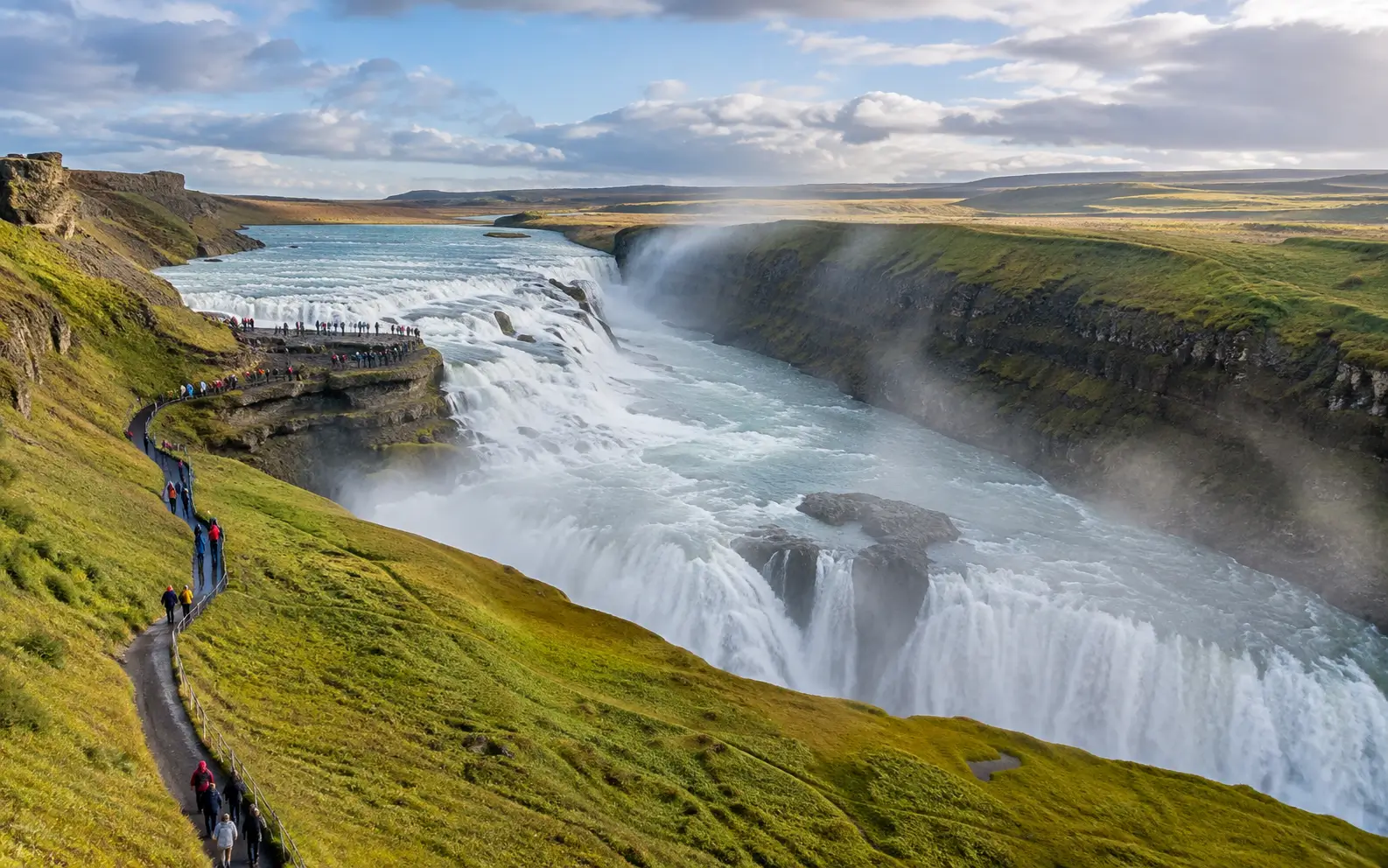
From Geysir, Gullfoss is a relatively short drive farther east.
For many visitors:
this is the most visually dramatic of the three major Golden Circle stops.
The Hvítá River drops through two main stages into a narrow canyon.
The upper drop is about:
11 metres
and the lower drop about:
21 metres.
But the measurements do not explain the experience very well.
What makes Gullfoss impressive is the combination of:
- ✓Water volume
- ✓Canyon
- ✓Mist
- ✓Sound
- ✓Multiple viewing levels
What Does Gullfoss Mean?
Gullfoss means:
Golden Falls.
The waterfall is closely tied to the identity and name of the Golden Circle route.
Upper and Lower Viewing Areas
Gullfoss can be experienced from different viewpoints.
The upper areas provide:
- ✓Broader perspective
- ✓Canyon view
- ✓Easier overview
A lower path can bring you much closer to the falls when:
- ✓Conditions
- ✓Seasonal access
allow it.
Do not assume every path will always be open.
Lower Path Can Close
The path closer to the waterfall can be affected by:
- ✓Ice
- ✓Snow
- ✓Wet conditions
- ✓Seasonal safety concerns
Official regional guidance specifically warns that trails around Gullfoss can close.
If a path is closed:
do not cross the barrier.
The upper viewpoints still provide an excellent experience.
Prepare to Get Wet
Mist from Gullfoss can reach the viewing areas.
Bring:
- ✓Waterproof jacket
even if Reykjavík was dry when you left.
The combination of:
- ✓Mist
- ✓Wind
- ✓Cold
can make the waterfall feel significantly colder than the car park.
How Long Should You Spend at Gullfoss?
For most first-time visitors:
45–75 minutes
is enough.
That allows time for:
- ✓Main viewpoints
- ✓Walking
- ✓Photos
- ✓Facilities
Photography-focused visitors may stay longer.
In winter, access can be slower because:
- ✓Ice
- ✓Snow
may make walking more cautious.
Is Gullfoss Free?
There is no general attraction ticket required simply to view the waterfall.
You may still spend money on:
- ✓Food
- ✓Shopping
- ✓Activities
nearby.
Always check current parking/access arrangements before travel because site management can change over time.
Why Gullfoss Works Well as the Third Core Stop
If you travel in the common direction:
Þingvellir → Geysir → Gullfoss
the route builds naturally.
You move from:
History and geology
to:
Geothermal activity
to:
Large-scale waterfall landscape
The three experiences do not compete with each other.
They complement each other.
Should You Turn Around After Gullfoss?
You have several options.
Option 1: Return Directly to Reykjavík
Best when:
- ✓Weather is worsening
- ✓You started late
- ✓You are tired
- ✓Core three sights were enough
Option 2: Complete the Larger Loop
Continue through South Iceland and add:
- ✓One or two optional stops
before returning to Reykjavík.
Option 3: Continue Toward South Iceland
If your accommodation is around:
- ✓Selfoss
- ✓Hella
- ✓Hvolsvöllur
you do not need to return to Reykjavík at all.
This is one reason self-driving works especially well when the Golden Circle begins a longer Iceland road trip.
Do Not Force Extra Stops Into the Day
Once you finish Gullfoss, ask:
- ✓What time is it?
- ✓What is the weather?
- ✓Is everyone still enjoying the day?
- ✓How much daylight remains?
- ✓Where are we sleeping?
Only then decide whether to add:
- ✓Kerið
- ✓Geothermal bathing
- ✓Farm stop
- ✓Smaller waterfall
- ✓Food experience
The core Golden Circle is already:
a complete sightseeing day.
Optional stops should improve it, not make it exhausting.
The Three Stops Need Different Amounts of Time
A common mistake is assigning:
45 minutes to everything.
I would think about them differently.
Þingvellir
Allow the most time because you need to:
- ✓Walk
- ✓Understand the landscape
Geysir
Stay long enough to:
- ✓Explore
- ✓See multiple eruptions
Gullfoss
Give enough time for:
- ✓Viewpoints
- ✓Conditions
- ✓Mist
A good Golden Circle should not feel like:
three parking lots and three photographs.
A Sensible Core Time Budget
Without creating a rigid itinerary, a useful planning framework is:
| Stop | Typical First-Time Time |
|---|---|
| Þingvellir | 1.5–2 hours |
| Geysir/Strokkur | 45–75 minutes |
| Gullfoss | 45–75 minutes |
| Food/rest | 45–90 minutes |
| Optional stops | Add only if time allows |
Driving and parking come on top of this.
That is why I recommend:
a full day rather than half a day.
Is the Golden Circle Too Tourist-Friendly?
Some experienced travelers dismiss the route because it is:
- ✓Famous
- ✓Busy
- ✓Accessible
I do not think that is a good reason to skip it.
A place does not become less:
- ✓Geologically important
- ✓Historically important
- ✓Visually impressive
because other people want to see it.
The better approach is to:
- ✓Time your visit well
- ✓Avoid rushing
- ✓Choose optional stops selectively
rather than seeking remoteness purely for its own sake.
What the Golden Circle Does Best
The Golden Circle is particularly strong at giving first-time visitors a fast introduction to:
why Iceland feels different.
In one day, you encounter:
- ✓Tectonic rifting
- ✓Icelandic national history
- ✓Geothermal energy
- ✓Erupting hot water
- ✓Glacial river
- ✓Major waterfall
That is a very high amount of variety for a route close to Reykjavík.
This is why it remains one of the most useful first-day or early-trip experiences in Iceland.
Which Optional Golden Circle Stops Are Actually Worth Adding?
The classic Golden Circle is complete with:
- ✓Þingvellir
- ✓Geysir
- ✓Gullfoss
Everything else is optional.
That distinction matters because the wider Golden Circle region contains enough:
- ✓Waterfalls
- ✓Farms
- ✓Geothermal baths
- ✓Historic sites
- ✓Food experiences
- ✓Craters
to turn one comfortable sightseeing day into an exhausting checklist.
For most first-time visitors, I would add:
one major optional experience
or:
two short optional stops.
For example:
Good Combination
Core three + Kerið + one food stop
or:
Core three + Friðheimar lunch
or:
Core three + geothermal bath
Too Much for Most People
Core three + Kerið + Brúarfoss + Friðheimar + Secret Lagoon + Laugarvatn Fontana
You could physically connect those places.
That does not make it a good day.
Optional Stops at a Glance
| Optional Stop | Best For | Typical Time to Allow | Booking? |
|---|---|---|---|
| Kerið | Quick geology stop | 30–60 min | Usually simple visit |
| Laugarvatn Fontana | Geothermal bathing | 1.5–2.5 hrs | Recommended |
| Friðheimar | Food and greenhouse experience | 1.5–2 hrs | Book main restaurant |
| Secret Lagoon | Traditional geothermal soak | 1.5–2 hrs | Strongly recommended |
| Brúarfoss | Photography and waterfall | 45–90+ min | Usually no activity booking |
| Skálholt | History and culture | 30–60 min | Usually not for normal visit |
| Efsti-Dalur II | Farm food and ice cream | 30–90 min | Depends on experience |
The real decision is not:
“Which stop is best?”
It is:
“What is missing from the rest of my Golden Circle day?”
If you already have:
- ✓History at Þingvellir
- ✓Geothermal activity at Geysir
- ✓Waterfall at Gullfoss
then another:
- ✓Food experience
- ✓Bath
- ✓Farm stop
often adds more variety than another natural viewpoint.
Kerið Crater
Kerið is one of the easiest optional Golden Circle stops to understand.
It is a volcanic crater with:
- ✓Red volcanic slopes
- ✓Lake at the bottom
- ✓Walking paths around the rim
Visit South Iceland currently describes the crater as approximately:
55 metres deep
and around:
3,000 years old.
It is located on Road 35, which makes it easy to integrate into many self-drive Golden Circle loops.
Is Kerið Worth Visiting?
Yes, if you want:
- ✓A short volcanic-landscape stop
- ✓Easy access
- ✓Something visually different from the core three sights
Kerið works particularly well because it does not usually require:
- ✓Half a day
- ✓Special equipment
- ✓Long hike
You can see the crater relatively efficiently.
How Long Should You Spend at Kerið?
For a normal first visit:
30–60 minutes
is enough.
You can:
- ✓Walk part or all of the rim
- ✓Look down into the crater
- ✓Descend toward the lake if conditions and access allow
Photography-focused travelers may stay longer.
Kerið Is Better as an Extra, Not a Replacement
I would not remove:
- ✓Þingvellir
- ✓Geysir
- ✓Gullfoss
just to include Kerið on a first trip.
The crater is a:
strong fourth stop
rather than one of the defining three.
When Should You Add Kerið?
It works particularly well when you:
- ✓Self-drive
- ✓Have enough daylight
- ✓Are completing the larger loop back toward Reykjavík
- ✓Want a shorter extra stop
It is much easier to add than a:
- ✓Two-hour spa
- ✓Long hike
- ✓Scheduled meal
because the timing is more flexible.
Kerið in Winter
Snow can dramatically change the appearance of the crater.
It can also make paths:
- ✓Slippery
- ✓Icy
Do not assume a short attraction means:
easy walking in every season.
Wear footwear appropriate for current conditions.
Is There an Entrance Fee?
Kerið is one of the Golden Circle natural attractions where visitors should expect a:
site access fee.
Fees can change, so check the current amount when traveling rather than building your budget around an old blog post.
The important planning point is simply:
Kerið is not a completely free roadside stop.
Laugarvatn
Laugarvatn is a small settlement located conveniently between:
- ✓Þingvellir
- ✓Geysir
That makes it one of the easiest places to turn the Golden Circle from:
three attractions
into:
a slower regional experience.
Its strongest visitor draw is geothermal activity.
Laugarvatn Fontana
Laugarvatn Fontana combines:
- ✓Geothermal pools
- ✓Natural steam rooms
- ✓Lake setting
- ✓Geothermal food traditions
It is different from simply seeing geothermal activity at Geysir.
At Geysir:
you observe geothermal power.
At Fontana:
you bathe in and experience geothermal heat.
That makes the two stops complementary rather than repetitive.
Is Laugarvatn Fontana Worth Adding?
Yes, particularly if:
- ✓You want geothermal bathing
- ✓You do not want to wait until Reykjavík for a spa
- ✓You prefer a smaller regional experience
- ✓You are spending a slower day on the Golden Circle
It becomes harder to justify if you already have another major geothermal bath booked the same day.
You usually do not need:
Fontana + Secret Lagoon
on one standard Golden Circle day.
Choose one.
How Much Time Should You Allow at Fontana?
For normal bathing:
1.5–2.5 hours
is a useful planning range.
That includes time for:
- ✓Changing
- ✓Showering
- ✓Bathing
- ✓Steam rooms
- ✓Slowing down
If you add a food or bakery experience:
allow more time.
The Geothermal Bakery Experience
One of Laugarvatn Fontana's most distinctive experiences is its geothermal bakery.
Traditional-style Icelandic rye bread is baked using:
geothermal heat in the ground.
The experience can include:
- ✓Seeing the geothermal baking process
- ✓Learning how it works
- ✓Tasting freshly baked rye bread
This adds a cultural and food dimension to the Golden Circle rather than another landscape stop.
Book the Bakery Experience if It Matters
Do not arrive assuming the bakery experience will begin:
whenever you are ready.
It operates on scheduled times.
If it is a priority:
book it and build the surrounding Golden Circle stops around that time.
The exact schedule can change by season.
Current Fontana Note
Laugarvatn Fontana completed a major renovation and reopened:
August 1, 2026.
Because facilities and schedules have recently changed, check current booking information rather than relying on pre-renovation reviews or photos.
Fontana vs Secret Lagoon
These are both geothermal experiences.
But they feel different.
Choose Laugarvatn Fontana If:
- ✓Lake setting appeals to you
- ✓Steam rooms matter
- ✓Geothermal bread interests you
- ✓You want the stop between Þingvellir and Geysir
Choose Secret Lagoon If:
- ✓You want a more traditional lagoon-style soak
- ✓Flúðir fits your route
- ✓You want to combine bathing with Friðheimar or southern Golden Circle stops
You do not need both on the same first visit.
Friðheimar
Friðheimar is one of the Golden Circle's strongest food experiences.
It is a family-run farm known especially for:
greenhouse-grown tomatoes.
Geothermal energy helps create the warm greenhouse environment needed to grow vegetables through Iceland's cold climate.
For visitors, the appeal is not simply:
“eat tomato soup.”
It is seeing how:
- ✓Geothermal energy
- ✓Icelandic agriculture
- ✓Local food
connect.
What Is the Friðheimar Restaurant Experience?
The main restaurant operates inside the greenhouse.
You eat among:
- ✓Tomato plants
- ✓Greenhouse structures
with dishes centered heavily around the farm's produce.
The best-known option is:
tomato soup with freshly baked bread.
The menu also includes other tomato- and vegetable-based dishes.
Is Friðheimar Worth It?
Yes, especially if:
- ✓Food matters to you
- ✓You want something beyond natural attractions
- ✓You have children interested in farms
- ✓You want a proper lunch stop
It creates a useful break in a Golden Circle day.
After several hours of:
- ✓Walking
- ✓Driving
- ✓Outdoor sightseeing
a planned meal can improve the whole route.
Friðheimar Is More Than a Restaurant
The farm also works with:
- ✓Greenhouse horticulture
- ✓Icelandic horses
and offers additional experiences.
But some of these require:
advance arrangement or prebooking.
Do not assume you can arrive and automatically join:
- ✓Private greenhouse visit
- ✓Stable visit
- ✓Horse program
without planning.
Do You Need to Book Friðheimar?
For the main greenhouse restaurant:
yes, I would book ahead.
It is extremely well known and can be busy.
A Golden Circle itinerary built around:
“we will eat there whenever we arrive”
creates unnecessary risk.
Choose a lunch time and build the route around it.
Important Friðheimar Distinction
Friðheimar now also has:
Vínstofa Friðheima
in another greenhouse.
That venue operates differently from the famous main greenhouse lunch experience and currently welcomes small groups without the same normal advance-table requirement.
So if you see conflicting online advice saying:
- ✓“You must book”
- ✓“You do not need to book”
the information may be referring to:
different Friðheimar dining experiences.
For the famous tomato-greenhouse meal:
reserve it if it matters to your trip.
How Much Time Should You Allow at Friðheimar?
For a relaxed meal:
1.5–2 hours
is reasonable.
Do not schedule:
Friðheimar lunch at 13:00
and another fixed experience far away at:
14:00.
Meals take time.
Parking takes time.
You may want to look around.
Give the stop room to work.
Where Does Friðheimar Fit Best?
It fits particularly well:
- ✓After Geysir/Gullfoss
- ✓Before completing the southern loop
- ✓Combined with Flúðir
- ✓On a slower reverse Golden Circle route
The exact position depends on:
- ✓Lunch booking
- ✓Driving direction
This is a case where:
reservation time should help decide the route order.
Efsti-Dalur II
If you want a shorter farm-food stop than Friðheimar, consider:
Efsti-Dalur II.
This family farm sits within the Golden Circle region and offers products made from or connected to the farm, including:
- ✓Ice cream
- ✓Skyr
- ✓Cheese
- ✓Other local food
It can also provide a look at Icelandic farm life.
Why Efsti-Dalur Works Well
It is useful when you want:
- ✓Quick food stop
- ✓Ice cream
- ✓Family-friendly break
- ✓Farm atmosphere
without committing to a long scheduled lunch experience.
It can be particularly good for travelers with children.
How Long Should You Spend?
A quick:
30–45 minute
stop may be enough if you only want:
- ✓Ice cream
- ✓Short break
A longer meal or farm experience requires more time.
Friðheimar vs Efsti-Dalur
Choose:
Friðheimar
for:
- ✓Destination meal
- ✓Greenhouse experience
- ✓Planned lunch
Choose:
Efsti-Dalur
for:
- ✓More casual stop
- ✓Farm products
- ✓Ice cream
- ✓Flexible timing
There is little reason to force both into a crowded day unless food and farms are a major interest.
Secret Lagoon
Secret Lagoon is located at:
Flúðir.
It is one of the strongest options for travelers who want to finish or break up the Golden Circle with:
geothermal bathing.
The experience is simpler and more traditional in feel than a large luxury spa.
The main pool is surrounded by an active geothermal area, including hot springs that are:
not for bathing.
Is Secret Lagoon Worth Adding?
Yes, especially when you want:
- ✓Relaxation after sightseeing
- ✓Geothermal bathing
- ✓A slower end to the day
It works particularly well after:
- ✓Þingvellir
- ✓Geysir
- ✓Gullfoss
when you have already completed the main outdoor attractions.
How Long Should You Allow?
Secret Lagoon says an average individual visit is roughly:
1.5–2 hours.
That is a good planning figure.
Add:
- ✓Driving
- ✓Changing
- ✓Showering
around the bath itself.
Do not describe it in your itinerary as:
“quick 45-minute stop.”
Do You Need to Book Secret Lagoon?
Reservations are currently:
strongly recommended.
The lagoon accepts bookings by:
- ✓Date
- ✓Time slot
and cannot guarantee walk-in availability.
If bathing is a priority:
reserve.
If it is only:
“maybe if we have time”
do not lock the entire day around it.
What Is Included?
Standard admission currently includes:
- ✓Changing facilities
- ✓Lockers
- ✓Lagoon access
Items such as:
- ✓Towel rental
- ✓Swimsuit rental
- ✓Drinks
may cost extra.
Bring your own:
- ✓Swimsuit
- ✓Towel
if that is easier.
Remember Icelandic Shower Etiquette
Before entering geothermal pools and lagoons, follow the facility's shower rules.
That normally means:
washing thoroughly before entering the water.
This is normal Icelandic bathing culture.
Follow the posted instructions.
Secret Lagoon With Children
Children can visit subject to the lagoon's current:
- ✓Age
- ✓Supervision
rules.
Families should check the latest policy before booking rather than relying on an old article.
Geothermal bathing is relaxing, but adults still need to supervise children closely around:
- ✓Water
- ✓Hot geothermal areas
Flúðir
Even if you are not using Secret Lagoon, Flúðir can be useful for:
- ✓Food
- ✓Fuel
- ✓Accommodation
- ✓Groceries
- ✓Swimming
The area has a strong horticultural identity because geothermal heat supports:
- ✓Greenhouses
- ✓Agriculture
This makes the Golden Circle region more than a chain of famous natural attractions.
Brúarfoss
Brúarfoss is known for its striking:
blue water.
The river splits and falls through dark rock before converging into a vivid central channel.
It is much smaller than Gullfoss.
That is exactly why comparing the two only by:
size
misses the point.
Gullfoss gives you:
- ✓Scale
- ✓Power
Brúarfoss gives you:
- ✓Color
- ✓Detail
- ✓A more intimate waterfall landscape
Is Brúarfoss Worth Adding?
Yes, particularly for:
- ✓Photography
- ✓Waterfall lovers
- ✓Travelers who want a quieter natural stop
But I would not make it essential for every first-time Golden Circle visitor.
You are already seeing:
Gullfoss.
Ask whether another waterfall is more valuable to you than:
- ✓Farm lunch
- ✓Geothermal bath
- ✓Historic stop
How Much Time Does Brúarfoss Need?
Do not plan it as a:
five-minute roadside photograph.
Allow roughly:
45–90 minutes or more
depending on:
- ✓Current access
- ✓Parking
- ✓Walking
- ✓Weather
- ✓Photography
Access arrangements around popular Icelandic natural sites can change, so follow the current local parking and trail signs rather than an old route saved from a blog.
Brúarfoss vs Kerið
Choose:
Brúarfoss
if you want:
- ✓Waterfall photography
- ✓Blue water
- ✓More natural walking
Choose:
Kerið
if you want:
- ✓Volcanic geology
- ✓Shorter, simpler stop
- ✓Something different from Gullfoss
For most first-time visitors:
Kerið adds more variety.
For serious waterfall lovers:
Brúarfoss may be more appealing.
Skálholt
Skálholt provides something very different from:
- ✓Craters
- ✓Hot springs
- ✓Waterfalls
It is one of Iceland's most important historic religious and cultural sites.
The first bishopric in South Iceland was established at Skálholt in:
1056.
For centuries, the site played a major role in Iceland's:
- ✓Religious life
- ✓Education
- ✓Culture
- ✓Politics
Is Skálholt Worth Adding?
It is strongest for travelers interested in:
- ✓History
- ✓Churches
- ✓Icelandic culture
- ✓Quieter stops
It is less essential if your Golden Circle priorities are almost entirely:
- ✓Landscape
- ✓Geothermal activity
For history-focused travelers, however, it pairs especially well with Þingvellir.
You get two very different parts of Icelandic history in the same day.
How Long Should You Spend at Skálholt?
For a normal stop:
30–60 minutes
can work well.
You can see:
- ✓Cathedral
- ✓Historic setting
- ✓Archaeological/cultural features
without turning it into a half-day visit.
Who Should Skip Skálholt?
Skip it if:
- ✓Day is already full
- ✓History does not interest you
- ✓You have a fixed spa or restaurant booking
Do not visit simply because:
it is on a list.
That is how Golden Circle days become overloaded.
Food Stops Are Part of the Golden Circle Experience
One of the most interesting features of this region is how geothermal energy connects with food production.
South Iceland has a strong tradition of:
- ✓Dairy farming
- ✓Meat production
- ✓Vegetable growing
- ✓Greenhouse horticulture
The regional geothermal resources make year-round cultivation possible in ways that surprise many first-time visitors.
That means a farm or food stop is not merely:
lunch.
It can add cultural context to the route.
How Should You Choose Your Food Stop?
Want a Destination Meal?
Choose:
Friðheimar.
Want Farm Ice Cream or Casual Food?
Choose:
Efsti-Dalur.
Want Geothermal Bread?
Choose:
Laugarvatn Fontana's bakery experience.
Want History + Food?
Skálholt and the surrounding regional food options can work.
The key is not to make:
every meal an attraction.
You still need time for the core route.
Should You Add Horse Riding?
The Golden Circle region has several Icelandic horse experiences.
This can work extremely well if:
- ✓Horses are a priority
- ✓You have more than one day
- ✓You intentionally reduce other stops
A proper horse ride is not:
a 20-minute roadside stop.
It changes the day.
For a standard one-day Golden Circle:
I would choose either:
- ✓Horse activity
- ✓Major geothermal bath
- ✓Long farm experience
rather than trying to combine all three.
What About Geothermal Baths?
For a one-day Golden Circle, choose:
one.
Strong regional options include experiences around:
- ✓Laugarvatn
- ✓Flúðir
There is little benefit in using several hours to visit two different geothermal bathing facilities unless:
geothermal bathing is the main purpose of your trip.
Bath at the Beginning or End of the Day?
For most travelers:
later is easier.
Why?
If you begin with a long soak, you may feel:
- ✓Relaxed
- ✓Slow
- ✓Less motivated to walk
through several outdoor attractions.
Using a bath near the end gives you:
- ✓Reward after sightseeing
- ✓Warmth after a cold day
- ✓Slower finish
The exception is when a:
- ✓Booking time
- ✓Route direction
makes an earlier bath much more logical.
Is a Geothermal Bath Worth It in Summer?
Yes.
Geothermal bathing is not only a:
winter activity.
Summer gives you:
- ✓Long daylight
- ✓Outdoor views
- ✓More flexible timing
The water remains warm even when the weather is:
- ✓Cool
- ✓Windy
Is It Better in Winter?
Winter can make geothermal bathing feel especially atmospheric.
But remember:
- ✓Driving takes longer
- ✓Daylight is shorter
- ✓Weather is less predictable
A two-hour bath uses a much larger percentage of:
a December sightseeing day
than:
a June sightseeing day.
That should affect how many other stops you plan.
Golden Circle With Only One Extra Stop
If you can add only one optional stop, I would choose based on traveler type.
First-Time Couple
Kerið or geothermal bath
Family
Efsti-Dalur or geothermal bath suited to your children
Food Traveler
Friðheimar
Photographer
Brúarfoss or Kerið
History Traveler
Skálholt
Slow-Travel Visitor
Laugarvatn Fontana
There is no universal winner.
Golden Circle With Two Extra Stops
A strong combination could be:
Option A: Nature + Food
Kerið + Friðheimar
Option B: Waterfall + Farm
Brúarfoss + Efsti-Dalur
Option C: History + Relaxation
Skálholt + Secret Lagoon
Option D: Geothermal Culture
Laugarvatn Fontana + geothermal bakery
That last option is really one larger experience rather than two separate sightseeing stops.
Golden Circle With Children
Families should prioritize:
- ✓Short walking intervals
- ✓Food
- ✓Toilets
- ✓Warm breaks
rather than maximizing stop count.
A strong family day could include:
- ✓Þingvellir
- ✓Geysir
- ✓Gullfoss
- ✓Farm ice cream
or:
- ✓Core three
- ✓Family-friendly geothermal bath
Do not expect children to remain excited by:
six consecutive landscape stops.
Variety matters.
Golden Circle for Couples
Couples can comfortably add:
- ✓Farm lunch
- ✓Geothermal bath
but doing both plus multiple extra natural stops can make the day long.
Choose whether you want the day to feel more:
active
or:
relaxed.
Then plan accordingly.
Golden Circle for Photographers
Photography changes the time calculation dramatically.
A normal traveler may spend:
45 minutes
at a stop.
A photographer may want:
- ✓Different viewpoints
- ✓Better light
- ✓Fewer crowds
- ✓Longer exposures
- ✓Weather changes
If photography is a main priority:
reduce the number of optional attractions.
The best photographic day is not necessarily the one with the most locations.
Golden Circle for Solo Travelers
Solo self-drive gives you excellent flexibility.
But you are also:
- ✓Driver
- ✓Navigator
- ✓Photographer
Leave enough time to stop safely rather than trying to use:
- ✓Phone
- ✓Camera
while driving.
If you do not want that responsibility:
a guided Golden Circle tour remains one of Iceland's easiest solo-travel choices.
How Many Stops Are Too Many?
For one normal day, I would aim for:
3 Core Stops
Always.
Plus 1 Major Extra
Such as:
- ✓Friðheimar
- ✓Fontana
- ✓Secret Lagoon
or:
Plus 2 Short Extras
Such as:
- ✓Kerið
- ✓Skálholt
That is enough.
Once your plan contains:
seven or eight named attractions
you are probably designing a checklist rather than a good travel day.
Use Must-See and Optional Stops
A better Golden Circle plan separates stops into two groups.
Must See
- ✓Þingvellir
- ✓Geysir
- ✓Gullfoss
Optional
Choose perhaps:
- ✓Kerið
- ✓Brúarfoss
- ✓Friðheimar
- ✓Bath
- ✓Skálholt
Then decide the optional stop based on:
- ✓Weather
- ✓Energy
- ✓Time
unless you have a fixed reservation.
Fixed Reservations Change the Route
A reservation at:
- ✓Friðheimar
- ✓Laugarvatn Fontana
- ✓Secret Lagoon
becomes an anchor point.
Build the rest of the day around it.
Do not try to force the normal clockwise or counterclockwise order when it makes you:
- ✓Rush
- ✓Backtrack
- ✓Arrive late
The Golden Circle is flexible enough to change direction around a reservation.
Do Not Book Too Many Fixed Times
One fixed reservation can help structure the day.
Three can make it fragile.
For example:
- ✓11:00 activity
- ✓13:00 lunch
- ✓16:00 bath
leaves little room for:
- ✓Weather
- ✓Traffic
- ✓Longer Þingvellir walk
- ✓Unexpected stop
Keep some of the day:
unscheduled.
A Better Way to Build the Golden Circle
Start with:
Core three.
Then ask:
Do I want more nature?
Add:
- ✓Kerið
- ✓Brúarfoss
Do I want food/culture?
Add:
- ✓Friðheimar
- ✓Efsti-Dalur
- ✓Skálholt
Do I want relaxation?
Add:
- ✓Fontana
- ✓Secret Lagoon
Pick:
one category
rather than trying to complete all three.
That creates a more coherent day.
My First-Time Optional Stop Priority
If I were helping a first-time visitor with one normal day, I would prioritize:
1. Kerið
when you want an easy fourth sightseeing stop.
2. Friðheimar
when food and geothermal agriculture appeal to you.
3. One Geothermal Bath
when relaxation matters.
4. Brúarfoss
when waterfalls or photography are a priority.
5. Skálholt
when history is a major interest.
That order can change completely based on:
- ✓Traveler
- ✓Season
- ✓Reservation availability
which is why there is no single “perfect” expanded Golden Circle route.
The Main Rule for Optional Stops
Every optional stop should answer:
“Does this make my day better?”
not:
“Can I technically fit it?”
The Golden Circle is one of Iceland's easiest routes to overplan because everything looks close on a map.
Leave enough space to:
- ✓Walk
- ✓Eat
- ✓Watch Strokkur erupt again
- ✓Stay longer at Gullfoss
- ✓Change the plan when weather changes
That flexibility is one of the main advantages of doing the Golden Circle independently.
What Is the Best Time to Visit the Golden Circle?
The Golden Circle can work in every season.
The better question is:
What kind of Golden Circle day do you want?
Each season changes:
- ✓Daylight
- ✓Road conditions
- ✓Walking conditions
- ✓Crowd levels
- ✓Photography
- ✓How flexible your schedule can be
For the easiest first-time self-drive experience, the warmer months give you more daylight and more room to change plans.
Winter can be beautiful, but the day requires more discipline because:
- ✓Daylight is limited
- ✓Roads can become icy
- ✓Weather changes may affect your timing
- ✓Walking paths can be slower
Spring and autumn sit somewhere between the two.
There is no single month that is best for every traveler.
Golden Circle in Summer
Summer gives you the most freedom.
From roughly June through August, Iceland has very long daylight hours. Around June, the sky stays light for almost the entire day.
For a Golden Circle trip, that changes the way you can plan.
You do not need to fit every outdoor stop into a narrow daylight window.
You can:
- ✓Leave Reykjavík later
- ✓Spend longer at Þingvellir
- ✓Take a slow lunch
- ✓Add one optional stop
- ✓Stay out into the evening
This makes summer especially forgiving for first-time visitors.
Why Summer Is Easier for First-Time Visitors
The biggest benefit is not warmer weather.
It is:
time flexibility.
If your lunch takes longer than expected or you spend an extra 30 minutes somewhere, the day does not immediately fall apart because sunset is approaching.
Walking conditions are also usually simpler than in winter.
That helps at places where you may spend more time outside.
Summer Does Not Mean Warm Weather
Do not pack for Iceland as if you are visiting a hot European summer destination.
Even in summer, you can experience:
- ✓Cool temperatures
- ✓Rain
- ✓Strong wind
- ✓Fast weather changes
A sunny morning in Reykjavík does not tell you exactly what conditions will feel like several hours later around the route.
Pack for changing conditions.
Summer Crowds
The trade-off for easier conditions is:
more visitors.
Summer is Iceland's busiest travel period.
Expect the three main Golden Circle attractions to feel busiest around normal daytime sightseeing hours.
If crowd levels matter to you, summer gives you one big advantage:
long evenings.
You can use those extra daylight hours to travel earlier or later than many group tours.
Late Evening Golden Circle Trips
During the brightest part of summer, a later Golden Circle trip can work very well.
You may find:
- ✓Fewer large groups
- ✓Softer light
- ✓Less pressure to finish before dark
But do not forget one practical point.
Visitor services may not follow the same long schedule as the daylight.
A place can still be bright outside while:
- ✓Restaurants
- ✓Shops
- ✓Visitor facilities
have already closed.
If you plan a very late drive, carry:
- ✓Food
- ✓Water
- ✓Enough fuel
and do not depend on every service being open.
Golden Circle in Winter
Winter creates a very different day.
The route itself does not stop being useful.
The main difference is that you need to treat:
daylight as a limited resource.
Around late December, Reykjavík receives only around four to five hours of daylight.
That means a winter Golden Circle day cannot be planned the same way as a June day.
Winter Daylight Changes the Schedule
In summer, losing 30 minutes may mean very little.
In winter, 30 minutes can affect whether your final outdoor stop happens:
- ✓In daylight
- ✓During twilight
- ✓After dark
For this reason, winter travelers should be more selective.
I would keep the day focused on:
- ✓Core attractions
- ✓One planned meal or break
- ✓Very limited extras
unless conditions are excellent.
Do Not Build a Winter Golden Circle Day Around Summer Timings
This is a common planning error.
A traveler sees an itinerary written for:
- ✓June
- ✓July
- ✓August
and assumes the same stop count will work in:
- ✓December
- ✓January
It may not.
Your winter pace can be slower because of:
- ✓Frost
- ✓Ice
- ✓Snow
- ✓Short daylight
- ✓More careful driving
- ✓More careful walking
The solution is not to move faster.
The solution is:
plan less.
Start Winter Days With a Clear Priority Order
A good winter plan separates places into:
Priority Stops
The sights you came to see.
Optional Stops
Places you visit only if:
- ✓Roads are good
- ✓Weather is stable
- ✓Daylight remains
- ✓You still have enough energy
This prevents you from rushing through the best parts of the route just to reach an optional attraction.
Winter Walking Conditions
Even when roads are open, paths can still be:
- ✓Snowy
- ✓Icy
- ✓Wet
- ✓Slippery
That can change the time you need outside the car.
A 15-minute walk in summer may take much longer when every step requires more care.
Footwear becomes far more useful than trying to save a few minutes.
Should You Drive the Golden Circle in Snow?
Snow itself does not automatically mean the route must be cancelled.
The decision depends on:
- ✓Road condition
- ✓Wind
- ✓Visibility
- ✓Forecast
- ✓Your driving experience
- ✓Rental company guidance
Fresh snow on a maintained road is very different from:
- ✓Severe wind
- ✓Blowing snow
- ✓Poor visibility
- ✓Ice
Do not judge conditions only from what you see outside your Reykjavík hotel.
Check the actual route.
Golden Circle in Spring
Spring is a transition season.
The days become longer quickly, which can make road trips easier as the season progresses.
But spring can still bring:
- ✓Cold air
- ✓Snow
- ✓Rain
- ✓Mud
- ✓Wind
- ✓Ice
especially earlier in the season.
Do not assume:
April means winter is finished.
Icelandic conditions do not follow the same seasonal pattern travelers may know from warmer countries.
Why Spring Can Be a Good Choice
Spring gives you a useful balance.
You can get:
- ✓More daylight than winter
- ✓Fewer visitors than peak summer
- ✓Easier scheduling as the season progresses
It can work very well for travelers who do not need:
- ✓Midnight Sun
- ✓Peak summer conditions
but want more freedom than a short winter day provides.
Golden Circle in Autumn
Autumn can also work very well.
September in particular still gives you a reasonable amount of daylight while bringing:
- ✓Cooler temperatures
- ✓Fewer peak-season crowds
- ✓Darker nights
As autumn continues, the day becomes shorter quickly.
That means an itinerary that works comfortably in early September may feel very different several weeks later.
Autumn Weather Can Change Fast
Autumn is one of those times when you should avoid planning by:
month name alone.
Two trips only a few weeks apart can have very different:
- ✓Daylight
- ✓Temperature
- ✓Wind
- ✓Road conditions
Check the forecast close to the actual day of travel.
Best Golden Circle Season by Travel Style
Want the Easiest First Self-Drive?
Choose:
late spring through summer.
You get more daylight and more flexibility.
Want Long Photography Hours?
Choose:
summer.
The long days give you far more freedom to move around the route.
Want a Winter Feel?
Choose:
winter, but keep the itinerary simpler.
Want Fewer Peak-Season Visitors?
Consider:
spring or autumn.
Want the Most Flexible Stop Count?
Summer wins because daylight gives you more room.
Daylight Matters More Than Temperature
Many first-time travelers look at the temperature first.
For this particular route, I would look at:
daylight first.
You can dress for cold weather.
You cannot create extra daylight in December.
Daylight affects:
- ✓Departure time
- ✓Number of stops
- ✓Photography
- ✓Walking
- ✓Optional attractions
- ✓How much schedule delay you can absorb
This becomes one of the biggest differences between a summer and winter Golden Circle day.
Check Sunrise and Sunset for Your Actual Date
Do not use a general statement such as:
“Iceland gets five hours of daylight in winter.”
Daylight changes significantly across the season.
A trip in:
- ✓Early November
- ✓Late December
- ✓Late February
will not have the same usable light.
Before finalizing your daily plan, check:
- ✓Sunrise
- ✓Sunset
- ✓Civil twilight
for your actual travel date.
Then build the route around that.
Weather Can Change the Golden Circle Plan
The Golden Circle is relatively close to Reykjavík.
That sometimes gives visitors false confidence.
They think:
“It is only a day trip, so weather is not a major issue.”
I would not plan that way.
Icelandic weather can change during the day.
Conditions can also differ between:
- ✓Reykjavík
- ✓Þingvellir
- ✓Eastern parts of the route
The weather you see at breakfast is not your forecast for the entire day.
Check Conditions Before Leaving Reykjavík
Before starting a self-drive day, check:
- ✓Weather forecast
- ✓Wind
- ✓Road condition
- ✓Weather warnings
- ✓Any active travel alerts
Do this:
before leaving, not after you have already reached the first difficult section.
If official travel advice says conditions are poor:
change the plan.
A popular sightseeing route is still not worth driving in unsafe conditions.
Check Conditions Again During the Day
The morning check is the minimum.
If weather is changing, look again during:
- ✓Lunch
- ✓Fuel stop
- ✓Longer break
This is especially useful in:
- ✓Winter
- ✓Early spring
- ✓Late autumn
Your original plan does not need to survive unchanged until evening.
A good Iceland road trip plan can change.
Wind Is One of the Biggest Factors
Visitors often think first about:
- ✓Rain
- ✓Snow
but strong wind can create major problems too.
Wind can affect:
- ✓Driving
- ✓Walking
- ✓Car doors
- ✓Photography
- ✓How cold the air feels
A temperature that looks manageable on your phone can feel much colder in exposed areas.
Protect Your Car Door in Strong Wind
One small habit matters a lot in Iceland.
When opening a car door in strong wind:
hold it firmly.
Do not allow the wind to catch it.
A strong gust can damage:
- ✓Door
- ✓Hinges
- ✓Nearby vehicle
Passengers should know this too.
The driver is not the only person opening a door during the day.
Rain Does Not Ruin the Golden Circle
Light or normal rain does not automatically make the route a bad idea.
Some places can look very dramatic in:
- ✓Cloud
- ✓Mist
- ✓Rain
The bigger issue is comfort.
If your clothes become wet early in the day, every later outdoor stop becomes less enjoyable.
That is why waterproof clothing matters more than hoping for a completely dry forecast.
When Should You Change the Day Completely?
Consider changing or delaying your route when official guidance warns of conditions such as:
- ✓Severe wind
- ✓Dangerous road conditions
- ✓Very poor visibility
- ✓Major snow
- ✓Significant weather warnings
Do not make the decision based on:
“I have already paid for the rental car.”
That money is already spent.
It should not decide whether you drive into unsafe conditions.
What Should You Wear on the Golden Circle?
Think in:
layers.
You will move repeatedly between:
- ✓Warm car
- ✓Cold outdoor areas
- ✓Wind
- ✓Rain
- ✓Heated visitor facilities
One heavy coat with little underneath is often less flexible than several layers.
A Simple Clothing System
For most travelers, think about:
Base Layer
Something comfortable next to your skin.
Warm Middle Layer
Such as:
- ✓Fleece
- ✓Wool sweater
- ✓Warm synthetic layer
Outer Layer
Something that protects against:
- ✓Wind
- ✓Rain
This system lets you adjust throughout the day.
Bring a Waterproof Outer Layer
This is useful in every season.
You may face:
- ✓Rain
- ✓Waterfall spray
- ✓Wet snow
A normal fashion jacket may look warm but still leave you wet.
Waterproof or strongly water-resistant outer clothing can make a major difference during a full sightseeing day.
What Shoes Should You Wear?
Choose shoes based on:
walking conditions, not how formal the trip looks.
You will spend time around:
- ✓Gravel
- ✓Wet paths
- ✓Uneven surfaces
- ✓Slopes
Depending on season, you may also encounter:
- ✓Mud
- ✓Snow
- ✓Ice
Comfortable footwear with good grip is a better choice than smooth everyday shoes.
Do You Need Hiking Boots?
For the standard Golden Circle:
serious mountain boots are not required for everyone.
You are not doing a Highland trek.
But shoes should be:
- ✓Comfortable
- ✓Stable
- ✓Suitable for wet conditions
In winter, grip becomes far more significant.
Winter Traction Can Help
In icy conditions, simple traction aids worn over suitable footwear can make walking easier.
Whether you need them depends on:
- ✓Current weather
- ✓Path condition
- ✓Your balance and confidence
Do not rely on them as permission to ignore a closed or unsafe path.
If access is blocked:
stay out.
Bring Gloves and a Hat Outside Summer Too
Wind can make exposed areas feel much colder than expected.
Small items such as:
- ✓Gloves
- ✓Warm hat
- ✓Neck covering
take little luggage space but can make outdoor stops much more comfortable.
Even outside deep winter, carrying them can be useful.
What Should You Keep in the Car?
For a one-day Golden Circle drive, I would keep a small day kit with:
- ✓Water
- ✓Snacks
- ✓Warm extra layer
- ✓Waterproof jacket
- ✓Phone charger
- ✓Portable battery
- ✓Sunglasses
- ✓Basic personal medicine
- ✓Dry socks
In colder months, add extra attention to:
- ✓Warm clothing
- ✓Food
- ✓Phone battery
You may never need the backup items.
That is fine.
Keep Your Phone Charged
Your phone may be doing several jobs during the day:
- ✓Navigation
- ✓Weather checking
- ✓Road-condition checking
- ✓Photography
- ✓Booking confirmation
- ✓Communication
Cold weather can also reduce battery performance.
Start the day with:
- ✓Charged phone
- ✓Car charging option
and preferably:
- ✓Backup battery
Do not begin a full road day at 35 percent battery.
Download What You Need Before Leaving
Mobile coverage is generally good along popular routes, but your trip should not depend completely on having perfect data service every second.
Before leaving, it can help to save:
- ✓Route
- ✓Hotel details
- ✓Booking confirmations
- ✓Key addresses
This is especially useful if you are continuing beyond the Golden Circle afterward.
Fuel Planning
The Golden Circle is not one of Iceland's most isolated driving routes.
You will find towns and services around the wider region.
Still:
do not wait until the warning light appears.
If your tank is getting low and you pass a convenient fuel stop:
use it.
This becomes more useful when you plan to continue:
- ✓Deeper into South Iceland
- ✓To rural accommodation
instead of returning directly to Reykjavík.
Do You Need to Fill the Tank Before Leaving Reykjavík?
Starting with enough fuel is the simplest approach.
You do not necessarily need a completely full tank for the core route.
But beginning the day with:
plenty of range
removes one unnecessary task from the itinerary.
The same logic applies to electric vehicles.
Know:
- ✓Your usable range
- ✓Charging plan
- ✓What your accommodation offers
before adding a long extension to the day.
Do Not Confuse Driving Distance With Day Length
The map can make the Golden Circle look simple.
The problem is that:
driving distance is only one part of the day.
Your total time also includes:
- ✓Parking
- ✓Walking
- ✓Toilets
- ✓Food
- ✓Photos
- ✓Waiting
- ✓Weather delays
- ✓Getting dressed for outdoor stops
- ✓Returning to the car
This is why a route that looks easy on a map can still fill an entire day.
Food Planning Without Overplanning
Part 1 covered the main food experiences.
For the rest of your practical planning, decide one thing before leaving:
Is food part of the experience or simply a meal?
If food is part of the experience:
use a planned stop.
If you mainly want to keep moving:
choose something more flexible.
This prevents every meal from becoming another scheduled attraction.
Carry Snacks Even With a Lunch Plan
A reservation does not guarantee you will never get hungry before it.
Carry something simple in the car.
This is especially useful for:
- ✓Children
- ✓Winter trips
- ✓Long photography stops
- ✓Travelers with dietary needs
Snacks also reduce the temptation to rush a place because everyone wants food immediately.
Bring Water
This sounds basic, but it is easy to forget on a day made up of repeated short drives.
Bring reusable water bottles.
Then refill them when practical.
There is no reason to treat a one-day road trip as if you need to carry a huge emergency food supply, but basic food and water make the day easier.
Toilets and Visitor Facilities
The major Golden Circle stops have established visitor facilities.
Still, do not assume:
every optional roadside stop has a toilet.
Use facilities when you reach:
- ✓Main attractions
- ✓Restaurants
- ✓Fuel stations
- ✓Visitor centers
rather than waiting until you urgently need one.
This becomes especially useful when traveling with:
- ✓Children
- ✓Older travelers
How Much Does a Golden Circle Day Cost?
There is no single correct budget.
The core natural sightseeing route can be relatively affordable compared with activity-heavy Iceland days.
Your main costs may include:
- ✓Rental car
- ✓Fuel or charging
- ✓Parking/service fees
- ✓Food
- ✓Optional site fees
Your total increases quickly if you add:
- ✓Guided activity
- ✓Geothermal bathing
- ✓Farm experience
- ✓Scheduled meal
- ✓Horse riding
This is another reason to choose optional experiences carefully.
A Low-Cost Golden Circle Day
A lower-cost version can focus on:
- ✓Core three sights
- ✓Simple food
- ✓Limited paid extras
You do not need a premium experience at every stop for the day to feel complete.
The core route already contains the main reason most people come.
A Mid-Range Golden Circle Day
A typical self-drive day might combine:
- ✓Core route
- ✓Rental-car costs
- ✓Fuel
- ✓Normal restaurant meal
- ✓One paid optional stop
This is enough for most first-time travelers.
A Higher-Cost Golden Circle Day
Costs rise when the itinerary includes several booked experiences.
For example:
- ✓Snorkeling
- ✓Destination lunch
- ✓Geothermal bath
- ✓Horse riding
can turn a simple sightseeing day into one of the more expensive days of the trip.
That may be worth it.
But choose those activities because you want them, not because they appear on every itinerary online.
Accessibility and Mobility
The Golden Circle can work for travelers with different mobility levels, but each stop is different.
The main attractions have developed visitor infrastructure.
That does not mean:
every viewpoint and path is equally easy.
Conditions can change because of:
- ✓Distance
- ✓Slopes
- ✓Gravel
- ✓Snow
- ✓Ice
- ✓Weather
Travelers with limited mobility should plan the specific viewpoints they want rather than assuming they need to follow the same walking route as everyone else.
Þingvellir Requires the Most Planning for Mobility
Of the core three stops, Þingvellir can involve the most walking if you want to see several areas.
You do not need to cover the entire park.
A visitor with limited walking ability can focus on:
- ✓Easier-access areas
- ✓Main viewpoint
- ✓Visitor facilities
instead of trying to reproduce a long walking route.
Because the site covers a large area, deciding:
what matters most
before arriving can save energy.
Geysir Can Be a Shorter Outdoor Visit
The main geothermal area is more compact than Þingvellir.
That can make it easier for travelers who want:
- ✓Shorter walking distance
- ✓Nearby facilities
Weather still matters.
Wet, icy, or snowy surfaces can change how easy the visit feels.
Gullfoss Has Different Viewing Choices
You do not need to use every viewing level to experience Gullfoss.
If:
- ✓Stairs
- ✓Slippery ground
- ✓Longer walking
are difficult, choose the viewpoint that works with your mobility.
Trying to reach the closest possible viewing point is not required for a worthwhile visit.
Families With Strollers
A stroller may work in some developed visitor areas, but do not assume it will work equally well on:
- ✓Every trail
- ✓Every slope
- ✓Snow
- ✓Ice
- ✓Rough ground
For small children, a child carrier may sometimes be easier depending on:
- ✓Season
- ✓Planned walking
Choose based on the exact day rather than the route name.
Golden Circle With Older Travelers
The route can work very well for older travelers because sightseeing is broken into:
- ✓Drive
- ✓Stop
- ✓Walk
- ✓Rest
You do not need to complete long hikes.
A better plan may simply involve:
- ✓Fewer optional stops
- ✓Longer rests
- ✓Easy viewpoints
- ✓Warm indoor breaks
The goal is not to match the pace of a 25-year-old traveler.
Should You Visit the Golden Circle in Bad Weather?
This depends on:
how bad the weather is.
Cloud or rain alone does not mean cancel.
Dangerous road or wind conditions are different.
Think in three levels.
Normal Icelandic Weather
Examples:
- ✓Cloud
- ✓Light rain
- ✓Cold
- ✓Moderate wind
The trip may still work.
Difficult Conditions
Examples:
- ✓Snow
- ✓Ice
- ✓Stronger wind
- ✓Poor visibility
Recheck the route and reduce the plan if needed.
Serious Warnings
Follow official advice.
Change:
- ✓Time
- ✓Route
- ✓Travel day
if necessary.
The Golden Circle will still exist tomorrow.
What if the Weather Gets Worse After You Start?
Do not let the original itinerary trap you.
If you have already completed the main sights and conditions are getting worse:
go back.
You do not need to use every remaining hour just because an optional stop exists on your list.
Likewise, if conditions improve later:
you can decide whether one additional stop still makes sense.
Should You Wait for Perfect Weather?
Usually:
no.
If you wait for a completely:
- ✓Windless
- ✓Dry
- ✓Sunny
Iceland day, you may waste a lot of time.
Plan around:
safe conditions, not perfect conditions.
A cloudy Golden Circle day can still be excellent.
Can You See the Northern Lights on a Golden Circle Day?
The Golden Circle is not mainly a northern-lights route.
But during the darker part of the year, you may have a chance to see the aurora later in the day if:
- ✓Skies are clear
- ✓Solar activity is suitable
- ✓You are away from bright lights
Do not extend an already tiring driving day deep into the night simply because an app shows a possible aurora.
Driver fatigue matters too.
Golden Circle and Northern Lights Tour on the Same Day
This can work better if:
- ✓Someone else is driving the evening tour
- ✓You have had enough rest
A long self-drive day followed by several more hours of nighttime driving is different.
Be realistic about:
- ✓Energy
- ✓Sleep
- ✓Next day's plans
Seeing more is not useful if you are too tired to travel safely.
Can You Combine the Golden Circle With the South Coast?
Technically:
yes.
For a normal first-time sightseeing day:
I would usually keep them separate.
Both areas contain enough to fill their own day.
Combining them can create exactly the problem this guide has tried to avoid:
too much driving and too little time outside the car.
When Combining Them Makes Sense
It can make sense when:
- ✓You are not returning to Reykjavík
- ✓The Golden Circle is the start of a longer road trip
- ✓You will sleep farther east
- ✓You are deliberately seeing only a limited part of each area
In that case, you are using the Golden Circle as:
a route into the next part of Iceland
rather than trying to complete two full sightseeing days at once.
When You Should Keep Them Separate
Keep them separate if you want proper time for:
- ✓Walking
- ✓Photography
- ✓Food
- ✓Optional stops
- ✓Breaks
This is especially true in winter.
Two good days are better than one overloaded day.
Golden Circle on Your Arrival Day
I would be careful with this plan.
After an international flight, you may be dealing with:
- ✓Poor sleep
- ✓Time-zone change
- ✓Airport procedures
- ✓Rental-car collection
Starting a long sightseeing drive immediately can make the first day harder than expected.
If you arrived well rested on a short flight and conditions are easy, part of the route may work.
But do not force a full Golden Circle day after a tiring overnight flight.
Golden Circle on Your Last Day
This can work if your flight is:
the following day.
It becomes riskier when you need to finish the route and then reach the airport for a same-day flight.
I would not build a tight schedule where:
- ✓Weather
- ✓Road delay
- ✓Longer stop
could threaten an international departure.
Your last major sightseeing day should still leave enough travel margin.
Best Place for the Golden Circle in an Iceland Itinerary
For many first-time trips, the Golden Circle works well:
- ✓Near the beginning
- ✓Before going farther into South Iceland
- ✓As a Reykjavík-based day trip
Doing it early can also help you adjust to:
- ✓Icelandic roads
- ✓Weather
- ✓Driving style
before you tackle longer daily distances.
Golden Circle as Your First Self-Drive Day
The route is often a good introduction to Icelandic road travel because you can practice:
- ✓Reading local road signs
- ✓Using fuel stations
- ✓Parking at attractions
- ✓Adjusting to weather
- ✓Managing repeated stops
without beginning in one of the country's most remote areas.
That does not make the route risk-free.
It simply makes it more manageable than starting your trip with a very long remote drive.
Do You Need a Detailed Minute-by-Minute Schedule?
No.
Part 1 already showed why stop times vary.
For Part 2, the better planning method is:
Set Your Departure Window
Know roughly when you want to leave.
Know Your Three Priorities
The classic stops remain the base of the day.
Add Any Fixed Reservation
Place one scheduled activity or meal if you have one.
Keep the Rest Flexible
Let:
- ✓Weather
- ✓Daylight
- ✓Energy
decide the rest.
This works better than trying to predict exactly where you will be at:
2:17 PM.
Build Buffer Time Into the Day
A good schedule needs space.
Add room for things such as:
- ✓Parking
- ✓Queue
- ✓Toilet
- ✓Wrong turn
- ✓Photo stop
- ✓Slow meal
- ✓Weather check
- ✓Longer walk
Without buffer time, every small delay becomes stressful.
With buffer time, the same delay barely matters.
Do Not Use Every Extra Hour
If your plan finishes earlier than expected, that does not mean you failed to use the day properly.
You can:
- ✓Return to Reykjavík
- ✓Have dinner
- ✓Rest
- ✓Prepare for the next driving day
Iceland trips often involve several long outdoor days.
Saving some energy can improve the rest of the trip.
A Good Golden Circle Day Should Still Feel Flexible
The biggest planning advantage of this route is that you can change it.
You can:
- ✓Leave earlier
- ✓Leave later
- ✓Reverse direction
- ✓Drop optional stops
- ✓Stay longer somewhere you enjoy
- ✓Continue into South Iceland
- ✓Return to Reykjavík early
Use that flexibility.
Do not remove it by creating an itinerary where every hour is already booked.
Common Planning Mistake: Packing for Reykjavík Instead of the Route
You may leave your hotel and think:
“It feels fine outside.”
Then several hours later you are standing near exposed water or open ground in:
- ✓Wind
- ✓Spray
- ✓Cold rain
Dress for the sightseeing day.
Not for the five-minute walk from your hotel to the car.
Common Planning Mistake: Trusting One Weather App
Use official Icelandic weather and road information when making a driving decision.
A general phone-weather app may be useful for a quick view.
It should not be your only source for:
- ✓Road warnings
- ✓Severe wind
- ✓Travel alerts
especially outside summer.
Common Planning Mistake: Making Every Stop Non-Negotiable
Your itinerary should have:
priorities, not demands.
If conditions change, something may need to go.
Dropping one optional stop is better than:
- ✓Driving too fast
- ✓Skipping food
- ✓Driving tired
- ✓Reaching the final stop in poor conditions
Flexibility is part of good trip planning.
Common Planning Mistake: Underestimating Wind Chill
A temperature reading alone can make the day look comfortable.
Wind can change how it feels outside.
This matters because Golden Circle sightseeing means repeatedly leaving a warm vehicle.
Bring one extra warm layer even if you think:
“I probably will not need it.”
Common Planning Mistake: Leaving Wet Clothes On
If you become wet early in the day, change or dry what you can.
Sitting in wet:
- ✓Socks
- ✓Gloves
- ✓Inner layers
can make later stops uncomfortable.
Keeping a small dry backup in the car is an easy fix.
Common Planning Mistake: Driving Tired
The Golden Circle feels easy because individual driving sections are often manageable.
But the full day may include:
- ✓Several hours behind the wheel
- ✓Walking
- ✓Cold weather
- ✓Constant stopping
- ✓Decision making
By evening, you may be more tired than expected.
If you are the only driver:
plan your return before exhaustion becomes the thing making decisions for you.
Common Planning Mistake: Adding Stops Because They Are Nearby
A place being:
15 or 20 minutes away
does not mean it costs only 15 or 20 minutes.
You also need time to:
- ✓Turn off the route
- ✓Park
- ✓Walk
- ✓Visit
- ✓Return
- ✓Rejoin the route
A small map detour can easily use an hour.
This is another reason Part 1's optional-stop limits matter.
Common Planning Mistake: Ignoring the Next Day
Do not plan the Golden Circle in isolation.
Ask:
What am I doing tomorrow?
If tomorrow includes:
- ✓Long drive
- ✓Early activity
- ✓Airport departure
- ✓Major hike
then finishing today's route completely exhausted may not be the best decision.
Your Iceland itinerary should work across several days, not just one.
Practical Golden Circle Morning Checklist
Before leaving, confirm:
- ✓Weather checked
- ✓Road conditions checked
- ✓Phone charged
- ✓Navigation ready
- ✓Fuel or battery range sufficient
- ✓Waterproof layer packed
- ✓Warm layer packed
- ✓Water packed
- ✓Snacks packed
- ✓Fixed reservations confirmed
- ✓Accommodation location known
Then go.
You do not need a complicated pre-trip routine.
You simply want to avoid discovering an easy-to-fix problem once you are already on the route.
Practical Check During the Day
Around the middle of the trip, ask:
- ✓Is the weather still good?
- ✓Are road conditions changing?
- ✓How much daylight remains?
- ✓Is everyone tired?
- ✓Do we still want the optional stop?
- ✓Do we need food?
- ✓Do we need fuel?
This one check can stop a comfortable day from turning into a rushed evening.
Who Should Keep the Golden Circle Very Simple?
I would keep it especially simple for:
- ✓First winter self-drive
- ✓Travelers with limited daylight
- ✓Families with very young children
- ✓Travelers with mobility limits
- ✓Anyone arriving tired
- ✓Anyone continuing a long distance afterward
Simple does not mean:
less successful.
It often means you get more time at the places you actually care about.
Who Can Build a Longer Golden Circle Day?
A longer day can work for travelers who have:
- ✓Summer daylight
- ✓Their own vehicle
- ✓Good weather
- ✓No early next-day commitment
- ✓Strong interest in photography or regional experiences
Even then:
keep at least part of the schedule open.
The route is more enjoyable when you can change your mind.
The Best Golden Circle Plan Is Not the Longest One
After reading all the possible:
- ✓Stops
- ✓Activities
- ✓Farms
- ✓Baths
- ✓Waterfalls
- ✓Historic places
it is easy to think a better itinerary means:
adding more.
Usually it does not.
For a first-time visitor, a good Golden Circle day gives you:
- ✓Enough time outside the car
- ✓Enough time to eat
- ✓Enough flexibility for weather
- ✓Enough daylight for the season
- ✓Enough energy to enjoy the final stop
That is a much better measure of success than counting how many pins you reached on a map.
Sample Golden Circle Itineraries
By this point, you know what the Golden Circle includes and how the season, weather, daylight, and optional stops affect the day.
Now you can turn that information into an actual plan.
The schedules below are examples rather than strict timetables.
Use them to decide:
- ✓How early to leave
- ✓How many stops to include
- ✓Where to place a meal
- ✓Whether a booked activity fits
- ✓Where to sleep afterward
Your exact timing should still change based on:
- ✓Season
- ✓Weather
- ✓Daylight
- ✓Reservations
- ✓Your own pace
Classic One-Day Golden Circle Self-Drive
This is the version I would use for many first-time visitors traveling from Reykjavík.
Morning
Leave Reykjavík early enough that you do not begin the first major stop near lunchtime.
Drive to:
Þingvellir National Park
Allow enough time for the walking route you selected before the trip.
Then continue toward:
Geysir and Strokkur
Use this part of the day for:
- ✓Geothermal sightseeing
- ✓Toilets
- ✓Coffee or a light break if needed
Continue to:
Gullfoss
By this point, you have completed the classic three attractions.
Afternoon
Take a proper food break.
Then decide whether the day still has room for:
one short optional stop
or:
one larger booked experience.
Do not assume you must add something.
If:
- ✓Weather is worsening
- ✓Everyone is tired
- ✓Daylight is becoming limited
return toward Reykjavík.
Evening
Return to Reykjavík or continue to your next accommodation.
This version works well because the core sights remain the priority and the final part of the day stays flexible.
Classic Golden Circle With Kerið
This version works well for travelers who want one additional natural stop without booking a long activity.
A practical order can be:
- ✓Þingvellir
- ✓Geysir
- ✓Gullfoss
- ✓Meal
- ✓Kerið
- ✓Reykjavík
Kerið works naturally near the later part of many loop routes.
The main benefit is flexibility.
Unlike a booked spa or restaurant, you can skip Kerið if:
- ✓Weather changes
- ✓Day runs late
- ✓Everyone is tired
That makes it a good optional stop for a first self-drive.
Golden Circle With Friðheimar
If the greenhouse meal is one of your priorities, treat the reservation as the fixed point of the day.
Do not force the same sightseeing order used by everyone else.
Instead:
- ✓Note your restaurant time
- ✓Check realistic driving time around it
- ✓Place the three main attractions before and after the meal
- ✓Leave buffer time
For example, a midday booking may work with:
Þingvellir → Geysir → lunch → Gullfoss
or another order depending on your reservation.
The meal becomes part of the day rather than something squeezed between two parking stops.
Golden Circle With a Geothermal Bath
A bath works best when it replaces other extras rather than being added on top of them.
A good structure is:
Earlier in the Day
- ✓Þingvellir
- ✓Geysir
- ✓Gullfoss
Later
- ✓Meal
- ✓One geothermal bathing experience
- ✓Accommodation or Reykjavík
This creates a natural change of pace.
You spend the earlier part of the day sightseeing and the later part slowing down.
Golden Circle With Silfra
Silfra changes the timing more than a normal sightseeing stop.
If snorkeling or diving is booked, start with the activity time.
Then build the rest of the route around it.
For example:
Morning
Silfra activity at Þingvellir
After the Activity
Continue with:
- ✓Remaining Þingvellir time if needed
- ✓Geysir
- ✓Gullfoss
Late Day
Return or continue to accommodation.
I would usually avoid adding another major scheduled activity to the same day.
Silfra plus the main Golden Circle already gives you a full plan.
Summer Golden Circle Itinerary
Summer allows the most flexible version of the route.
A relaxed summer day can look like:
Morning
- ✓Leave Reykjavík
- ✓Þingvellir
Late Morning
- ✓Drive through the region at an easy pace
- ✓Geysir
Early Afternoon
- ✓Gullfoss
Afternoon
- ✓Lunch
- ✓One optional stop
Evening
Choose between:
- ✓Another short stop
- ✓Geothermal bath
- ✓Slow return to Reykjavík
- ✓Continue to South Iceland
The long daylight means you do not need to treat every minute as fixed.
Still, avoid using the extra light as an excuse to create a 14-hour checklist.
Late Summer Golden Circle Plan
A later start can work especially well during the brightest part of the year.
For example:
Late Morning
Leave Reykjavík.
Midday to Afternoon
Visit:
- ✓Þingvellir
- ✓Geysir
- ✓Gullfoss
Late Afternoon or Evening
Add:
- ✓Kerið
- ✓Food
- ✓Short regional stop
then return.
This can help travelers who prefer:
- ✓Slower mornings
- ✓Evening photography
- ✓Fewer large daytime groups
Just make sure any restaurant or booked attraction still fits its own opening schedule.
Winter Golden Circle Itinerary
Winter needs a simpler plan.
A good approach is:
Before Daylight
Leave Reykjavík early enough to reach the first attraction around the useful daylight period.
Daylight Hours
Prioritize:
- ✓Þingvellir
- ✓Geysir
- ✓Gullfoss
Late Afternoon
Have a meal or begin the return.
Evening
Return to Reykjavík unless:
- ✓You already have nearby accommodation
- ✓Conditions remain good
- ✓You have a planned evening activity
In winter, I would rather complete three major stops comfortably than rush five.
Winter Golden Circle With One Extra Experience
If you want one major extra in winter, choose it carefully.
A geothermal bath can work well because it does not require another long outdoor sightseeing stop.
For example:
- ✓Þingvellir
- ✓Geysir
- ✓Gullfoss
- ✓Early meal
- ✓Geothermal bath
- ✓Return
But check driving conditions before committing to the final part of the day.
If weather worsens:
skip the extra.
Spring Golden Circle Plan
Spring gives you more scheduling room as daylight increases.
A good spring plan can include:
- ✓Core three
- ✓Lunch
- ✓One short extra
with another optional stop kept as a backup.
This is useful because spring conditions can vary.
You might start the day expecting:
- ✓Kerið
but decide later that:
- ✓Road condition
- ✓Wind
- ✓Rain
make an earlier return better.
Keep the final stop flexible.
Autumn Golden Circle Plan
Autumn works similarly.
Earlier in the season, the day may still support:
- ✓Core route
- ✓Lunch
- ✓One or two extras
Later in autumn, reduce the plan as daylight becomes shorter.
The calendar month alone should not decide your stop count.
Use your actual travel date.
Golden Circle Without a Car
Travelers staying in Reykjavík can easily make the Golden Circle a tour day.
This is often the simplest option when:
- ✓You do not want to rent a vehicle
- ✓You are traveling solo
- ✓You do not feel confident driving in winter
- ✓Your Iceland stay is short
- ✓You want a guide to provide context
A standard tour usually centers on the same three core attractions.
The main difference is that:
the operator controls the timetable.
Standard Golden Circle Bus Tour
A standard bus tour usually works best for travelers who want:
- ✓Lower cost than a private tour
- ✓Simple Reykjavík pickup
- ✓Main three sights
- ✓No driving responsibility
The trade-off is flexibility.
You cannot decide that you suddenly want:
- ✓Another hour at Þingvellir
- ✓A long photography session
- ✓An unplanned farm stop
because the group follows a schedule.
For many first-time visitors, that trade-off is acceptable.
Small-Group Golden Circle Tour
A small-group tour may suit you if you want something between:
- ✓Large bus tour
- ✓Private tour
Potential benefits can include:
- ✓Smaller vehicle
- ✓Smaller group
- ✓Easier communication with the guide
- ✓Less time managing a large group at each stop
It usually costs more than a basic coach tour.
Decide whether the smaller group matters enough to justify the price difference.
Private Golden Circle Tour
A private tour gives you the most control without self-driving.
It can make sense for:
- ✓Families
- ✓Small groups sharing the price
- ✓Older travelers
- ✓Photography-focused travelers
- ✓People who want a specific route
- ✓Travelers with mobility needs
The main disadvantage is:
cost.
For one solo traveler, a private tour may be difficult to justify.
For a family or small group, the price difference can become more reasonable when shared.
Golden Circle Tour With Extra Activities
Some tours combine the core route with an extra experience such as:
- ✓Geothermal bathing
- ✓Snowmobile activity
- ✓Farm visit
- ✓Snorkeling
These can be useful when that activity is already high on your Iceland list.
But check what the extra activity does to:
- ✓Time at the classic sights
- ✓Total tour length
- ✓Price
A tour with more included stops is not automatically better.
How to Choose a Golden Circle Tour
Before booking, compare more than the headline price.
Look at:
- ✓Total duration
- ✓Group size
- ✓Pickup system
- ✓Core stops
- ✓Optional stops
- ✓Time allowed at each location
- ✓Included admission
- ✓Activity requirements
- ✓Cancellation terms
- ✓Age restrictions where relevant
The same phrase:
Golden Circle tour
can describe very different days.
Check Whether Hotel Pickup Is Actually Included
Do not assume every tour collects passengers directly from every Reykjavík hotel.
Depending on:
- ✓Accommodation location
- ✓Vehicle access
- ✓Reykjavík traffic rules
you may need to walk to a designated pickup point.
Check this before the morning of the tour.
You do not want to discover at departure time that your meeting point is several streets away.
Check the Real Tour Duration
A tour advertised as:
8 hours
may involve:
- ✓Pickup time
- ✓Drop-off time
- ✓Several passenger stops
The time you personally spend away from your hotel may be longer.
If you have:
- ✓Dinner reservation
- ✓Evening flight
- ✓Northern lights tour
afterward, leave enough room.
Do not schedule another activity minutes after the advertised return time.
Large Bus vs Small Group
Neither is automatically better.
Large Bus
Can be better for:
- ✓Lower budget
- ✓Simple sightseeing
- ✓Travelers who do not mind larger groups
Small Group
Can be better for:
- ✓Easier group movement
- ✓More guide interaction
- ✓Travelers who prefer smaller vehicles
Private
Can be better for:
- ✓Maximum control
- ✓Families or groups
- ✓Special requirements
Pick based on the day you want rather than assuming the most expensive option must be the best.
Self-Drive or Tour for Winter?
For experienced winter drivers, self-drive can still work when conditions are suitable.
For visitors who are:
- ✓Uncomfortable with snow
- ✓Uncomfortable with ice
- ✓Unused to strong wind
a guided tour may remove a major source of stress.
But tours are also affected by severe weather.
Booking a tour does not mean:
weather stops mattering.
Operators can:
- ✓Change schedules
- ✓Alter routes
- ✓Cancel
when conditions require it.
Where Should You Stay for the Golden Circle?
You do not need to sleep inside the Golden Circle region.
For most first-time travelers, the accommodation choice depends on:
what you are doing the next day.
That question is more useful than asking which town is closest to the middle of the route.
Stay in Reykjavík
Reykjavík is the easiest base when:
- ✓Golden Circle is a day trip
- ✓You do not want to change hotels
- ✓You are taking a tour
- ✓You have several Reykjavík-based days
The main advantage is simplicity.
You can leave in the morning and return to:
- ✓Same room
- ✓Same luggage setup
- ✓Same evening restaurant options
This works very well on shorter trips.
Who Should Choose Reykjavík?
Reykjavík is especially practical for:
- ✓First-time visitors
- ✓Short stays
- ✓Tour users
- ✓Travelers without rental cars
- ✓Winter visitors who want fewer hotel changes
The disadvantage is that you return over some of the same ground rather than continuing deeper into South Iceland.
Stay Around Laugarvatn
Laugarvatn can make sense when you want:
- ✓A quieter regional stay
- ✓Easy access to the Golden Circle
- ✓Geothermal bathing
- ✓A slower schedule
It works well for travelers spending more than one day in the area.
You also avoid having to return all the way to Reykjavík after sightseeing.
Stay Around Flúðir
Flúðir works well when your trip includes:
- ✓Secret Lagoon
- ✓Friðheimar region
- ✓Southern Golden Circle stops
It can be a practical overnight if you want the Golden Circle to feel like a regional stay rather than a single loop from Reykjavík.
Stay Around Selfoss
Selfoss is one of the most practical choices if you are moving from the Golden Circle into South Iceland.
It gives you access to:
- ✓Accommodation
- ✓Restaurants
- ✓Shops
- ✓Fuel
- ✓Main onward roads
This makes it less about:
staying at an attraction
and more about:
positioning yourself well for tomorrow.
Why Selfoss Works Well for Road Trips
Suppose your next day continues toward:
- ✓Waterfalls
- ✓Black-sand coast
- ✓Vík
- ✓Further South Iceland
Sleeping around Selfoss can reduce the need to return west to Reykjavík and then drive east again the next morning.
That can save:
- ✓Time
- ✓Fuel
- ✓Repeated driving
For a multi-day road trip, this can be more useful than sleeping in the most scenic location.
Stay Farther South or East
If the Golden Circle is the first day of a longer South Iceland trip, you may continue past the region to accommodation farther along your route.
This can work if:
- ✓You started early
- ✓You are not tired
- ✓Weather remains good
- ✓The next day's route benefits from it
Do not add a long evening drive only to say:
we got farther.
Where you sleep should make the next day easier without making the current day exhausting.
Reykjavík vs Golden Circle Countryside
Choose Reykjavík if you value:
- ✓Convenience
- ✓Restaurants
- ✓No hotel change
- ✓Tour access
Choose regional accommodation if you value:
- ✓Slower travel
- ✓Less backtracking
- ✓Rural setting
- ✓Easier continuation into South Iceland
Neither option is universally better.
Should You Stay Two Nights in the Golden Circle Region?
It can make sense if your plans include several slower experiences such as:
- ✓Geothermal bathing
- ✓Farm visits
- ✓Horse riding
- ✓Long photography sessions
For a basic first visit to the three main attractions:
one full day is usually enough.
Two nights should support extra experiences rather than simply stretching the same sightseeing route.
- ↗
- ↗
- ↗
Golden Circle FAQ
Is the Golden Circle a Road?
Not exactly.
It is a sightseeing route connecting major attractions in Southwest Iceland.
You use several public roads rather than one road officially named:
Golden Circle Road.
Is the Golden Circle the Same as the Ring Road?
No.
The Golden Circle is a relatively short sightseeing route near Reykjavík.
The Ring Road circles much of Iceland and normally forms part of a multi-day trip.
They serve very different travel plans.
Is Golden Circle the Same as South Coast?
No.
They are separate sightseeing areas.
The Golden Circle focuses on places such as:
Þingvellir
Geysir
Gullfoss
South Coast itineraries usually focus on a different set of attractions farther south and east.
Can You Walk the Golden Circle?
Not as a normal first-time sightseeing plan.
The attractions are spread across a large road route.
Visitors normally use:
Rental car
Tour vehicle
Walking applies within individual attractions, not between the whole set of major stops.
Can You Cycle the Golden Circle?
Experienced cyclists may plan cycling routes through the region.
But it is very different from doing the standard sightseeing loop by car.
You would need to consider:
Weather
Wind
Road traffic
Distance
Equipment
Accommodation
For most first-time visitors, cycling is not the normal way to complete the route.
Can You Visit the Golden Circle From Keflavík Airport?
Yes, but the airport is not beside the Golden Circle.
You must first account for the drive from the Reykjanes Peninsula toward Reykjavík and the Golden Circle region.
I would be careful about planning a full route immediately after:
Long overnight flight
Poor sleep
Rental-car collection
Fatigue should decide more than map distance.
Is the Golden Circle Close to Reykjavík?
Yes, compared with many other Iceland sightseeing regions.
That is one of the main reasons it works so well as a:
Reykjavík day trip.
You can see several major sites without changing accommodation.
Can I Do the Golden Circle After Landing in Iceland?
You can.
But whether you should depends on:
Arrival time
Flight length
Sleep
Weather
Season
If you feel tired:
do not begin a long self-drive just because the attractions fit on the map.
Can You Do the Golden Circle Before a Flight Home?
I would avoid a tight same-day plan before an international flight.
Weather and road delays can happen.
If the Golden Circle is your final major sightseeing day, it is safer when your flight leaves:
the next day.
Is the Golden Circle Free?
Many of the core natural attractions do not require a normal sightseeing admission ticket.
However, your day can still include costs such as:
Parking or service fees
Rental car
Fuel
Food
Optional attractions
Activities
Do not interpret:
free natural attractions
as:
free day trip.
Is Parking Free Everywhere?
No.
Parking and service-fee systems vary by location.
They can also change over time.
Check the current system for the places you plan to visit rather than assuming all Golden Circle parking works the same way.
Do I Need Cash?
Most travelers can handle normal purchases using cards.
Still, your payment setup should work internationally.
Before traveling, check:
Bank travel settings if required
Card PIN
Foreign transaction fees
It is better to fix payment problems before starting the road trip.
Do You Need a Guide at Þingvellir?
No.
You can visit independently.
A guide can add:
Historical context
Geological explanation
but the park can still be visited without one.
If history matters to you, spending more time there is often more useful than rushing through with no context.
Is Strokkur Guaranteed to Erupt While I Am There?
Strokkur erupts frequently, which is why most visitors have a strong chance of seeing it during a normal visit.
Natural geothermal activity is still natural.
Do not treat it like a scheduled theme-park show.
Give yourself enough time to wait for more than one eruption.
Can I Touch the Water at Geysir?
Stay on the marked paths and follow barriers.
Geothermal water and ground can be dangerously hot.
A pool that looks calm is not an invitation to test the temperature.
Can You Swim at Gullfoss?
No.
Gullfoss is a major waterfall and river system, not a swimming location.
View it from the established visitor areas.
Can You Swim at Þingvellir?
Normal casual swimming is not what Silfra visits are for.
Silfra snorkeling and diving are controlled activities with specific rules and equipment.
Book through the proper activity system if you want that experience.
Is Golden Circle Good for Children?
Yes.
It works particularly well for families because the day contains several different types of attraction.
The key is keeping the schedule reasonable.
Children may enjoy:
Geyser eruptions
Waterfall
Farm stop
Ice cream
Geothermal bathing where age rules allow
Give them warm breaks and avoid creating a long list of similar outdoor stops.
Is Golden Circle Good for Older Travelers?
Yes.
You can adjust how much walking you do.
The route does not require one long hike.
Choose:
Suitable viewpoints
Fewer extras
More rest time
based on the traveler rather than trying to copy someone else's schedule.
Is Golden Circle Wheelchair Accessible?
Accessibility varies by:
Attraction
Specific viewpoint
Season
Weather
Major sites have developed visitor areas, but that does not mean every trail or viewpoint has the same access.
Check the particular area you want to visit before the trip.
Can I Bring a Baby?
Yes, families travel the Golden Circle with babies.
Plan around:
Warm clothing
Feeding
Changing
Car-seat needs
Shorter outdoor periods
A slower day usually works better than trying to maximize stops.
Is Golden Circle Safe for Solo Travelers?
For most solo travelers, it can be a very practical Iceland route.
You can choose between:
Self-drive
Group tour
If you self-drive, make sure you are comfortable managing:
Navigation
Weather checks
Driving
Stops
by yourself.
Is the Golden Circle Good in Rain?
Rain alone does not mean the day is ruined.
Wear suitable waterproof clothing and continue if:
Roads are safe
Conditions remain manageable
Some visitors actually prefer dramatic cloud and mist around the main natural sites.
What if Strokkur or Gullfoss Is Very Crowded?
Give yourself time.
Crowds often move in waves.
A large tour group may arrive and then leave within a relatively short period.
You do not need to compete for the same viewpoint immediately.
Can You See the Golden Circle in Three Hours?
That would be extremely rushed from Reykjavík.
You would spend much of the time:
Driving
Parking
Getting in and out of the car
A short visit may physically reach some places, but it would not match the type of day recommended in this guide.
Is Six Hours Enough?
Six hours can work for a fairly focused route.
But it gives you less room for:
Long walks
Meals
Optional stops
Delays
For a first visit, I still prefer giving the Golden Circle most of a day.
Is Eight Hours Enough?
For many first-time visitors:
yes.
Eight hours can give you a good core Golden Circle experience if:
Conditions are normal
You do not overload the route
You are not adding several long activities
Your exact day may still become longer.
Is Ten Hours Too Long?
Not necessarily.
A summer self-drive with:
Core sights
Meal
One major extra
Slow photography
can easily become a long but comfortable day.
The issue is not the number of hours.
The issue is whether you are still enjoying them.
Is the Golden Circle Better Clockwise or Counterclockwise?
There is no universal winner.
Choose the direction based on:
Weather
Reservation time
Accommodation
Crowd strategy
Where you are sleeping
Part 1 explains why reversing the route can sometimes work better.
Should Golden Circle Be My First Day in Iceland?
It can be an excellent early-trip activity.
It introduces you to:
Icelandic roads
Major natural features
Geothermal activity
Local history
without requiring a remote multi-day route.
Just avoid making it your first day if you are badly tired after the flight.
Golden Circle or Blue Lagoon?
They are different experiences.
Golden Circle is a sightseeing route.
A geothermal lagoon is a bathing experience.
If you have enough time, they do not need to compete for the same place in your itinerary.
If you have very limited time, choose based on whether you value:
Sightseeing
or:
Geothermal relaxation
more.
Golden Circle or South Coast?
For a very short first visit, this can be a difficult choice.
Choose the Golden Circle if you want:
History
Geothermal features
Famous waterfall
Easier Reykjavík day trip
Choose South Coast if your priorities lie more with that region's:
Waterfalls
Coast
Longer road day
If your trip allows:
give each its own day.
Final Golden Circle Planning Checklist
Before your trip, confirm the following.
Route
- ✓Core three attractions chosen
- ✓Driving direction decided
- ✓Optional stops separated from must-see stops
- ✓Final accommodation known
Reservations
- ✓Restaurant booking confirmed if needed
- ✓Geothermal bath confirmed if needed
- ✓Silfra or other activity confirmed
- ✓Tour pickup details checked if using a tour
Weather and Roads
- ✓Forecast checked
- ✓Road conditions checked
- ✓Warnings checked
- ✓Daylight checked for your exact date
Vehicle
- ✓Enough fuel or charge
- ✓Rental rules known
- ✓Navigation ready
- ✓Phone charging available
Clothing
- ✓Waterproof outer layer
- ✓Warm middle layer
- ✓Suitable footwear
- ✓Hat and gloves when conditions require them
- ✓Spare dry items if useful
Day Bag
- ✓Water
- ✓Snacks
- ✓Phone
- ✓Battery pack
- ✓Booking details
- ✓Personal medicine
- ✓Sunglasses
During the Day
Ask yourself:
- ✓Are conditions still safe?
- ✓How much daylight remains?
- ✓Are we still enjoying the pace?
- ✓Do we really need the optional stop?
- ✓Do we need food or fuel?
- ✓Are we too tired to keep driving?
That last check matters more than completing every item on your original plan.
My Recommended Golden Circle Plan for a First Visit
If this is your first trip to Iceland and you have one normal day, I would keep the plan simple.
Start with:
Þingvellir → Geysir → Gullfoss
Give each one enough time.
Add:
one extra experience
only if it matches what you personally want from the day.
That extra might be:
- ✓Kerið
- ✓Farm meal
- ✓Geothermal bath
- ✓Another short regional stop
You do not need to prove that you used every available hour.
The Golden Circle works because three very different major places already fit into one practical day.
Final Thoughts
The Golden Circle deserves its reputation as one of Iceland's best routes for first-time visitors, but it is better when you stop treating it as a race between famous locations. Give Þingvellir enough time, let Strokkur erupt more than once, enjoy Gullfoss from the viewpoints that suit the conditions, and add extras only when they improve your day. With sensible timing, weather checks, suitable clothing, and a flexible plan, one Golden Circle day can give you a strong introduction to Iceland without turning your trip into a checklist.

Adnan Ahmed
RoamPlans AuthorTravel Planning Researcher & Editor
Adnan Ahmed is the travel planning researcher and editor behind RoamPlans. He creates clear, practical guides to help travelers compare destinations, plan routes, estimate costs, and avoid common trip-planning mistakes. His work combines careful source research, official travel information, and regular content reviews to keep each guide useful and current.
- ✓Destination Research
- ✓Budget Planning
- ✓Route Planning
- ✓Beginner Travel Guides



Turn This Guide into a Practical Trip Plan
Use the recommended Free Travel Itinerary Builder or explore more free RoamPlans tools.