
Iceland South Coast Guide: Waterfalls, Beaches and Glacier Stops
Iceland's South Coast is one of the best routes for a first trip because so many different natural sights sit along the same ↗ main road. In one day or a short two-day trip, you can see tall waterfalls, glacier-covered mountains, black sand beaches, sea cliffs, small villages, and glacier tongues without driving on Highland roads.
The route begins east of Reykjavík and follows Route 1, Iceland's Ring Road, through South Iceland. For many first-time visitors, the main section runs from Reykjavík through Seljalandsfoss and Skógafoss to Vík. Travelers with more time can continue farther east toward Skaftafell and Jökulsárlón.
That creates one important planning decision:
How far along the South Coast should you go?
Trying to see everything between Reykjavík and Jökulsárlón as a normal day trip creates too much driving. For most first-time visitors, I would separate the South Coast into:
Western South Coast:
- ✓Reykjavík to Vík
and:
Eastern South Coast:
- ✓Vík to Skaftafell and Jökulsárlón
This guide covers both, but it will help you decide how much actually belongs in your trip.
Iceland South Coast at a Glance
| Question | Practi cal Answer |
|---|---|
| Main road | Route 1 / Ring Road |
| Best starting point | Reykjavík for most first-time visitors |
| Main western stops | Seljalandsfoss , Skógafoss , Sólheimajökull , Dyrhólaey , Reynisfjara , Vík |
| Main eastern stops | Fjaðrárgljúfur , Skaftafell , Jökulsárlón , Diamond Beach |
| Time needed | 1 day to Vík , 2–3 days for the wider South Coast |
| Self-drive or tour? | Both work well |
| 4WD required? | Normally no for the standard Route 1 trip in suitable conditions |
| F-roads required? | No f or the main South Coast sights in this guide |
| Open year-round? | Main Route 1 generally operates year-round, weather permitting |
| Best for | Waterfalls, black sand beaches, glaciers, first-time Iceland trips |
| Can it be a day trip? | Yes, especially Reykjavík to Vík and back |
| Better with an overnight? | Yes if continuing east of Vík |
The key point is simple:
The South Coast is a region, not one attraction.
You do not need to reach its farthest famous stop to say you experienced it.
Where Is Iceland's South Coast?
The South Coast stretches east from the Reykjavík region along the southern side of Iceland.
The main visitor route follows Route 1, passing areas shaped by:
- ✓Glaciers
- ✓Volcanoes
- ✓Rivers
- ✓Waterfalls
- ✓Coastal erosion
- ✓Black volcanic sand
For first-time trip planning, the most useful section starts around the waterfall country east of Hvolsvöllur and continues through:
- ✓Skógar
- ✓Vík
- ✓Kirkjubæjarklaustur
- ✓Skaftafell
- ✓Jökulsárlón
You can keep going farther east, but by that point you are moving into a longer Ring Road-style trip.
Why Is the South Coast So Popular?
The South Coast gives you a high number of major sights without requiring difficult remote driving.
You can reach many famous places from Route 1 or short side roads.
That means you can experience:
- ✓Waterfalls
- ✓Ocean cliffs
- ✓Black beaches
- ✓Glacier views
- ✓Volcanic features
without needing:
- ✓F-roads
- ✓River crossings
- ✓Highland driving
This makes the route especially useful for:
- ✓First-time visitors
- ✓Short Iceland trips
- ✓Families
- ✓Self-drive travelers
- ✓Guided tour travelers
Is the Iceland South Coast Worth It?
For most first-time visitors:
yes.
If your Iceland trip has enough time for Reykjavík plus two major sightseeing areas, the South Coast is one of the strongest choices.
What makes it work so well is variety.
At Seljalandsfoss, you experience a waterfall from behind when the path is open.
At Skógafoss, you stand in front of a much wider and more forceful waterfall.
Around Sólheimajökull, you see a glacier tongue reaching down from the ice cap.
At Reynisfjara, you experience:
- ✓Black volcanic sand
- ✓Basalt cliffs
- ✓Atlantic waves
Then the route continues east toward larger glacier areas.
The stops feel connected, but they do not feel like copies of each other.
South Coast Vs Golden Circle
The South Coast and Golden Circle should usually be treated as separate sightseeing days.
The Golden Circle focuses on:
- ✓Þingvellir
- ✓Geysir
- ✓Gullfoss
The South Coast focuses more on:
- ✓Waterfalls
- ✓Black sand coast
- ✓Glaciers
- ✓Coastal villages
Both work well for first-time visitors.
But they have different character.
Which Is Better for a First-Time Visitor?
If you have enough time:
do both.
If you must choose one, think about what you want most.
Choose the Golden Circle If You Want:
- ✓Icelandic history
- ✓Tectonic geology
- ✓Geysers
- ✓Easier compact loop
- ✓Reykjavík day-trip simplicity
Choose the South Coast If You Want:
- ✓More waterfalls
- ✓Black sand beaches
- ✓Glacier views
- ✓Coastal scenery
- ✓A longer road-trip feel
Neither replaces the other.
Can You Do the Golden Circle and South Coast in One Day?
Technically, you can connect parts of them.
For a normal first-time sightseeing day:
I would not recommend it.
Both deserve enough time for:
- ✓Walking
- ✓Photos
- ✓Food
- ✓Weather changes
- ✓Unplanned delays
Combining them often creates a day built around:
how many stops can we reach?
rather than:
how much can we actually enjoy?
If you have two days, give each area its own day.
How Long Do You Need for the Iceland South Coast?
This depends mainly on:
how far east you want to go.
For most first-time visitors, think in three levels.
One-Day South Coast Trip
A one-day trip from Reykjavík works best when your main turnaround point is around:
Vík.
A typical day can include:
- ✓Seljalandsfoss
- ✓Skógafoss
- ✓One glacier-related stop or viewpoint
- ✓Reynisfjara
- ✓Vík
Depending on:
- ✓Season
- ✓Weather
- ✓Daylight
you may add another short stop.
This is already a long sightseeing day.
Is Reykjavík to Vík and Back Realistic in One Day?
Yes.
It is one of the most common South Coast day trips.
But do not think of it only as:
Reykjavík → Vík → Reykjavík.
The purpose of the trip is everything you visit along the way.
You will spend a large part of the day:
- ✓Stopping
- ✓Walking
- ✓Taking photos
- ✓Eating
- ✓Moving between attractions
This is why a simple map distance does not tell you how long the day actually feels.
Two-Day South Coast Trip
Two days give you a much better pace.
You can spend the first day exploring the western section and sleep around:
- ✓Vík
- ✓Nearby countryside
Then continue east the next morning.
This gives you more room for places such as:
- ✓Fjaðrárgljúfur
- ✓Skaftafell
- ✓Jökulsárlón
- ✓Diamond Beach
without turning the trip into one extremely long day.
Why Two Days Are Better for the Wider South Coast
The eastern part of the route contains some of Iceland's strongest glacier scenery.
But it sits much farther from Reykjavík.
Trying to visit Jökulsárlón from Reykjavík and return the same day means a large amount of driving.
A two-day trip gives you time to:
- ✓Stop properly
- ✓Walk
- ✓Eat
- ✓Adjust for weather
- ✓See places in daylight
- ✓Avoid driving exhausted late at night
For a first visit:
two days is the better choice if Jökulsárlón is a priority.
Three-Day South Coast Trip
Three days work especially well if you want to include:
- ✓Glacier activity
- ✓Longer walks
- ✓Skaftafell
- ✓Jökulsárlón
- ✓Slower photography
- ✓More relaxed accommodation
A three-day version also gives you more protection against weather disrupting one part of the trip.
You do not need to fill every hour.
The benefit is having enough room to stop when something deserves more time.
Can You Visit Jökulsárlón as a Day Trip From Reykjavík?
It is possible.
But I would treat it as:
a very long day
rather than a standard South Coast day trip.
If Jökulsárlón is one of your main Iceland priorities, staying overnight in South Iceland makes far more sense.
Otherwise, much of your day becomes driving past places you should have had time to enjoy.
Where Should a One-Day South Coast Trip Turn Around?
For most first-time visitors:
Vík is the natural turnaround area.
That gives you access to the strongest western South Coast stops without forcing the eastern section into the same day.
You can explore:
- ✓Waterfalls
- ✓Glacier area
- ✓Black sand coast
- ✓Vík
then return to Reykjavík.
Where Should a Two-Day South Coast Trip Turn Around?
A two-day trip can reasonably push farther east toward:
Jökulsárlón and Diamond Beach
if:
- ✓Weather is suitable
- ✓You start at a sensible time
- ✓You sleep somewhere along the South Coast
The exact overnight location depends on how you divide the route.
We will cover that later in this guide.
Self-Drive vs Guided South Coast Tour
Both work well.
The right choice depends more on:
- ✓Confidence
- ✓Season
- ✓Trip length
- ✓Desired flexibility
than on the attractions themselves.
Self-Drive Is Better If You Want:
- ✓Flexible stop duration
- ✓Earlier or later starts
- ✓Photography time
- ✓Overnight travel
- ✓Glacier activity with your own schedule
- ✓Freedom to continue east
- ✓Ability to change the plan during the day
Self-driving is especially useful on a:
two- or three-day South Coast trip.
You can choose where to sleep and how far to travel each day.
Guided Tour Is Better If You Want:
- ✓No driving
- ✓No parking decisions
- ✓Guide commentary
- ✓Reykjavík pickup
- ✓Easier winter logistics
- ✓A fixed day plan
For a one-day Reykjavík to Vík route, a guided tour can be very practical.
You see the main western South Coast sights without needing a rental car.
Is the South Coast Easy to Drive?
Compared with many remote Iceland routes:
generally yes.
The main trip follows Route 1.
You do not need Highland roads for the major stops covered in a standard South Coast trip.
But easy route planning does not mean:
easy weather every day.
The South Coast can experience:
- ✓Strong wind
- ✓Heavy rain
- ✓Snow
- ✓Ice
- ✓Poor visibility
especially outside summer.
Do You Need 4WD for the South Coast?
For the standard Route 1 South Coast trip in normal conditions:
usually no.
A normal rental car can work for:
- ✓Seljalandsfoss
- ✓Skógafoss
- ✓Vík
- ✓Standard Route 1 travel
A 4WD vehicle does not remove:
- ✓Ice
- ✓Wind risk
- ✓Poor visibility
- ✓Road closures
Vehicle choice and safe conditions are separate issues.
For detailed driving rules rather than repeating them here, use Driving in Iceland: Road Rules, Weather and Safety.
Do You Need F-Roads?
Not for the standard South Coast route in this guide.
The major first-time sights are reached from:
- ✓Route 1
- ✓Normal connecting roads
Some adventures farther inland or into Highland areas are different.
Do not confuse:
South Iceland
with:
the Highlands.
They are not the same driving environment.
Which Direction Should You Drive the South Coast?
If you are starting in Reykjavík and returning there:
you will naturally drive east first, then west on the return.
Unlike the Golden Circle, this is not really a loop.
It is more like:
an out-and-back route
for Reykjavík-based day trips.
That makes stop order more important.
Should You Stop at Everything on the Way East?
Not necessarily.
One useful self-drive strategy is:
Outbound
Visit some major stops.
Return
Save one or two stops for the drive back.
This can help you:
- ✓Spread out the day
- ✓Avoid rushing
- ✓Adjust around crowds
- ✓Use changing weather
For example, if one waterfall is extremely busy when you pass in the morning, you may decide to visit it on the return.
Should You Drive Straight to Vík First?
Sometimes.
Driving east first and visiting places on the way back can make sense when:
- ✓You want to reach Reynisfjara earlier
- ✓Weather is better farther east
- ✓You have a fixed booking near Vík
- ✓You want a different crowd pattern
You do not need to stop simply because an attraction appears first on the road.
The Main Western South Coast Route
For a normal Reykjavík to Vík trip, the important route sequence is roughly:
- ✓Reykjavík
- ✓Hvolsvöllur area
- ✓Seljalandsfoss
- ✓Skógar and Skógafoss
- ✓Sólheimajökull area
- ✓Dyrhólaey
- ✓Reynisfjara
- ✓Vík
You can add other places.
But these form the main planning backbone.
Stop 1: Seljalandsfoss
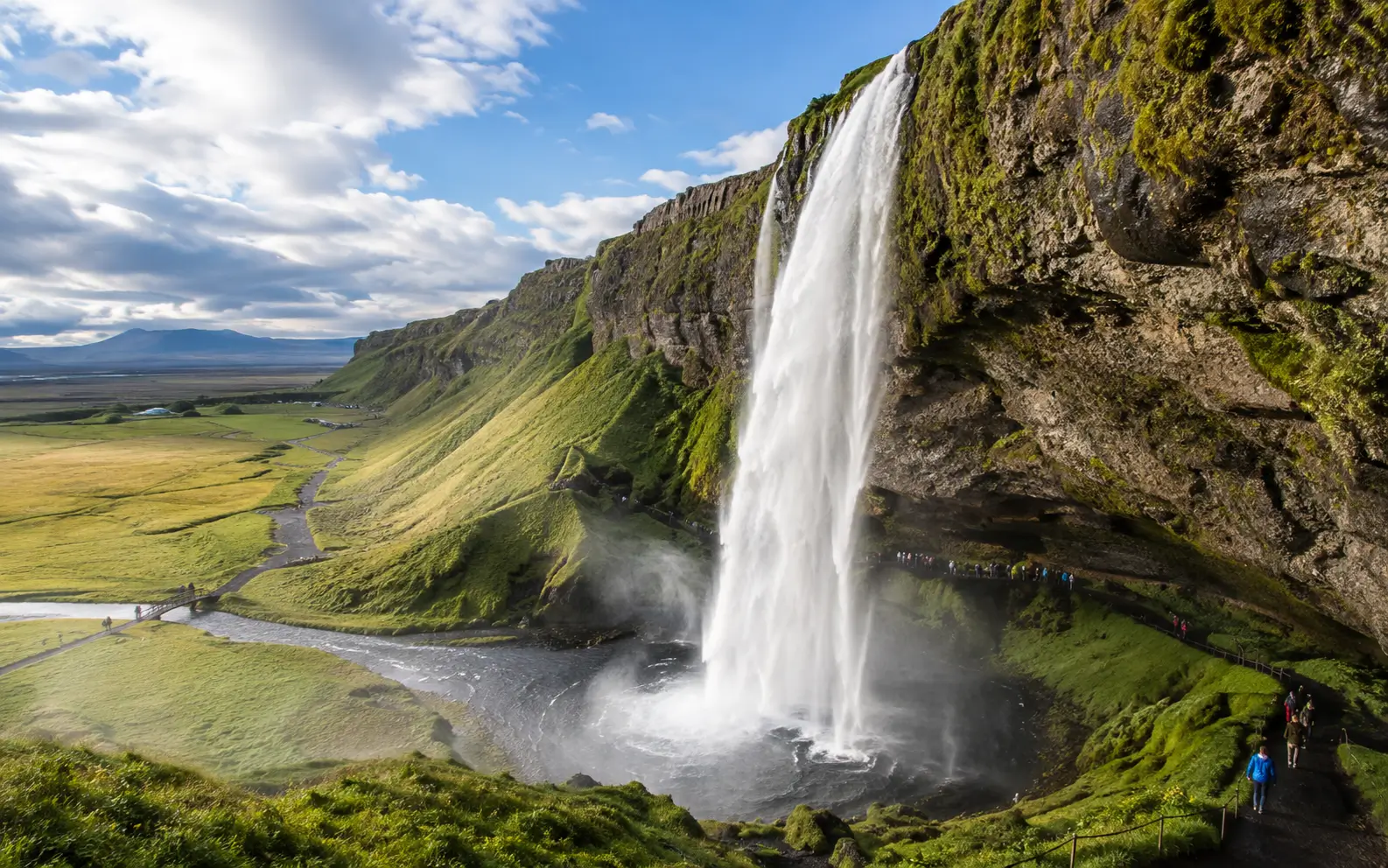
Seljalandsfoss is one of the most recognizable waterfalls on Iceland's South Coast.
It drops around:
60 metres
from the cliff above.
Its most famous feature is not simply its height.
It is the path that can take visitors:
behind the waterfall
when conditions and access allow.
That changes the experience completely.
Instead of viewing the waterfall only from the front, you can look outward through the falling water toward the open land below.
Why Seljalandsfoss Is Different
Iceland has many waterfalls.
Very few offer this type of viewing angle.
From the front, Seljalandsfoss appears relatively narrow.
Behind it, the experience becomes more about:
- ✓Sound
- ✓Mist
- ✓Wet rock
- ✓Moving water
- ✓The view through the falls
This is why simply taking a photo from the car-park side misses much of what makes the stop special.
Can You Always Walk Behind Seljalandsfoss?
No.
Access depends on:
- ✓Ice
- ✓Snow
- ✓Water
- ✓Path conditions
In winter, the path may become unsafe.
Waterfall spray can freeze around the cliffs and walkway.
If the path is:
- ✓Closed
- ✓Roped off
- ✓Clearly unsafe
do not go around the barrier.
You can still enjoy Seljalandsfoss from the front.
Prepare to Get Wet
If you walk behind the waterfall:
expect water.
The amount depends on:
- ✓Wind
- ✓Water flow
- ✓Where you stand
A waterproof outer layer is far more useful here than an umbrella.
Also protect:
- ✓Camera
- ✓Phone
before walking behind the falls.
What Shoes Work Best at Seljalandsfoss?
Wear shoes with:
- ✓Good grip
- ✓Stable sole
The path can be:
- ✓Wet
- ✓Uneven
- ✓Slippery
even outside winter.
This is not a technical hike.
But smooth city shoes are not the best option if you plan to complete the full path.
How Long Should You Spend at Seljalandsfoss?
For a normal first visit:
45–60 minutes
works well if the behind-the-waterfall path is open.
You may need less time if:
- ✓Path is closed
- ✓Weather is poor
You may need more if:
- ✓Photography matters
- ✓You also visit Gljúfrabúi
Should Seljalandsfoss Be Your First South Coast Stop?
For many self-drive visitors:
yes.
It sits naturally along the route east.
It also gives you a strong first outdoor stop after the longer drive from Reykjavík.
But there is no rule requiring you to stop immediately.
Weather and timing can decide.
Gljúfrabúi
A short distance from Seljalandsfoss is:
Gljúfrabúi.
This waterfall is partly hidden inside a narrow gorge.
That makes it feel very different from the open view at Seljalandsfoss.
You cannot appreciate it properly from the road.
The rock walls hide most of the falling water.
Is Gljúfrabúi Worth Adding?
If you are already visiting Seljalandsfoss:
usually yes.
It is close enough that it works more like:
an extension of the same stop
than a separate major attraction.
This is one of those cases where adding another waterfall does not necessarily overload the day.
What Is Visiting Gljúfrabúi Like?
The area near the waterfall can be:
- ✓Wet
- ✓Slippery
- ✓Narrow
Visitors who move closer into the gorge should expect:
a lot of water.
This is not the place to protect a clean pair of fashion shoes.
Wear suitable footwear and keep electronics protected.
Is Gljúfrabúi Suitable for Everyone?
Not always.
You may decide not to enter farther if:
- ✓Water level is uncomfortable
- ✓Rocks are slippery
- ✓You have mobility limits
- ✓Falling-rock conditions concern you
- ✓Children are not comfortable
You do not need to force the closest viewpoint just because other visitors are doing it.
How Much Extra Time Does Gljúfrabúi Need?
Allow roughly:
20–40 additional minutes
depending on:
- ✓Walking pace
- ✓Crowds
- ✓Conditions
- ✓How far you go
Combined with Seljalandsfoss, the full stop can easily take:
around 1–1.5 hours.
Seljalandsfoss and Gljúfrabúi Together
These waterfalls work well as one combined stop because they offer two very different experiences.
Seljalandsfoss
Open setting and the famous behind-the-waterfall path.
Gljúfrabúi
Hidden waterfall inside a narrow gorge.
If your day is already crowded, you do not need to search for several more minor waterfalls immediately afterward.
You have already had a strong start.
Eyjafjallajökull Along the Route
As you continue east, you travel below the area of:
Eyjafjallajökull.
This glacier-covered volcano became internationally famous after its:
2010 eruption
disrupted air travel across Europe.
For travelers, the interesting part is seeing how close:
- ✓Farms
- ✓Main road
- ✓Waterfalls
sit to Iceland's volcanic and glacial systems.
You are not visiting an isolated geological display.
People live and farm directly below these features.
Do You Need a Separate Eyjafjallajökull Stop?
Not necessarily.
For most first-time South Coast visitors, it works better as:
part of the route context
rather than another long attraction.
If you already have:
- ✓Waterfalls
- ✓Glacier stop
- ✓Beach
- ✓Vík
planned for the day, do not add another stop only because the volcano name is famous.
Stop 2: Skógafoss
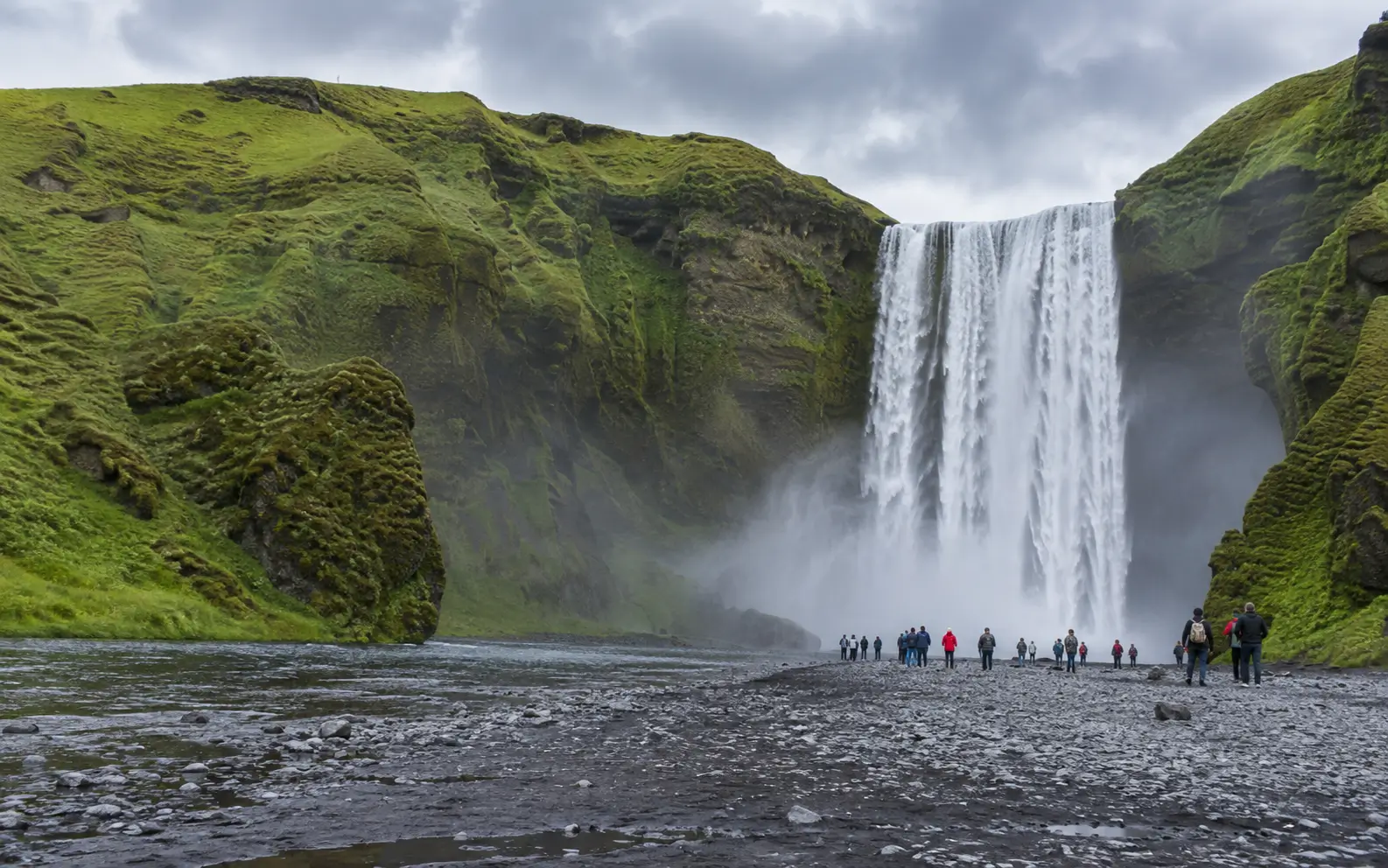
Skógafoss is one of the biggest highlights of the western South Coast.
It also drops around:
60 metres
but feels completely different from Seljalandsfoss.
Skógafoss is:
- ✓Wider
- ✓More forceful
- ✓More direct
You stand in front of a large wall of falling water.
Why Skógafoss Feels Different From Seljalandsfoss
The two waterfalls are sometimes grouped together simply because they are close to the same road.
But the experiences are different.
Seljalandsfoss
The main feature is moving around and behind the falling water.
Skógafoss
The main feature is standing in front of the waterfall and feeling its size and spray.
That is why both are worth visiting.
They do not duplicate each other.
The View From the Bottom
The base of Skógafoss gives you the most dramatic sense of:
- ✓Height
- ✓Sound
- ✓Spray
You can walk relatively close across the flat ground.
But the closer you go:
the wetter you may become.
On a sunny day, mist around the falls can also produce:
- ✓Rainbows
which is one reason the waterfall is so popular with photographers.
The Staircase at Skógafoss
Beside the waterfall, a steep staircase leads upward to a viewing area above the falls.
This gives you a very different angle.
From above, you can look across:
- ✓The waterfall
- ✓Skógá River
- ✓Southern plains
The staircase contains hundreds of steps.
You do not need to climb it to say you properly visited Skógafoss.
Is the Skógafoss Staircase Worth It?
Yes, if:
- ✓Weather is good
- ✓You have enough time
- ✓Stairs are comfortable for you
- ✓You want a different viewpoint
Skip it if:
- ✓Day is already running late
- ✓Conditions are icy
- ✓You have mobility limits
- ✓Your main interest is the base view
The best view for you is not necessarily the highest one.
What Is Beyond the Top of Skógafoss?
The path continues along the Skógá River past more waterfalls.
It forms part of the famous hiking route toward:
Fimmvörðuháls.
This is a completely different activity from a normal South Coast sightseeing stop.
Do not accidentally turn your day trip into a long hike unless you planned for it.
For a standard first visit:
the waterfall and upper viewpoint are enough.
How Long Should You Spend at Skógafoss?
For most visitors:
45–75 minutes
works well.
Use less time if you only see the base.
Use more if you:
- ✓Climb the staircase
- ✓Take many photos
- ✓Walk slightly beyond the upper viewpoint
For a full South Coast day, I would avoid turning it into a multi-hour hiking stop unless Skógafoss is one of your main priorities.
Seljalandsfoss vs Skógafoss
You do not need to choose.
For a normal first South Coast trip:
visit both.
But if time becomes unexpectedly short:
Seljalandsfoss
is better for the unusual behind-the-waterfall experience.
Skógafoss
is better for scale and force.
Most first-time visitors will want both because they show two different types of Icelandic waterfall experience.
Skógar
The area around Skógafoss is known as:
Skógar.
For many visitors, the waterfall is the main reason to stop.
But the area can also work as a:
- ✓Meal break
- ✓Rest stop
- ✓Museum stop
- ✓Overnight area
depending on your itinerary.
If you are heading toward Vík in one day, you do not need to explore everything around Skógar.
Save enough time for the:
- ✓Glacier
- ✓Coast
- ✓Beach
still ahead.
How Much Time Should the First Two Waterfalls Take?
For a normal first-time South Coast day:
| Stop | Useful Time |
|---|---|
| Seljalandsfoss | 45–60 min |
| Gljúfrabúi | +20–40 min |
| Skógafoss | 45–75 min |
If you visit all three carefully, you may already spend:
around 2.5–3 hours
on waterfalls alone.
That does not include:
- ✓Driving
- ✓Parking
- ✓Food
- ✓Toilets
This is why a South Coast day can become long even though the attractions look close together on a map.
Do Not Spend the Whole Day Chasing Waterfalls
The South Coast contains many waterfalls.
You could keep adding them.
For a first visit, I would not.
Seljalandsfoss, Gljúfrabúi, and Skógafoss already give you:
- ✓Walk-behind waterfall
- ✓Hidden gorge waterfall
- ✓Large front-facing waterfall
After that, the day benefits more from changing the type of stop.
The next major theme should be:
glaciers.
That is where the western South Coast begins to feel very different again.
What Comes After Skógafoss?
Continuing east from Skógar brings you toward one of the most useful glacier stops for first-time visitors:
Sólheimajökull.
From there, the route continues toward:
- ✓Dyrhólaey
- ✓Reynisfjara
- ✓Vík
Those stops require a different type of planning from the waterfall section.
You are moving from:
cliff waterfalls
into:
glacier and Atlantic coast country.
Stop 3: Sólheimajökull Glacier
After Skógafoss, the South Coast begins to show another major side of Iceland:
glaciers.
Sólheimajökull is one of the easiest glacier areas to include on a western South Coast trip.
It is an outlet glacier connected to the larger:
Mýrdalsjökull ice cap.
The glacier reaches down between dark mountains and volcanic ground, making it possible to see glacier ice without traveling deep into Iceland.
For first-time visitors, this can be the first moment when the scale of Iceland's glaciers starts to feel real.
Why Sólheimajökull Is Worth Stopping For
You do not need to book a glacier hike to make the stop worthwhile.
Even a normal visit can give you views of:
- ✓Glacier ice
- ✓Meltwater
- ✓Dark volcanic material
- ✓Surrounding mountains
It also adds something completely different after the waterfall section.
Your South Coast day changes from:
waterfalls
to:
ice and volcanic geology.
That variety is one reason the route works so well.
Can You Walk to Sólheimajökull Yourself?
You can visit the designated public viewing area and follow normal visitor paths.
But there is a major difference between:
walking near the glacier
and:
walking onto the glacier.
Do not walk onto glacier ice without the correct guided activity, safety equipment, and local knowledge.
Glacier surfaces can contain:
- ✓Deep cracks
- ✓Weak ice
- ✓Meltwater channels
- ✓Unstable sections
What looks like solid ice from a distance may not be safe.
Glacier Conditions Change
A glacier is not a fixed attraction.
Its edge can change because of:
- ✓Melting
- ✓Ice movement
- ✓Calving
- ✓Weather
- ✓Meltwater
That means an access point used in an old:
- ✓Blog
- ✓Video
- ✓Map
- ✓Social media post
may no longer be suitable.
Follow the current signs and local instructions when you arrive.
How Close Should You Go to the Glacier?
Stay within the permitted visitor area unless you are part of an organized activity.
Do not climb onto:
- ✓Ice blocks
- ✓Glacier edge
- ✓Unstable moraine
just to get a closer photograph.
The glacier will still be impressive from a safe position.
How Long Should You Spend at Sólheimajökull?
For a normal viewing visit:
45–75 minutes
can work well.
That gives you time to:
- ✓Walk from the parking area
- ✓See the glacier
- ✓Take photographs
- ✓Return without rushing
If you book a glacier hike:
the stop becomes much longer.
Should You Add a Glacier Hike?
A guided glacier hike can be one of the strongest activities on the South Coast.
It works especially well if:
- ✓You have never walked on a glacier
- ✓You want an active experience
- ✓You have enough time
- ✓The activity is a major trip priority
But it changes your schedule.
A glacier hike is not:
a quick extra stop.
It may take several hours once you include:
- ✓Check-in
- ✓Equipment
- ✓Safety briefing
- ✓Walk to the glacier
- ✓Time on the ice
- ✓Return
Do You Need Glacier Equipment?
For an organized glacier walk:
yes.
The operator normally provides or specifies equipment such as:
- ✓Crampons
- ✓Helmet
- ✓Ice axe
- ✓Harness when required
You also need suitable personal clothing.
Follow the operator's instructions before the activity.
Do not assume normal trainers are suitable simply because the hike is sold to beginners.
Can Beginners Do a Glacier Hike?
Many South Coast glacier tours are made for first-time participants.
You usually do not need previous glacier experience for an introductory trip.
But each operator has its own rules for:
- ✓Minimum age
- ✓Footwear
- ✓Fitness
- ✓Medical conditions
Check these before booking.
Is a Glacier Hike Worth It on a One-Day South Coast Trip?
It can be.
But if you add a glacier hike to a Reykjavík day trip, you should reduce something else.
A realistic priority might become:
- ✓One or two major waterfalls
- ✓Glacier hike
- ✓Reynisfjara
- ✓Vík
rather than trying to visit every possible stop.
The activity should replace extra sightseeing time.
It should not simply be added on top.
Sólheimajökull Without a Glacier Hike
This is the better option if:
- ✓You want a shorter stop
- ✓You are traveling with young children
- ✓You do not want a physical activity
- ✓Your day is already full
- ✓You plan another glacier activity later
You can still experience the glacier area without stepping onto the ice.
For many first-time visitors, that is enough.
Sólheimajökull vs Skaftafell Glacier Activities
If your South Coast trip continues east for two or three days, you do not necessarily need to book glacier activities in both areas.
Sólheimajökull is convenient for the western South Coast.
Skaftafell works better when:
- ✓You are already staying farther east
- ✓You want to spend more time in Vatnajökull National Park
- ✓Your itinerary includes Jökulsárlón
Choose the location that fits your route.
Mýrdalsjökull
Sólheimajökull flows from:
Mýrdalsjökull.
Mýrdalsjökull is a much larger ice cap.
Below it sits:
Katla volcano.
This is an important part of the South Coast story.
Here, glaciers and volcanoes are connected.
The region has been shaped by:
- ✓Ice
- ✓Eruptions
- ✓Floods
- ✓Sediment
over long periods.
You do not need a separate Katla stop to appreciate this relationship.
Should You Visit an Ice Cave Near the South Coast?
Ice-cave trips are separate activities.
They should not be confused with a normal glacier viewpoint.
Depending on:
- ✓Season
- ✓Cave conditions
- ✓Operator
- ✓Location
an ice-cave experience can take a large part of the day.
If an ice cave is one of your main Iceland goals:
build the itinerary around it.
Do not try to squeeze it between ordinary sightseeing stops.
After Sólheimajökull: Coast or Glacier First?
Once you leave the glacier area, the next major group of stops sits around:
- ✓Dyrhólaey
- ✓Reynisfjara
- ✓Vík
These places introduce the Atlantic coast.
At this point, your day changes again.
You move from:
glacier ice
to:
black volcanic shore and sea cliffs.
Stop 4: Dyrhólaey
Dyrhólaey is a high coastal promontory west of Vík.
It is known for:
- ✓Sea views
- ✓Cliffs
- ✓Large rock arch
- ✓Birdlife
- ✓Lighthouse
- ✓Views across black sand
The elevated position makes it very different from standing directly on Reynisfjara.
At Dyrhólaey, you are looking across the coast from above.
What Does Dyrhólaey Mean?
The name is commonly connected with the idea of:
door hill island.
The large opening through the rock creates the famous natural arch.
From suitable viewpoints, you can see how the ocean has shaped the headland.
Why Visit Dyrhólaey?
The main reason is perspective.
From the area, you may get wide views over:
- ✓Black coastline
- ✓Atlantic Ocean
- ✓Reynisdrangar area
- ✓Mýrdalsjökull direction
- ✓Surrounding farmland
It helps you see how the different parts of the South Coast connect.
Dyrhólaey Is Not the Same as Reynisfjara
These two places are close enough that some visitors treat them as one stop.
They are not.
Dyrhólaey
Best for:
- ✓High viewpoints
- ✓Cliffs
- ✓Coast views
- ✓Birdlife
Reynisfjara
Best for:
- ✓Black sand
- ✓Basalt columns
- ✓Sea stacks
- ✓Close coastal experience
If you have enough time:
visit both.
How Long Should You Spend at Dyrhólaey?
For a normal first visit:
45–75 minutes
is a useful range.
You may stay longer if:
- ✓Photography matters
- ✓Bird watching matters
- ✓Weather is clear
You may stay less if:
- ✓Wind is very strong
- ✓Visibility is poor
- ✓Daylight is limited
Be Careful Around Cliff Edges
Dyrhólaey is exposed.
Wind can be strong.
Do not stand close to a cliff edge for a photograph.
Keep a safe distance even when:
- ✓Ground looks dry
- ✓Other visitors stand closer
- ✓Weather seems calm
A sudden gust can change conditions quickly.
Dyrhólaey and Puffins
During the nesting season, Dyrhólaey can be a good place to see:
puffins.
But wildlife should never be treated as guaranteed.
You may see:
- ✓Many birds
- ✓A few birds
- ✓None
depending on:
- ✓Season
- ✓Time
- ✓Conditions
Do not approach nesting birds closely.
Give them space.
Can Parts of Dyrhólaey Close?
Access can sometimes be limited to protect:
- ✓Nesting birds
- ✓Visitors
- ✓Natural areas
Follow current signs and local access rules.
Do not plan your entire South Coast day around one exact Dyrhólaey path being available.
The wider area still has several coastal views.
Stop 5: Reynisfjara Black Sand Beach
Reynisfjara is one of Iceland's most famous beaches.
It is known for:
- ✓Black volcanic sand
- ✓Basalt columns
- ✓Sea stacks
- ✓Powerful Atlantic waves
- ✓Dark cliffs
For many visitors, it is the most memorable coastal stop on the South Coast.
It is also a place where safety matters more than getting close to the water.
Why Is Reynisfjara Black?
The sand comes from volcanic material.
Over time:
- ✓Lava
- ✓Rock
- ✓Volcanic debris
have been broken down by:
- ✓Ocean
- ✓Weather
- ✓Erosion
creating the dark shore.
This is why the beach looks completely different from the pale sandy beaches many travelers know.
Hálsanefshellir Cave and Basalt Columns
At the eastern side of the beach, you can see striking basalt formations.
The rock columns form geometric shapes created as lava cooled.
Nearby is:
Hálsanefshellir Cave.
Access around the cave depends on:
- ✓Tide
- ✓Waves
- ✓Conditions
Never enter or remain in an area simply because you saw another visitor there.
The sea determines what is safe.
Reynisdrangar Sea Stacks
Offshore, you can see:
Reynisdrangar.
These tall rock formations rise from the ocean close to Vík.
They are one of the defining views of this part of Iceland.
You can see them from:
- ✓Reynisfjara
- ✓Vík area
- ✓Other coastal viewpoints
depending on conditions.
Reynisfjara Sneaker Waves
This is one of the most serious safety points on the South Coast.
Reynisfjara is known for:
sneaker waves.
These are waves that can travel much farther up the beach than the waves before them.
The danger is that the shoreline may look calm for several minutes.
Then one wave reaches much farther inland.
Stay Far From the Water
Do not use the wet sand line as a safe-distance marker.
Stay well back from the active surf.
Follow:
- ✓Warning lights
- ✓Safety signs
- ✓Barriers
- ✓Current instructions
when you arrive.
The beach may look beautiful and calm.
That does not mean the sea is safe.
Never Turn Your Back on the Ocean
This is especially important when taking photographs.
Visitors often:
- ✓Face the cliffs
- ✓Face the basalt columns
- ✓Look at a phone screen
while the sea is behind them.
Do not do this near the active shoreline.
Keep awareness of the water at all times.
Do Not Chase a Photograph
If a photograph requires you to stand:
- ✓Close to the waves
- ✓On wet rocks
- ✓Beyond a safety area
skip it.
A photograph is not worth being knocked over or pulled into the sea.
There are plenty of safe views from farther back.
Can Children Visit Reynisfjara?
Yes, but adults need to keep children:
very close.
Do not allow children to:
- ✓Run near the waves
- ✓Play at the water's edge
- ✓Wander away from adults
Treat the beach as a sightseeing location.
Not as a swimming or playing beach.
Can You Swim at Reynisfjara?
No.
Do not enter the water.
The beach is known for dangerous waves and strong ocean conditions.
This is not a place for:
- ✓Swimming
- ✓Paddling
- ✓Playing in surf
Stay on the beach at a safe distance.
How Long Should You Spend at Reynisfjara?
For most first-time visitors:
45–75 minutes
is enough.
That gives you time to see:
- ✓Black sand
- ✓Basalt columns
- ✓Sea stacks
- ✓Wider beach
without rushing.
You may stay longer for photography.
But extra time should not mean moving closer to dangerous water.
Is Reynisfjara Still Worth Visiting if the Weather Is Bad?
Sometimes.
Cloud, rain, or dark skies can make the beach feel even more dramatic.
But there is a difference between:
poor photography weather
and:
unsafe coastal conditions.
If local safety guidance limits access:
follow it.
The beach is not worth taking a risk.
Dyrhólaey or Reynisfjara if You Have Limited Time?
For a first South Coast trip, I would usually prioritize:
Reynisfjara.
It gives you the classic black-sand beach experience.
Choose Dyrhólaey instead if:
- ✓High coastal views matter more
- ✓Reynisfjara conditions are poor
- ✓Bird watching is a priority
With enough time:
visit both.
Stop 6: Vík
Vík is the main village on this section of Iceland's South Coast.
It works well as:
- ✓Meal stop
- ✓Fuel stop
- ✓Grocery stop
- ✓Overnight base
- ✓Turnaround point
for a one-day route from Reykjavík.
The village is small.
But its location makes it very useful.
Why Vík Matters for Trip Planning
By the time you reach Vík from Reykjavík, you may already have visited:
- ✓Two or three waterfalls
- ✓Glacier
- ✓Dyrhólaey
- ✓Reynisfjara
That means Vík often arrives at exactly the point when you need:
- ✓Food
- ✓Toilets
- ✓Fuel
- ✓Rest
For a one-day trip, this is also a good place to ask:
Do we continue or start heading back?
Vík Church
The white church above the village is one of Vík's best-known sights.
Its elevated position gives you views across:
- ✓Village
- ✓Coast
- ✓Reynisdrangar
You do not need a long visit.
It works well as a short viewpoint stop.
Black Sand Beach at Vík
Vík also has its own black-sand coast.
You can see the Reynisdrangar sea stacks from this side as well.
This gives you another perspective without returning to the same section of Reynisfjara.
Should You Stay Overnight in Vík?
For a one-day western South Coast trip:
you do not need to.
For a two-day or three-day South Coast trip:
Vík is one of the best overnight areas.
It sits naturally between:
- ✓Western waterfalls
- ✓Coastal stops
- ✓Eastern South Coast
This makes it useful for breaking a long route into manageable sections.
Why Vík Is a Good Overnight Base
Staying in Vík means you can finish the western section without driving all the way back to Reykjavík.
The next morning, you are already positioned for:
- ✓Fjaðrárgljúfur
- ✓Skaftafell
- ✓Jökulsárlón
That saves repeated driving.
It also makes the eastern section much easier to enjoy.
Should a One-Day Trip Continue East of Vík?
Usually:
not very far.
You can technically keep driving.
But every kilometre east means you must also travel back if Reykjavík is your base.
For a normal one-day trip:
Vík is a sensible limit.
Save the eastern South Coast for an overnight trip.
East of Vík: The South Coast Changes Again
Once you continue east of Vík, towns become fewer and distances between major stops become larger.
The route crosses:
- ✓Wide black sand plains
- ✓Lava areas
- ✓River systems
- ✓Glacier-fed regions
You also move closer to:
Vatnajökull, Europe's largest ice cap by volume.
This is where a two-day or three-day South Coast trip becomes very different from the normal Reykjavík-to-Vík day trip.
Fjaðrárgljúfur Canyon
Fjaðrárgljúfur is a deep canyon near Kirkjubæjarklaustur.
It is known for:
- ✓Steep canyon walls
- ✓River below
- ✓Walking viewpoints
- ✓Green slopes in warmer months
It makes a good stop between:
- ✓Vík
- ✓Skaftafell
if you have enough time.
Is Fjaðrárgljúfur Essential?
No.
It is a strong optional stop.
But the eastern South Coast already contains several major attractions.
If time is limited, I would protect time for:
- ✓Skaftafell
- ✓Jökulsárlón
- ✓Diamond Beach
before adding every canyon or viewpoint.
How Long Should You Spend at Fjaðrárgljúfur?
Allow roughly:
45–90 minutes
depending on:
- ✓Walking
- ✓Weather
- ✓Viewpoints
- ✓Current access
Do not rush the canyon into a ten-minute roadside stop.
If you cannot give it reasonable time:
skip it.
Respect Trail Closures
Sensitive areas in Iceland can close temporarily because of:
- ✓Wet ground
- ✓Erosion
- ✓Maintenance
- ✓Safety
If a trail is closed:
do not cross the barrier.
These restrictions protect both:
- ✓Visitors
- ✓Natural ground
Use the open viewpoints instead.
Kirkjubæjarklaustur
Kirkjubæjarklaustur is a small South Coast village that can be useful for:
- ✓Fuel
- ✓Food
- ✓Accommodation
- ✓Rest
Travelers sometimes rush through it because larger attractions sit farther east.
But on a multi-day route, practical towns matter.
Use them when you need:
- ✓Food
- ✓Fuel
- ✓Toilet
- ✓Break
rather than waiting for the next major attraction.
Stop 7: Skaftafell
Skaftafell sits within:
Vatnajökull National Park.
This is no longer a quick roadside attraction.
It is an area where you can choose between:
- ✓Short visit
- ✓Hiking
- ✓Glacier activity
- ✓Longer nature stop
How much time it deserves depends on your itinerary.
Why Skaftafell Is Different
Skaftafell brings together:
- ✓Mountains
- ✓Glacier views
- ✓Hiking trails
- ✓Waterfalls
- ✓National park facilities
It works best for travelers who want to:
get out of the car and spend time walking.
If your trip is built only around roadside viewpoints, you may not use Skaftafell to its full value.
How Much Time Do You Need at Skaftafell?
For a basic stop:
1–2 hours
may give you time for:
- ✓Visitor area
- ✓Short walk
- ✓Nearby views
For a proper hike:
allow:
several hours.
If you book a glacier activity:
it can use a large part of the day.
Do Not Treat Skaftafell Like a 30-Minute Stop
This is an easy mistake.
Travelers see:
Skaftafell
on a list and try to add it between several other major attractions.
The area works much better when you decide what you want to do there.
Ask:
- ✓Short walk?
- ✓Waterfall hike?
- ✓Glacier activity?
- ✓Longer trail?
Then give it suitable time.
Svartifoss
One of Skaftafell's best-known hikes leads to:
Svartifoss.
The waterfall drops in front of dark basalt columns.
Its name means:
Black Falls.
The basalt setting makes it visually different from the major waterfalls you saw earlier on the South Coast.
Is Svartifoss Worth the Hike?
Yes, if:
- ✓You enjoy walking
- ✓You have enough time
- ✓Weather is suitable
But it should be treated as:
a hike
rather than a roadside waterfall.
If your day already includes:
- ✓Jökulsárlón
- ✓Diamond Beach
- ✓Long drive
you may need to choose between a proper Skaftafell visit and more time farther east.
Skaftafell Glacier Views
The area also provides access to views and trails connected with glacier outlets from Vatnajökull.
This is one reason Skaftafell can replace another glacier stop rather than simply being added after it.
If you already spent several hours on a glacier activity earlier in the trip:
you may prefer a hiking-focused visit here.
Stop 8: Jökulsárlón Glacier Lagoon
For many travelers, Jökulsárlón is the main reason to continue into the eastern South Coast.
The lagoon sits beside Route 1.
It contains icebergs that have broken away from:
Breiðamerkurjökull, an outlet glacier of Vatnajökull.
The ice then moves through the lagoon before eventually reaching the ocean.
Why Jökulsárlón Is So Special
The lagoon is constantly changing.
You may see icebergs that are:
- ✓White
- ✓Blue
- ✓Clear
- ✓Streaked with volcanic material
The number, shape, and location of icebergs can change.
That means two visits may look very different.
Jökulsárlón Is Not a Fixed Photo Stop
Do not arrive expecting to reproduce one exact photograph you saw online.
The lagoon changes with:
- ✓Ice movement
- ✓Wind
- ✓Weather
- ✓Season
- ✓Light
That is part of the experience.
Walk around the public viewing area and see what the lagoon looks like that day.
How Long Should You Spend at Jökulsárlón?
For a basic visit:
60–90 minutes
is a useful starting point.
You may want longer if:
- ✓Photography matters
- ✓You walk farther
- ✓You watch wildlife
- ✓You book a boat tour
A boat activity changes the schedule considerably.
Can You See Seals at Jökulsárlón?
Sometimes.
Seals can appear in and around the lagoon.
But wildlife is never guaranteed.
Do not build the stop around:
we must see seals.
Enjoy the lagoon first.
Treat wildlife as an extra.
Can You Touch or Climb Onto Ice at Jökulsárlón?
Do not step onto floating ice.
Ice can:
- ✓Move
- ✓Break
- ✓Roll
- ✓Separate
without warning.
View it from safe ground or as part of an approved activity.
Boat Tours at Jökulsárlón
Boat trips can give you a closer view of the lagoon during the operating season.
Different tour types may use:
- ✓Larger amphibious boats
- ✓Smaller zodiac-style boats
The experience, duration, and minimum age can differ.
If a boat tour matters to you:
book it as a fixed part of the day.
Is a Jökulsárlón Boat Tour Necessary?
No.
The lagoon is impressive from land.
A boat tour is an extra experience.
Choose it if:
- ✓You want more time around ice
- ✓You enjoy guided activities
- ✓Your schedule has enough room
Skip it if:
- ✓Time is limited
- ✓Weather is poor
- ✓You prefer photography from shore
You do not need a boat ticket to appreciate Jökulsárlón.
Stop 9: Diamond Beach
Across Route 1 from Jökulsárlón is the black-sand shore commonly called:
Diamond Beach.
Ice from the lagoon can travel out toward the sea.
Some pieces are then washed onto the dark shore.
The contrast between:
- ✓Clear or blue ice
- ✓Black sand
creates the famous appearance.
Is There Always Ice on Diamond Beach?
The amount can vary.
You may see:
- ✓Many large pieces
- ✓Small pieces
- ✓Much less ice than expected
depending on:
- ✓Tide
- ✓Ice movement
- ✓Weather
- ✓Ocean conditions
Do not treat the beach as a guaranteed display arranged for photographs.
It changes naturally.
Do Not Climb on the Ice
Ice blocks on the beach can look stable.
They may not be.
Do not:
- ✓Climb onto large pieces
- ✓Stand between ice and incoming water
- ✓Sit on ice close to the surf
The tide and waves can move heavy ice.
Keep a safe distance.
Diamond Beach Is Still an Ocean Beach
The ice gets most of the attention.
But do not forget that you are beside:
the Atlantic Ocean.
Watch the waves.
Stay aware of:
- ✓Water
- ✓Tide
- ✓Moving ice
Photography should never make you stop watching the shoreline.
How Long Should You Spend at Diamond Beach?
Around:
30–60 minutes
works for many visitors.
You may stay longer for photography.
Because Jökulsárlón is directly nearby, most travelers visit:
both in the same stop.
Jökulsárlón and Diamond Beach Together
Allow roughly:
1.5–2.5 hours
for a relaxed visit to both without a boat tour.
Add more time if you include:
- ✓Boat activity
- ✓Long photography
- ✓Meal
- ✓Longer walk
This pair can easily become the main attraction of your eastern South Coast day.
Is Jökulsárlón Worth Driving So Far?
If you have:
two or more South Coast days
I think it is one of the strongest places to include.
If you have only:
one day from Reykjavík
the answer changes.
The distance can turn the day into too much driving.
In that case:
stay focused on the western South Coast and save Jökulsárlón for a future overnight route.
Western vs Eastern South Coast
It helps to think of the region in two sections.
Western South Coast
Best for:
- ✓Seljalandsfoss
- ✓Skógafoss
- ✓Sólheimajökull
- ✓Dyrhólaey
- ✓Reynisfjara
- ✓Vík
This section works as a Reykjavík day trip.
Eastern South Coast
Best for:
- ✓Canyons
- ✓Skaftafell
- ✓Vatnajökull views
- ✓Jökulsárlón
- ✓Diamond Beach
This section works much better with an overnight.
If You Have Only One Day
Do not feel that stopping around Vík means:
you missed the South Coast.
You still get:
- ✓Major waterfalls
- ✓Glacier
- ✓Black sand
- ✓Sea cliffs
- ✓Coastal village
That is already an excellent first-time South Coast experience.
If You Have Two Days
Two days let you connect:
western South Coast + eastern glacier region
without turning the trip into one huge driving day.
This is where the full route becomes much stronger.
You can use Vík or another South Coast area as your overnight base, then continue east in the morning.
If You Have Three Days
Three days give you room for:
- ✓Glacier activity
- ✓Skaftafell hike
- ✓Slower Jökulsárlón visit
- ✓More photography
- ✓Less evening driving
This is my preferred amount of time if the South Coast is one of the main parts of your Iceland trip.
Do Not Judge the South Coast by Stop Count
A day with:
five well-chosen stops
can be much better than one with:
ten rushed stops.
The South Coast looks easy to fill because many famous places appear along one road.
But every stop uses time for:
- ✓Parking
- ✓Walking
- ✓Weather
- ✓Toilets
- ✓Food
- ✓Photography
Choose the strongest stops for your available time.
My Priority Order for a First South Coast Visit
If you have one day from Reykjavík, I would protect time for:
1. Seljalandsfoss
For the unusual waterfall experience.
2. Skógafoss
For scale and direct waterfall views.
3. One Glacier Stop
For something completely different from the waterfalls.
4. Reynisfjara
For the black-sand coast.
5. Vík
For food, rest, and route structure.
Dyrhólaey and other stops can be added if:
- ✓Time
- ✓Weather
- ✓Daylight
allow.
My Priority Order for a Two-Day South Coast Trip
Keep the western highlights.
Then protect time for:
1. Skaftafell
if hiking or glacier activities matter.
2. Jökulsárlón
as the main eastern highlight.
3. Diamond Beach
because it naturally pairs with the lagoon.
4. One Additional Short Stop
such as Fjaðrárgljúfur if the day still has enough room.
Do not turn the second day into another list of ten attractions.
What Is the Best Time to Visit Iceland's South Coast?
The South Coast works in every season.
But the experience changes a lot between:
- ✓Summer
- ✓Winter
- ✓Spring
- ✓Autumn
For first-time visitors, the biggest differences are:
- ✓Daylight
- ✓Road conditions
- ✓Walking conditions
- ✓Weather
- ✓Crowds
- ✓How many stops fit comfortably into one day
There is no single best month for everyone.
The better season depends on the type of trip you want.
South Coast in Summer
Summer is the easiest season for a long South Coast road trip.
You get:
- ✓Very long daylight
- ✓More flexible driving hours
- ✓Easier walking conditions
- ✓More time for outdoor stops
This matters because the South Coast contains many places where you may want to stay longer than expected.
A summer day gives you more room to:
- ✓Walk behind waterfalls
- ✓Visit a glacier
- ✓Spend time on the coast
- ✓Stop for food
- ✓Continue farther east
without watching sunset approach after every stop.
Summer Does Not Mean Hot Weather
Icelandic summer can still feel:
- ✓Cool
- ✓Wet
- ✓Windy
You may leave Reykjavík under blue sky and reach another part of the South Coast in:
- ✓Rain
- ✓Low cloud
- ✓Strong wind
Dress for changing weather rather than for the season name.
A waterproof outer layer is useful even in July.
Why Summer Works Well for a Two-Day South Coast Trip
A two-day summer trip gives you plenty of time to divide the route.
For example:
Day 1
Reykjavík to Vík
Day 2
Vík to the eastern glacier region
You can then decide whether to:
- ✓Return west
- ✓Stay another night
- ✓Continue around Iceland
The long daylight gives you much more flexibility if one stop takes longer than expected.
Summer Crowds
Summer is also the busiest period.
Popular places can feel busy during normal daytime hours.
This can include:
- ✓Seljalandsfoss
- ✓Skógafoss
- ✓Reynisfjara
- ✓Jökulsárlón
Do not expect famous South Coast sights to feel empty in peak season.
The long daylight does give self-drive travelers one advantage:
you can travel earlier or later.
South Coast in Winter
Winter creates a very different trip.
The main challenge is:
limited daylight.
You may have only a small part of the day for outdoor sightseeing.
That means your winter itinerary should contain:
- ✓Fewer stops
- ✓More time between them
- ✓More flexibility
Trying to use a summer schedule in December is one of the easiest ways to make the trip stressful.
Winter Road Conditions
Route 1 is a major road.
But winter weather can still bring:
- ✓Snow
- ✓Ice
- ✓Strong wind
- ✓Poor visibility
- ✓Temporary closures
Do not think:
main road = always easy road.
Check conditions before leaving and again during a longer day.
If weather gets worse:
reduce the route.
Winter South Coast Day Trip
For a Reykjavík-based winter day trip, I would keep the route focused on the western section.
A good target is:
- ✓Seljalandsfoss
- ✓Skógafoss
- ✓One glacier stop
- ✓Reynisfjara or Vík
depending on:
- ✓Daylight
- ✓Weather
- ✓Road conditions
Do not force every stop from a summer itinerary into a short winter day.
Should You Drive to Jökulsárlón in Winter?
You can visit the eastern South Coast in winter.
But I would not treat Reykjavík to Jökulsárlón and back as a normal winter day trip.
The distance is long.
You also have:
- ✓Short daylight
- ✓Possible ice
- ✓Slower driving
- ✓More chance of weather delays
If Jökulsárlón matters to you in winter:
stay overnight.
That gives the trip much more room.
South Coast in Spring
Spring can be a very good time to visit.
Daylight increases fast.
You may also find fewer visitors than during peak summer.
But conditions can still include:
- ✓Snow
- ✓Ice
- ✓Rain
- ✓Strong wind
especially earlier in the season.
Do not assume that the arrival of April means winter driving conditions have completely disappeared.
Why Spring Works Well
Spring can give you a useful balance between:
- ✓Longer days
- ✓Fewer peak-season visitors
- ✓More flexible sightseeing
As the season moves forward, it becomes easier to build:
- ✓One-day Vík trips
- ✓Two-day eastern South Coast trips
without working around very short daylight.
South Coast in Autumn
Autumn also works well.
Early autumn can still provide enough daylight for a full road day.
As the weeks pass, daylight drops.
Weather can also become less predictable.
A plan that works comfortably in early September may need to be reduced later in the season.
Autumn for Photographers
Autumn can be especially appealing if you want:
- ✓Darker skies
- ✓Softer light
- ✓Fewer peak-summer visitors
But photography takes time.
If you plan to wait for:
- ✓Better light
- ✓Changing cloud
- ✓Fewer people
reduce the number of stops.
A photography-focused South Coast trip should not also be the trip with the longest stop list.
Best Season by Travel Style
Want the Easiest Self-Drive?
Choose:
late spring or summer.
Want the Most Daylight?
Choose:
summer.
Want Snow and Winter Conditions?
Choose:
winter, but keep the route simpler.
Want Fewer Peak-Season Visitors?
Consider:
spring or autumn.
Want a Two- or Three-Day Slow Trip?
Any season can work if your plan matches:
- ✓Daylight
- ✓Road conditions
- ✓Weather
Daylight Should Help Decide Your Route
The South Coast is longer than the Golden Circle.
That makes daylight even more important.
In summer, you can continue east and still have plenty of light.
In winter, every extra stop uses a much larger part of your day.
Before the trip, check:
- ✓Sunrise
- ✓Sunset
- ✓Usable daylight
for your exact date.
Then decide how far east you should travel.
Weather on the South Coast
The South Coast can be:
- ✓Wet
- ✓Windy
- ✓Changeable
You may drive through several different conditions in one day.
That means you should not base the whole plan on what the weather looks like outside your Reykjavík hotel.
Check the route itself.
Wind Can Change the Day
Strong wind affects more than driving.
It can make:
- ✓Waterfall spray travel farther
- ✓Coastal viewpoints uncomfortable
- ✓Car doors difficult to control
- ✓Walking slower
- ✓Cold temperatures feel much colder
This matters at exposed areas such as:
- ✓Dyrhólaey
- ✓Reynisfjara
- ✓Open sections east of Vík
If wind warnings are serious:
change the plan.
Rain Does Not Automatically Ruin the South Coast
Some South Coast sights work very well in:
- ✓Cloud
- ✓Mist
- ✓Light rain
Waterfalls can even feel more dramatic.
The problem begins when your clothing becomes wet early in the day.
Once that happens, every later stop becomes harder.
Bring a proper waterproof layer.
What Should You Wear?
Use layers.
A simple system is:
Base Layer
Comfortable clothing next to your skin.
Warm Middle Layer
Such as:
- ✓Fleece
- ✓Wool
- ✓Warm synthetic layer
Outer Layer
Something that blocks:
- ✓Wind
- ✓Rain
This lets you adjust during the day.
Footwear for the South Coast
Wear shoes that can handle:
- ✓Wet paths
- ✓Gravel
- ✓Mud
- ✓Uneven ground
In colder months, you may also face:
- ✓Snow
- ✓Ice
You do not need heavy mountain boots for every standard stop.
But good grip matters.
This is especially true near:
- ✓Waterfalls
- ✓Coastal paths
- ✓Glacier viewing areas
Keep Dry Clothes in the Car
A spare pair of:
- ✓Socks
- ✓Gloves
- ✓Warm layer
can be very useful.
You may get wet at:
- ✓Seljalandsfoss
- ✓Skógafoss
- ✓Rainy coastal stops
Changing one wet item can make the rest of the day much more comfortable.
What Should You Keep in the Car?
For a full South Coast day, I would carry:
- ✓Water
- ✓Snacks
- ✓Warm extra layer
- ✓Waterproof jacket
- ✓Charged phone
- ✓Phone charger
- ✓Portable battery
- ✓Personal medicine
- ✓Dry socks
For a longer winter drive, pay even more attention to:
- ✓Food
- ✓Warm clothing
- ✓Fuel
- ✓Phone battery
Fuel Planning
The western South Coast has several towns and service areas.
Farther east, services become more spread out.
Do not wait for the fuel warning light.
Good places to think about fuel include areas around:
- ✓Hvolsvöllur
- ✓Vík
- ✓Kirkjubæjarklaustur
depending on your route.
If you see a useful fuel stop and your range is getting low:
use it.
Electric Car Planning
An electric vehicle can work on the South Coast.
But you need to think about:
- ✓Range
- ✓Charging locations
- ✓Weather
- ✓Accommodation charging
- ✓Distance between overnight stops
Cold weather can affect usable range.
Do not build your plan around reaching a charger with almost no battery left.
Keep a margin.
Food Planning
Do not spend the whole day searching for food after you become hungry.
Decide before leaving whether you want:
- ✓Quick meal
- ✓Café stop
- ✓Proper restaurant
For a one-day western route, Vík is a natural place for a meal.
On a longer route, other towns and visitor areas can also provide food.
Still carry snacks.
They are useful when:
- ✓A stop takes longer
- ✓Weather slows driving
- ✓Children get hungry
- ✓Your meal timing changes
Where Should You Stay on the South Coast?
Your best overnight location depends on:
where you want to be the next morning.
For most travelers, useful bases include:
- ✓Vík
- ✓Kirkjubæjarklaustur area
- ✓Skaftafell or nearby countryside
- ✓Areas farther east near the glacier region
You do not need to choose the most scenic hotel.
Choose the location that makes the next day easier.
Stay in Vík
Vík is one of the easiest first-night choices.
It works well if:
- ✓Day 1 covers the western South Coast
- ✓Day 2 continues east
- ✓You want restaurants and fuel nearby
- ✓You prefer a village rather than isolated accommodation
It gives the route a clean split.
Day 1
Reykjavík → Vík
Day 2
Vík → eastern South Coast
Who Should Stay in Vík?
Vík works especially well for:
- ✓First-time visitors
- ✓Families
- ✓Two-day trips
- ✓Travelers who want easy services
- ✓Winter trips where shorter driving days help
It is also useful if you do not want to arrive at isolated accommodation late at night.
Stay Around Kirkjubæjarklaustur
Kirkjubæjarklaustur works well if you want to cover more ground on Day 1.
It places you farther east for:
- ✓Skaftafell
- ✓Jökulsárlón
the next morning.
Choose it if:
- ✓You started early
- ✓Weather is good
- ✓You do not mind a longer first day
It can make Day 2 easier.
Stay Near Skaftafell
This is useful if:
- ✓Hiking is a priority
- ✓Glacier activity is booked
- ✓You want an early start
- ✓Jökulsárlón is also part of the trip
Sleeping closer to Skaftafell lets you avoid a long morning drive before an activity.
Stay Near Jökulsárlón
Accommodation near the glacier lagoon can work well when:
- ✓Photography matters
- ✓You want morning or evening light
- ✓You are continuing east
- ✓You want to avoid rushing back west
This is especially useful on a three-day trip.
Reykjavík as a Base
Reykjavík works very well for:
one-day western South Coast trips.
You can:
- ✓Leave in the morning
- ✓Reach Vík
- ✓Return in the evening
This keeps accommodation simple.
But Reykjavík becomes less practical when you want to reach:
- ✓Skaftafell
- ✓Jökulsárlón
- ✓Diamond Beach
without a very long day.
One-Day South Coast Itinerary From Reykjavík
For a first-time visitor with one full day, I would use the western route.
A realistic structure is:
Morning
Leave Reykjavík.
Drive east to:
Seljalandsfoss
Add Gljúfrabúi if:
- ✓Conditions are good
- ✓You have enough time
Continue to:
Skógafoss
Late Morning to Early Afternoon
Choose:
Sólheimajökull
for a glacier viewing stop.
If you have a booked glacier hike:
give it the time it needs and reduce later stops.
Afternoon
Continue toward:
Reynisfjara
Visit Dyrhólaey as well if:
- ✓Weather is good
- ✓Time allows
Then continue to:
Vík.
Late Afternoon or Evening
Use Vík for:
- ✓Food
- ✓Fuel
- ✓Short rest
Then return toward Reykjavík.
If one major stop was skipped earlier:
you may visit it on the way back if conditions and daylight still work.
One-Day South Coast Without Glacier Activity
This is the easiest version for many first-time visitors.
A strong route is:
- ✓Seljalandsfoss
- ✓Gljúfrabúi if time allows
- ✓Skógafoss
- ✓Sólheimajökull viewpoint
- ✓Reynisfjara
- ✓Vík
Dyrhólaey becomes:
optional.
This already gives you a very full day.
One-Day South Coast With a Glacier Hike
If a glacier hike is your main activity, reduce the stop count.
A better route can be:
- ✓Seljalandsfoss
- ✓Skógafoss
- ✓Glacier hike at Sólheimajökull
- ✓Reynisfjara
- ✓Vík
That is enough.
Do not keep adding stops simply because they are nearby.
One-Day Winter South Coast Itinerary
Winter needs more discipline.
I would use:
- ✓Seljalandsfoss
- ✓Skógafoss
- ✓One glacier stop
- ✓Reynisfjara
- ✓Vík if daylight and conditions remain good
Then return.
If road or weather conditions become poor:
turn back earlier.
The best winter route is the one you complete safely.
Two-Day South Coast Itinerary
Two days give you enough room to connect the western and eastern sections.
Day 1: Reykjavík to Vík
Start with:
- ✓Seljalandsfoss
- ✓Gljúfrabúi if suitable
- ✓Skógafoss
Then choose:
- ✓Sólheimajökull
- ✓Dyrhólaey
- ✓Reynisfjara
Finish in:
Vík.
Stay overnight.
Day 2: Vík to Jökulsárlón
Leave Vík and continue east.
Choose one shorter regional stop if time allows.
Then focus on:
- ✓Skaftafell
- ✓Jökulsárlón
- ✓Diamond Beach
The exact route depends on whether you are:
- ✓Returning west
- ✓Staying east
- ✓Continuing around Iceland
If you need to return to Reykjavík on Day 2:
do not spend too many hours at every stop.
The return distance is significant.
Better Two-Day Option if You Must Return to Reykjavík
If Reykjavík is your final destination on Day 2, consider sleeping farther east than Vík on the first night.
For example:
Day 1 can continue beyond Vík if:
- ✓You start early
- ✓Weather is good
- ✓You still have energy
Then Day 2 begins closer to:
- ✓Skaftafell
- ✓Jökulsárlón
This reduces the amount of driving after the glacier lagoon.
Three-Day South Coast Itinerary
Three days create the best pace for travelers who want more than roadside stops.
Day 1
Reykjavík to Vík
Focus on:
- ✓Waterfalls
- ✓Glacier view
- ✓Black-sand coast
Day 2
Vík toward Skaftafell
Use the day for:
- ✓Fjaðrárgljúfur if open and useful
- ✓Skaftafell
- ✓Hiking or glacier activity
Stay farther east.
Day 3
Visit:
- ✓Jökulsárlón
- ✓Diamond Beach
Then:
- ✓Return west
- ✓Continue east
depending on the wider trip.
This gives each section enough time.
Where Should You Put a Glacier Hike?
If a glacier hike matters to you, I would place it on a day that is not already packed with long driving.
For example:
Western Option
Sólheimajökull on Day 1
or:
Eastern Option
Skaftafell area on Day 2
You do not need both on a normal first trip.
Choose the one that fits your route.
Guided South Coast Tours
You do not need a rental car to see the western South Coast.
Many guided tours operate from Reykjavík.
These are useful for travelers who want:
- ✓No driving
- ✓No parking decisions
- ✓Guide commentary
- ✓Simple day-trip planning
The main question is:
how much of the South Coast does the tour actually cover?
Standard South Coast Day Tour
A standard Reykjavík day tour usually focuses on the western section.
The exact stops vary.
A typical route may include some combination of:
- ✓Seljalandsfoss
- ✓Skógafoss
- ✓Reynisfjara
- ✓Vík
Some tours add:
- ✓Glacier viewpoint
or another short stop.
Read the actual itinerary before booking.
Do not choose based only on the title.
Small-Group South Coast Tour
A small-group tour can suit travelers who want:
- ✓Smaller vehicle
- ✓Fewer passengers
- ✓More direct contact with the guide
It often costs more than a large coach tour.
The benefit is mainly:
- ✓Group size
- ✓Pace
- ✓Experience
rather than completely different attractions.
Private South Coast Tour
Private tours make more sense for:
- ✓Families
- ✓Groups
- ✓Photography-focused travelers
- ✓Travelers with mobility needs
- ✓People wanting a custom route
They cost more.
But a group sharing the price may find the difference more reasonable.
Multi-Day South Coast Tour
A multi-day guided tour is one of the easiest ways to reach the eastern section without self-driving.
It can include:
- ✓Waterfalls
- ✓Vík
- ✓Glacier activity
- ✓Skaftafell region
- ✓Jökulsárlón
- ✓Diamond Beach
This can be especially useful in winter if you do not want to drive long distances yourself.
Check Tour Duration Carefully
A tour listed as:
one day
can still be a very long day.
Before booking, check:
- ✓Departure time
- ✓Expected return
- ✓Pickup method
- ✓Number of stops
- ✓Activity duration
- ✓Meal arrangements
Do not place a tight dinner reservation immediately after the expected return time.
Road and weather delays can happen.
Large Bus vs Small Group vs Self-Drive
Large Bus
Best for:
- ✓Lower budget
- ✓Simple sightseeing
- ✓No driving
Small Group
Best for:
- ✓Smaller group
- ✓More guide interaction
- ✓Easier movement between stops
Private Tour
Best for:
- ✓Custom pacing
- ✓Families
- ✓Groups
- ✓Special needs
Self-Drive
Best for:
- ✓Full flexibility
- ✓Photography
- ✓Overnight trips
- ✓Continuing around Iceland
There is no single best option.
Common South Coast Planning Mistakes
The South Coast looks simple on a map.
Most problems happen because travelers underestimate:
- ✓Distance
- ✓Weather
- ✓Stop time
rather than because the route is difficult to understand.
Mistake 1: Trying to Reach Jökulsárlón on a Normal Day Trip
It can be done.
That does not make it the best plan.
For first-time visitors, the western South Coast already fills a full day.
If Jökulsárlón matters:
stay overnight.
Mistake 2: Adding Every Waterfall
Iceland has many waterfalls.
You do not need to stop at every one.
Part 1 already gives you several strong waterfall experiences.
Once you have those:
use the remaining time for something different.
Mistake 3: Treating Glacier Stops as Quick Photo Stops
A glacier viewpoint may be short.
A glacier hike is not.
Do not confuse the two when building your schedule.
If you book an activity:
remove other stops.
Mistake 4: Underestimating Reynisfjara
Reynisfjara is beautiful.
It is also a place where visitors need to take ocean safety seriously.
Do not:
- ✓Walk close to the waves
- ✓Turn your back on the sea
- ✓Follow another person into an unsafe area
Use the posted safety system.
Mistake 5: Planning by Distance Alone
A two-hour driving distance does not mean:
two hours of your day.
You still need:
- ✓Parking
- ✓Walking
- ✓Food
- ✓Toilets
- ✓Photos
- ✓Weather checks
This is why the same route can easily fill eight to ten hours.
Mistake 6: Booking Too Many Activities
A day containing:
- ✓Glacier hike
- ✓Long lunch
- ✓Multiple waterfalls
- ✓Dyrhólaey
- ✓Reynisfjara
- ✓Ice cave
may look exciting on paper.
In practice, it can become a race between bookings.
Pick one main paid activity.
Then build sightseeing around it.
Mistake 7: Driving Tired
The return from Vík can feel longer at the end of a full sightseeing day.
The same is even more true farther east.
If you are:
- ✓Tired
- ✓Losing concentration
- ✓Fighting sleep
do not treat reaching Reykjavík that night as more valuable than safety.
Plan overnight stays before the trip if the route is long.
Mistake 8: Ignoring the Next Day
Your South Coast plan should fit the wider Iceland trip.
If tomorrow includes:
- ✓Long drive
- ✓Early hike
- ✓Airport departure
- ✓Another full tour
do not finish today completely exhausted.
A good trip should work across several days.
Mistake 9: Assuming Every Viewpoint Is Always Open
Weather, erosion, nesting birds, trail work, and safety issues can affect access.
This is especially relevant at natural sites.
If an area is closed:
choose another viewpoint.
Do not cross barriers because an old travel guide shows someone standing there.
Mistake 10: Depending on Perfect Weather
Do not wait for:
- ✓Blue sky
- ✓No wind
- ✓No cloud
before enjoying the South Coast.
Safe conditions matter.
Perfect conditions do not.
Cloud and rain are part of Iceland travel.
- ↗
- ↗
- ↗
South Coast FAQ
Is Iceland's South Coast a Day Trip From Reykjavík?
Yes.
The western section to Vík works well as a long day trip.
For the eastern section around Jökulsárlón:
an overnight trip is better.
How Far Should I Go With One Day?
For most first-time visitors:
Vík is a sensible turnaround area.
You can see:
Waterfalls
Glacier
Black sand
Coast
without turning the day into a very long eastern drive.
Is One Day Enough for the South Coast?
One day is enough for:
the western highlights.
It is not enough to explore the full route to Jökulsárlón at a comfortable pace.
Is Two Days Enough?
Yes.
Two days can give you a strong first trip covering:
Western South Coast
Eastern glacier region
especially if you choose your overnight location well.
Are Three Days Too Much?
No.
Three days work very well if you want:
Glacier activity
Hiking
Slower photography
Less driving pressure
The extra time gives you a much better pace.
Do I Need 4WD?
For the normal Route 1 South Coast route in suitable conditions:
usually no.
Vehicle choice does not replace checking:
Weather
Roads
Rental rules
Are There F-Roads on the Standard Route?
You do not need F-roads for the main South Coast attractions covered in this guide.
The standard trip follows normal public roads.
Can I Do the South Coast Without Renting a Car?
Yes.
Guided tours from Reykjavík cover many western South Coast highlights.
Multi-day tours can also reach farther east.
Is the South Coast Good for Families?
Yes.
Families can enjoy:
Waterfalls
Glacier views
Black sand
Vík
Keep the stop count reasonable.
Young children may become tired long before adults do.
Is the South Coast Good for Older Travelers?
Yes.
Many major stops can be enjoyed without long hikes.
Choose:
Easier viewpoints
More rest time
Fewer stops
based on individual mobility.
Can I Take a Stroller?
A stroller can work in some developed areas.
It will be less useful on:
Wet trails
Gravel
Ice
Uneven coastal ground
A child carrier may work better at some stops.
Can I Swim at Reynisfjara?
No.
Treat Reynisfjara as a sightseeing beach.
Do not enter the sea.
Can I Walk on a Glacier Alone?
Do not walk onto glacier ice without proper knowledge and equipment.
Use a guided glacier activity if you want to step onto the glacier.
Viewing the glacier from a public visitor area is different.
Do I Need to Book a Glacier Hike?
If a glacier hike is important to you:
book ahead.
Availability can be limited, especially during busy travel periods.
The activity time will also help you build the rest of the day.
Can Children Do a Glacier Hike?
Some beginner glacier activities accept children above a set age.
Rules vary.
Check:
Minimum age
Footwear
Fitness needs
before booking.
Is Jökulsárlón Free to View?
You can view the glacier lagoon without taking a boat tour.
Activities and some visitor services can add costs.
The lagoon itself is still worth seeing from land.
Is Diamond Beach Next to Jökulsárlón?
Yes.
The two are close enough that visitors normally include them in the same stop.
Allow enough time for both.
Is There Always Ice on Diamond Beach?
No.
The amount of ice can change.
Ocean conditions, tide, and movement from the lagoon affect what reaches the beach.
Can I See Puffins on the South Coast?
You may see puffins during the nesting season in suitable coastal areas.
Wildlife sightings are never guaranteed.
Keep a respectful distance from nesting birds.
Can I See the Northern Lights on the South Coast?
During the darker months, it is possible if:
Skies are clear
Aurora activity is suitable
You are away from strong artificial light
Do not build a long driving day around an uncertain sighting.
Driver fatigue still matters.
Is Vík Worth Staying Overnight?
Yes, especially on a two-day trip.
It provides:
Accommodation
Food
Fuel
Good position for continuing east
For many first-time visitors, it is the easiest overnight choice.
Should I Stay in Reykjavík Instead?
Stay in Reykjavík if:
You are doing only the western section
You want one hotel
You are taking a guided day tour
Stay on the South Coast if:
You want Jökulsárlón
You want slower travel
You are continuing around Iceland
South Coast or Golden Circle?
If you have enough time:
do both.
Choose the South Coast if your main interests are:
Waterfalls
Glaciers
Black-sand coast
Choose the Golden Circle if you want:
Geysers
Þingvellir
A shorter loop
South Coast or Ring Road?
The South Coast is one section of a much larger Iceland road trip.
The Ring Road normally requires several days.
If you have only one to three days for road travel:
focus on the South Coast rather than pretending to complete the whole country.
Can I Combine the South Coast With the Golden Circle?
Yes on a multi-day trip.
I would not combine the full sightseeing routes into one normal day.
Give each area its own time.
Final South Coast Planning Checklist
Before leaving, check:
Route
- ✓Final turnaround point chosen
- ✓Main stops selected
- ✓Optional stops separated
- ✓Overnight location confirmed if needed
Activities
- ✓Glacier activity booked if needed
- ✓Boat activity booked if needed
- ✓Tour pickup confirmed if using a guide
Weather
- ✓Forecast checked
- ✓Wind checked
- ✓Road conditions checked
- ✓Any warnings checked
- ✓Daylight checked
Car
- ✓Enough fuel or charge
- ✓Navigation ready
- ✓Phone charger available
- ✓Rental rules known
Clothing
- ✓Waterproof outer layer
- ✓Warm layer
- ✓Suitable shoes
- ✓Hat and gloves when needed
- ✓Spare dry clothes if useful
Day Bag
- ✓Water
- ✓Snacks
- ✓Charged phone
- ✓Battery pack
- ✓Medicine
- ✓Booking details
During the Trip
Ask:
- ✓Are conditions still safe?
- ✓How much daylight remains?
- ✓Are we becoming tired?
- ✓Do we still need the optional stop?
- ✓Do we need fuel?
- ✓Where are we sleeping tonight?
These questions matter more than reaching every saved pin.
My Recommended South Coast Plan for First-Time Visitors
If you have:
One Day
Travel from Reykjavík to the Vík area and focus on:
- ✓Main waterfalls
- ✓One glacier stop
- ✓Reynisfjara
- ✓Vík
Two Days
Keep the western highlights, stay overnight, then continue toward:
- ✓Skaftafell
- ✓Jökulsárlón
- ✓Diamond Beach
Three Days
Add time for:
- ✓Glacier activity
- ✓Hiking
- ✓Slower stops
- ✓Less evening driving
The South Coast becomes better when you give it more time.
It does not become better simply because you add more pins.
Final Thoughts
Iceland's South Coast works so well for first-time visitors because each part of the route feels different. You can begin beside tall waterfalls, reach glacier ice later in the day, stand on a black-sand coast, and continue toward the huge ice fields farther east. The best plan is to decide how far your available time can comfortably take you, protect enough time for the places that matter most, and leave room for Iceland's weather to change the day.

Adnan Ahmed
RoamPlans AuthorTravel Planning Researcher & Editor
Adnan Ahmed is the travel planning researcher and editor behind RoamPlans. He creates clear, practical guides to help travelers compare destinations, plan routes, estimate costs, and avoid common trip-planning mistakes. His work combines careful source research, official travel information, and regular content reviews to keep each guide useful and current.
- ✓Destination Research
- ✓Budget Planning
- ✓Route Planning
- ✓Beginner Travel Guides



Turn This Guide into a Practical Trip Plan
Use the recommended Free Travel Itinerary Builder or explore more free RoamPlans tools.