
Beginner’s Guide to Travel Visas
A visa can be one of the most confusing parts of planning an international trip. Some travelers need ↗ to apply weeks before departure, while others can travel without a traditional visa or complete an electronic authorization online. The rule depends on your passport, destination, reason for travel, and length of stay.
When I plan an international trip, I check visa rules soon after checking my passport. I do this before paying for bookings that are hard to cancel. A route can look simple until you discover that your destination needs a visa, your connecting country has transit rules, or the type of visa you selected does not match what you plan to do.
For U.S. travelers, the U.S. Department of State recommends checking the destination’s current entry, exit, and visa requirements and confirming the latest rules with the foreign embassy where needed.
This beginner’s guide to travel visas explains what a visa is, how to find out whether you need one, the main visa types, and the terms you should know before starting an application.
Visa rules can change. Always confirm the current requirements through the destination country’s official immigration authority, embassy, or consulate before applying or traveling.
Key Takeaways
- ✓A visa is separate from your passport.
- ✓Whether you need one depends mainly on your nationality, destination, travel purpose, and length of stay.
- ✓Some travelers need a traditional visa, while others may qualify for an eVisa, electronic travel authorization, visa on arrival, or visa-free entry.
- ✓A tourist visa usually cannot be used for work or long-term study.
- ✓Transit countries may have their own visa rules even when they are not your final destination.
- ✓Visa validity and permitted length of stay are not always the same thing.
- ✓Single-entry and multiple-entry visas give different entry rights.
- ✓Getting a visa does not always mean border entry is automatic. Both U.S. and Schengen rules make clear that travelers can still face entry checks at the border.
- ✓Apply through official government systems whenever possible.
- ✓Check your visa details carefully before booking around them.
What Is a Travel Visa?
A travel visa is an official authorization that allows an eligible traveler to seek entry into another country for a specific purpose and period.
Depending on the country, a visa may appear as:
- ✓A sticker in your passport
- ✓A stamp
- ✓A separate paper document
- ✓An electronic visa linked to your passport
- ✓A digital approval that you show when traveling
Do not confuse a passport with a visa.
Your passport proves your identity and nationality.
A visa deals with permission connected to entering or staying in another country under certain conditions.
You may have a perfectly valid passport but still need a visa before traveling.
Does a Visa Guarantee That You Can Enter a Country?
Not always.
A visa can give you permission to travel to a border and request entry, but border authorities may still check whether you meet the entry conditions.
For example, U.S. government guidance says a U.S. visa allows a foreign traveler to reach a U.S. port of entry and request admission, but the visa itself does not guarantee entry.
The European Commission gives similar guidance for Schengen short-stay visas. A traveler may still need to show supporting information at the external border.
Depending on the country, an officer may ask about:
- ✓Purpose of your visit
- ✓Length of stay
- ✓Accommodation
- ✓Return or onward travel
- ✓Funds for the trip
- ✓Travel insurance
- ✓Other supporting documents
This is why getting the visa is one part of travel preparation rather than the final document check.
How Do You Know If You Need a Visa?
Do not search only:
Does this country require a visa?
That question is too broad.
The better question is:
Does this country require a visa for someone traveling on my passport, for my reason and length of stay?
Visa rules can differ between two travelers going to exactly the same destination.
Your Nationality
Visa requirements are often based on the passport you hold.
For example, one traveler may enter a country without a traditional visa while another traveler on the same flight may need to apply before departure.
If you have dual nationality, check which passport you will use for the trip.
Your Destination
Every country controls its own entry system.
Do not assume that because one nearby country allows you to enter without a visa, another will use the same rule.
This matters even inside regions that share some travel rules.
Your Reason for Travel
Your activity can determine which visa category applies.
Common purposes include:
- ✓Tourism
- ✓Visiting family
- ✓Business
- ✓Study
- ✓Work
- ✓Medical treatment
- ✓Transit
A visa issued for tourism may not allow paid employment.
Always choose the visa that matches what you actually plan to do.
Length of Stay
Short visits and long stays can fall under different visa systems.
The Schengen short-stay visa, for example, covers temporary visits of up to 90 days in any 180-day period for travelers who need that visa. Longer stays follow different national procedures.
Do not assume that a visa valid for several months means you can remain in the country for that whole period. We will explain this difference later in the guide.
Your Transit Route
Connections can also matter.
Some travelers need a transit visa for a country where they only change flights.
The European Commission, for example, has an airport transit visa category for certain travelers connecting through the international transit area of a Schengen airport. It does not allow the holder to leave that international transit area.
Check every country shown on your flight itinerary.
Where Should You Check Whether You Need a Visa?
Use official sources rather than relying on a social media post, travel forum, or an old article.
For a U.S. traveler, I would use this order.
1. U.S. Department of State Destination Information
The State Department publishes destination pages showing items such as:
- ✓Tourist visa requirements
- ✓Passport requirements
- ✓Entry and exit rules
- ✓Vaccination information
- ✓Local U.S. embassy guidance
Its international travel pages specifically direct travelers to check entry and visa requirements for the country they plan to visit.
2. Destination Country’s Official Immigration Website
Next, check the country that will actually issue or control the visa.
Look for its:
- ✓Immigration authority
- ✓Foreign ministry
- ✓Official visa portal
- ✓Embassy
- ✓Consulate
This is where you can confirm application forms, fees, processing rules, document requirements, and permitted activities.
3. Official Embassy or Consulate
Embassy information can help when the rule depends on nationality or residence.
This can be useful if:
- ✓Your passport situation is unusual
- ✓You have dual nationality
- ✓You are applying from a country where you are not a citizen
- ✓Your trip involves work or study
- ✓You cannot tell which visa category applies
4. Check Transit Countries Separately
Do this even if you do not plan to leave the airport.
Transit rules can depend on your nationality, visa status, airport, and whether you must pass through immigration.
Main Types of Travel Visas

There is no single global list of visa names because each country creates its own categories.
Still, beginners will see several common types.
Tourist Visa
A tourist visa is meant for leisure travel.
It may cover activities such as:
- ✓Vacation
- ✓Sightseeing
- ✓Visiting attractions
- ✓Visiting friends or family
- ✓Other approved short personal trips
The permitted activities depend on the destination.
Do not assume a tourist visa gives permission to work.
For example, countries commonly separate visitor, work, and study permissions into different immigration categories. The UK government does this across its visitor, work, and study visa systems.
Who Usually Needs a Tourist Visa?
That depends on the traveler’s passport.
You may:
- ✓Need to apply before travel
- ✓Qualify for an eVisa
- ✓Get a visa on arrival
- ✓Need an electronic authorization instead
- ✓Qualify for visa-free entry
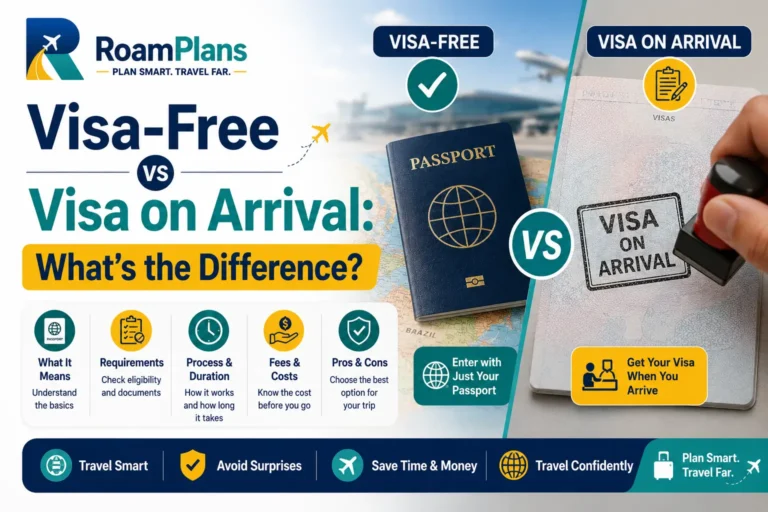
The next RoamPlans article, Visa-Free vs Visa on Arrival: What’s the Difference? will compare those entry methods in detail.
Business Visa
A business visa is generally used for approved short business activities rather than taking normal employment in the destination.
Depending on the country, permitted activities might include:
- ✓Business meetings
- ✓Conferences
- ✓Consultations
- ✓Negotiations
- ✓Trade events
The exact rules vary.
For example, U.S. government guidance separates temporary business visitor activities from employment visas and lists activities such as meetings, conventions, and contract negotiations under temporary business travel.
If you will actually work for an employer in the destination, do not assume a business visitor visa is enough.
Check the official immigration category for your planned activity.
Transit Visa
A transit visa is for travelers passing through a country on the way somewhere else.
You may need one even though:
- ✓You are staying only a few hours
- ✓You are not visiting the country
- ✓Your final destination is somewhere else
Whether you need it can depend on:
- ✓Nationality
- ✓Airport
- ✓Connection length
- ✓Whether you stay in the international transit zone
- ✓Whether you collect baggage
- ✓Whether you change airports
- ✓Whether you pass through immigration
As one example, Schengen rules include an airport transit visa that allows eligible holders to connect through an international transit area but does not allow them to leave that area.
This is why I check transit rules before booking complicated self-transfer flights.
Student Visa
A student visa or study permission is used when the main purpose of travel is education.
The correct category can depend on:
- ✓Length of course
- ✓Type of school
- ✓Full-time or short-term study
- ✓Age
- ✓Country
- ✓Educational institution
Do not assume a tourist visa allows long-term study.
Some countries allow certain short courses under visitor rules but require a student visa for longer programs. UK rules, for example, separate short visitor study from longer student visa categories.
For a normal vacation, this category will rarely matter. But it helps beginners see why travel purpose changes the type of permission needed.
Work Visa
A work visa or work permit is generally required when a traveler plans to take employment or perform work that is not allowed under visitor status.
Work immigration rules are far more detailed than tourist visa rules.
If the real purpose of the trip is employment, use the official work visa information for the destination rather than applying for a tourist visa because it looks easier.
For RoamPlans, our focus stays on short-term travelers, so we will not turn this guide into a work-immigration article.
What Is an eVisa?
An eVisa is a visa that can be applied for and issued electronically.
Instead of visiting an embassy to receive a physical visa sticker, an eligible traveler may complete an application through an official online system.
An eVisa application may ask for:
- ✓Passport details
- ✓Digital passport photo
- ✓Travel dates
- ✓Accommodation
- ✓Contact details
- ✓Supporting documents
- ✓Payment
After approval, the visa may be electronically linked to your passport or supplied as a downloadable document.
Check the Website Before You Pay
Visa searches often bring up private companies that look similar to government sites.
Before entering passport or payment details, confirm that you are using the destination government’s official visa service or an organization officially authorized to handle applications.
I prefer starting from the country’s embassy or immigration website and following its visa link from there.
Is an ETA the Same as a Visa?
Usually, no.
An electronic travel authorization, often called an ETA, eTA, ESTA, or another country-specific name, is generally used for travelers who do not need a traditional visa but still need approval before traveling.
The U.S. Department of State specifically notes that some countries require either a visa or an electronic travel authorization.
The UK provides another current example. Travelers who do not need a visa for certain short visits may still need an ETA before travel, depending on their status and nationality.
So:
Visa-free does not always mean authorization-free.
Always check whether an online approval is required even when a traditional visa is not.
What Is a Visa on Arrival?
A visa on arrival is issued after an eligible traveler reaches an approved airport, land border, or other entry point.
The traveler normally does not obtain the full visa before leaving home.
That does not mean there is nothing to prepare.
Depending on the destination, you may still need:
- ✓Passport with enough validity
- ✓Blank passport page
- ✓Visa fee
- ✓Passport photo
- ✓Hotel information
- ✓Return or onward ticket
- ✓Proof of funds
- ✓Supporting documents
Eligibility can depend on nationality and entry point.
We will compare this more closely with visa-free travel and eVisas in Visa-Free vs Visa on Arrival: What’s the Difference?
Single-Entry vs Multiple-Entry Visa
A visa can also control how many times you may enter.
This matters for multi-country trips.
Single-Entry Visa
A single-entry visa normally allows one entry during its permitted validity.
Once you leave the area covered by that visa, you may not be able to use the same visa again.
Multiple-Entry Visa
A multiple-entry visa allows more than one entry while it remains valid, subject to the visa’s other rules.
Schengen visa rules, for example, recognize both single-entry and multiple-entry short-stay visas.
Why This Matters on a Multi-Country Trip
Suppose you:
- 1Enter a country.
- 2Travel to another country outside that visa area.
- 3Return to the first country.
A single-entry visa may create a problem because your first departure may have used the only permitted entry.
Do not check only the expiration date.
Also look at the number of entries allowed.
Visa Validity vs Length of Stay
These two terms are easy to mix up.
Visa Validity
Visa validity tells you the period during which the visa can normally be used for travel or entry, subject to its conditions.
For example, a visa might be valid from:
June 1 to December 1
That does not automatically mean you can stay for six months.
Length of Stay
The permitted stay tells you how long you can remain after entering.
Depending on the visa system, it may be expressed as:
- ✓A set number of days
- ✓A stay per visit
- ✓A total number of days within a longer period
- ✓A date set at the border
The Schengen short-stay system is a good example. Eligible visa holders can generally stay up to 90 days within any 180-day period, even though a multiple-entry visa itself may remain valid for longer.
Do Not Use the Visa Expiration Date as Your Departure Rule
Always identify:
- ✓When you may enter
- ✓How many entries are allowed
- ✓How long each or all stays may last
- ✓The final date you must leave
Overstaying can create immigration problems and affect future travel.
Before booking a long stay, read the visa conditions rather than guessing from the expiration date printed on the document.
Does Your Visa Need to Match Your Passport?
Yes, the passport information used for a visa application needs careful checking.
Visa systems may use details such as:
- ✓Full name
- ✓Date of birth
- ✓Nationality
- ✓Passport number
- ✓Passport issue date
- ✓Passport expiration date
Enter this information directly from the passport you plan to use.
A simple passport-number typo can create a major problem later.
This also matters if you renew your passport after receiving a visa or electronic authorization. Rules for moving or using a visa with a new passport vary by country, so check with the authority that issued it before travel.
Check the Purpose Printed on Your Visa
Before making final travel plans, make sure the visa you received matches the reason for your trip.
A visa may place conditions on:
- ✓Tourism
- ✓Business
- ✓Study
- ✓Work
- ✓Number of entries
- ✓Permitted stay
- ✓Destination area
- ✓Travel dates
Do not assume that receiving any visa means every activity is allowed.
Read the approval and any conditions that come with it.
That small check can prevent you from discovering a problem only after you reach the border.
When Should You Apply for a Travel Visa?

Apply as early as the destination allows, especially if your trip depends on getting the visa first.
There is no single visa-processing timeline for every country. Some applications are decided within days, while others can take several weeks or longer. Processing can also depend on your nationality, application location, visa type, season, biometrics, interview availability, and whether officials ask for more documents. Canada, for example, states that visitor-visa processing varies by country and can also be affected by application completeness and how quickly information can be verified.
The Schengen system gives a useful example of why early planning helps. Applications normally must be submitted at least 15 days before travel and cannot normally be lodged more than six months before the trip. Standard processing is around 15 days, but some applications can take up to 45 days when further review or extra documents are needed.
Do Not Count Back From the Normal Processing Time
If an official website says a visa usually takes three weeks, I would not apply exactly three weeks before departure.
Leave extra room for:
- ✓Appointment availability
- ✓Biometrics
- ✓Document corrections
- ✓Requests for more information
- ✓Passport return
- ✓Public holidays
- ✓Busy travel periods
- ✓Changes to your itinerary
UK Standard Visitor visa applicants applying from outside the country are currently told they will usually receive a decision within three weeks after applying online, proving their identity, and providing their documents. That clock starts after those steps, not simply when you begin planning the application.
Should You Book Flights Before Applying for a Visa?
This depends on the visa rules.
Some applications ask for planned travel dates, an itinerary, accommodation, or evidence showing the purpose of the trip. That does not always mean you should buy a non-refundable ticket before approval.
For U.S. visitor visas, the Department of State directly tells applicants there is no guarantee that a visa will be issued and says not to make final travel plans or buy tickets until the visa has been granted.
My preferred approach is:
- 1Check what the visa application asks for.
- 2See whether a reservation or proposed itinerary is enough.
- 3Avoid expensive non-refundable bookings unless the rules clearly require them.
- 4Read cancellation conditions before paying.
- 5Finalize the trip after approval where possible.
Do not create fake flight or hotel reservations. The information you submit should reflect your genuine travel plans.
What Documents Do You Usually Need for a Travel Visa?

There is no universal document pack, but tourist visa applications often ask for several types of evidence.
You may need:
- ✓Valid passport
- ✓Visa application form
- ✓Passport photo
- ✓Travel dates
- ✓Travel itinerary
- ✓Accommodation information
- ✓Proof of funds
- ✓Proof of employment or other personal circumstances
- ✓Travel insurance
- ✓Return or onward travel information
- ✓Invitation letter where relevant
- ✓Biometrics
- ✓Visa application fee
For example, current Schengen guidance lists a valid passport, application form, compliant photo, medical insurance, proof of the purpose of the trip, financial means, accommodation, evidence of intent to return, and fingerprints among the standard requirements.
Do not build your application from a general internet checklist alone. Use the exact document list provided by the country and visa category you are applying for.
Check Your Passport Before Starting the Visa Application
Your passport details sit at the center of most visa applications.
Before submitting anything, check:
- ✓Full name
- ✓Passport number
- ✓Nationality
- ✓Date of birth
- ✓Passport issue date
- ✓Passport expiration date
- ✓Available blank pages
- ✓Passport condition
Enter information exactly as shown in the passport.
For Schengen applications, current EU guidance says the passport should normally remain valid for at least three months after departure from the Schengen area.
Other destinations use different passport rules, so check the country involved rather than applying the Schengen rule everywhere.
How to Fill Out a Visa Application Form
Visa forms can ask many questions, but the safest method is simple:
Answer accurately and keep the information consistent across your documents.
Common questions may cover:
- ✓Personal information
- ✓Passport details
- ✓Home address
- ✓Employment
- ✓Income
- ✓Previous travel
- ✓Travel dates
- ✓Accommodation
- ✓Family information
- ✓Who is paying for the trip
- ✓Travel purpose
- ✓Previous immigration history
The UK Standard Visitor application, for example, asks for planned travel dates, where the traveler will stay, expected trip cost, home address, income information where applicable, and other personal details. Depending on the applicant, travel history, employer information, sponsor information, or family details may also be requested.
Keep Your Answers Consistent
Suppose your application says:
10-day tourism trip
but your hotel reservation covers three months and your supporting letter describes business activities.
That mismatch could create questions.
Before submitting, compare:
Application → passport → itinerary → accommodation → financial evidence → supporting letters
Dates and basic trip details should make sense together.
How to Show the Purpose of Your Trip?
Visa officers may need evidence showing why you want to travel.
For a tourist, this could include:
- ✓Travel itinerary
- ✓Hotel bookings
- ✓Tour reservations
- ✓Planned travel dates
- ✓Details of people you will visit
- ✓Invitation information where relevant
The U.S. Department of State says additional documents for a visitor visa may be requested to show the purpose of the trip, the applicant’s intention to leave after the visit, and the ability to pay the trip costs.
Do not create an overly detailed itinerary simply to make the application look stronger.
A clear and believable travel plan is better than a long schedule filled with bookings you do not actually plan to use.
What Is Proof of Accommodation for a Visa?
Proof of accommodation shows where you plan to stay.
This may include:
- ✓Hotel reservation
- ✓Hostel booking
- ✓Vacation rental
- ✓Tour accommodation
- ✓Address of a friend or relative
- ✓Invitation or host information
Schengen visa rules specifically list evidence of accommodation as part of the supporting documentation used in the application.
The UK visitor application also asks where the applicant plans to stay during the visit.
What If You Are Staying With Someone?
If you are staying with family or friends, you may need details about your host instead of a hotel reservation.
Depending on the destination, this could include:
- ✓Host’s full name
- ✓Address
- ✓Contact information
- ✓Copy of identification
- ✓Proof of legal residence
- ✓Invitation letter
Only provide what the official checklist asks for.
What Is Proof of Funds for a Visa?
Proof of funds helps show that you can pay for your trip or that another person will cover the costs where sponsorship is permitted.
Possible evidence can include:
- ✓Bank statements
- ✓Payslips
- ✓Employment information
- ✓Savings records
- ✓Sponsor documents
- ✓Other accepted financial evidence
Schengen rules require evidence of financial means, while U.S. visitor visa guidance says applicants may be asked to show their ability to pay all trip costs. If another person will pay some or all of those costs, evidence of that arrangement may be used.
There Is No Universal Bank Balance
A common beginner question is:
How much money should I have in my bank account for a tourist visa?
There is no single amount that works for every visa.
What may matter includes:
- ✓Destination
- ✓Length of stay
- ✓Accommodation costs
- ✓Number of travelers
- ✓Who is paying
- ✓Country-specific minimum funds
- ✓Your overall financial situation
Check whether the destination publishes a minimum financial requirement.
Avoid moving money around simply to create a misleading picture of your finances. Submit accurate evidence that follows the official rules.
Do You Need Employment Documents?
Some visa systems may ask for information that helps explain your circumstances at home.
Depending on your situation, this might include:
- ✓Employment letter
- ✓Approved leave
- ✓Payslips
- ✓Business registration
- ✓Student enrollment
- ✓Retirement evidence
- ✓Other proof connected to your normal life
For U.S. visitor visas, official guidance states that evidence of employment or family ties may help show the purpose of the trip and intention to return home.
The exact evidence differs by country, so do not assume every tourist visa requires an employment letter.
Freelancers, business owners, students, retirees, and unemployed travelers may have different ways to document their circumstances.
Do You Need Travel Insurance for a Visa?
Sometimes.
Travel insurance is mandatory for some visa applications but optional for others.
Schengen short-stay visa applicants currently need medical insurance covering emergency medical care, hospitalization, and repatriation.
Other destinations may:
- ✓Require different coverage
- ✓Require insurance only for certain visa types
- ✓Recommend it without making it mandatory
- ✓Have no visa-related insurance condition
Check the visa requirements before buying a policy.
If insurance is mandatory, make sure the policy covers the required:
- ✓Dates
- ✓Geographic area
- ✓Medical benefits
- ✓Minimum coverage level
- ✓Other stated conditions
Do not assume any basic travel insurance plan will automatically meet a visa requirement.
Do You Need an Invitation Letter for a Tourist Visa?
Sometimes, especially if you are visiting friends, relatives, organizations, or attending an event.
An invitation letter may contain:
- ✓Host’s name
- ✓Relationship to you
- ✓Address
- ✓Contact details
- ✓Reason for your visit
- ✓Dates of stay
- ✓Who is paying
- ✓Where you will stay
But an invitation letter is not automatically required for every tourist visa.
A good example is the U.S. B visitor visa. The Department of State states that a letter of invitation or Affidavit of Support is not required for a standard visitor visa application and is not one of the main factors used to decide eligibility.
That is why copying advice from one country’s visa process into another can cause confusion.
Follow the checklist for your actual destination.
How Much Does a Tourist Visa Cost?
Visa fees vary widely by country and visa type.
There may be:
- ✓Government application fee
- ✓Visa application center service fee
- ✓Biometrics-related costs
- ✓Courier charges
- ✓Optional faster-processing fees
- ✓Translation costs
- ✓Document certification costs
For example, the current standard Schengen visa fee is €90 for adults and €45 for children aged 6 to 12, although other rates and exemptions apply to certain groups. Application centers may also charge a separate service fee.
Canada currently lists its visitor visa fee starting at CAN$100, with biometrics potentially required as part of the process.
For U.S. B visitor visas, the current non-refundable application fee shown by the Department of State is $185. Some applicants may also face an issuance fee depending on nationality.
Always check the official fee immediately before applying.
Are Visa Fees Refundable If You Are Refused?
Do not assume they are.
Many visa application fees pay for processing the application rather than buying approval.
For example, the U.S. B visitor visa application fee is described as non-refundable.
UK guidance also says an applicant seeking a long-term Standard Visitor visa will not receive the application fee back simply because a shorter visa is granted or the application is refused.
Read the refund policy before paying, especially if you also purchase optional services from an application center.
What Are Visa Biometrics?
Biometrics usually means fingerprints and a photograph collected to confirm your identity.
Whether you must provide them depends on the country, visa type, age, nationality, and previous biometric records.
Current Schengen visa guidance says fingerprints are collected when an application is submitted, with exemptions for certain categories.
UK Standard Visitor applicants may also need to attend a visa application center, show their passport, provide fingerprints and a photo, and submit required supporting documents.
Canada similarly requires fingerprints and a photo from many temporary-residence applicants. Applicants who receive a biometric instruction letter are told to book their collection appointment promptly to avoid delays.
Biometrics Can Add Time to the Process
Do not think of the online application as the final step.
If biometrics are required, you may also have to:
- 1Submit the application.
- 2Receive instructions.
- 3Book an appointment.
- 4Travel to an approved collection center.
- 5Give fingerprints and a photo.
- 6Wait for the visa process to continue.
Build that extra step into your travel timeline.
Do You Need a Visa Interview?
Some visa systems require interviews for many applicants, while others normally rely on forms, documents, and biometrics.
For U.S. visitor visas, interviews are generally required, subject to limited exceptions. Applicants are normally told to schedule the interview at a U.S. embassy or consulate, and wait times can vary by location, season, and visa category.
What Happens During a Visa Interview?
The officer may ask about:
- ✓Why you want to travel
- ✓Where you will stay
- ✓How long you plan to visit
- ✓Who is paying
- ✓Your work or studies
- ✓Your previous travel
- ✓Family circumstances
- ✓Your plans after the trip
Answer the question that is asked.
Do not memorize a dramatic speech.
Your answers should agree with the information already submitted in your application.
For U.S. visitor visas, the consular officer uses the interview and application information to decide whether the applicant meets the legal requirements for the visa.
How Long Does a Tourist Visa Take?
There is no useful worldwide average.
Even within one country, processing time can change based on:
- ✓Applicant location
- ✓Visa category
- ✓Season
- ✓Appointment availability
- ✓Application volume
- ✓Biometrics
- ✓Additional document requests
- ✓Security or administrative checks
Current examples show the variation. A UK Standard Visitor application from outside the country is usually decided within three weeks after identity and document steps are completed. A normal Schengen visa application is generally processed within 15 days but may take up to 45 days in cases needing deeper review. Canadian visitor visa processing varies by country and other application factors.
Check Processing Time Before Booking
Look up the current processing estimate when you begin planning the trip and again when you are ready to apply.
An estimate from six months ago may no longer reflect current demand.
What If the Visa Office Asks for More Documents?
Do not assume that a request for more information automatically means refusal.
Officials may need another document or clarification before making a decision.
Possible requests could involve:
- ✓Financial evidence
- ✓Accommodation
- ✓Employment
- ✓Travel purpose
- ✓Family information
- ✓Passport details
- ✓Missing forms
- ✓Better document copies
- ✓Additional evidence
EU Schengen guidance states that consulates can request additional documents beyond the standard application list, and cases requiring more review can take longer.
Respond within the stated deadline and follow the instructions exactly.
Do not send large amounts of unrelated paperwork unless requested.
What If Your Travel Plans Change After Applying for a Visa?
Small changes and major changes should not be treated the same way.
A small hotel change may be less serious than changing:
- ✓Travel dates
- ✓Main destination
- ✓Reason for travel
- ✓Length of stay
- ✓Passport
- ✓Person paying for the trip
The correct action depends on the visa system.
For example, UK guidance tells Standard Visitor applicants who need to change information after submission to contact UK Visas and Immigration.
If your plans change after applying, check the issuing authority’s instructions instead of assuming your original application still covers the new trip.
What If You Get a New Passport After Applying?
This can create a serious document mismatch.
Many visas and electronic applications are connected to a specific:
passport number + nationality + expiration date.
If you renew or replace your passport after submitting a visa application, tell the visa authority where required.
Do not assume an approved visa automatically transfers to the new passport.
The rules differ by destination. Some countries may allow a valid visa in an old passport to be used with a new passport, while others require an update or new application. For example, the United States currently permits a still-valid U.S. visa in an expired passport to be used with a new valid passport in qualifying circumstances, provided the visa has not been canceled or revoked.
Check the rule for the country that issued your visa before traveling.
Should You Use a Visa Agent?
A visa agent can sometimes help with:
- ✓Form preparation
- ✓Appointment booking
- ✓Document organization
- ✓Translation
- ✓Submission through an authorized center
But an agent cannot guarantee approval.
The final visa decision belongs to the immigration or consular authority.
Be especially careful with websites promising:
- ✓Guaranteed visas
- ✓Guaranteed approval
- ✓Secret embassy connections
- ✓Visas without required documents
- ✓Unrealistically fast approvals
For countries that use contracted visa application centers, check the official government website to confirm which company is authorized. The EU notes that service centers may collect Schengen applications on behalf of consulates and can charge an additional service fee.
Canada also tells travelers using paid immigration representatives to make sure the representative is authorized.
Final Check Before Submitting a Visa Application
Before clicking submit or handing over your application, check it one last time.
Personal Details
- ✓Name matches passport
- ✓Date of birth is correct
- ✓Nationality is correct
- ✓Passport number is correct
- ✓Passport expiration date is correct
Trip Details
- ✓Travel dates are correct
- ✓Visa category matches travel purpose
- ✓Accommodation details are correct
- ✓Main destination is correct
- ✓Transit information is checked
- ✓Length of stay makes sense
Supporting Documents
- ✓Required passport copy
- ✓Photo
- ✓Financial evidence
- ✓Accommodation evidence
- ✓Travel itinerary
- ✓Insurance if required
- ✓Invitation information if required
- ✓Employment or study records if required
- ✓Required translations
Application Process
- ✓Correct official application website
- ✓Correct fee
- ✓Biometrics appointment checked
- ✓Interview requirement checked
- ✓Processing time checked
- ✓Copies of submitted documents saved
I always prefer reviewing passport numbers, dates, and names separately rather than reading the whole application once from top to bottom. Small errors are easier to spot that way.
What Should You Check When Your Visa Is Approved?
Visa approval is good news, but do not put the document away without checking it.
Whether you receive a visa sticker, electronic visa, or digital approval, compare its information with your passport and travel plans.
Check:
- ✓Full name
- ✓Passport number
- ✓Nationality
- ✓Visa type
- ✓Number of entries
- ✓Valid-from date
- ✓Expiration date
- ✓Permitted stay
- ✓Any conditions or notes
A visa can be issued correctly while still being different from what you expected. For example, you may receive a single-entry visa when your itinerary requires you to leave and return.
Finding that problem before departure gives you time to contact the issuing authority.
Check the Number of Entries on Your Visa
Look for whether your visa allows:
- ✓One entry
- ✓Two entries
- ✓Multiple entries
This matters most on trips involving several countries.
Imagine this route:
Country A → Country B → Country A
If your visa for Country A allows only one entry, leaving for Country B may use up that permission. Returning could require another visa.
Do not assume that a visa remains usable until its expiration date regardless of how many times you enter.
Schengen visas, for example, can be issued for single or multiple entry, while the holder must still follow the permitted stay and validity conditions.
Visa Expiration Date vs How Long You Can Stay
This is one of the most common visa mistakes.
The visa expiration date does not always tell you how long you can remain in the country.
These can be two different things.
For example, official U.S. guidance explains that a visa’s validity tells a traveler when the visa may be used to request entry. The amount of time the traveler may actually stay is decided during admission at the U.S. border.
Example
Suppose your visa is valid from:
January 1 to December 31
That does not automatically mean you can stay in the country for one full year.
You might be allowed only:
- ✓30 days per trip
- ✓60 days
- ✓90 days
- ✓Six months
- ✓Another period set by immigration
Always check both:
Visa validity + permitted length of stay
Schengen Example
Schengen short-stay rules generally allow eligible travelers to remain for up to 90 days in any 180-day period.
A multiple-entry visa itself can remain valid for longer, but the traveler must still stay within the allowed 90/180-day limit.
This is why looking only at the visa expiration date can lead to an overstay.
Does Having a Visa Guarantee Entry?
No.
A visa usually gives you permission to travel to the border and request entry under that visa category.
Border authorities can still decide whether you meet the requirements when you arrive.
The U.S. Department of State explains that a visa does not guarantee admission. A Customs and Border Protection officer decides whether a traveler may enter and how long that person can stay.
You may still be asked for supporting information such as:
- ✓Passport
- ✓Visa
- ✓Purpose of visit
- ✓Hotel information
- ✓Return or onward ticket
- ✓Proof of funds
- ✓Travel insurance where required
- ✓Invitation information
- ✓Length of stay
Keep important supporting documents easy to reach during arrival.
What Happens at Immigration With a Visa?
When you reach immigration, an officer may scan or inspect your passport and visa.
You may be asked simple questions such as:
- ✓Why are you visiting?
- ✓How long will you stay?
- ✓Where are you staying?
- ✓When are you leaving?
- ✓Are you visiting anyone?
- ✓What do you plan to do during the trip?
Your answers should match the visa category and your real travel plans.
If you hold a tourist visa, for example, do not describe plans that clearly involve taking unauthorized employment.
Keep answers clear and accurate.
Check How Long Immigration Allows You to Stay
Do not assume the visa expiration date controls your departure date.
Some countries record the period you are allowed to remain when you enter.
In the United States, for example, CBP determines the authorized stay. The official admission record may show an admitted-until date or another status-based notation. The Department of State specifically warns travelers not to use the visa expiration date to calculate their permitted stay.
After entering a country, check any:
- ✓Passport stamp
- ✓Electronic entry record
- ✓Immigration document
- ✓Admission date
- ✓Required departure date
If you are unsure, use the destination immigration authority’s official system or contact the proper authority.
Can You Extend a Tourist Visa?
Sometimes, but the rules differ by country.
Do not assume every tourist visa can be extended.
Some countries may allow an extension only for limited reasons. Others may require you to leave and apply again.
The UK provides one example. A Standard Visitor who originally received permission for less than six months may, in qualifying circumstances, apply to extend their stay up to a total of six months. Longer visitor extensions are generally limited to specific situations.
If you think you may need more time:
- 1Check whether extensions are allowed.
- 2Check the deadline.
- 3Apply before your current permission expires where required.
- 4Keep proof of submission.
- 5Do not assume filing an application automatically gives the same rights in every country.
Use the immigration authority responsible for your destination rather than advice from another country’s visa system.
What Is a Visa Overstay?
A visa overstay generally means remaining beyond the period you are legally allowed to stay.
The important date may be different from the visa expiration date.
For U.S. visitors, for example, the authorized stay shown through the admission process controls how long the traveler may remain. Staying beyond that period can place the traveler out of status and may affect future visa eligibility.
Other countries have their own overstay rules and penalties.
Possible results can depend on the country and circumstances and may affect:
- ✓Future visas
- ✓Future entry
- ✓Immigration status
- ✓Fines or other legal action
- ✓Removal from the country
Do not plan to overstay because you think a few extra days will not matter.
If an emergency may prevent you from leaving on time, contact the appropriate immigration authority before your permission ends whenever possible.
What If Your Visa Application Is Refused?
A refusal does not have one universal meaning.
The reason, appeal process, and ability to reapply depend on the country and visa category.
Read the refusal decision carefully.
Look for:
- ✓Reason for refusal
- ✓Whether you can appeal
- ✓Appeal deadline
- ✓Whether you may reapply
- ✓Whether additional documents are needed
- ✓Whether a new fee is required
Do Not Immediately Submit the Same Application Again
First work out why it was refused.
If nothing changes, submitting the same facts and documents may lead to the same result.
For example, U.S. guidance says applicants refused under Section 214(b) may reapply if they believe their circumstances have changed. A new application and application fee are normally required.
Schengen applicants who are refused must be told why the visa was refused and how an appeal can be submitted.
The correct response depends on the refusal you actually received.
Common Reasons a Visa Application Can Have Problems
Visa systems differ, so there is no universal refusal list.
Still, applications can run into trouble when the information does not meet the visa requirements or cannot be supported properly.
Potential problems include:
- ✓Applying for the wrong visa category
- ✓Missing documents
- ✓Passport problems
- ✓Incorrect information
- ✓Inconsistent travel dates
- ✓Weak evidence for a required condition
- ✓Missing financial evidence where required
- ✓Unclear travel purpose
- ✓Not meeting the visa’s legal eligibility rules
- ✓False information
- ✓Failure to attend an interview or biometric appointment
- ✓Not responding to requests for additional information
Do not try to make an application look stronger by inventing information.
False documents or false statements can create far more serious immigration problems than a normal refusal.
Can You Reapply After a Visa Refusal?
Often, yes, but check the rules for the visa involved.
Before reapplying, ask:
What caused the refusal, and what is genuinely different now?
If the issue was a missing document, you may be able to correct it.
If you did not meet a legal requirement, simply submitting the same application again may not help.
For some refusal types, an appeal or review process may make more sense than a new application.
Schengen visa applicants who receive a refusal are given information about the reason and appeal process.
For certain U.S. visa refusals, reapplication requires a new application and fee.
Follow the instructions attached to your own refusal rather than copying what another traveler did.
Should You Mention a Previous Visa Refusal?
If an application asks about previous refusals, answer accurately.
Do not try to hide a refusal because you think it will automatically hurt the new application.
Many immigration systems keep application records.
Read the question carefully and provide the information requested.
The same rule applies to:
- ✓Previous overstays
- ✓Deportations
- ✓Immigration violations
- ✓Previous visa cancellations
- ✓Previous entry refusals
Never provide false information to make your travel history look better.
Can a Visa Be Canceled After It Is Issued?
Yes, depending on the country’s laws and circumstances.
Approval does not mean the visa can never be canceled or revoked.
Problems can arise if:
- ✓Eligibility changes
- ✓Incorrect information was used
- ✓Visa conditions are broken
- ✓Immigration authorities discover information that affects eligibility
- ✓The passport connected to the visa is lost, replaced, or canceled
- ✓Another legal reason applies
For U.S. visas, official guidance explains that visa validity can be affected by certain immigration violations, including some overstays.
If you receive a notice that your visa has been canceled or revoked, follow the instructions from the issuing authority.
What If Your Passport Expires Before Your Visa?
This situation can happen because a visa may remain valid longer than the passport it was placed in.
What happens next depends on the country.
Some governments may allow an active visa in the old passport to be used alongside a new passport.
Others may require:
- ✓Visa transfer
- ✓Passport update
- ✓New electronic authorization
- ✓New visa application
Do not cut a visa out of an old passport or try to move it yourself.
Check with the authority that issued the visa.
What If You Lose a Passport That Contains Your Visa?
Losing a passport can mean losing access to the visa inside it.
Start by following the passport-loss procedure for your nationality.
Then contact the country that issued the visa.
You may need to:
- ✓Report the visa lost
- ✓Provide a police report
- ✓Get a replacement passport
- ✓Submit a new visa application
- ✓Update an electronic visa
- ✓Provide proof of the original visa
A photocopy of the visa can help you identify its details, but it normally does not replace the original permission to travel.
This is another reason I keep secure copies of both my passport information page and major visas before an international trip.
Common Travel Visa Mistakes to Avoid
A good visa application is not about sending the biggest pile of documents.
It is about meeting the correct requirement with accurate information.
1. Checking Visa Rules Too Late
A visa may require:
- ✓Appointment
- ✓Biometrics
- ✓Interview
- ✓Document preparation
- ✓Processing time
Start the check early.
2. Using the Wrong Visa Category
Choose the category that matches what you actually plan to do.
Tourism, work, business, study, and transit can follow different rules.
3. Assuming Visa-Free and Visa on Arrival Mean the Same Thing
They are different entry arrangements.
The next RoamPlans guide, Visa-Free vs Visa on Arrival: What’s the Difference?, will explain those differences in more detail.
4. Forgetting Transit Visas
Your final destination may approve your trip while a connecting country creates a separate visa requirement.
Check the whole flight route.
5. Applying Through an Unofficial Website
Search results can contain private visa services.
Start from the destination government’s official immigration or embassy website.
6. Entering the Wrong Passport Number
Compare every digit with the physical passport before submitting.
7. Choosing Dates That Do Not Match
Check that your:
- ✓Visa form
- ✓Flights
- ✓Hotel
- ✓Insurance
- ✓Invitation
- ✓Itinerary
all tell a consistent story where the visa process requires these records.
8. Buying Non-Refundable Travel Too Early
A visa application is not a guarantee of approval.
Where possible, understand the visa process before committing large amounts of money to bookings you cannot change.
9. Assuming a Long-Valid Visa Allows a Long Stay
Visa validity and permitted stay can be different.
Check both.
10. Ignoring the Number of Entries
A single-entry visa can create problems on an itinerary that requires you to leave and return.
11. Forgetting to Check the Visa After Approval
Check your name, passport number, dates, visa type, permitted entries, and conditions.
12. Assuming a Visa Guarantees Entry
Border authorities can still check whether you meet entry requirements. U.S. guidance is explicit that visa issuance does not itself guarantee admission.
13. Staying Longer Than Allowed
Do not use the visa expiration date as your only guide.
Know your authorized departure date.
14. Giving False Information
Never submit fake bank statements, false reservations, fake employment documents, or invented travel details.
Use real information and genuine supporting evidence.
Final Visa Check Before International Travel
Once the visa is approved, complete one final check before departure.
Passport
- ✓Passport is valid
- ✓Destination validity requirement is met
- ✓Passport is in good condition
- ✓Passport number matches the visa
- ✓Transit-country passport rules checked
Visa
- ✓Correct name
- ✓Correct passport number
- ✓Correct visa category
- ✓Valid travel dates
- ✓Correct number of entries
- ✓Permitted stay understood
- ✓Visa conditions understood
Supporting Documents
- ✓Return or onward booking where needed
- ✓Accommodation details
- ✓Travel insurance where required
- ✓Proof of funds where required
- ✓Invitation information where required
- ✓Other visa-specific evidence
Route
- ✓Final destination visa checked
- ✓Transit visa requirements checked
- ✓Airport transfer requirements checked
- ✓Entry forms checked
Backups
- ✓Visa copy saved securely
- ✓Passport copy saved
- ✓Offline copy available
- ✓Important embassy or immigration contacts saved
Do this check a few days before departure rather than while standing at the airline counter.
Frequently Asked Questions
A travel visa is an authorization connected to entering or staying in another country for an approved purpose. The exact rules depend on the destination and visa category.
No. Whether you need one depends on factors such as your nationality, passport, destination, reason for travel, and length of stay. Some travelers qualify for visa-free entry or another form of authorization.
A passport proves your identity and nationality. A visa is an authorization issued under another country’s immigration system for a particular type of travel.
An eVisa is applied for and issued electronically. A traditional visa may involve an embassy, consulate, application center, or physical visa placed in the passport. The exact process depends on the destination.
Usually not. An electronic travel authorization is commonly used for certain travelers who do not need a traditional visa but still need pre-travel approval.
A visa on arrival is issued to an eligible traveler at an approved border or airport after arrival. Documents, fees, eligibility rules, and permitted entry points can still apply.
Apply within the destination’s permitted application window and leave more time than the normal processing estimate. Appointments, biometrics, document requests, and extra review can extend the process.
It depends on the visa. Some applications ask for an itinerary or travel plans without requiring a fully paid non-refundable ticket. U.S. visitor visa guidance, for example, tells applicants not to make final travel plans or buy tickets until a visa has been issued.
There is no worldwide amount. Financial requirements depend on the destination, length of stay, travel costs, sponsorship, and visa rules.
Some visa systems require it, while others do not. Check the official visa requirements for your destination before buying a policy.
No. A visa may allow you to travel to a border and request entry, but border officers may still check your eligibility and decide whether you can enter.
Yes, depending on the destination and visa. Accommodation information may be checked during the visa application or at the border.
Yes. Some travelers may need to show that they plan to leave within their permitted stay.
A single-entry visa generally permits one entry during its allowed validity. Leaving may mean that the visa cannot be used to enter again.
A multiple-entry visa allows repeated entry during its validity, subject to the permitted stay and other visa conditions.
No. A visa may remain valid for months or years while each visit is limited to a much shorter period. U.S. and Schengen rules both provide clear examples of this difference.
Some countries allow extensions in certain situations, while others do not. Check the destination’s immigration rules before your current permission expires.
The results depend on the country and your circumstances. An overstay can affect your immigration status and future travel. U.S. guidance, for example, warns that remaining beyond an authorized stay may affect future visa eligibility.
Often, yes, but check the refusal instructions first. You may need to correct the problem, provide different evidence, submit a new application, pay another fee, or use an appeal process.
Start with the destination country’s official immigration, foreign ministry, embassy, or consulate website. U.S. travelers can also use U.S. Department of State destination information as a starting point.
Final Thoughts
In short, Travel visas become much easier to plan once you separate the process into a few questions:
Do I need a visa? What type do I need? When should I apply? What documents are required? What does the approval actually allow me to do?
I check those questions early because visa rules can affect flights, hotels, transit routes, passport renewal, and the length of the trip.
Do not treat visa approval as the end of the process. Check the visa after it is issued, understand the number of entries and permitted stay, keep supporting documents available, and confirm current entry rules again before departure.
Most of all, use official visa information for the country you are visiting. Travel blogs can help explain the process, but the immigration authority decides the rules that apply to your trip.

Adnan Ahmed
RoamPlans AuthorTravel Planning Researcher & Editor
Adnan Ahmed is the travel planning researcher and editor behind RoamPlans. He creates clear, practical guides to help travelers compare destinations, plan routes, estimate costs, and avoid common trip-planning mistakes. His work combines careful source research, official travel information, and regular content reviews to keep each guide useful and current.
- ✓Destination Research
- ✓Budget Planning
- ✓Route Planning
- ✓Beginner Travel Guides
Turn This Guide into a Practical Trip Plan
Use the recommended Editorial Policy or explore more free RoamPlans tools.
2 Comments