Trip Cancellation Insurance Guide: What Is Covered and What Is Not?
Canceling an international trip ↗ can be disappointing. It can also become expensive when flights, hotels, cruises, tours, and other bookings are already paid for and cannot be refunded.
When I look at trip cancellation insurance, I do not start with the percentage or dollar amount shown on the sales page. I first calculate how much of the trip is genuinely non-refundable. Then I check the policy’s covered reasons, exclusions, purchase timing, maximum benefit, and what documentation would be required if I had to cancel.
That process matters because trip cancellation insurance is not a general money-back guarantee. NAIC explains that travel insurance can reimburse prepaid, non-refundable travel expenses when a trip is canceled for reasons covered by the policy, but plans differ in what situations qualify.
For a beginner traveler, the most important question is therefore not:
“Does this policy have trip cancellation coverage?”
It is:
“Under exactly what circumstances would this policy reimburse the money I could lose?”
Trip cancellation coverage, covered reasons, exclusions, reimbursement limits, and claim requirements vary between policies. Always read the actual policy wording before relying on cancellation protection.
Key Takeaways
- ✓Trip cancellation insurance generally applies when you must cancel before departure for a reason covered by the policy.
- ✓It usually focuses on eligible prepaid and non-refundable trip expenses.
- ✓Simply changing your mind is generally different from canceling for a standard covered reason.
- ✓Illness, injury, or death can be covered reasons in some policies, subject to definitions and exclusions.
- ✓Severe weather, transportation problems, or other events may be included depending on the policy.
- ✓The policy’s definition of family member, traveling companion, and covered reason can affect a claim.
- ✓Refundable bookings should not automatically be treated the same as non-refundable financial losses.
- ✓Pre-existing medical-condition rules can affect some cancellation claims.
- ✓Cancel for Any Reason, or CFAR, can provide broader flexibility but generally reimburses only part of the trip cost and has additional conditions. NAIC currently describes typical CFAR reimbursement as about 50%–75% of total trip price.
- ✓Buying insurance early can matter because some benefits or waivers have time-sensitive eligibility rules.
- ✓Strong documentation is important when making a cancellation claim.
What Is Trip Cancellation Insurance?

Trip cancellation insurance is travel insurance designed to help reimburse eligible prepaid, non-refundable trip expenses when you cannot take the trip because of a reason covered by the policy.
NAIC includes trip cancellation among the main forms of travel insurance and describes cancellation/interruption/delay protection as coverage for prepaid, non-refundable travel expenses when a traveler is prevented from taking all or part of a trip under covered circumstances.
Depending on the trip and policy, insured expenses may include eligible:
- ✓Flights
- ✓Hotels
- ✓Cruises
- ✓Tours
- ✓Vacation packages
- ✓Train reservations
- ✓Activity bookings
- ✓Other prepaid travel arrangements
The exact expenses that qualify depend on the insurer’s definition of insured trip cost.
Trip Cancellation Insurance Protects Money Already at Risk
I find it easier to understand cancellation insurance by starting with the money.
Imagine you booked:
- ✓Flights: $1,800
- ✓Hotels: $2,000
- ✓Tours: $900
Your total trip cost is:
$4,700
But suppose:
- ✓Hotels are fully refundable
- ✓$300 of the tours can be canceled free
- ✓Flights are non-refundable
Your actual non-refundable exposure may be much lower than $4,700.
That is the amount I would examine closely before deciding how much cancellation protection matters.
Refundable and Non-Refundable Costs Are Different
This is easy to overlook when calculating trip cost.
Suppose you cancel tomorrow.
Refundable Hotel
The hotel returns your money.
Your financial loss may be:
$0
Non-Refundable Hotel
The hotel keeps your payment.
Your financial loss may be:
the amount you paid
Trip cancellation insurance is generally most relevant to prepaid expenses you cannot recover elsewhere.
Do not insure numbers blindly.
First understand what you could actually lose.
Trip Cancellation Insurance Is Not the Same as a Supplier Refund
There can be several possible sources of money after a canceled trip.
For example:
- ✓Airline refund
- ✓Hotel refund
- ✓Tour-company refund
- ✓Credit-card protection
- ✓Travel insurance
These are not automatically the same thing.
If a hotel returns your full payment, you generally no longer have that same financial loss to claim as an unreimbursed cancellation expense.
Keep records showing:
- ✓Original cost
- ✓Refund received
- ✓Refund denied
- ✓Remaining loss
That makes the financial picture much clearer.
What Does “Covered Reason” Mean?
A covered reason is a circumstance specifically recognized by the policy as potentially qualifying for cancellation benefits.
This is one of the most important phrases in trip cancellation insurance.
You cannot safely assume:
“I had a good reason to cancel.”
means:
“I had an insured reason to cancel.”
The policy decides.
Depending on the plan, covered reasons may involve certain situations connected with:
- ✓Illness
- ✓Injury
- ✓Death
- ✓Severe weather
- ✓Transportation disruptions
- ✓Other specific events
The list differs by policy.
Illness Can Be a Covered Reason
Illness is one of the commonly recognized reasons associated with trip cancellation coverage.
NAIC consumer guidance has described trip cancellation as reimbursement for prepaid travel expenses when travelers are unable to take a trip because they or a family member become ill or die.
However, that does not mean:
any illness = automatic reimbursement.
The policy may define:
- ✓How serious the illness must be
- ✓Who must be ill
- ✓What medical evidence is required
- ✓Whether a doctor must advise against travel
- ✓How pre-existing-condition rules apply
Read those conditions carefully.
Injury Can Also Affect a Trip Cancellation Claim
Suppose you break your leg several days before an international trip.
The cancellation may potentially fall within an injury-related covered reason if the policy conditions are met.
The insurer could require evidence such as:
- ✓Medical report
- ✓Doctor statement
- ✓Treatment record
- ✓Proof that you could not reasonably take the trip
The exact documentation depends on the policy.
Do not assume a photograph of the injury alone will be enough.
Death of a Family Member May Be Covered
Some cancellation policies can cover certain situations when a qualifying family member dies before departure.
But the policy’s definition of family member matters.
It may specify exactly which relationships qualify.
Do not assume your personal definition of family automatically matches the insurance contract.
Search the policy’s definitions section.
A Traveling Companion Can Matter Too
Some policies contain benefits connected to a covered event affecting your traveling companion.
Again, check the definition.
A policy may define a traveling companion differently from:
- ✓Friend living at destination
- ✓Tour guide
- ✓Person you planned to meet
- ✓Relative who is not traveling
Insurance definitions can be narrower than everyday language.
Severe Weather May Be Covered in Certain Situations
Weather can potentially affect trip cancellation coverage, but the exact trigger matters.
A storm existing somewhere near your destination does not automatically mean you can cancel and receive reimbursement.
The policy may require a particular covered consequence.
For example, the wording may focus on situations involving transportation or another defined covered event.
So instead of asking:
“Does this policy cover bad weather?”
ask:
“What specific weather-related events qualify for cancellation coverage?”
Bad Vacation Weather Is Different from a Covered Cancellation
Imagine you are worried that your beach trip will be rainy.
Your flights are operating.
Your hotel is open.
The destination is accessible.
You simply decide you would rather not go.
Do not assume standard cancellation coverage applies because the weather forecast looks poor.
Trip cancellation insurance protects against defined insured risks.
It does not guarantee good holiday weather.
Transportation Problems May Be Covered Depending on the Policy
Certain transportation disruptions may fall within cancellation or delay benefits when policy conditions are satisfied.
NAIC’s travel-insurance materials recognize trip cancellation, interruption, and delay as separate but related protections.
This is why you should identify which benefit applies.
A problem before the trip may involve cancellation.
A shorter disruption may involve travel delay.
A problem after departure may involve interruption.
They should not be treated as interchangeable.
Trip Cancellation Vs Trip Interruption
These two benefits are often sold together, but they apply at different stages.
Trip Cancellation
The covered problem prevents you from starting the trip.
Trip Interruption
The trip has already begun, but a covered event forces you to interrupt or end it early.
For example:
Two days before departure: a qualifying emergency prevents travel.
That may involve cancellation.
Five days into a 14-day trip: a qualifying emergency forces you home.
That may involve interruption.
This article stays focused on cancellation before departure.
Do Not Confuse Cancellation with Travel Delay
A delay does not automatically mean the whole trip is canceled.
NAIC notes that cancellation, interruption, and delay can address different travel losses and that some policies apply specific conditions before a delay can become a cancellation-related claim.
If a flight is delayed, check whether you are expected to:
- ✓Continue traveling
- ✓Accept alternative transportation
- ✓Wait for a stated period
- ✓Meet another policy condition
before abandoning the trip.
Can a Doctor Tell You to Cancel the Trip?
A medical recommendation can become important in an illness- or injury-related cancellation claim.
Depending on the policy, the insurer may need medical evidence showing that travel was not medically appropriate.
This is different from simply feeling uncomfortable about traveling.
If health is the cancellation reason, obtain appropriate medical documentation.
Do not ask a doctor to alter or exaggerate what happened for insurance purposes.
What If You Cancel Because You Are Worried About Getting Sick?
Fear of becoming ill is different from actually experiencing a covered illness.
A traveler may reasonably decide:
“I do not feel comfortable going.”
But standard cancellation insurance generally works through stated covered reasons.
Personal concern by itself should not be assumed to qualify.
This is one of the situations where broader cancellation protection such as CFAR may be relevant if available and if all its conditions are satisfied.
What Does Trip Cancellation Usually Not Cover?
Common non-covered situations can include circumstances that do not meet the policy’s covered reasons.
For example:
- ✓Simply changing your mind
- ✓Deciding the trip is too expensive
- ✓Finding a cheaper vacation
- ✓Becoming too busy at work, unless specifically covered
- ✓Not wanting to travel
- ✓Problems already excluded by the policy
- ✓Other personal decisions outside the listed covered reasons
These are examples for understanding the concept.
The actual exclusion list belongs to your policy.
“I Don’t Want to Go Anymore” Is Usually Not Standard Cancellation Coverage
This is one of the biggest misunderstandings beginners can have.
Standard trip cancellation insurance is usually based on specified covered events.
It is not generally designed as:
pay a premium → cancel whenever you want → get a full refund.
If that flexibility is important, investigate broader cancellation options before booking or soon after making your initial trip payment.
What Is Cancel for Any Reason Coverage?

Cancel for Any Reason is commonly shortened to CFAR.
It provides broader cancellation flexibility than standard covered-reason cancellation.
NAIC’s April 2026 travel-insurance guidance says CFAR can allow travelers to cancel for reasons not included in standard trip cancellation coverage and typically receive a partial refund of about 50%–75% of total trip price.
This is why CFAR should not be described as:
100% refund for anything at any time.
It comes with conditions.
CFAR Usually Has Extra Requirements
CFAR arrangements can have requirements involving:
- ✓Purchase timing
- ✓Amount of trip cost insured
- ✓How long before departure you cancel
- ✓Partial reimbursement
- ✓Other eligibility conditions
New York DFS consumer guidance has also warned that CFAR protection typically costs more than standard travel insurance and has timing restrictions.
The exact terms vary by product and jurisdiction.
Read them before paying extra.
Standard Cancellation vs CFAR
A simple comparison looks like this:
| Feature | Standard Trip Cancellation | CFAR |
|---|---|---|
| Reason for cancellation | Must normally meet covered reason | Broader flexibility |
| Reimbursement | According to policy benefit | Usually partial |
| Extra cost | Included in qualifying plan | Often costs extra |
| Purchase timing | Policy-specific | Often stricter |
| Cancellation deadline | Policy-specific | Often must cancel before a stated cutoff |
| Availability | Common | Not available in every product/jurisdiction |
NAIC currently describes typical CFAR reimbursement as roughly 50%–75%, while state rules and individual product terms can differ.
CFAR Is Not Automatically the Better Choice
Broader flexibility sounds attractive.
But it can cost more and reimburse less than standard cancellation coverage.
Ask:
- ✓What cancellation risks actually concern me?
- ✓Are those already covered under the standard policy?
- ✓What percentage would CFAR reimburse?
- ✓How much extra does it cost?
- ✓When must I purchase it?
- ✓How early must I cancel?
Then decide whether the extra flexibility is worth the price.
What Is an Insured Trip Cost?
The insured trip cost is generally the amount of eligible trip expense you declare or insure according to the policy’s rules.
This can affect:
- ✓Cancellation limit
- ✓Premium
- ✓Certain benefits
- ✓Eligibility conditions
Do not guess what belongs in this number.
Follow the insurer’s definition.
Which Trip Expenses Should You Review?
Before buying cancellation insurance, make a simple list.
Flights
How much would you lose if you canceled?
Hotels
Which reservations are refundable?
Tours
Are deposits refundable?
Cruises
What cancellation schedule applies?
Activities
Can they be canceled without charge?
Other Transportation
Are rail, ferry, or transfer bookings refundable?
Then calculate the amount genuinely at risk.
Example: Calculating Non-Refundable Trip Cost

Suppose your bookings are:
| Booking | Paid | Refundable? | Possible Loss |
|---|---|---|---|
| Flight | $1,500 | No | $1,500 |
| Hotel | $2,000 | Yes | $0 |
| Tour | $800 | 50% refundable | $400 |
| Train tickets | $200 | No | $200 |
Total paid:
$4,500
Possible non-refundable loss:
$2,100
This is much more useful for planning than simply saying:
“My trip costs $4,500.”
Always follow the insurer’s own rules when declaring insured trip cost.
Why You Should Not Intentionally Underinsure Without Checking
A traveler may be tempted to enter a lower trip cost to reduce the insurance price.
That can create problems if the policy requires certain eligible costs to be insured for a benefit or waiver to apply.
Do not change the trip cost just to lower the premium without understanding the consequences.
Read the terms first.
You May Also Be Able to Recover Money From the Travel Supplier
Before assuming the insurer owes the entire canceled-trip cost, check:
- ✓Airline refund
- ✓Airline credit
- ✓Hotel refund
- ✓Tour refund
- ✓Cruise refund
- ✓Other reimbursement
Travel insurance generally addresses eligible financial loss remaining after the applicable rules and other recoveries are considered.
Keep written evidence showing what suppliers refunded and what they refused to refund.
What About Airline Travel Credits?
A credit is not always the same as cash.
How it affects an insurance claim depends on the policy and circumstances.
If an airline gives you a travel credit instead of a refund, keep:
- ✓Credit amount
- ✓Expiration date
- ✓Terms
- ✓Airline communication
Then ask the insurer how that credit affects the eligible loss.
Do not assume either:
credit = no claim
or
credit = insurer ignores it.
The policy controls.
Does Trip Cancellation Cover Pre-Existing Medical Conditions?
This is an important area to check.
Some policies can exclude claims linked to pre-existing medical conditions, while some plans may offer a waiver of that exclusion when stated requirements are met.
NAIC advises consumers to review pre-existing-condition restrictions because travel policies can treat them differently.
That means an illness can be a covered cancellation reason in general while a particular medical history may still affect the claim.
A Pre-Existing Condition Can Involve Someone Other Than the Traveler
Depending on the policy, a cancellation could involve illness affecting:
- ✓Traveler
- ✓Traveling companion
- ✓Family member
The contract may define whose medical history matters and how pre-existing-condition provisions apply.
This is why I would search the policy for:
pre-existing condition
and
family member
before relying on medically related cancellation protection.
Purchase Timing Can Matter
Some travel insurance benefits and waivers can depend on when you purchase the policy relative to your first trip payment.
CFAR is one clear example of a benefit where timing requirements commonly apply. NAIC and New York DFS both describe CFAR as subject to additional timing conditions.
If cancellation protection matters to you, I would compare policies soon after making meaningful non-refundable bookings rather than automatically waiting until departure week.
Buying Early Does Not Mean Buying Blindly
There is still no reason to accept the first insurance offer you see.
A better sequence is:
- ✓Make the first important trip booking.
- ✓Review cancellation terms.
- ✓Calculate non-refundable costs.
- ✓Identify your main cancellation risks.
- ✓Compare appropriate policies.
- ✓Check time-sensitive options.
- ✓Read exclusions.
- ✓Buy only when you understand the coverage.
This balances timing with careful comparison.
How Much Trip Cancellation Coverage Do You Need?
There is no universal amount.
The answer depends largely on how much eligible prepaid money you could lose.
For example:
Traveler A
Non-refundable cost:
$700
Traveler B
Non-refundable cost:
$12,000
Their cancellation exposure is very different.
Do not automatically insure the same amount simply because both are taking international trips.
Trip Cancellation Coverage Is About Financial Exposure
This is the main idea I use throughout the decision.
Imagine two people travel to the same destination for the same number of days.
Traveler One
- ✓Refundable hotel
- ✓Flexible airfare
- ✓No prepaid tour
Traveler Two
- ✓Non-refundable flights
- ✓Non-refundable resort
- ✓Prepaid cruise
- ✓Prepaid excursions
Their destination is identical.
Their cancellation risk is not.
Insurance should be compared with the money actually at risk.
How Does This Fit With Broader Travel Insurance?
Trip cancellation is only one part of a travel insurance policy. Medical care, evacuation, baggage, delays, and interruption can have separate benefits and exclusions.
Related RoamPlans guide: Complete Travel Insurance Guide for International Travelers explains how these protections fit together so beginners can see the full insurance picture before comparing individual benefits.
Coverage and Exclusions Need to Be Read Together
Seeing:
Trip cancellation — 100% of insured trip cost
does not answer:
Which cancellations qualify?
The benefit amount and covered reasons must be read together.
Related RoamPlans guide: What Does Travel Insurance Cover — and What Does It Not Cover? explains how policy benefits, exclusions, deductibles, limits, and triggers determine whether different travel losses may qualify.
Who Should Give Trip Cancellation Coverage More Attention?
I would pay closer attention if the trip has:
- ✓High non-refundable cost
- ✓Cruise
- ✓Expensive package tour
- ✓Several family members
- ✓Large prepaid hotel deposits
- ✓Expensive international flights
- ✓Fixed-date tours or events
- ✓Other bookings that would be difficult to replace or refund
The more money you stand to lose, the more important the cancellation decision can become.
When Cancellation Coverage May Matter Less
It may deserve less priority when:
- ✓Most bookings are refundable
- ✓Trip cost is very low
- ✓You can comfortably absorb the loss
- ✓Existing protection covers important cancellation risks
That does not answer whether you need medical, evacuation, or other travel protection.
It only affects the cancellation part of the decision.
A Simple Trip Cancellation Test
Before buying, answer these five questions:
1. How Much Could I Lose?
Calculate eligible non-refundable costs.
2. Could I Comfortably Lose That Amount?
If yes, you may choose to carry more of the cancellation risk yourself.
3. What Events Am I Most Concerned About?
For example:
- ✓Illness
- ✓Family emergency
- ✓Weather disruption
- ✓Other specific risks
4. Does the Policy Cover Those Events?
Do not assume.
Check.
5. What Important Risks Are Excluded?
This may decide whether the policy actually fits your trip.
My Trip Cancellation Rule
When I compare cancellation insurance, I do not ask:
“How much cancellation coverage does this policy advertise?”
I ask:
“If I had to cancel this exact trip for one of the realistic reasons I am concerned about, would that reason qualify, how much money would still be unrecoverable, and what evidence would I need?”
That question turns trip cancellation insurance from a checkout add-on into a practical financial decision.
The goal is not to insure the disappointment of missing a trip.
It is to protect eligible money you could genuinely lose when a covered event prevents you from traveling.
Which Cancellation Reasons Are Most Important to Check?
A policy can list several covered reasons, but that does not mean every traveler needs to give each one equal attention.
I would start with the situations that could realistically affect my trip.
For many travelers, these include:
- ✓Serious illness or injury
- ✓Illness or death of a qualifying family member
- ✓Serious problems affecting a traveling companion
- ✓Certain transportation disruptions
- ✓Certain severe weather events
- ✓Other circumstances specifically listed in the policy
NAIC explains that trip cancellation coverage can reimburse prepaid, non-refundable travel expenses when a traveler cannot take a trip because of a covered event, while emphasizing that the exact covered situations depend on the policy.
The goal is not to memorize a general list.
It is to check whether the reasons that matter to your trip appear in the policy.
Illness Before Departure
Illness is one of the most common reasons travelers think about when buying cancellation insurance.
Suppose you become seriously ill three days before departure and your doctor advises that you should not travel.
A cancellation claim may be possible if:
- ✓Illness is a covered reason
- ✓The medical situation meets the policy definition
- ✓No relevant exclusion applies
- ✓Required medical documentation is provided
- ✓Other claim conditions are met
NAIC has long used illness affecting the traveler or a family member as an example of a situation trip cancellation insurance can address.
But the policy still controls the result.
A Mild Illness May Be Treated Differently From a Serious One
Do not assume every cold, headache, or minor illness automatically qualifies.
Some policies may require the illness or injury to be serious enough to prevent travel under the policy’s conditions.
That is why medical evidence can matter.
If health is the reason for cancellation, the insurer may request documentation from a qualified medical professional.
Do not cancel an expensive trip based only on an assumption about coverage.
Injury Before the Trip
The same general principle can apply to injury.
For example:
You injure your knee one week before a walking tour.
The important questions become:
- ✓Is injury a covered reason?
- ✓Does the injury medically prevent the trip?
- ✓Is the planned activity relevant?
- ✓Is medical documentation available?
- ✓Does any pre-existing-condition rule apply?
The answer comes from the policy, not simply from how inconvenient or painful the injury feels.
What If a Family Member Becomes Seriously Ill?
Some trip cancellation policies may provide coverage when a qualifying family member experiences a serious covered illness or injury.
But there are two things to check carefully:
Who qualifies as a family member?
and
What medical circumstances qualify?
The policy’s definitions section matters.
Your own understanding of family may be broader than the insurance definition.
Read the Definition of “Family Member”
Policies may define family relationships specifically.
Do not assume every:
- ✓Relative
- ✓Partner
- ✓Household member
- ✓Friend
- ✓Person you care for
will automatically fit that definition.
If a family emergency is one of the main reasons you are considering cancellation coverage, find this definition before buying.
Related RoamPlans guide: Family Travel Insurance Guide: Coverage for Parents and Children explains how family definitions, children, parents, medical emergencies, and shared trip costs can affect insurance planning.
What If Your Traveling Companion Becomes Ill?
A policy may also contain coverage connected to a covered medical event affecting a traveling companion.
Again, read the definition.
Someone you planned to meet at the destination may not necessarily be treated the same way as a person booked to travel with you.
Check:
- ✓Who counts as a traveling companion
- ✓Whether that person is insured
- ✓What event qualifies
- ✓What documentation is required
This becomes especially important when two people share non-refundable accommodation or tour bookings.
What If Someone Dies Before the Trip?
Death of the traveler, qualifying family member, or another person defined by the policy can be among the reasons addressed by some cancellation plans. NAIC consumer guidance specifically gives illness or death of the traveler or a family member as examples associated with trip cancellation coverage.
A claim could still depend on:
- ✓Policy definitions
- ✓Relationship
- ✓Timing
- ✓Pre-existing-condition provisions where relevant
- ✓Supporting documentation
The seriousness of the event does not remove the need to meet policy terms.
What About Severe Weather?
Severe weather can affect cancellation insurance, but the connection must match the policy.
For example, a major storm could cause:
- ✓Airport closure
- ✓Common-carrier disruption
- ✓Damage to accommodation
- ✓Other travel problems
Some policies may recognize particular weather-related circumstances as covered reasons.
But poor weather alone should not be treated as automatic cancellation coverage.
The practical question is:
What specific consequence of the weather must occur before this benefit applies?
A Bad Forecast Is Not the Same as a Covered Event
Imagine you booked a beach vacation.
Five days before departure, the forecast shows rain.
Your airline is still operating.
Your hotel is open.
The destination remains accessible.
You simply decide the trip will not be enjoyable.
That situation is very different from a covered transportation shutdown or another event specifically defined by the policy.
Standard cancellation insurance is not designed as a weather-satisfaction guarantee.
What If a Hurricane Is Approaching?
The answer depends on both timing and policy language.
You need to check:
- ✓Whether the event qualifies
- ✓When you purchased the policy
- ✓Whether the disruption was already known
- ✓Whether transportation or accommodation has actually been affected
- ✓What the policy requires before cancellation is covered
Buying insurance after a known problem has developed should not be assumed to protect against that already-known event.
Insurance generally addresses uncertain future risks according to its terms.
What About Transportation Disruptions?
Trip cancellation policies can interact with transportation problems, but cancellation and delay should be separated.
A flight disruption may lead to:
- ✓Rebooking
- ✓Travel delay
- ✓Missed connection
- ✓In some circumstances, cancellation of the overall trip
NAIC notes that some policies may require a significant portion of the trip to be lost because of a covered delay before a cancellation benefit applies, and travelers may be expected to make a good-faith effort to continue their trip by alternative means.
Do not abandon a trip immediately and assume cancellation insurance will reimburse everything.
Try to Continue the Trip When the Policy Requires It
Suppose your first flight is canceled.
Before deciding the entire vacation is lost, check:
- ✓Airline rebooking options
- ✓Alternative flights
- ✓Policy requirements
- ✓Travel-delay coverage
- ✓Missed-connection coverage
Some policies may expect you to make reasonable efforts to continue your journey before treating the trip as canceled.
Keep evidence of:
- ✓Flight cancellation
- ✓Rebooking attempts
- ✓Airline communications
- ✓Alternative options offered
What If Your Travel Supplier Goes Out of Business?
Supplier financial problems can become complicated.
NAIC consumer guidance notes that some policies may address cancellations connected to a tour operator going out of business, but documentation requirements can be significant and policy-specific.
Do not assume every airline, cruise, hotel, or tour-company failure is automatically covered.
Search the policy for terms such as:
- ✓Financial default
- ✓Supplier default
- ✓Insolvency
where relevant.
Supplier Failure Is Different From a Normal Refund Dispute
Imagine a tour company cancels your tour but is still operating and simply refuses a refund.
That is not automatically the same insurance situation as an eligible supplier financial default.
The insurer may need to determine:
- ✓Why the supplier failed to provide the trip
- ✓Whether another refund source exists
- ✓Whether the policy includes that specific risk
Keep all supplier correspondence.
What If Your Employer Cancels Your Vacation?
Work problems are another area where assumptions can cause trouble.
You may have approved vacation time when booking, but your employer later asks you to work.
Do not automatically assume standard cancellation insurance covers this.
Some policies may include specific employment-related covered reasons, while others may not.
Search the covered-reasons section for the exact work situation you are concerned about.
What If You Lose Your Job?
Job loss can also be policy-specific.
Some policies may contain employment-related cancellation provisions under defined conditions.
Others may not.
If this risk matters to you, check details such as:
- ✓Type of employment
- ✓Length of employment
- ✓Whether termination was voluntary
- ✓Other conditions stated by the policy
Do not rely on a generic list online.
What About Jury Duty or a Legal Obligation?
Some travel policies may identify certain legal obligations as covered circumstances.
Again, definitions matter.
The policy may specify exactly what qualifies.
If this is an important concern for you, search for:
- ✓Jury duty
- ✓Subpoena
- ✓Court
- ✓Legal obligation
in the policy rather than assuming the entire category is covered.
What If Your Home Is Seriously Damaged?
Some policies can contain cancellation protection for certain serious events affecting a traveler’s primary residence.
For example, a major covered event could make it unreasonable or impossible to leave home.
But the specific trigger, amount of damage, and covered causes can differ.
Do not assume any household problem qualifies.
Find the exact wording.
What If Your Passport Is Lost Before Departure?
Losing a passport can stop an international trip, but you should not automatically assume that cancellation insurance covers the resulting loss.
Travel-document problems can be treated differently depending on:
- ✓Cause of loss
- ✓Policy language
- ✓Assistance benefits
- ✓Available replacement options
Normal responsibility for having valid travel documents remains part of trip planning.
If passport loss is specifically important to you, search the policy before relying on cancellation protection.
What If Your Visa Is Denied?
A visa denial should not automatically be treated as a covered cancellation reason.
Travelers are generally responsible for ensuring they meet their destination’s entry requirements.
If you are buying expensive non-refundable travel before receiving a visa decision, that creates a financial risk you should think about separately.
Check supplier refund terms and the insurance policy before assuming a visa problem will be reimbursed.
What If You Make a Mistake With Your Passport?
Examples include:
- ✓Passport expired
- ✓Insufficient validity
- ✓Wrong name on booking
- ✓Missing visa
- ✓Missing entry authorization
Do not expect cancellation insurance to automatically protect against travel-document planning errors.
Insurance is not a replacement for checking entry requirements before booking.
What If You Change Your Destination?
Suppose you booked Italy but later decide you would rather visit Japan.
That is a personal change of plans.
Standard covered-reason trip cancellation should not generally be treated as flexible itinerary insurance.
The same applies when:
- ✓You find a better deal
- ✓Friends change plans
- ✓You prefer another destination
- ✓You decide the trip is too expensive
This is where standard cancellation and CFAR differ most clearly.
When CFAR May Be Worth Considering
CFAR can make more sense when your biggest concern is something standard insurance may not cover.
For example, you may want more flexibility because of:
- ✓Personal uncertainty
- ✓Changing plans
- ✓Concerns outside standard covered reasons
NAIC says CFAR augments normal cancellation insurance by allowing cancellation for reasons not covered by the standard plan, with typical reimbursement of about 50%–75% of total trip price.
That flexibility comes at a cost.
CFAR Does Not Remove All Rules
A policy may still require:
- ✓Purchase within a specific period
- ✓Insurance of required trip costs
- ✓Cancellation before a stated deadline
- ✓Compliance with other eligibility rules
CFAR means broader reasons for cancellation.
It does not mean:
no conditions.
Read the benefit carefully.
CFAR Can Pay Less Than Standard Covered-Reason Cancellation
This is an important tradeoff.
Suppose:
Standard cancellation claim for a covered reason: may reimburse according to the standard cancellation benefit.
CFAR cancellation: may reimburse only a stated percentage.
NAIC’s current 2026 guidance describes typical CFAR reimbursement as around 50%–75% of total trip price.
So broader flexibility can mean lower reimbursement.
CFAR Example
Suppose your eligible insured trip cost is:
$6,000
You cancel for a reason that does not qualify under standard cancellation coverage.
If the CFAR benefit provides:
75% reimbursement
then the potential maximum under that benefit could be:
$4,500
subject to the policy’s conditions.
You would still be responsible for the remaining amount.
This is why the phrase Cancel for Any Reason can sound broader than the financial benefit actually is.
When Standard Cancellation May Be Enough
CFAR may not be necessary when the reasons you care about are already clearly covered by the standard policy and you are comfortable with the remaining risk.
For example, your main concern might be a serious medical emergency.
If the standard policy clearly addresses that risk and the terms fit your situation, paying extra for broader flexibility may provide less value to you.
Make the decision based on your actual concerns.
Should You Buy Cancellation Insurance for a Refundable Trip?
Maybe not much cancellation coverage is needed if almost everything is refundable.
Imagine:
- ✓Flexible flight
- ✓Fully refundable hotel
- ✓Tours paid on arrival
Your cancellation exposure could be very small.
Medical, evacuation, baggage, or delay protection may still be relevant, but that is a separate decision.
Related RoamPlans guide: Do You Really Need Travel Insurance? explains how to compare your non-refundable trip cost, existing protection, medical risk, destination, and the amount you could comfortably lose yourself.
Cancellation Insurance Matters More as Non-Refundable Cost Grows
Consider three trips.
Trip A
Non-refundable cost:
$300
Trip B
Non-refundable cost:
$3,000
Trip C
Non-refundable cost:
$15,000
All three travelers could face the same illness before departure.
But their financial losses are very different.
The higher the amount genuinely at risk, the more carefully I would examine cancellation coverage.
How Much Can Trip Cancellation Insurance Reimburse?
The maximum depends on the policy and insured trip cost.
The policy may state cancellation coverage as:
- ✓Up to the insured trip cost
- ✓Up to a dollar maximum
- ✓Another defined benefit
But the amount shown is not a guaranteed payment.
The actual reimbursable loss can be reduced by:
- ✓Refunds
- ✓Credits
- ✓Other compensation
- ✓Policy limits
- ✓Ineligible expenses
You need to show what money you actually lost.
Do Not Claim Costs That Were Already Refunded
Suppose:
Hotel: $2,000
Hotel refund: $2,000
Remaining hotel loss:
$0
That hotel cost should not be treated the same way as a non-refundable expense still owed to you.
Keep every refund record.
The insurer may need a clear picture of:
original payment → refund → remaining loss.
What About Partial Refunds?
Suppose:
Tour cost: $1,200
Tour company refunds: $500
Remaining loss:
$700
That remaining amount may be the financial loss relevant to the insurance review, subject to policy rules.
Keep both the original invoice and refund statement.
What About Travel Credits Instead of Refunds?
A travel credit can complicate the calculation.
If an airline provides:
$1,000 future travel credit
instead of returning cash, the insurer may need to know:
- ✓Credit value
- ✓Expiration
- ✓Restrictions
- ✓Whether it can be transferred
- ✓Whether you accepted it
Do not hide the credit from the claim.
Ask the insurer how it affects the eligible cancellation loss under your policy.
How Do Credit-Card Benefits Affect Cancellation Insurance?
Some credit cards provide certain trip cancellation or interruption benefits when eligibility requirements are met.
Before buying extra protection, check your current card’s benefit guide.
Then compare:
- ✓Covered reasons
- ✓Maximum reimbursement
- ✓Who is covered
- ✓What portion of the trip must be paid with the card
- ✓Exclusions
A card benefit may reduce your insurance gap, but do not assume it automatically replaces a full travel policy.
Who Should Be Insured on a Shared Trip?
When several people share costs, understand how the insurance applies to each traveler.
For example:
A couple shares a $4,000 hotel booking.
A family shares a vacation rental.
A group shares a tour deposit.
Check:
- ✓Which travelers are insured
- ✓Who paid
- ✓How trip cost is allocated
- ✓Whether cancellation by one person affects the others
This becomes important when only one traveler experiences the covered event.
What If Only One Person in the Group Cannot Travel?
Suppose four friends booked a vacation.
One becomes seriously ill.
Does everyone automatically have the right to cancel and claim?
Not necessarily.
The result can depend on:
- ✓Who is insured
- ✓Who qualifies as a traveling companion
- ✓Policy definitions
- ✓Covered reasons
- ✓Shared booking arrangements
Do not assume one person’s covered event automatically creates coverage for every member of a large group.
What Documentation Does a Cancellation Claim Usually Need?

The exact requirements depend on why you canceled.
But a claim commonly needs evidence of both:
the reason for cancellation
and
the amount of financial loss.
Useful documents can include:
- ✓Original bookings
- ✓Proof of payment
- ✓Supplier cancellation terms
- ✓Refund statements
- ✓Airline or hotel correspondence
- ✓Medical documentation
- ✓Other evidence related to the covered reason
NAIC has specifically noted that thorough documentation can be required for cancellation claims, including proof of trip costs and refunds received.
For a Medical Cancellation, Keep Medical Evidence
If illness or injury prevents travel, the insurer may require documentation supporting that reason.
Possible records can include:
- ✓Doctor statement
- ✓Medical report
- ✓Treatment information
- ✓Dates of medical care
The policy tells you what is required.
Do not wait several months to ask a healthcare provider for documents if you already know a claim will be made.
For a Weather or Transportation Cancellation, Keep Provider Evidence
Useful documentation can include:
- ✓Airline cancellation notice
- ✓Reason given by carrier
- ✓Original itinerary
- ✓Rebooking information
- ✓Airport or transportation notice
- ✓Evidence of accommodation closure where relevant
Screenshots can help, but official provider communication is usually stronger evidence.
For a Supplier Problem, Keep Financial Records
Save:
- ✓Booking invoice
- ✓Payment confirmation
- ✓Refund request
- ✓Supplier response
- ✓Credit offered
- ✓Refund received
- ✓Proof of remaining loss
The insurer needs to understand exactly how much money remains unrecovered.
Contact the Travel Supplier Before Assuming a Total Loss
If you must cancel, contact:
- ✓Airline
- ✓Hotel
- ✓Cruise company
- ✓Tour provider
- ✓Other supplier
Ask what can be:
- ✓Refunded
- ✓Credited
- ✓Rescheduled
Insurance is not always the first or only source of recovery.
This step also gives you documentation for the claim.
Notify the Insurer Promptly
When you know cancellation may be necessary, check your policy’s notice requirements.
Do not leave the claim untouched until months after the planned trip.
Ask the insurer:
- ✓What should I do now?
- ✓What documents are required?
- ✓What claim deadline applies?
- ✓Should I cancel suppliers immediately?
- ✓Is medical documentation required?
Record the claim number.
Do Not Delay Canceling and Increase the Loss Without Checking
Suppose your hotel cancellation penalty is:
$500 today
but:
$2,000 next week.
If you already know you cannot travel, delaying action could increase the financial loss.
Policies can contain duties to minimize or avoid unnecessary losses.
Follow insurer instructions and supplier cancellation rules rather than allowing avoidable penalties to grow.
Keep a Cancellation File
I would create one folder containing:
Insurance
- ✓Policy
- ✓Policy number
- ✓Claim form
Bookings
- ✓Flights
- ✓Hotels
- ✓Tours
- ✓Cruise
- ✓Other prepaid arrangements
Reason
- ✓Medical evidence
- ✓Airline notice
- ✓Other supporting documents
Financial Evidence
- ✓Payments
- ✓Refunds
- ✓Credits
- ✓Remaining losses
This makes the claim much easier to organize.
Create a Simple Loss Table
For a complicated trip, I would make a table like this:
| Booking | Original Cost | Refund/Credit | Remaining Loss |
|---|---|---|---|
| Flight | $1,600 | $600 | $1,000 |
| Hotel | $2,000 | $2,000 | $0 |
| Tour | $900 | $300 | $600 |
| Train | $200 | $0 | $200 |
Total remaining financial loss:
$1,800
This makes it much easier to understand what you are actually asking the insurer to review.
What If the Claim Is Denied?
A cancellation claim can be denied for different reasons.
Possible issues include:
- ✓Cancellation reason not covered
- ✓Exclusion applies
- ✓Insufficient documentation
- ✓Pre-existing-condition provision
- ✓Missed claim deadline
- ✓Expense was refundable
- ✓Maximum benefit reached
- ✓Other policy condition not satisfied
Do not assume a denial means the same thing in every case.
Read the insurer’s explanation.
Check Which Policy Section the Insurer Used
If a claim is denied, ask:
- ✓Which covered-reason definition applies?
- ✓Which exclusion applies?
- ✓What document is missing?
- ✓Can additional evidence be submitted?
- ✓Is there an internal review process?
A disagreement about missing paperwork is very different from a situation where your cancellation reason is expressly outside coverage.
When Can an Insurance Regulator Help?
For U.S. policies, insurance regulation is primarily handled at the state level.
NAIC directs consumers who have unresolved problems with an insurance company or agent to their state insurance department, including issues involving denials, delays, and settlements.
Before filing a complaint, organize:
- ✓Policy
- ✓Claim
- ✓Denial letter
- ✓Supporting evidence
- ✓Communication with insurer
The Most Important Cancellation Question Comes Before You Buy
Do not wait until you have to cancel to ask:
“Would this reason be covered?”
Ask before purchasing.
Think about the situations that worry you most.
Then search the policy for each one.
If your main concern is not covered, you can compare another plan or decide whether broader cancellation protection makes sense.
My Covered-Reason Check
Before buying, I would make a short list.
Reason I Am Concerned About
Example:
Serious illness before departure
Is It Listed?
Yes / No / Unclear
Important Conditions
Example:
Medical documentation required.
Important Exclusion
Example:
Pre-existing-condition rules.
Repeat this for the few risks that genuinely matter to you.
It is much more useful than trying to memorize every sentence of the policy.
A Policy With More Covered Reasons Is Not Automatically Better
Imagine one policy lists 20 covered reasons.
Another lists 15.
The first is not automatically better.
Maybe the five extra reasons are irrelevant to your trip.
Compare:
- ✓Your actual risks
- ✓Trip cost
- ✓Definitions
- ✓Limits
- ✓Exclusions
- ✓Price
The policy should solve the risks you actually have.
Cancellation Insurance Is Most Valuable Before Something Goes Wrong
The best time to understand trip cancellation insurance is while the trip is still going as planned.
That gives you time to:
- ✓Compare policies
- ✓Check purchase deadlines
- ✓Review CFAR
- ✓Understand pre-existing-condition rules
- ✓Calculate non-refundable costs
- ✓Save documents
Once a problem already exists, your options can be much more limited.
My Practical Rule
I would never buy trip cancellation insurance because a checkout page says:
Protect your $5,000 trip.
I would first ask:
How much of that $5,000 is actually non-refundable?
Then:
What realistic events could force me to cancel?
Then:
Does this policy cover those events under terms I understand?
That sequence makes cancellation coverage much easier to judge.
The policy does not need to cover every imaginable reason.
It needs to cover the risks you care about enough to insure, at a price and reimbursement level that make sense for the money you genuinely have at risk.
When Should You Buy Trip Cancellation Insurance?
If cancellation protection matters to you, I would review insurance soon after making the first meaningful non-refundable trip payment.
Buying early can matter because some benefits have purchase deadlines. NAIC’s June 2026 consumer guidance also warns that waiting until a storm has already been named can mean claims related to that known storm are unlikely to be covered by a newly purchased policy.
This does not mean you should rush into the first policy offered at checkout.
It means you should compare coverage while useful options are still available.
Why Purchase Timing Matters
Timing can affect areas such as:
- ✓Pre-existing-condition waiver eligibility
- ✓CFAR eligibility
- ✓Known or foreseeable events
- ✓Other policy-specific benefits
CFAR, for example, normally must be purchased within a specified period after booking, and the traveler is generally required to insure eligible prepaid, non-refundable expenses.
Always use the deadline written in the policy you are considering.
Do Not Wait for a Problem Before Buying
Travel insurance is designed for uncertain future risks.
Suppose a major storm is already known and likely to affect your trip.
Buying a policy at that point should not be assumed to cover losses caused by that storm. NAIC specifically notes that buying after a storm has already been named may leave related claims uncovered.
This principle is useful beyond weather:
Insurance works best when purchased before the problem becomes known.
How to Compare Trip Cancellation Policies

When I compare plans, I use the same order each time.
1. Calculate the Money at Risk
List your eligible prepaid, non-refundable costs.
2. Identify the Reasons You Care About
For example:
- ✓Serious illness
- ✓Injury
- ✓Family emergency
- ✓Severe weather
- ✓Transportation disruption
- ✓Natural disaster
- ✓Legal obligation
NAIC currently gives examples of potentially covered cancellation or interruption circumstances including illness or injury affecting the traveler or companion, hospitalization or death of a family member, severe weather, transportation disruption, natural disasters, jury duty, and being required to testify in court.
Do not assume every plan includes every example.
3. Read the Covered Reasons
Search the policy for each concern.
4. Read the Exclusions
Check whether another section limits that coverage.
5. Check the Maximum Benefit
Make sure it matches the amount you need to protect.
6. Check Purchase Deadlines
Especially if CFAR or another time-sensitive feature matters.
7. Review Claim Requirements
Find out what evidence would be required if you canceled.
Do Not Compare Only the Premium
Suppose:
Plan A costs $110
Plan B costs $160
Plan A may look better because it is cheaper.
But perhaps Plan B covers a cancellation risk that matters to you and Plan A does not.
The better comparison is:
covered reasons + exclusions + limit + conditions + price
A cheap policy that does not address your main risk may provide poor value.
Check the Definitions Section Before Buying
Some of the most important cancellation terms can be hidden behind policy definitions.
Look for:
- ✓Family member
- ✓Traveling companion
- ✓Trip
- ✓Sickness
- ✓Injury
- ✓Pre-existing condition
- ✓Common carrier
- ✓Covered reason
- ✓Trip cost
Those definitions can decide whether a situation qualifies.
I would especially check family member if illness or death of someone at home is one of my main concerns.
Read the Exclusions After the Covered Reasons
I use this order deliberately.
First:
What does the policy say it covers?
Then:
What wording could take that coverage away?
NAIC’s current travel-insurance guidance lists common exclusion areas such as pre-existing medical conditions, pandemics, civil or political unrest, pregnancy and childbirth, and certain risky activities, while emphasizing that policies differ.
Your policy may contain different or additional exclusions.
How to Choose a Trip Cancellation Policy That Fits Your Trip
The right cancellation protection depends on the amount you could lose and the events you genuinely want protection against.
Related RoamPlans guide: How to Choose the Best Travel Insurance for Your Trip explains the wider buying process, including limits, deductibles, exclusions, medical protection, activities, existing coverage, and policy comparison.
What to Do If You Think You Need to Cancel
If something happens before departure, avoid immediately assuming:
“My trip is insured, so I can cancel everything.”
Instead, if circumstances allow:
- ✓Review the relevant policy benefit.
- ✓Contact your insurer.
- ✓Contact travel suppliers.
- ✓Find out what can still be refunded.
- ✓Collect evidence supporting the cancellation reason.
- ✓Follow claim instructions.
This helps you understand what financial loss actually remains.
Step 1: Read the Covered Reason
Find the policy wording that appears relevant to your situation.
For example:
Illness
Severe weather
Natural disaster
Jury duty
Then check all conditions attached to that reason.
Do not rely only on the short benefit summary.
Step 2: Contact the Insurer
Explain what happened and ask:
- ✓Does this situation potentially fall under my cancellation benefit?
- ✓What documents will you need?
- ✓Do I need a doctor’s statement?
- ✓Should I cancel my bookings now?
- ✓What claim deadline applies?
- ✓What should I do with supplier credits?
Record:
- ✓Date
- ✓Time
- ✓Person you spoke with
- ✓Claim/reference number
That record can be useful later.
Step 3: Contact Every Travel Supplier
Check the cancellation terms for:
- ✓Airline
- ✓Hotel
- ✓Cruise
- ✓Tour
- ✓Train
- ✓Rental
- ✓Activity provider
Ask how much will be:
- ✓Refunded
- ✓Credited
- ✓Forfeited
Insurance usually focuses on the remaining eligible loss, so knowing what suppliers will return is important.
Step 4: Cancel in Time to Avoid Unnecessary Loss
Suppose a hotel will charge:
$300 if canceled today
but:
$1,500 if canceled tomorrow.
Once you know you cannot travel, unnecessarily allowing the loss to grow may complicate the situation.
Follow the insurer’s instructions and supplier rules promptly.
Step 5: Document the Reason for Cancellation
The evidence depends on what happened.
Medical Reason
Possible documents:
- ✓Doctor statement
- ✓Medical report
- ✓Treatment record
- ✓Relevant dates
Airline or Transportation Problem
Possible documents:
- ✓Cancellation notice
- ✓Delay notice
- ✓Rebooking options
- ✓Original itinerary
Natural Disaster or Weather Event
Possible evidence:
- ✓Airline communication
- ✓Accommodation closure
- ✓Transportation disruption
- ✓Other relevant official/provider documentation
Legal Obligation
Possible evidence:
- ✓Jury summons
- ✓Court notice
- ✓Other required legal document
The policy determines what documentation is sufficient.
Step 6: Document the Financial Loss
For every booking, keep:
- ✓Original invoice
- ✓Proof of payment
- ✓Cancellation terms
- ✓Refund
- ✓Credit
- ✓Remaining loss
A simple table helps:
| Expense | Paid | Refund/Credit | Remaining Loss |
|---|---|---|---|
| Flight | $1,400 | $400 | $1,000 |
| Hotel | $1,800 | $1,800 | $0 |
| Tour | $700 | $200 | $500 |
| Train | $150 | $0 | $150 |
Potential remaining loss:
$1,650
The insurer will still determine which amount is eligible under the policy.
How to File a Trip Cancellation Claim
Once the trip has been canceled and your losses are clear, follow the insurer’s claim process.
A typical file may include:
- ✓Claim form
- ✓Policy number
- ✓Original itinerary
- ✓Booking confirmations
- ✓Proof of payment
- ✓Cancellation evidence
- ✓Refund information
- ✓Supporting evidence for the covered reason
Keep your own copy of every document you submit.
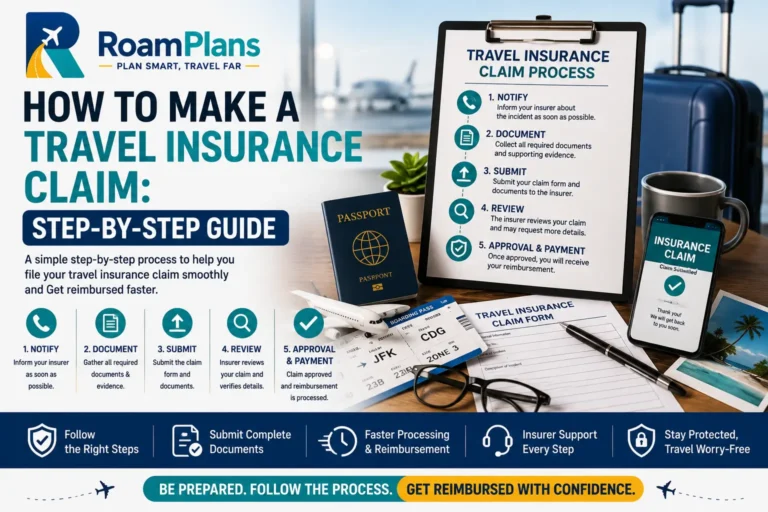
Related RoamPlans guide: How to Make a Travel Insurance Claim: Step-by-Step Guide explains claim forms, receipts, supporting documents, deadlines, follow-up, denials, and appeals in more detail.
Do Not Submit Only the Total Amount You Lost
A claim is easier to understand when each expense is explained separately.
Instead of:
“My trip cost $8,000 and I want $8,000 back.”
show:
- ✓Flight cost
- ✓Airline refund
- ✓Hotel cost
- ✓Hotel refund
- ✓Tour cost
- ✓Tour refund
- ✓Remaining eligible loss
That gives the insurer a clear financial trail.
Keep Credits and Refunds Transparent
If a travel provider gives you a credit, voucher, partial refund, or rebooking option, keep the documentation.
Do not hide it because you think it will reduce the insurance payment.
The insurer decides how those amounts affect the claim under the policy.
Accurate documentation protects the credibility of your claim.
How Long Should You Keep Cancellation Documents?
Keep the relevant records until the claim and any review process are fully complete.
Useful records include:
- ✓Policy
- ✓Claim form
- ✓Medical evidence
- ✓Booking invoices
- ✓Refund statements
- ✓Credits
- ✓Insurer correspondence
- ✓Claim decision
Do not delete emails just because the trip date has passed.
What If Your Trip Cancellation Claim Is Denied?
A denial does not automatically mean the claim was handled incorrectly.
It also does not mean you should accept an unclear explanation without reviewing it.
Read:
- ✓Reason for denial
- ✓Policy provision cited
- ✓Exclusion cited
- ✓Missing-document request
- ✓Calculation of the loss
Then compare the explanation with your policy.
Common Reasons a Cancellation Claim May Fail
Depending on the policy and circumstances, problems can include:
- ✓Cancellation reason is not covered
- ✓An exclusion applies
- ✓Pre-existing-condition rules affect the claim
- ✓Required documents are missing
- ✓Expense was refundable
- ✓Claim was filed outside required procedures
- ✓Loss exceeds the applicable limit
- ✓CFAR requirements were not met
- ✓Another policy condition was not satisfied
The exact reason should come from the insurer’s written explanation.
Ask Whether Additional Evidence Can Be Submitted
If documentation is the problem, ask:
What exactly is missing?
For example:
- ✓Doctor statement
- ✓Airline confirmation
- ✓Proof of payment
- ✓Refund statement
- ✓Supplier cancellation policy
Then ask whether the claim can be reconsidered after you provide it.
Keep a Communication Log
For any significant claim, keep a record of:
- ✓Dates
- ✓Calls
- ✓Emails
- ✓Names
- ✓Reference numbers
- ✓Documents submitted
NAIC’s March 2026 complaint guidance recommends keeping policy details, records, documentation, and a history of communications if a consumer later needs help from a state insurance department.
When to Contact a State Insurance Department
For U.S. consumers, first try to resolve the problem directly with the insurer.
If a serious issue remains unresolved, the state department of insurance can handle complaints about matters such as unfair claim delays or denials, failure to honor a policy, lack of timely communication, or possible violations of state insurance rules.
NAIC says state insurance departments can also answer consumer questions about travel insurance.
Common Trip Cancellation Insurance Mistakes
A useful cancellation policy can still disappoint if you misunderstand how it works.
Mistake 1: Assuming Every Cancellation Is Covered
Standard cancellation depends on covered reasons.
Mistake 2: Buying Based Only on the Coverage Amount
100% trip cancellation coverage means little if your reason does not qualify.
Mistake 3: Ignoring Refundable Bookings
Calculate the money you could actually lose.
Mistake 4: Waiting Too Long to Review Insurance
Time-sensitive options can disappear, and known events may not be covered by newly purchased insurance.
Mistake 5: Assuming CFAR Means 100% Back
NAIC says CFAR generally reimburses only a portion of trip expenses and normally comes with additional eligibility and cancellation conditions.
Mistake 6: Ignoring Pre-Existing-Condition Rules
Medical history can affect cancellation claims depending on policy terms.
Mistake 7: Not Reading Family-Member Definitions
A person you consider family may not fit the policy definition.
Mistake 8: Failing to Keep Supplier Refund Records
The insurer needs to see the remaining financial loss.
Mistake 9: Canceling Without Checking the Policy
Where circumstances allow, understand the relevant benefit before making an expensive decision.
Mistake 10: Losing Claim Documentation
Keep evidence from the moment the problem begins.
Related RoamPlans guide: Travel Insurance Mistakes to Avoid Before and During Your Trip covers the wider errors travelers make when buying coverage, reading exclusions, documenting losses, and using insurance during a trip.
A 10-Minute Trip Cancellation Policy Check
Before buying, I would run through this quick review.
Minute 1: Find the Cancellation Limit
How much is insured?
Minute 2: Find Covered Reasons
Does the list include the risks you care about?
Minute 3: Find Medical Cancellation Rules
What evidence is required?
Minute 4: Search “Pre-Existing”
Could medical history affect the benefit?
Minute 5: Find Family-Member Definition
Who actually qualifies?
Minute 6: Find Traveling-Companion Definition
Who is included?
Minute 7: Review Exclusions
What important risks remain uninsured?
Minute 8: Search CFAR
If available, what percentage, deadlines, and conditions apply?
Minute 9: Check Claim Requirements
What documentation would you need?
Minute 10: Compare Your Non-Refundable Cost
Does the coverage match the financial loss you actually face?
If an important answer is unclear, I would investigate before buying.
Final Trip Cancellation Insurance Checklist
Before Buying
- ✓Calculate total prepaid trip cost
- ✓Separate refundable expenses
- ✓Calculate non-refundable exposure
- ✓Identify main cancellation risks
- ✓Compare several suitable policies
- ✓Read covered reasons
- ✓Read exclusions
- ✓Check maximum cancellation benefit
Medical Cancellation
- ✓Illness conditions checked
- ✓Injury conditions checked
- ✓Doctor-documentation requirements checked
- ✓Pre-existing-condition definition checked
- ✓Waiver eligibility checked where relevant
Other Cancellation Risks
- ✓Severe weather terms checked
- ✓Transportation disruption checked
- ✓Natural disaster terms checked
- ✓Employment-related reasons checked if important
- ✓Legal-obligation reasons checked if important
- ✓Supplier-default terms checked if important
Family and Companions
- ✓Family-member definition checked
- ✓Traveling-companion definition checked
- ✓Shared trip costs understood
- ✓Coverage for each traveler confirmed
CFAR
- ✓CFAR availability checked
- ✓Purchase deadline checked
- ✓Reimbursement percentage checked
- ✓Insured-trip-cost requirement checked
- ✓Cancellation deadline checked
After Buying
- ✓Policy saved
- ✓Full wording downloaded
- ✓Insured trip cost correct
- ✓Travel dates correct
- ✓Policy number saved
- ✓Claims contact saved
If You Must Cancel
- ✓Read applicable covered reason
- ✓Contact insurer
- ✓Contact travel suppliers
- ✓Cancel bookings promptly where appropriate
- ✓Request refunds
- ✓Record travel credits
- ✓Collect supporting evidence
- ✓Calculate remaining financial loss
- ✓Submit claim according to policy
- ✓Keep copies of everything
Frequently Asked Questions
Trip cancellation insurance can reimburse eligible prepaid, non-refundable trip costs when you cancel for a reason covered by the policy. Current NAIC examples include certain serious illnesses or injuries, qualifying family emergencies, severe weather, transportation disruptions, natural disasters, and some legal obligations. Coverage varies by policy.
Standard trip cancellation insurance generally does not. The reason normally must be covered by the policy.
It can when illness meets the policy conditions. NAIC gives illness or injury affecting the traveler or travel companion as examples of reasons that may qualify.
It can depending on the policy. NAIC includes hospitalization or death of a non-traveling family member among current examples of potentially covered reasons.
Not always. Pre-existing medical conditions are a common exclusion area, although specific policies may provide different treatment or waiver options.
Certain severe weather events may qualify depending on the policy and resulting disruption. A poor vacation weather forecast alone should not be assumed to create coverage. NAIC includes severe weather among current examples of potentially covered trip disruptions.
Some policies may cover qualifying natural disasters affecting your home or destination. NAIC currently lists this as an example of an event that can fall under cancellation/interruption coverage.
It may when the transportation problem meets the policy’s covered conditions. Airline refunds, rebooking, delay benefits, and cancellation insurance should be checked separately.
Standard cancellation insurance should not be assumed to cover a simple change of mind. Broader CFAR protection may provide more flexibility when available.
CFAR is an optional form of broader cancellation protection that can allow cancellation for reasons outside the standard covered list. NAIC says it typically reimburses only part of trip expenses and comes with purchase and cancellation conditions.
Usually not. NAIC’s current travel-insurance guidance describes typical CFAR reimbursement as approximately 50%–75% of total trip price.
Consider comparing coverage soon after making meaningful non-refundable trip payments, especially if time-sensitive benefits matter. NAIC also warns that waiting until a storm is already named may leave losses related to that known storm uncovered.
Its cancellation value may be lower if most of your expenses can already be refunded. Calculate the amount you could actually lose before deciding.
Depending on the plan, eligible prepaid and non-refundable travel expenses can be reimbursed when a covered cancellation occurs. The exact definition of insured trip cost belongs to the policy.
Eligible non-refundable hotel costs may be included when the cancellation reason and expense satisfy policy terms.
Eligible prepaid, non-refundable flight costs can be part of a cancellation claim when the policy conditions are met.
Keep documentation showing the credit amount and conditions and ask the insurer how it affects the remaining eligible loss.
Record the refund. Your remaining financial loss is different once money has been returned.
Requirements depend on the reason, but commonly useful records include booking confirmations, proof of payment, supplier refund information, and evidence supporting the reason for cancellation.
If circumstances allow, review the policy and contact your insurer first. You also need to check supplier refunds and minimize avoidable financial loss.
Read the denial and policy provision cited. Ask whether additional evidence or an internal review is available. If a serious unresolved problem remains, U.S. consumers can contact their state insurance department; NAIC says state regulators can investigate issues such as unfair claim delays or denials.
Final Thoughts
Trip cancellation insurance makes the most sense when you understand exactly what money you are trying to protect.
When I plan a trip, I start by separating:
money already paid
from
money I could actually lose.
Then I identify the realistic situations that could stop the trip.
Only after that do I compare insurance.
A policy that says:
100% trip cancellation
may sound reassuring.
But that number is only useful when the cancellation reason qualifies, the expense is eligible, exclusions do not apply, and you can provide the required evidence.
It is to protect meaningful prepaid, non-refundable expenses from the specific cancellation risks you decide are worth transferring to an insurer.

Adnan Ahmed
RoamPlans AuthorTravel Planning Researcher & Editor
Adnan Ahmed is the travel planning researcher and editor behind RoamPlans. He creates clear, practical guides to help travelers compare destinations, plan routes, estimate costs, and avoid common trip-planning mistakes. His work combines careful source research, official travel information, and regular content reviews to keep each guide useful and current.
- ✓Destination Research
- ✓Budget Planning
- ✓Route Planning
- ✓Beginner Travel Guides



Turn This Guide into a Practical Trip Plan
Use the recommended Airline Baggage Allowance Checker or explore more free RoamPlans tools.