What Does Travel Insurance Cover — and What Does It Not Cover?
Travel insurance can look broad when you first read a benefit ↗ summary. You may see trip cancellation, medical care, baggage, delays, and emergency evacuation listed together and assume almost any travel problem will be covered.
When I compare a policy, I look at it differently. I check each benefit separately and ask three questions: What event triggers this benefit? What is the maximum amount the policy can pay? What situations are excluded? That gives a much clearer picture than relying on phrases such as “comprehensive coverage.”
This distinction matters because travel insurance does not cover every problem that happens during a trip. The National Association of Insurance Commissioners (NAIC) says policies can cover areas such as trip cancellation, interruption, delays, baggage problems, medical emergencies, and evacuation, but every policy sets its own limits and defines what it will and will not cover.
For international travelers, I also check the medical section carefully. The U.S. Department of State recommends reviewing travel medical and medical evacuation protection because normal U.S. health coverage may not provide the same protection abroad.
What is covered by travel insurance? Depending on the policy, it can reimburse eligible losses from covered trip cancellations or interruptions, medical emergencies, evacuation, travel delays, missed connections, and baggage problems. What does travel insurance not cover? Common exclusions include changing your mind, known or foreseeable events, excluded pre-existing conditions, uncovered high-risk activities, unlawful or reckless conduct, unattended belongings, losses outside the policy dates or limits, and claims without required evidence.
| Travel problem | When it may be covered | When it is commonly not covered |
|---|---|---|
| Canceling a trip | A reason specifically named in the policy occurs | You simply change your mind or the reason is excluded |
| Medical care abroad | An eligible unexpected illness or injury occurs during the trip | The condition, treatment, activity, or destination is excluded |
| Flight delay or missed connection | The cause and minimum delay satisfy the relevant benefit | The wait is too short, the cause is excluded, or no eligible expense is incurred |
| Lost, stolen, or delayed baggage | The loss meets the baggage benefit and documentation rules | The item is excluded, left unattended, over a sublimit, or not properly reported |
A benefit appearing on a policy summary does not mean every event related to that benefit is covered. The actual policy wording, definitions, exclusions, limits, deductibles, and claim conditions decide whether a loss qualifies.
Key Takeaways
-
✓Travel insurance can cover several different types of travel losses, but coverage varies by policy.
-
✓Trip cancellation usually applies only when the reason meets the policy’s covered conditions.
-
✓Trip interruption deals with qualifying problems after the trip has already started.
-
✓Travel medical insurance can cover eligible medical expenses incurred during travel.
-
✓Emergency medical evacuation is different from ordinary medical treatment.
-
✓Baggage loss, baggage delay, and travel delay are separate benefits.
-
✓Some policies include missed-connection or rental-vehicle benefits.
-
✓Pre-existing medical conditions and higher-risk activities can be excluded or restricted depending on the plan.
-
✓Each benefit can have its own maximum amount, deductible, waiting period, and documentation rules.
-
✓The safest way to compare coverage is to read the full policy, not only the sales page.
What Does Travel Insurance Usually Cover?

A comprehensive travel insurance policy may combine several forms of protection.
NAIC identifies common travel insurance categories including:
-
✓Trip cancellation
-
✓Trip interruption
-
✓Trip delay
-
✓Baggage loss or delay
-
✓Emergency medical or dental expenses
-
✓Emergency transportation or evacuation
-
✓Other travel-related benefits depending on the policy
Not every policy contains every benefit.
Even when two policies use the same benefit name, their limits and conditions can be very different.
For example, two plans may both advertise trip cancellation, but one may insure $5,000 of eligible prepaid costs while another may insure $20,000.
The benefit name is only the beginning of the comparison.
Coverage Comes With Conditions
Travel insurance generally works when three things line up:
A covered event happens
The loss falls within a policy benefit
You meet the policy conditions
For example, simply losing money does not automatically create a covered claim.
The policy may require:
-
✓A specific covered reason
-
✓A minimum delay period
-
✓Supporting documents
-
✓Timely reporting
-
✓Insurer approval
-
✓Other benefit-specific conditions
NAIC advises consumers to ask exactly what a policy covers because each plan sets its own limits and covered situations.
What Is a Covered Reason?
A covered reason is an event specifically recognized by the policy as potentially eligible for a benefit.
This term is especially important for trip cancellation and interruption.
A policy might list certain events involving:
-
✓Illness
-
✓Injury
-
✓Death
-
✓Severe weather
-
✓Transportation problems
-
✓Other stated circumstances
But the exact list belongs to the policy.
I would never assume:
“This is a serious problem, so insurance must cover it.”
Instead, I would find the benefit section and check whether that particular reason appears within the coverage.
What Is an Exclusion?
An exclusion is a situation, activity, condition, or loss the policy says it does not cover.
Exclusions can be just as important as the benefits themselves.
Depending on the plan, exclusions may involve areas such as:
-
✓Certain pre-existing medical conditions
-
✓Higher-risk recreational activities
-
✓Known or foreseeable events
-
✓Other situations specifically excluded by the contract
NAIC advises travelers to review exclusions carefully and lists pre-existing health conditions and certain dangerous activities among areas that may be excluded.
A policy can have a large coverage limit and still be a poor fit if the situation you care about falls under an exclusion.
Covered Does Not Mean Unlimited
Every major benefit can have a limit.
For example:
Trip cancellation: up to the insured trip cost or stated maximum
Emergency medical: up to the medical benefit limit
Baggage: up to the baggage limit, sometimes with smaller per-item limits
Travel delay: up to a daily or total maximum
Medical evacuation: up to the evacuation benefit limit
The policy schedule usually shows these amounts.
Always compare the limit with the financial risk you are trying to protect.
What Does Trip Cancellation Insurance Cover?
Trip cancellation insurance generally applies when a covered event prevents you from taking the trip before departure.
NAIC describes trip cancellation coverage as reimbursement for eligible prepaid travel expenses when a traveler cannot take a trip for a reason covered by the policy.
Depending on the plan, eligible prepaid costs may involve:
-
✓Flights
-
✓Hotels
-
✓Cruises
-
✓Tours
-
✓Other non-refundable travel arrangements
However, simply deciding not to travel is not automatically covered.
The reason for cancellation has to fit the policy.
Common Trip Cancellation Situations
Policies vary, but covered cancellation reasons can involve events such as certain:
-
✓Illnesses
-
✓Injuries
-
✓Deaths
-
✓Severe weather disruptions
-
✓Transportation problems
-
✓Other events named in the contract
Do not build your expectations from a generic online list.
Read the exact policy you are considering.
If one particular cancellation risk matters to you, search for it specifically in the policy.
What Trip Cancellation Usually Does Not Mean
Standard cancellation insurance should not be treated as:
“I can cancel whe never I want and receive all my money back.”
Standard coverage generally requires a qualifying covered reason.
Broader cancellation protection may be available through products such as Cancel for Any Reason coverage, but those options normally have additional conditions and may reimburse only part of the insured trip cost.
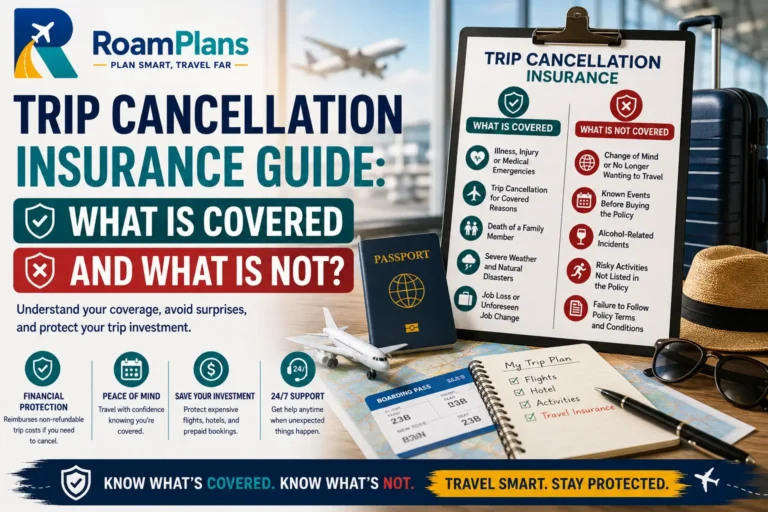
The Trip Cancellation Insurance Guide ↗ explains cancellation reasons, exclusions, timing, and broader cancellation options in detail.
What Does Trip Interruption Insurance Cover?
Trip interruption deals with certain covered problems that occur after the trip has already started.
Imagine a traveler is halfway through a two-week trip when a qualifying emergency forces an early return.
Depending on the policy, interruption coverage may help with eligible:
-
✓Unused prepaid trip costs
-
✓Additional transportation
-
✓Other covered expenses
NAIC includes trip interruption alongside cancellation as a major travel insurance protection.
Trip Cancellation vs Trip Interruption
The easiest distinction is:
Trip cancellation = before departure
Trip interruption = after departure
They can also have different:
-
✓Coverage limits
-
✓Covered reasons
-
✓Reimbursement rules
Do not assume one automatically includes the other.
Check both benefit sections.
What Does Travel Medical Insurance Cover?
Travel medical insurance can cover eligible medical expenses caused by a covered illness or injury during the insured trip.
Depending on the policy, this may involve:
-
✓Doctor visits
-
✓Hospital treatment
-
✓Emergency treatment
-
✓Medical tests
-
✓Certain prescription expenses
-
✓Emergency dental treatment
-
✓Other covered medical services
NAIC describes travel medical coverage as reimbursement for medical and emergency dental expenses arising from illness or injury while traveling.
The State Department also advises international travelers to confirm what medical protection they have abroad before leaving home.
Travel Medical Coverage Is Especially Important to Check Abroad
Your normal U.S. health insurance may not work overseas in the same way it works at home.
The State Department recommends checking:
-
✓Whether medical care abroad is covered
-
✓Whether emergency transportation is covered
-
✓Whether the traveler must pay upfront
-
✓What the insurer requires during an emergency
That means having domestic health insurance does not automatically answer whether separate travel medical coverage is useful.
What Travel Medical Insurance May Not Cover
Medical exclusions vary by policy.
Possible issues can involve:
-
✓Certain pre-existing medical conditions
-
✓Treatment outside the policy period
-
✓Non-emergency or excluded treatment
-
✓Injuries connected to excluded activities
-
✓Other medical situations named in the exclusions
NAIC tells travelers to ask specifically about pre-existing conditions and medical exclusions before buying.
The Travel Medical Insurance Guide for International Travelers ↗ covers medical limits, deductibles, overseas treatment, evacuation, and pre-existing condition rules in more detail.
What Does Emergency Medical Evacuation Cover?

Medical evacuation coverage deals with transportation needed during certain qualifying medical emergencies.
Depending on the plan and medical situation, this may involve:
-
✓Ambulance transport
-
✓Air ambulance
-
✓Transfer to a suitable medical facility
-
✓Other covered emergency transportation
The State Department strongly recommends considering medical evacuation insurance for destinations with higher risk or limited medical care.
Medical Evacuation Is Not the Same as Choosing to Fly Home
This distinction matters.
A traveler cannot necessarily decide:
“I would rather recover at home, so insurance should buy me a flight.”
Medical evacuation benefits can require:
-
✓Medical necessity
-
✓Insurer approval
-
✓Coordination through assistance services
-
✓Transport to a facility selected under the policy terms
Read who decides where you will be transported and when evacuation qualifies.
Why Evacuation Limits Matter
Emergency medical transportation can become extremely expensive.
Current State Department guidance says medical evacuation by air ambulance back to the United States can cost roughly $20,000 to $200,000, depending on location and medical condition.
That makes the evacuation limit worth checking separately from the normal emergency medical limit.
A policy may treat these as two different benefits.
Does Travel Insurance Cover Emergency Dental Care?
Some travel medical policies include emergency dental benefits related to an injury or sudden dental problem.
NAIC includes emergency dental expenses within its description of travel medical coverage.
However, the dental limit can be much lower than the overall medical limit.
Routine dental care is also different from emergency treatment.
Check the exact policy.
Does Travel Insurance Cover Lost Baggage?

Many comprehensive travel insurance plans include baggage protection.
NAIC describes baggage or personal-effects insurance as protection for qualifying luggage and belongings that are:
-
✓Lost
-
✓Stolen
-
✓Damaged
The benefit normally has a maximum amount.
It can also include lower limits for individual items or particular categories of property.
Does Baggage Coverage Pay the Full Cost of Everything?
Not necessarily.
Policies may contain:
-
✓Overall baggage limit
-
✓Per-item maximum
-
✓Special limits for valuables
-
✓Excluded belongings
-
✓Required proof of loss
You should pay special attention if you travel with valuable:
-
✓Electronics
-
✓Cameras
-
✓Jewelry
-
✓Sporting equipment
-
✓Professional equipment
A $2,000 baggage limit does not always mean the insurer will pay $2,000 for one stolen laptop.
Read the per-item rules.
What Is Baggage Delay Coverage?
Baggage delay applies when checked baggage is temporarily delayed rather than permanently lost.
Depending on the policy, it can help reimburse certain necessary purchases such as:
-
✓Basic clothing
-
✓Toiletries
-
✓Other essential items
The bag normally has to remain delayed beyond a stated waiting period.
NAIC treats baggage loss and baggage delay as separate travel coverage categories.
Baggage Loss and Baggage Delay Are Different
Think of them this way:
Baggage delay: your suitcase may still arrive later.
Baggage loss: the suitcase is treated as lost under the relevant process.
Different benefits can apply.
Keep:
-
✓Airline baggage report
-
✓Bag tag
-
✓Receipts
-
✓Reference number
if luggage does not arrive.
What Does Travel Delay Insurance Cover?
Travel delay coverage can reimburse certain additional expenses when a qualifying delay meets the policy requirements.
Eligible costs may include items such as:
-
✓Meals
-
✓Hotel
-
✓Local transportation
-
✓Other necessary expenses defined by the policy
NAIC includes trip delay among the recognized forms of travel insurance coverage.
However, a delay usually has to meet the policy’s required duration and covered cause.
What Does Flight Insurance Cover?
“Flight insurance” can describe a limited policy offered during airline or booking-site checkout, or it can be used informally for flight-related benefits inside a broader travel policy. Depending on the contract, it may cover eligible trip cancellation or interruption, qualifying flight delays, missed connections, and baggage loss or delay.
It does not automatically cover every canceled flight, schedule change, voluntary rebooking, missed departure, or extra expense. Check the named covered reasons, waiting period, reimbursement limits, exclusions, and whether the airline must refund or assist you first.
A Flight Delay Does Not Automatically Create a Claim
Imagine your flight is delayed by two hours.
Your policy may require a longer waiting period before travel-delay coverage begins.
It may also restrict covered reasons.
That means you should check:
-
✓Minimum delay time
-
✓Covered causes
-
✓Daily limit
-
✓Total limit
-
✓Required evidence
before assuming the expense is covered.
What Does Missed Connection Coverage Do?
Some travel policies include a missed-connection benefit.
This can apply when a covered delay causes you to miss certain scheduled onward transportation.
It may be useful for trips involving:
-
✓Multiple flights
-
✓Cruises
-
✓Tours
-
✓Other fixed departures
NAIC’s insurance glossary includes missed connections among travel-related financial losses that travel coverage can address.
Again, the specific trigger belongs to the policy.
Does Travel Insurance Cover Rental Cars?
Some travel insurance products may include rental-vehicle damage coverage, while some credit cards or auto policies may provide separate protection.
NAIC’s definition of travel insurance includes rental vehicle damage among risks that travel insurance can cover.
Do not assume a general travel policy automatically includes full rental-car protection.
Check:
-
✓Vehicle damage
-
✓Theft
-
✓Liability
-
✓Deductible
-
✓Country restrictions
-
✓Excluded vehicle types
These can be separate issues.
One Event Can Trigger Several Benefits
Imagine this sequence:
Severe weather delays your flight overnight.
Your checked baggage also fails to arrive.
You may potentially look at separate benefits for:
-
✓Travel delay
-
✓Baggage delay
But each benefit still has its own rules.
One event does not mean every section of the policy automatically pays.
You would need to check each applicable benefit separately.
What Travel Insurance Coverage Should a Beginner Check First?
For most first-time international travelers, I would start with these five areas:
1. Emergency Medical
Ask:
What happens if I need hospital care abroad?
2. Medical Evacuation
Ask:
What happens if the local hospital cannot provide suitable care?
3. Trip Cancellation
Ask:
How much non-refundable money could I lose before departure?
4. Trip Interruption
Ask:
What happens financially if I must return home early?
5. Major Exclusions
Ask:
Which realistic situations on my trip are specifically excluded?
Once these are clear, baggage and delay benefits become easier to compare.
Do Not Judge Coverage by the Number of Benefits
A policy with 20 listed benefits is not automatically better than one with 12.
The better question is:
Does this policy cover the fin ancial risks that matter on my trip?
For example, I would rather clearly understand:
-
✓Medical limit
-
✓Evacuation
-
✓Cancellation
-
✓Main exclusions
than buy a plan because it lists many small benefits I may never need.
The policy should fit the trip.
The trip should not be forced to fit the policy.
What Does Travel Insurance Cover — and What Does It Not Cover? — Part 2
What Does Travel Insurance Commonly Not Cover?

A long list of benefits can make a travel policy look like complete protection, but every policy has boundaries.
NAIC’s current travel-insurance guidance lists several areas that are commonly excluded in at least some policies, including pre-existing health conditions, pandemics, civil or political unrest, pregnancy and childbirth, and certain higher-risk activities. It also stresses that every policy is different.
This is why I never use a general list of exclusions to decide what one specific policy covers.
I use the list to know what to look for, and then I check the actual contract.
The Difference Between “Not Covered” and “Not Covered in This Situation”
This distinction is important.
Sometimes an entire type of loss is excluded.
Other times, the policy contains the benefit, but your particular event does not meet its conditions.
For example, a policy may contain trip cancellation coverage, but your reason for canceling may not be one of its covered reasons.
Similarly, medical coverage may exist, but an injury connected to an excluded activity may fall outside that protection.
The benefit name alone does not tell the whole story. NAIC recommends reviewing both coverage and exclusions because policy terms vary.
Does Travel Insurance Cover Changing Your Mind?
Standard trip cancellation insurance generally should not be treated as coverage for simply deciding that you no longer want to take the trip.
Normal cancellation benefits depend on covered reasons listed in the policy.
Broader Cancel for Any Reason, or CFAR, options can exist, but they have their own eligibility rules and usually provide only partial reimbursement rather than automatically returning 100% of the trip cost. New York’s Department of Financial Services has similarly warned consumers that CFAR protection is different from standard travel insurance and may reimburse only part of eligible expenses.
So if your concern is:
“What if I simply decide not to travel?”
standard cancellation insurance may not solve that problem.
Fear of Traveling Is Not Automatically a Covered Reason
Suppose news about your destination makes you uncomfortable.
You decide:
I no longer feel comfortable going.
That concern may be completely understandable.
But whether the cancellation is insured depends on the actual covered reasons in your policy.
Do not assume fear, worry, or a personal change of plans automatically qualifies.
Check the contract before canceling an expensive trip based on an assumption about reimbursement.
What About Events You Already Knew About?
Travel insurance is designed around uncertain risks.
A policy purchased after a disruption has already become known should not be assumed to cover losses caused by that existing event.
For example, if you wait until a major problem is already affecting your trip and then buy insurance, the new policy may not treat that existing situation the same way it would have treated an unforeseen future event.
The exact treatment depends on the policy, so read the definitions and exclusions rather than relying on the purchase date alone.
Why Buying Insurance After a Problem Starts Can Be Too Late
Imagine a severe disruption is already affecting your scheduled destination.
You then buy travel insurance because you are worried that your trip will be canceled.
Insurance does not normally work like purchasing a refund guarantee after you already know the risk has appeared.
This is one reason I prefer comparing policies when I begin making meaningful non-refundable bookings rather than waiting until something starts going wrong.
Are Pre-Existing Medical Conditions Covered?
Sometimes they may be.
Sometimes they may be excluded.
NAIC specifically identifies pre-existing health conditions as one of the common travel-insurance exclusion areas and advises travelers to check whether pre-existing conditions affect medical coverage.
The difficult part is that the phrase pre-existing condition can have a policy-specific definition.
Do not decide for yourself that:
“My condition is minor, so it does not count.”
Read the definition used by the insurer.
Pre-Existing Conditions Can Affect More Than Medical Bills
A pre-existing medical condition can matter in more than one section of a travel policy.
Depending on the wording, it could potentially affect claims connected with:
-
✓Medical treatment
-
✓Trip cancellation
-
✓Trip interruption
-
✓Medical evacuation
That is why I would search the entire policy for the phrase pre-existing condition, not just the medical section.
What Is a Pre-Existing Condition Waiver?
Some travel insurance policies can offer a waiver of the normal pre-existing-condition exclusion when certain requirements are met.
Those requirements can differ by plan and may involve when you purchased the coverage or other eligibility conditions.
Do not assume that seeing:
Pre-existing conditions covered
on a comparison page means there are no conditions attached.
Open the full policy and check how the waiver works.
Does Travel Insurance Cover Pregnancy?
Pregnancy and childbirth are among the areas NAIC currently lists as common travel-policy exclusions, although the exact treatment varies by policy.
That does not mean every medical problem involving a pregnant traveler is automatically excluded.
It means pregnancy-related coverage requires careful policy review.
A policy may distinguish between:
-
✓Routine pregnancy-related care
-
✓Childbirth
-
✓Unexpected medical complications
-
✓Trip cancellation connected to pregnancy
-
✓Other emergency treatment
Never assume the same rule applies to all of these situations.
Pregnancy Is a Good Example of Why Definitions Matter
Consider two different situations:
Situation A: A traveler needs routine pregnancy-related care during a planned trip.
Situation B: A traveler experiences an unexpected medical emergency.
Those events are not necessarily treated the same way by an insurance contract.
If pregnancy could affect your trip, ask the insurer directly which benefits and exclusions apply to your circumstances.
For medical advice about whether it is safe for you to travel, speak with your healthcare professional.
Insurance coverage and medical fitness to travel are separate questions.
Does Travel Insurance Cover Pandemics?
NAIC currently identifies pandemics as one of the common exclusion areas found in travel policies.
However, you should not turn that into a universal statement that every policy excludes every pandemic-related loss.
Policy wording can change.
Coverage may also depend on:
-
✓The specific benefit
-
✓The reason for cancellation
-
✓Medical treatment terms
-
✓When the policy was purchased
-
✓Other policy definitions
Search the actual policy for terms related to epidemics, pandemics, and infectious disease if this risk matters to you.
Does Travel Insurance Cover Civil or Political Unrest?
Civil and political unrest at the destination is another area NAIC lists among common travel-policy exclusions.
Again, policy-specific wording matters.
Do not assume that:
protest at destination = automatic cancellation reimbursement
or:
political unrest = never covered.
Find the exact section dealing with the event.
Travel Advisories Do Not Automatically Decide Insurance Coverage
Government travel advisories are important for safety planning.
But an advisory and an insurance contract serve different purposes.
A government warning does not automatically tell you whether a particular cancellation, interruption, or evacuation claim qualifies.
For insurance, you still need to check:
-
✓Covered reason
-
✓Exclusion
-
✓Effective date
-
✓Destination wording
-
✓Other policy conditions
Use official travel advice for the travel decision and policy wording for the insurance decision.
Does Travel Insurance Cover Adventure Activities?
Not always.
NAIC specifically identifies higher-risk activities such as bungee jumping, backcountry skiing, and snowboarding among examples that may be excluded by travel policies. Its consumer guidance also warns that medical evacuation coverage may exclude activities the insurer considers dangerous.
That makes activity coverage especially important when the activity is one of the main reasons for your trip.
Do Not Assume “Adventure Sports Covered” Means Every Activity Is Covered
Policies may classify activities differently.
A plan might cover one type of skiing but place conditions on another activity.
The wording could also depend on factors such as:
-
✓Whether the activity is recreational
-
✓Whether you are competing
-
✓Location
-
✓Altitude
-
✓Certification
-
✓Equipment
-
✓Other policy-specific conditions
Do not rely on the marketing category.
Search for your actual activity.
Rela ted RoamPlans guide: Adventure Travel Insurance ↗: What Activities Are Covered? explains how to check sports, trekking, skiing, diving, evacuation, equipment, and activity exclusions before buying.
Medical Evacuation Can Also Have Activity Exclusions
This is easy to overlook.
A traveler may check:
Emergency medical evacuation — included
and feel protected.
But NAIC warns that evacuation coverage may not apply when the injury occurs during an activity the insurer considers dangerous, and notes that specialist insurance products exist for some activities.
So for an adventure trip, check both:
Is the medical tr eatment covered?
and
Is evacuation after this activity covered?
Does Travel Insurance Cover Illegal Activity?
You should never assume insurance will protect the financial consequences of breaking the law.
Policy exclusions can contain restrictions tied to particular acts or circumstances, and the exact wording depends on the insurer and plan.
For travelers, the practical rule is simple:
Read the general exclusions section and follow the laws of the destination.
If a particular situation matters to your trip, ask the insurer how the exclusion applies before relying on coverage.
What About Alcohol or Drug-Related Incidents?
Travelers sometimes assume that any accidental injury abroad is covered because the policy includes emergency medical treatment.
That is too broad.
Some policies can contain exclusions or limitations connected to particular conduct or circumstances.
Because the wording varies, do not rely on a general internet statement such as:
“Alcohol-related accidents are always covered.”
or:
“Alcohol-re lated accidents are never covered.”
Search the policy’s general and medical exclusions and ask the insurer if the wording is unclear.
Does Travel Insurance Cover Reckless Behavior?
Insurance is not a license to ignore normal safety precautions.
Policies may contain terms that affect losses arising under particular circumstances, and higher-risk activities are a known exclusion area in travel insurance.
If the trip involves something unusual or high risk, confirm coverage before participating.
Do not make the first policy review after an accident.
Does Travel Insurance Cover Unattended Belongings?
Baggage coverage should not be treated as unlimited protection for anything you leave anywhere.
A policy can contain conditions about:
-
✓How loss or theft must occur
-
✓Reporting requirements
-
✓Evidence
-
✓Maximum limits
-
✓Excluded property
-
✓Other baggage-specific rules
So if expensive belongings are important to your trip, read the baggage exclusions and definitions carefully.
Theft Must Usually Be Documented Properly
If something is stolen, documentation can become important.
Depending on the circumstances and policy, you may need evidence from:
-
✓Police
-
✓Airline
-
✓Hotel
-
✓Transportation provider
-
✓Other responsible authority
Do not wait until returning home to think about documentation.
Report the incident while you are still at the destination whenever it is safe and appropriate to do so.
Does Travel Insurance Cover Cash?
Do not assume cash receives the same protection as normal baggage.
Travel policies can place special restrictions on particular property or exclude certain items.
Before traveling with a significant amount of cash, search the policy for:
-
✓Cash
-
✓Currency
-
✓Money
-
✓Negotiable instruments
-
✓Valuables
If you cannot find clear wording, ask the insurer.
Does Travel Insurance Cover Expensive Electronics?
Possibly, but the amount can be much lower than the overall baggage benefit.
Policies can use:
-
✓Per-item limits
-
✓Category limits
-
✓Overall baggage limits
That is why someone traveling with a $3,000 camera should not simply see:
Baggage coverage: $3,000
and assume the entire camera value would be reimbursed.
Look at individual-item limits and exclusions.
Does Travel Insurance Cover Phones and Laptops?
They may fall within baggage or personal-property coverage depending on the policy, but electronics can be subject to special limits or conditions.
Before relying on the policy for expensive technology, check:
-
✓Per-item limit
-
✓Theft requirements
-
✓Damage rules
-
✓Excluded causes
-
✓Proof of ownership
Your homeowners, renters, or other insurance may also provide some protection, so check existing coverage before paying for overlapping benefits.
Airline Compensation and Travel Insurance Are Not the Same Thing
When an airline delays your flight or baggage, there may be more than one possible source of help.
These can include:
-
✓Airline responsibility
-
✓Credit-card benefits
-
✓Travel insurance
-
✓Other applicable protections
Travel insurance does not automatically replace an airline’s own obligations.
Likewise, an airline refusing to reimburse one expense does not automatically mean travel insurance will pay it.
Each system has its own rules.
Ask the Airline for Documentation
When a delay, cancellation, or baggage problem happens, ask the airline for written confirmation where available.
Useful evidence may include:
-
✓Delay notice
-
✓Cancellation notice
-
✓Reason given
-
✓New itinerary
-
✓Baggage report
-
✓Property irregularity report
-
✓Rebooking information
That documentation can make it much easier to show what happened if you later file an insurance claim.
Does Travel Insurance Cover a Missed Flight Because You Were Late?
Do not assume missed-connection coverage protects every missed flight.
If you oversleep, leave for the airport too late, or misjudge transportation time, the policy may treat that very differently from a qualifying delay caused by a covered event.
Check what the missed-connection benefit actually requires.
The phrase:
missed connection
does not mean:
every connection you personally miss.
Does Travel Insurance Cover Bad Weather?
It can, depending on the policy and benefit.
Weather can potentially affect:
-
✓Cancellation
-
✓Interruption
-
✓Travel delay
-
✓Missed connections
But the event normally has to satisfy the policy terms.
A rainy vacation is very different from a covered transportation disruption caused by severe weather.
Read the trigger.
Bad Weather Does Not Mean a Bad Vacation Is Insured
Suppose you book a beach holiday.
It rains every day.
You are disappointed, but all flights operate, your hotel is open, and the trip continues.
Do not assume travel insurance reimburses the vacation because the weather ruined your plans.
Insurance normally addresses covered financial losses, not whether the experience met your expectations.
Does Travel Insurance Cover Natural Disasters?
A natural disaster can potentially affect several travel benefits, depending on the policy.
But timing and definitions matter.
You should check:
-
✓What event qualifies
-
✓Whether your destination or accommodation must become unusable
-
✓Whether transportation must be disrupted
-
✓When you purchased the policy
-
✓Whether any exclusion applies
Do not wait until a major event is already known before reading how your policy handles it.
Does Travel Insurance Cover War?
Do not assume it does.
Political and civil unrest are already identified by NAIC as common exclusion areas in travel policies.
War-related circumstances can have separate policy language.
If you are traveling somewhere affected by armed conflict or serious instability, read the relevant exclusions carefully and review current official travel advice before making decisions.
Does Travel Insurance Cover Terrorism?
Some policies may address terrorism separately from war, political unrest, or civil disturbance.
The definition and eligibility rules can be narrow.
Do not assume that an event described as terrorism in the news automatically meets your insurer’s definition.
Read:
-
✓Definition
-
✓Geographic requirement
-
✓Timing
-
✓Cancellation conditions
-
✓Exclusions
in your specific plan.
Does Travel Insurance Cover Government Border Closures?
Coverage for border closures or government actions should never be assumed.
Whether a loss qualifies depends on the policy and the exact cause of the disruption.
This became an important lesson for travelers during large global disruptions: the fact that travel becomes impossible does not automatically mean every travel policy reimburses every loss.
Search specifically for government action, border restrictions, and related exclusions where relevant.
Does Travel Insurance Cover Visa Problems?
Usually, you should not assume insurance will pay simply because you failed to obtain the required travel documents.
Getting the correct:
-
✓Passport
-
✓Visa
-
✓ETA
-
✓Entry permit
-
✓Other documents
is part of normal trip preparation.
If a document issue could affect your travel, read the cancellation exclusions rather than assuming a denied visa or invalid passport is covered.
Does Travel Insurance Cover Passport Loss?
Travel insurance and travel-assistance services may provide certain benefits or assistance connected to lost travel documents, depending on the plan.
But losing a passport does not automatically mean the insurer pays every resulting expense.
The policy may distinguish between:
-
✓Assistance replacing documents
-
✓Certain covered expenses
-
✓Trip delay
-
✓Other related losses
Check the actual benefits rather than relying on the word assistance.
Travel Assistance Is Not Always Insurance Coverage
A plan may advertise 24-hour assistance that can help travelers locate medical facilities, arrange services, or deal with travel problems.
That service can be valuable.
But assistance does not automatically mean the insurer pays the cost of everything it helps arrange.
For example:
help finding a hospital
is different from:
insurance paying the hospital bill.
Always check which part is an assistance service and which part is an insured benefit.
Does Travel Insurance Cover Rental-Car Accidents?
Some travel policies can include rental-car damage benefits, but they should not be confused with complete auto insurance.
A rental-car accident can raise several different questions:
-
✓Damage to rental vehicle
-
✓Liability to another driver
-
✓Medical injury
-
✓Personal belongings
-
✓Roadside costs
Do not assume one travel-insurance benefit handles all of them.
Check your rental agreement, personal auto insurance, credit-card protection, and travel policy separately.
Does Travel Insurance Cover Everything Stolen From a Rental Car?
Do not assume so.
Baggage coverage and vehicle-damage coverage are different benefits.
If belongings are stolen from a rental car, the policy’s baggage conditions and exclusions matter.
If the vehicle itself is damaged, a separate rental-car benefit may apply.
Always match the loss to the correct coverage section.
What About Problems Caused by a Tour Operator or Travel Supplier?
Supplier problems can create complicated coverage questions.
For example:
-
✓Tour canceled
-
✓Hotel closed
-
✓Airline failed
-
✓Travel supplier stopped operating
Whether your insurance responds depends on the reason, benefit, and policy wording.
Do not assume:
supplier will not refund me = insurer must refund me.
Check the specific financial-default, cancellation, or other applicable provisions where the policy contains them.
What If You Simply Do Not Enjoy the Trip?
Travel insurance does not exist to guarantee satisfaction.
Examples such as:
-
✓Hotel was disappointing
-
✓Destination was boring
-
✓Food was not enjoyable
-
✓Weather was unpleasant
-
✓You changed your mind about the itinerary
should not be treated as automatically insured losses.
Insurance is tied to qualifying events and financial losses under the policy.
It is not a vacation satisfaction guarantee.
What Happens When Several Exclusions Seem to Apply?
If you cannot understand whether an exclusion applies, do not guess.
Ask the insurer or licensed agent a specific question.
Instead of saying:
“Am I fully cove red?”
ask:
“If I need medical treatment after participating in this exact activity at this destination, does the policy’s activity exclusion apply?”
Specific questions usually produce more useful answers.
Where possible, keep the response in writing.
Read the General Exclusions and the Benefit-Specific Exclusions
A policy can contain exclusions in more than one place.
I would check:
General Exclusions
Rules affecting much of the policy.
Medical Exclusions
Restrictions applying specifically to medical benefits.
Cancellation Exclusions
Restrictions affecting cancellation or interruption.
Baggage Exclusions
Property or circumstances not covered.
Activity Exclusions
Sports or activities restricted by the plan.
Do not stop after reading one exclusion list.
Limits Can Reduce Coverage Even When the Claim Is Valid
Something can be covered and still not be paid in full.
Imagine:
Covered baggage loss: $2,000
but:
Per-item maximum: $500
If a qualifying $1,500 camera is stolen, the per-item limit may matter even if the overall baggage benefit is higher.
The same concept can apply to:
-
✓Medical care
-
✓Dental
-
✓Delay
-
✓Baggage
-
✓Cancellation
-
✓Other benefits
Coverage and full reimbursement are not the same thing.
Deductibles Can Also Affect What You Receive
Suppose your policy has an applicable:
$250 medical deductible
and you have:
$600 in eligible medical expenses.
The deductible can affect how much the policy pays under its terms.
When comparing plans, I look at:
benefit limit + deductible + exclusions
together.
A large coverage number alone is not enough.
Waiting Periods Matter for Delay Benefits
Travel-delay and baggage-delay benefits can require the problem to continue for a specified period before coverage begins.
For example, a policy might not treat a short inconvenience the same way it treats an overnight disruption.
Never assume:
delay = immediate reimbursement.
Check:
-
✓Required number of hours
-
✓Covered reason
-
✓Maximum reimbursement
-
✓Necessary receipts
before spending money based on expected insurance reimbursement.
Documentation Can Decide Whether a Covered Loss Is Payable
Even when the event appears covered, the insurer may need evidence.
Depending on the situation, useful documents can include:
-
✓Medical records
-
✓Doctor statement
-
✓Airline notice
-
✓Baggage report
-
✓Police report
-
✓Receipts
-
✓Proof of payment
-
✓Original booking
-
✓Refund statement
Insurance claims are easier to support when you document the event while it is happening.
Coverage Can Also Depend on Reporting the Problem
Certain losses may need to be reported promptly to:
-
✓Airline
-
✓Police
-
✓Hotel
-
✓Insurer
-
✓Emergency assistance provider
depending on the event and policy.
For example, if baggage is missing after a flight, report it before leaving the airport where possible.
If an item is stolen, obtain appropriate local documentation where required and safe to do so.
Do not assume you can rebuild all the evidence after returning home.
A Simple Way to Read an Exclusion
When I find an exclusion, I use four questions.
1. What Exactly Is Excluded?
Look for the definition.
2. Which Benefits Does It Affect?
Medical?
Cancellation?
Evacuation?
Everything?
3. Is There an Exception to the Exclusion?
Read the complete paragraph, not just the first line.
4. Does It Matter for My Trip?
An exclusion for an activity you will never do may have little importance.
An exclusion covering the main purpose of your trip is a major issue.
Coverage Should Match Your Real Itinerary
Imagine two travelers buy the same policy.
Traveler One
-
✓City sightseeing
-
✓Museums
-
✓Restaurants
-
✓Standard flights
Traveler Two
-
✓High-altitude trekking
-
✓Remote area
-
✓Adventure activities
The same exclusions can have very different importance for them.
That is why the right question is not:
“Is this a good travel insurance policy?”
It is:
“Is this a good travel insurance policy for this trip?”
My Coverage Check Before Buying
Before I rely on any plan, I want clear answers to these questions:
-
✓What cancellation reasons are covered?
-
✓What cancellation reasons are not covered?
-
✓What medical conditions are excluded?
-
✓How are pre-existing conditions treated?
-
✓Are my activities covered?
-
✓What is excluded from medical evacuation?
-
✓What are the baggage limits?
-
✓What property is restricted?
-
✓What delay waiting periods apply?
-
✓What deductibles apply?
-
✓What documentation will I need?
-
✓Are there exclusions relevant to my destination?
If the important answers are unclear, I keep reading before buying.
The Most Important Rule About Travel Insurance Exclusions
Do not memorize a generic exclusion list and assume it applies everywhere.
NAIC’s April 2026 guidance makes the central point clearly: policies differ, even though common exclusion areas include pre-existing health conditions, pandemics, civil and political unrest, pregnancy and childbirth, and certain risky activities.
Use those examples as warning signs.
Then read the policy you are actually considering.
A good travel insurance decision is not knowing that the plan has cancellation, medical, and baggage coverage.
It is knowing when those benefits apply, where they stop, and which risks you would still have to pay for yourself.
What Does Travel Insur ance Cover — and What Does It Not Cover? — Part 3
Travel Insurance Coverage at a Glance

After reading the benefits and exclusions separately, I find it helpful to put them side by side.
The table below is a general comparison, not a promise of coverage. Travel insurance policies differ, and the actual contract always controls what is covered. NAIC specifically advises travelers to review a policy’s benefits, limits, and exclusions rather than assuming every travel problem is included.
| Travel Problem | May Be Covered When | May Not Be Covered When |
|---|---|---|
| Trip cancellation | A listed covered reason forces you to cancel | You simply change your mind or the reason is excluded |
| Trip interruption | A covered event forces you to end the trip early | The interruption does not meet policy conditions |
| Emergency medical care | You have a covered illness or injury during the trip | Treatment or circumstances fall under an exclusion |
| Medical evacuation | Medically necessary transport meets policy conditions | Transport is not authorized or the cause is excluded |
| Baggage loss | Eligible belongings are lost, stolen, or damaged | Property or circumstances are excluded |
| Baggage delay | Checked baggage is delayed beyond the required period | Delay is shorter than the waiting period |
| Travel delay | A covered delay lasts long enough to qualify | The cause or duration does not qualify |
| Missed connection | A covered delay causes an eligible missed connection | You simply arrive late for reasons outside the benefit |
| Adventure injury | The activity is specifically allowed | The sport or activity is excluded |
| Rental-car damage | The policy includes eligible rental vehicle protection | Vehicle, country, or type of damage is excluded |
NAIC’s travel-insurance guidance recognizes benefits including cancellation, interruption, delays, baggage, medical protection, evacuation, missed connections, and rental-vehicle damage, but individual policies define the conditions for those benefits.
The Word “Covered” Needs Three More Questions
When I see a benefit described as covered, I immediately ask:
1. Covered for What Reason?
The event must normally fit the policy.
2. Covered Up to How Much?
Every benefit may have a limit.
3. Covered Under What Conditions?
There may be:
-
✓Deductibles
-
✓Waiting periods
-
✓Reporting requirements
-
✓Pre-authorization
-
✓Documentation requirements
-
✓Other conditions
This keeps me from reading:
Emergency medical coverage included
and assuming:
Every medical expense abroad will be paid.
Those statements are not the same.
Example 1: You Become Sick During Your Trip
Imagine you develop a serious illness while traveling abroad and need hospital treatment.
A travel medical benefit may help if:
-
✓The illness qualifies
-
✓Treatment occurs during the insured period
-
✓The destination is covered
-
✓No applicable exclusion removes coverage
-
✓You follow required claim procedures
Travel medical insurance is specifically designed for short-term medical care arising from covered illness or injury during travel.
But you would still need to check:
-
✓Medical limit
-
✓Deductible
-
✓Pre-existing condition rules
-
✓Primary or secondary coverage
-
✓Authorization requirements
The phrase medical coverage included does not answer those questions.
Example 2: You Decide Not to Travel
Suppose nothing has happened to your flight, hotel, health, or destination.
You simply change your mind.
Standard trip cancellation insurance should not automatically be treated as protection for that decision.
Standard coverage generally depends on the reasons listed by the policy.
If flexibility to cancel outside standard covered reasons matters to you, you would need to examine any broader cancellation option available under the plan and its conditions.
This is why the reason for cancellation matters just as much as the amount of cancellation coverage.
Example 3: A Family Emergency Forces You Home
Imagine you are halfway through your trip when a serious covered family emergency requires you to return home.
This may fall under trip interruption rather than trip cancellation because the trip has already started.
Depending on the policy, eligible costs might include:
-
✓Unused prepaid arrangements
-
✓Additional transportation
-
✓Other qualifying expenses
But check how the policy defines:
family member
and
covered emergency.
Your everyday definition may not be identical to the insurance definition.
Example 4: Your Suitcase Arrives Two Days Late
This may involve baggage delay rather than baggage loss.
If the delay exceeds the policy’s required waiting period, eligible essential purchases may qualify for reimbursement.
Keep:
-
✓Baggage report
-
✓Airline reference
-
✓Receipts
-
✓Boarding pass
Do not use the delay as an opportunity to replace an entire wardrobe and assume insurance will pay.
The policy determines which purchases are considered eligible and how much can be reimbursed.
Example 5: Your Bag Is Permanently Lost
Now the relevant benefit may be baggage loss rather than baggage delay.
The insurer may ask for evidence of:
-
✓Airline report
-
✓Contents of the bag
-
✓Ownership
-
✓Item value
Limits can apply both to the entire baggage claim and individual items.
That distinction matters if you travel with expensive electronics, jewelry, cameras, or specialist equipment.
Example 6: Your Flight Is Delayed Overnight
Travel-delay coverage may help with eligible additional costs such as:
-
✓Hotel
-
✓Meals
-
✓Ground transportation
but only if the delay meets the policy conditions.
Check:
-
✓Minimum waiting period
-
✓Covered reason
-
✓Daily maximum
-
✓Total maximum
NAIC includes trip and baggage delay among the common financial losses addressed by travel coverage.
Keep the airline’s written notice and all relevant receipts.
Example 7: You Miss Your Cruise Because Your First Flight Was Delayed
This could potentially involve missed-connection coverage if your policy contains that benefit and the cause meets its terms.
But compare that with a very different scenario:
You arrive at the airport late because you left your hotel too late.
Both situations involve a missed connection.
They do not necessarily create the same insurance result.
This is why the cause matters.
Example 8: You Are Injured While Trekking
Suppose your policy contains:
$100,000 emergency medical coverage
and
$500,000 medical evacuation coverage.
Those numbers look strong.
But if your trekking activity falls under an activity exclusion, the large headline limits may not solve the problem you expected them to solve.
NAIC specifically warns that medical and evacuation coverage may exclude activities an insurer considers dangerous.
For an activity-focused trip, always check the activity before comparing the benefit amount.
Example 9: You Need Medical Evacuation
Imagine you are seriously injured in a remote location and suitable treatment is not available nearby.
Medical evacuation coverage can be particularly important in this situation.
The State Department strongly recommends considering medical evacuation insurance for higher-risk areas and destinations with limited medical care.
It also notes that many ordinary health plans may cover some medical costs abroad without paying to transport you back to the United States by air ambulance.
That is why I check medical treatment and evacuation as separate benefits.
Example 10: Your Vacation Is Ruined by Rain
Your beach trip lasts seven days.
It rains for six.
Your hotel remains open.
Flights operate.
You complete the trip.
You may be disappointed, but travel insurance is not generally a guarantee that a vacation will be enjoyable.
Without an insured loss that meets the policy terms, bad weather alone should not be assumed to create reimbursement.
Insurance protects against specified financial risks.
It does not promise good travel experiences.
How to Check a Travel Insurance Policy in 10 Minutes
A full policy deserves a careful read before purchase, but I use this quick check to find major problems early.
Minute 1: Find the Benefit Schedule
Look for:
-
✓Medical
-
✓Evacuation
-
✓Cancellation
-
✓Interruption
-
✓Baggage
-
✓Delays
This gives you the headline limits.
Minute 2: Check the Medical Limit
Ask:
Would this amount be appropriate for the trip I am taking?
For international travel, the State Department recommends checking whether your existing health coverage applies abroad and considering separate medical insurance where necessary.
Minute 3: Check Medical Evacuation
Do not assume it shares the medical-treatment limit.
Find:
-
✓Evacuation maximum
-
✓Authorization conditions
-
✓Where you may be transported
Minute 4: Read Trip Cancellation Reasons
Search:
trip cancellation
then:
covered reasons
Do not stop at the benefit amount.
Minute 5: Search for Pre-Existing Conditions
Use your PDF search function.
Search:
pre-existing
Read every important occurrence.
Minute 6: Search Your Planned Activities
If you plan to:
-
✓Ski
-
✓Dive
-
✓Trek
-
✓Cycle
-
✓Climb
-
✓Ride a motorbike
search for those activities or the relevant sports exclusion.
Minute 7: Read General Exclusions
This is one of the sections I would never skip.
A benefit table tells you what the policy offers.
Exclusions tell you where that protection stops.
Minute 8: Check Deductibles and Waiting Periods
Look particularly at:
-
✓Medical deductible
-
✓Travel-delay waiting time
-
✓Baggage-delay waiting time
Minute 9: Check Claim Requirements
Find out:
-
✓Who must be contacted
-
✓What evidence is required
-
✓Whether authorization is needed
-
✓How claims are submitted
Minute 10: Check the Emergency Assistance Number
Make sure you know who to call if something serious happens overseas.
If the policy still makes sense after this quick check, I would then read the important sections in full before purchasing.
Do Not Ignore Definitions
Insurance policies often have a definitions section.
It may look boring, but it can change how a benefit works.
Important definitions may include:
-
✓Family member
-
✓Trip
-
✓Traveling companion
-
✓Sickness
-
✓Injury
-
✓Pre-existing condition
-
✓Common carrier
-
✓Covered reason
-
✓Baggage
-
✓Destination
For example, you may consider someone a close family member personally.
The policy may use a specific legal definition.
For a claim, the policy definition matters.
Look for Coverage Limits Inside Other Limits
A policy may display:
Baggage: $2,500
but then contain a smaller:
per-item limit.
It may display:
Medical: $100,000
but have a separate, much lower:
dental benefit.
Travel delay can also have both:
daily maximum
and
total maximum.
Never assume the largest number shown applies to every expense within that benefit.
Check Whether a Deductible Applies
A deductible is an amount you may need to pay before an applicable benefit pays according to its terms.
For example:
-
✓Medical expenses: $1,000
-
✓Deductible: $250
The policy may treat the first portion differently from the remaining eligible expense.
Two plans with identical medical limits can therefore offer different practical protection if their deductibles are different.
Check Whether Medical Coverage Is Primary or Secondary
This can affect the claim process.
If coverage is secondary, you may need to submit eligible expenses to another insurer first.
You could then have to provide:
-
✓Explanation of benefits
-
✓Denial
-
✓Amount already paid
before the travel insurer processes its portion.
That is worth knowing before you need hospital treatment overseas.
Who Pays First: Airline, Credit Card, or Travel Insurance?
Travel problems sometimes involve several possible sources of reimbursement.
For example, after a flight disruption you may have:
-
✓Airline assistance
-
✓Credit-card benefits
-
✓Travel insurance
Do not assume you can receive the full cost independently from every source.
Instead:
-
1Determine what the airline or supplier provides.
-
2Check your credit-card benefit.
-
3Review the insurance policy.
-
4Keep documentation showing amounts already reimbursed.
The policy will explain how other insurance or reimbursement affects its benefit.
Travel Assistance Can Be Useful Even When It Does Not Pay the Bill
Travel assistance and travel insurance are not identical.
NAIC notes that travel insurance can be bundled with non-insurance services such as travel assistance, but only the insurance component is regulated as insurance.
Assistance services may help with:
-
✓Finding medical facilities
-
✓Coordinating emergency help
-
✓Travel arrangements
-
✓Other support
But always ask:
Is the service helping arrange this expense, or is my insurance benefit actually paying it?
That distinction can prevent expensive assumptions.
What Documentation Should You Save?
A simple rule I follow is:
If a travel problem costs money, document it while it is happening.
Depending on the claim, useful evidence may include:
Trip Cancellation
-
✓Original booking
-
✓Proof of payment
-
✓Cancellation notice
-
✓Refund information
-
✓Evidence supporting the covered reason
Medical Claim
-
✓Medical report
-
✓Itemized bill
-
✓Receipt
-
✓Prescription
-
✓Payment evidence
-
✓Authorization where required
Baggage Claim
-
✓Airline baggage report
-
✓Police report where relevant
-
✓Baggage tag
-
✓Item list
-
✓Proof of ownership where available
Travel Delay
-
✓Airline confirmation
-
✓Original itinerary
-
✓New itinerary
-
✓Hotel receipt
-
✓Meal receipts
-
✓Transportation receipts
Do not wait until several weeks after returning home to reconstruct everything.
A Covered Event Can Still Need Strong Evidence
A traveler may genuinely experience a covered problem.
But the insurer still needs enough information to verify:
-
✓What happened
-
✓When it happened
-
✓Why it happened
-
✓What financial loss resulted
-
✓Whether another company refunded anything
That does not mean insurers require the exact same evidence for every claim.
It means documentation is part of the insurance process.
How to Make a Travel Insurance Claim
If an insured problem happens, contact the insurer as required, organize the evidence, follow the submission instructions, and keep copies of everything you provide.
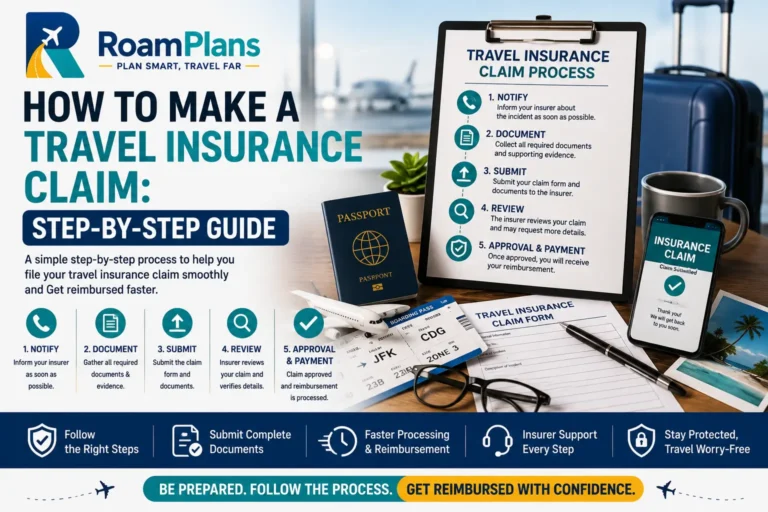
Related RoamPlans guide: How to Make a Travel Insurance Claim ↗ explains claim forms, receipts, medical records, airline documents, deadlines, denied claims, and follow-up in detail.
What If the Insurer Denies Your Claim?
A denial does not necessarily mean you should immediately give up, nor does it mean the insurer is automatically wrong.
Read the explanation.
Look for:
-
✓Policy provision cited
-
✓Exclusion
-
✓Missing document
-
✓Benefit limit
-
✓Deadline issue
-
✓Other reason
Then compare that explanation with your policy and evidence.
If information is missing, ask what additional documentation is required.
Ask About the Insurer’s Review Process
If you believe a decision should be reconsidered, ask:
-
✓Is there an internal review process?
-
✓What documents can I submit?
-
✓What is the deadline?
-
✓Where should the request be sent?
Keep your communication organized.
For U.S. consumers, state departments of insurance can also receive complaints involving insurers. NAIC provides a directory for finding the appropriate state insurance department and says consumers may file complaints involving issues such as claim delays, denials, or settlements.
Coverage Questions to Ask Before Buying
If a policy is unclear, ask specific questions.
Instead of:
“Does this cover everything?”
ask:
“Is emergency hospital treatment in Japan covered under this plan?”
or:
“Does this policy cover recreational skiing at the resort I am visiting?”
or:
“If my mother becomes seriously ill and I cancel my trip, does she meet the policy definition of a family member?”
Specific questions are easier to compare with policy wording.
Where practical, keep important answers in writing.
How to Choose Coverage That Fits Your Trip
The goal should not be finding the policy with the longest list of benefits.
Start with your actual trip:
-
✓Destination
-
✓Trip cost
-
✓Health coverage
-
✓Activities
-
✓Trip length
-
✓Existing insurance
-
✓Biggest financial risks
Then compare policies against those needs.
Related RoamPlans guide: How to Choose the Best Travel Insurance for Your Trip ↗ walks through the full buying process, including limits, deductibles, exclusions, medical needs, trip cost, activities, and existing coverage.
Coverage Mistakes Often Come From Assumptions
Many insurance problems begin before a claim is ever filed.
Examples include:
-
✓Assuming all cancellation reasons qualify
-
✓Not checking medical exclusions
-
✓Ignoring pre-existing condition wording
-
✓Assuming an adventure activity is covered
-
✓Looking only at the largest benefit number
-
✓Not checking baggage per-item limits
-
✓Forgetting delay waiting periods
-
✓Depending only on a credit card without reading its benefits
-
✓Failing to save documentation
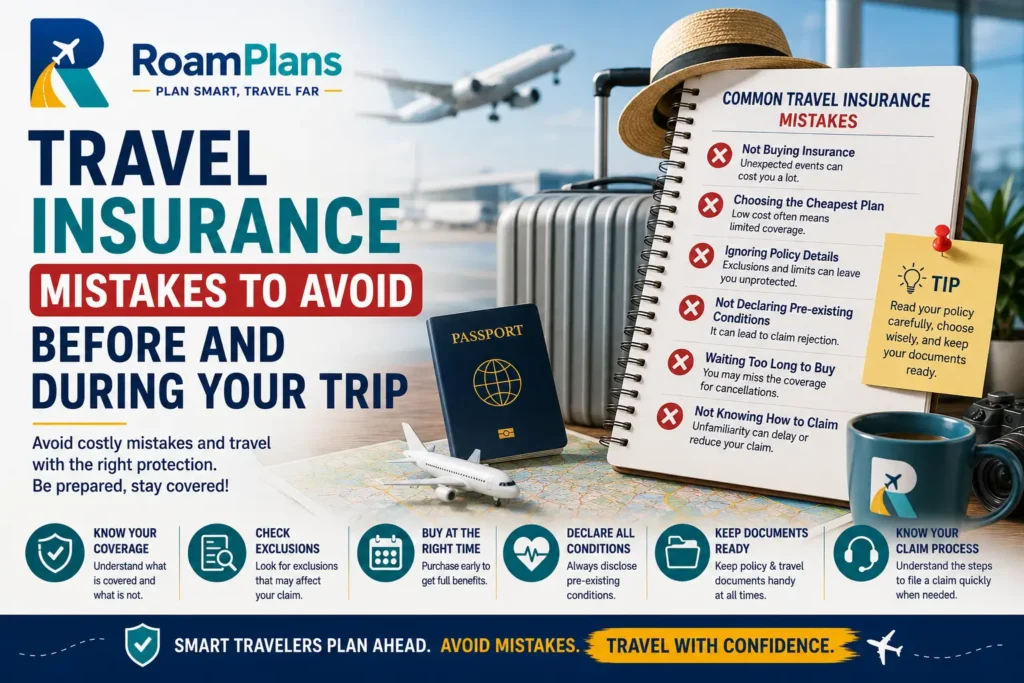
Related RoamPlans guide: Travel Insurance Mistakes to Avoid Before and During Your Trip ↗ covers these preventable errors and how to avoid them before they affect a claim.
My Final Coverage Review Before Buying
I would not buy until I can answer the following.
Trip Cancellation
-
✓What reasons qualify?
-
✓What reasons are excluded?
-
✓How much trip cost is insured?
-
✓What is the maximum benefit?
Trip Interruption
-
✓What events qualify?
-
✓Are additional transportation costs included?
-
✓Are unused prepaid costs covered?
Medical
-
✓Emergency medical limit checked
-
✓Deductible checked
-
✓Pre-existing condition rules checked
-
✓Primary vs secondary checked
-
✓Planned destinations covered
Medical Evacuation
-
✓Evacuation limit checked
-
✓Medical necessity rules checked
-
✓Authorization process checked
-
✓Transport destination checked
-
✓Activities checked
Baggage
-
✓Overall limit checked
-
✓Per-item limit checked
-
✓Electronics and valuables checked
-
✓Excluded property checked
Delays
-
✓Travel-delay waiting period checked
-
✓Baggage-delay waiting period checked
-
✓Daily maximum checked
-
✓Covered reasons checked
Activities
-
✓Every important activity searched
-
✓Altitude restrictions checked where relevant
-
✓Competition restrictions checked
-
✓Equipment requirements checked where relevant
General Exclusions
-
✓Pre-existing conditions
-
✓Known events
-
✓Destination-related exclusions
-
✓Higher-risk activities
-
✓Other exclusions relevant to the trip
Claims
-
✓Emergency number saved
-
✓Claim process understood
-
✓Reporting requirements checked
-
✓Documentation requirements checked
If I cannot answer an important question, I treat that as a reason to investigate further before paying.
Frequently Asked Questions
Common exclusions can include changing your mind, foreseeable events, excluded pre-existing conditions, uncovered risky activities, unlawful or reckless conduct, unattended belongings, losses outside policy dates or limits, and undocumented claims. The exact policy wording controls.
Depending on the policy, flight insurance may cover eligible cancellation or interruption, qualifying delays, missed connections, and baggage problems. It does not cover every airline disruption or voluntary change, so check its covered reasons, waiting periods, limits, and exclusions.
Depending on the policy, travel insurance can cover trip cancellation or interruption, travel and baggage delays, lost or damaged baggage, medical treatment, emergency evacuation, missed connections, and other travel losses.
No. Policies contain limits, exclusions, definitions, and claim conditions. NAIC specifically advises consumers to understand what a policy covers and excludes before buying.
Many travel medical policies cover eligible short-term treatment for covered illness or injury during travel. Coverage limits, deductibles, pre-existing-condition rules, and exclusions vary.
It can. Medical evacuation insurance is intended for qualifying emergency medical transportation under the policy terms. The State Department particularly recommends considering it for higher-risk areas or places with limited medical care.
It depends on the policy. Pre-existing conditions can be excluded, while some plans may provide a waiver when eligibility requirements are met. Read the specific policy definition and conditions.
Standard trip cancellation normally requires a covered reason. Some plans offer broader Cancel for Any Reason protection subject to additional conditions.
It may cover certain financial losses when the cancellation and resulting loss meet the policy’s covered reasons and other conditions. Airline obligations and insurance benefits should also be checked separately.
Many policies contain travel-delay coverage, but minimum delay periods, covered causes, reimbursement limits, and documentation requirements can apply. NAIC identifies trip delays as one form of travel coverage.
Many plans include baggage-delay benefits, but the delay usually must exceed a policy-defined waiting period before eligible essential purchases can be reimbursed.
Many comprehensive policies provide eligible baggage-loss protection. Total limits, per-item limits, exclusions, and documentation requirements can apply.
It may, depending on the baggage benefit and the circumstances. Reporting requirements, per-item limits, excluded property, and evidence can affect a claim.
Possibly, but electronics may be subject to per-item or category limits. Check the baggage section instead of assuming the full baggage maximum applies to one device.
Certain weather-related disruptions may qualify under cancellation, interruption, delay, or missed-connection benefits. Ordinary bad vacation weather does not automatically create a covered claim.
It may cover certain losses resulting from a qualifying natural disaster, depending on the benefit, timing, definitions, and exclusions.
Not automatically. NAIC warns that some policies exclude activities considered dangerous.
Coverage varies. Pregnancy and childbirth can appear among exclusion areas, while unexpected medical complications may be treated differently depending on the policy. Read the exact medical and cancellation wording.
Do not assume it does. Civil or political unrest can be an exclusion area in travel policies. Always check the specific contract.
These situations can have specific definitions and exclusions. Coverage should be checked directly in the policy rather than assumed from general travel-insurance benefits.
Some policies include missed-connection benefits for qualifying covered disruptions. Simply arriving late through your own planning does not automatically qualify.
Some travel policies include rental-vehicle damage protection. That is not necessarily the same as liability or complete auto insurance.
Sometimes arrangements may be possible through assistance services, while in other situations a traveler may have to pay and seek reimbursement. The State Department recommends checking how your specific insurer handles overseas medical care before departure.
No. NAIC explains that travel assistance can be bundled with insurance but is a non-insurance service. Assistance may help arrange support without necessarily paying every associated expense.
Read the benefit schedule, definitions, covered reasons, exclusions, limits, deductibles, and claim requirements. If something important remains unclear, ask the insurer before relying on it.
Final Thoughts
In short, The most important lesson is that travel insurance should never be reduced to:
covered
or
not covered
without context.
A policy might cover medical emergencies but exclude a particular activity.
It may cover trip cancellation but only for listed reasons.
It may cover baggage but limit how much can be paid for one item.
It may include travel delay but require the delay to last a certain number of hours.
When I review a policy, I therefore look at four things together:
Benefit
Trigger
Limit
Exclusion
That tells me much more than the headline coverage amount.
If you can answer that clearly before buying, you are much less likely to discover an important coverage gap only after something goes wrong.

Adnan Ahmed
RoamPlans AuthorTravel Planning Researcher & Editor
Adnan Ahmed is the travel planning researcher and editor behind RoamPlans. He creates clear, practical guides to help travelers compare destinations, plan routes, estimate costs, and avoid common trip-planning mistakes. His work combines careful source research, official travel information, and regular content reviews to keep each guide useful and current.
- ✓Destination Research
- ✓Budget Planning
- ✓Route Planning
- ✓Beginner Travel Guides


Turn This Guide into a Practical Trip Plan
Use the recommended Airline Baggage Allowance Checker or explore more free RoamPlans tools.