Female Solo Travel Safety Guide
Traveling alone as a woman can offer freedom that is difficult to get ↗ on a group trip. You decide where to stay, how slowly to travel, what to see, and when to change your plans. At the same time, women traveling alone can face situations that deserve extra thought, including unwanted attention, harassment, accommodation privacy, transportation choices, cultural expectations, and personal safety after dark. The U.S. State Department specifically notes that women travelers may face added health and security risks in some destinations.
The aim is not to make solo travel sound frightening. Good preparation is about keeping control of the parts of a trip that matter most: where you stay, how you get around, who knows where you are, how you leave an uncomfortable situation, and where you can get help. I also would not judge a destination only from a viral safest countries list or one traveler’s story. For safety information, current official destination guidance should come first, followed by recent local research and practical traveler experience.
This female solo travel safety guide is written for beginners. It focuses on issues that can affect women traveling alone without repeating the general advice already covered in Solo Travel Safety Tips for Beginners. Topics such as destination research, tourist scams, emergencies, and theft are included only where they directly affect a woman traveling by herself.
Safety Note: No country, city, hotel, or activity can be guaranteed safe. Risks can vary by location, time of day, local laws, current conditions, activity, and the individual traveler. Check current official travel advice before leaving and during the trip when conditions change.
Key Takeaways
Research how women travelers are treated at the specific destination, not just its general crime level.
Check local laws, customs, transportation practices, and cultural expectations before arriving.
Choose accommodation based on location, access, security, and support as well as price.
Make your arrival as simple as possible, especially on a first solo trip.
Use transportation you can verify and know how you will return before going out.
Keep your accommodation details and room number private.
Share basic trip information with someone you trust and use a simple check-in routine.
You do not need to stay in any situation that makes you uncomfortable just to appear friendly or polite.
Is Solo Travel Safe for Women?
Women travel alone successfully in many parts of the world, but there is no destination that is equally safe for every woman.
The better question is:
What risks apply to me in this destination, and can I manage them comfortably?
A city’s overall crime rate does not tell you everything you need to know. Women may encounter issues that receive less attention in general travel statistics, such as street harassment, unwanted attention, sexual harassment, drink spiking, restrictions affecting women, or different social expectations.
Official travel guidance reflects this difference. The U.S. State Department advises women travelers to research destination-specific laws, cultural expectations, transportation, lodging, harassment risks, and available support before traveling. The UK government gives similar guidance, noting that women traveling alone can face added risks or obstacles in some countries and should research local culture and women’s experiences before departure.
This does not mean assuming that every unfamiliar destination is dangerous.
It means researching the situations you are actually likely to face rather than using a simple safe or unsafe label.
How Is Female Solo Travel Safety Different?
Much of good solo travel safety is the same for everyone.
You still need secure accommodation, reliable transportation, backup money, protected documents, communication, and an emergency plan.
But women may also need to think about:
Unwanted attention or harassment
Sexual harassment or assault risks
Accommodation privacy
Local expectations about women
Clothing rules or customs
Gender-specific local laws
Transportation after dark
Drink safety
Dating and social situations
How authorities respond to women reporting problems
Access to women’s health products or medical services
Whether certain places or activities have restrictions affecting women
These risks are not the same everywhere.
For example, the State Department’s country guidance can contain women-specific warnings where conditions require them. Some destination pages identify harassment or sexual-assault risks affecting women separately from general crime information.
That is why I would never build a female solo travel plan from general travel tips alone.
Research the Destination from a Woman’s Point of View

Start with your government’s current travel advice.
For U.S. travelers, check the State Department Travel Advisory and country information for your destination. Then look specifically for sections covering women travelers, crime, local laws, transportation, health, and emergency assistance.
Do not stop after reading the country’s advisory level.
Look for answers to practical questions such as:
Are there women-specific safety warnings?
Is street harassment commonly reported?
Are there local laws that affect women differently?
Are there clothing requirements in certain places?
Is public transportation commonly used by women at night?
Are licensed taxis or ride apps recommended?
Are there areas travelers are advised to avoid?
How are sexual assault or harassment reports handled locally?
Where is the nearest embassy or consulate?
What local emergency number would you call?
Are there cultural expectations a visitor should know?
The State Department’s current women-traveler guidance specifically recommends researching social and cultural attitudes toward women and reviewing destination-specific information before travel.
Recent reports from women who have actually visited can add useful context, especially about transportation, unwanted attention, and what an area feels like after dark.
But treat personal reports as one layer of research, not your final answer.
One traveler saying I felt completely safe does not guarantee that another woman will have the same experience. Similarly, one bad experience does not automatically describe an entire country.
For the full destination research process, use How to Check If a Destination Is Safe Before You Travel↗.
Avoid Relying on Safest Countries for Women Lists
Lists of the safest countries for solo female travelers can be useful for ideas, but they are a weak way to make the final decision.
They often reduce an entire country to one score.
Your actual trip takes place in specific:
Neighborhoods
Hotels
Streets
Train stations
Airports
Taxi routes
Tourist areas
Beaches
Nightlife areas
Safety can also change between daytime and late evening.
Instead of asking:
Is this country safe for women?
ask:
How would I actually travel here?
For example:
Where would you stay?
How would you reach the hotel from the airport?
Would you use public transportation at night?
Would you be walking back from restaurants alone?
Are you visiting a major city or remote area?
Would you be joining tours or spending most days independently?
These questions tell you much more about the trip you are actually planning.
Learn the Local Laws and Cultural Expectations
Traveling somewhere new does not mean you have to agree with every local custom.
But knowing the rules before arriving can prevent confusion and legal problems.
Depending on the destination, women may encounter different expectations around:
Clothing
Religious sites
Public behavior
Alcohol
Dating
Photography
Public displays of affection
Gender-separated spaces
Driving
Identification
Medication
The State Department advises women to check destination laws and social expectations because rights and legal protections available in the United States may not apply in the same way abroad.
The UK government’s guidance for women travelers also recommends researching local customs, expected dress, and how women are treated at the destination.
Does a Woman Need to Change How She Dresses?
There is no single travel dress rule for women.
What makes sense depends on the destination and what you plan to visit.
Some religious buildings or local communities have specific dress requirements. In other destinations, normal clothing from home may attract no unusual attention at all.
Check the actual local rules rather than relying on stereotypes.
Following a dress requirement at a religious or legally regulated place is different from suggesting that clothing causes harassment. Responsibility for harassment always rests with the person doing it.
The practical goal is to know the local situation before you pack.
Choose Accommodation With Solo Safety in Mind

For a woman traveling alone, accommodation is more than a place to sleep.
Its location can affect transportation, walking routes, late-night arrivals, and how easily you can ask for help.
Before booking, check:
The exact area
Recent guest reviews
Comments from women traveling alone where available
Distance from transport
How the surrounding streets look on a map
How you would return after dark
Whether reception is staffed
Entrance security
Check-in arrangements
Whether there is local support if something goes wrong
A room that costs slightly less but leaves you with an isolated walk every evening may not be the better value.
I would compare the whole daily situation, not just the nightly rate.
For example, if Hotel A is close to a main transport route and Hotel B requires several transfers plus a long walk at night, the difference matters when you are traveling alone.
The State Department recommends researching lodging before arrival, looking at the surrounding area, considering security features, and knowing how to exit the property during an emergency.
For a deeper look at location research, read How to Choose a Safe Area to Stay (Beginner’s Guide)↗.
Check Accommodation Reviews Differently
Do not look only at the overall star rating.
Search recent reviews for words and issues that matter to a woman staying alone.
Look for comments about:
Location after dark
Door locks
Building access
Reception
Noise outside
Staff behavior
Unauthorized visitors
Lighting around the entrance
Walking from public transport
Taxi access
Previous security concerns
One negative review does not automatically mean a property is unsafe.
Look for patterns.
Several recent guests mentioning the same broken entrance lock deserves more attention than one guest complaining that the breakfast was late.
Also check when the reviews were written. Security, management, and surrounding conditions can change.
Protect Your Room Number and Accommodation Details
Your exact room number does not need to become public information.
At check-in, there is no need to repeat it loudly if staff have already given it to you.
Avoid posting photos that clearly reveal:
Your room number
Hotel key information
Exact accommodation location
Private entrance codes
Details showing that you are staying there alone
If someone asks where you are staying and you do not know them well, giving the neighborhood instead of the exact hotel is usually enough.
You also do not need to tell a stranger how many nights you are staying.
Check the Room After You Enter
You do not need to turn hotel check-in into a security inspection.
Check a few basics:
Does the door lock correctly?
Do windows and balcony doors close properly?
Do you know where the emergency exit is?
Can people enter the building without any control?
Is there a way to contact reception or the host?
Do you know what to do if you become locked out?
If a door, lock, window, or access system is clearly not working, report it.
If the problem is serious and cannot be fixed, asking for another room or changing accommodation can be reasonable.
You do not have to stay somewhere that makes you feel unsafe simply because you already paid.
Think Carefully About Hostels and Shared Accommodation
Hostels can be social, affordable, and practical for solo travelers.
But room setup matters.
If you prefer more privacy, consider:
Female-only dorms
Private rooms
Lockers large enough for valuables
Bathrooms with suitable privacy
24-hour or late reception
Controlled building access
Female-only dorms can make some travelers more comfortable, but the label alone should not replace checking the property itself.
Read recent reviews about staff, lockers, doors, bathrooms, location, and how the hostel handles problems.
If someone in shared accommodation behaves in a way that makes you uncomfortable, tell staff early.
You do not have to wait for the behavior to become serious before asking to move beds or rooms.
Make Your Arrival Simple

Your first few hours in a new place deserve extra planning.
After a long flight or train journey, you may be tired, carrying luggage, checking directions, trying to connect to mobile data, and learning a new transport system at the same time.
Before departure, know:
Your arrival airport or station
Your accommodation address
Check-in time
How you plan to reach the property
Where official transport leaves from
Rough travel time
Approximate transport cost
What happens if you arrive late
How you will contact the accommodation
What your second transport option is
Save this information offline.
For a first female solo trip, I prefer reducing decisions during arrival rather than finding the cheapest possible option after landing.
Daytime Arrival Can Make a First Trip Easier
If possible, arriving during daylight can give you time to learn the area before night.
You can:
Find your accommodation more easily
See the surrounding streets
Locate nearby transport stops
Buy basic supplies
Ask staff questions
Learn how the entrance works
A night arrival is not automatically unsafe.
It simply means the transport and check-in plan should be clearer before you travel.
If you land late, check whether public transportation will still operate and whether reception will be open.
Use Transportation You Can Verify
Transportation is one situation where giving up control can create extra risk.
Before using a taxi or ride app, learn how legitimate services work at the destination.
At an airport or station, avoid assuming that anyone who approaches you saying taxi is an authorized driver.
Where ride apps are available:
Match the license plate.
Check the driver’s details.
Confirm the vehicle.
Use the trip shown in your own app.
Avoid entering a different vehicle because someone says the original driver changed.
Share ride details with a trusted person when it makes sense.
With taxis, use official ranks, hotel-arranged vehicles, or other locally recommended systems where available.
Do this research before you need the ride.
That is especially useful late at night when you are tired and have fewer transport options.
Know How You Will Return Before Going Out Alone
Getting somewhere during daylight can be very different from getting home late at night.
Before heading to a restaurant, event, beach, nightlife area, or other unfamiliar place, check the return journey.
Ask:
When does public transport stop?
Are ride apps available there?
Are licensed taxis easy to find?
How far will I need to walk?
Will the route be busy or quiet at night?
Will I have mobile service?
What is my backup if the first option fails?
Do not wait until midnight to discover that the last train left at 11:30.
If the return plan starts becoming uncertain, deal with it early.
Leaving an hour earlier is usually easier than trying to solve transportation after most options have disappeared.
Share Your Plans With Someone You Trust
When traveling alone, at least one trusted person should know the basic shape of your trip.
Share information such as:
Destination
Travel dates
Accommodation
Flight or train details
Major day trips
How you normally plan to communicate
You do not need someone following every movement.
A simple check-in routine may be enough.
For example:
Message after reaching a new destination
Check in once each evening
Share location during a late ride
Tell someone before a remote activity
Message once you return to your accommodation
The system should be simple enough that you actually use it.
For eligible U.S. citizens and nationals traveling internationally, STEP can also provide safety and security messages from the nearest U.S. embassy or consulate.
Your trusted contact and STEP serve different purposes. One gives someone close to you awareness of your plans; the other provides an official communication channel for certain developments abroad.
Handle Unwanted Attention Without Feeling You Must Be Polite

Women traveling alone may receive unwanted attention, persistent questions, staring, comments, or invitations they did not ask for.
You do not owe anyone your time, personal details, phone number, hotel name, or explanation for leaving.
If someone makes you uncomfortable:
Keep your answers short.
Move closer to other people.
Enter a shop, hotel, café, station, or other staffed place.
Call someone you trust.
Ask staff or security for help.
Leave instead of trying to convince the person to stop.
Contact local authorities if you believe you are in danger.
Sometimes women stay in uncomfortable conversations because they do not want to appear rude.
Safety matters more than politeness.
You can end a conversation without explaining why.
Be Careful About Sharing That You Are Alone
You do not need to hide solo travel from everyone you meet.
But a stranger does not need to know:
That nobody is expecting you
Your exact hotel
Your room number
How long you are staying alone
Where you will be later
When you plan to return
Whether your room will be empty
How much money you have
If someone asks questions that feel too personal, keep your answer general.
You might mention the neighborhood instead of the hotel or simply say you already have plans later.
You are allowed to protect personal information without feeling dishonest.
Trust Your Reaction When Someone Makes You Uncomfortable
You do not need proof that someone has bad intentions before creating distance.
If a driver, traveler, date, tour guide, hotel guest, or stranger makes you uncomfortable, change the situation.
That might mean:
Getting out at a busy place
Returning to reception
Changing seats
Ending a conversation
Leaving a venue
Booking another ride
Moving to another room
Calling someone
At the same time, feelings should work alongside reliable information.
An unfamiliar street may feel uncomfortable simply because it is new, while a busy tourist area may feel safe even though pickpocketing is common there.
Use both local research and your judgment in the moment.
Be Smart About Nightlife

Going out at night does not automatically make solo female travel unsafe.
The bigger issue is whether you still control your transportation, drink, phone, money, and decisions.
Before going out, know:
How you will return
When public transport stops
Whether licensed taxis or ride apps are available
Whether your phone has enough battery
Whether someone knows where you are
What your backup plan is
Avoid waiting until the end of the night to work out how to get back.
Keep Control of Your Drink
Do not leave a drink unattended.
Be cautious with drinks you did not see prepared or open yourself.
If you suddenly feel much more intoxicated, confused, dizzy, or unwell than expected, tell someone you trust or venue staff and seek help.
Do not leave with someone you do not trust simply because they offer assistance.
Know Your Own Alcohol Limit
Alcohol can reduce your ability to judge people, read directions, manage money, or respond to problems.
When traveling alone, there may be no friend beside you to notice that you have had too much.
Enjoying nightlife does not require giving up control of your decisions.
If you feel your awareness dropping, that is a good time to leave.
Be Careful When Meeting Someone From a Dating App
Some women use dating or social apps while traveling.
There is nothing unusual about that, but the first meeting should still be treated as a meeting with someone you do not know.
For a first meeting:
Choose a public place.
Arrange your own transportation.
Tell someone where you are going.
Keep control of your phone and belongings.
Avoid giving your room number.
Do not depend on the other person for your return.
Keep your drink with you.
Leave if the person pressures you.
If someone becomes angry because you want to meet publicly, arrange your own ride, or tell a friend where you are, take that behavior seriously.
A reasonable person should respect basic boundaries.
Do Not Let Someone Control Your Transportation
Transportation is one of the fastest ways to lose control of a situation.
If you have just met someone, avoid becoming completely dependent on them for:
Getting back to your accommodation
Reaching another city
Finding your hotel
Accessing your luggage
Using their phone
Paying for the ride
Keep enough money and phone access to arrange another option.
If you are using a ride app, keep the trip visible on your own device.
If using a taxi, learn how official taxis operate before you need one.
If a driver changes the agreed route and you are concerned, check your map and ask about the change. If the situation feels unsafe, move to a public place when you can do so safely and get help.
Use Location Sharing Carefully
Private location sharing can be useful during certain parts of a solo trip.
For example, you may choose to share your location with someone you trust during:
A late-night ride
A first meeting
A remote hike
A long drive
An unfamiliar day trip
This is different from publicly posting your exact location.
A trusted person knowing where you are can help.
Hundreds of strangers knowing your hotel, café, or live route usually does not.
Think Before Posting in Real Time
Social media can reveal more than you realize.
A simple photo might show:
Your hotel name
Room number
Balcony view
Building entrance
Street location
Travel dates
That you are alone
You do not need to stop sharing your trip.
But consider posting after leaving the location rather than while you are still there.
Also avoid showing hotel key cards, booking details, passports, boarding passes, or anything with personal information.
Keep Your Phone Ready for Safety, Not Just Photos

For a woman traveling alone, your phone may be your map, transport tool, translator, emergency contact, and payment method.
Before the trip:
Use a strong screen lock.
Turn on device tracking where available.
Keep key accounts protected.
Save emergency numbers.
Save accommodation details offline.
Keep a backup charging option if you expect long days.
Know how to lock the phone remotely.
Keep another way to access key information.
Do not allow one lost phone to remove your maps, money access, hotel address, and emergency contacts at the same time.
Be Careful in Crowded Places
Crowded areas can create several problems at once.
You may be watching your phone, carrying bags, looking for directions, and trying to avoid people around you.
That can make it easier for someone to take advantage of distraction.
Pay extra attention in:
Train stations
Metro systems
Airports
Markets
Festivals
Tourist attractions
Busy shopping areas
Packed buses
Keep bags closed and valuable items where you can feel or see them.
If someone creates an unusual distraction, check your belongings before moving on.
For a deeper breakdown of distraction theft, fake officials, taxi tricks, and other common problems, see Common Tourist Scams and How to Avoid Them↗.
Decide What You Really Need to Carry
You do not need every valuable item with you every day.
Before leaving your accommodation, ask:
Would losing this make the rest of my trip difficult?
That question helps decide what should stay secure.
Depending on local identification rules and your plans, you may not need to carry:
Every bank card
Large amounts of cash
Expensive jewelry
Backup documents
Extra electronic devices
Keep your main items secure, but do not carry all backups together.
If one bag disappears, it should not remove every way you have to identify yourself, pay, communicate, and return to your accommodation.
Have a Backup Payment Method
Women traveling alone should avoid depending on one card or one digital wallet.
A simple setup may include:
One main payment card
One second card stored separately
A small amount of local cash
Secure access to banking information
If your wallet is stolen, your backup should still be available.
If your phone controls your digital wallet, banking app, and authentication codes, think about how you would access money without it.
This does not need to become complicated.
You simply need one realistic second option.
Know What to Do If Someone Follows You

If you believe someone is following you, avoid leading them directly to your accommodation.
Move toward a place with people and staff, such as:
A hotel lobby
Restaurant
Café
Shop
Station office
Security desk
Police station
If possible, call someone and tell them where you are.
You can also tell staff clearly that you believe someone is following you and that you need help.
If the person continues following you or you believe there is an immediate threat, contact local emergency services.
Do not worry about whether you are overreacting.
You can reassess the situation once you are somewhere safer.
Know What to Do With Persistent Harassment
Harassment can range from repeated comments to someone blocking your path, touching you, following you, or refusing to leave you alone.
Your response depends on the situation.
If it is safe to do so:
Move away.
Go somewhere staffed or crowded.
Tell someone clearly what is happening.
Contact security or police if needed.
Keep any useful evidence if the incident becomes serious.
You do not have to confront the person yourself.
Your goal is to get out of the situation, not win an argument.
Think Carefully About Remote Places
A quiet beach, mountain trail, countryside route, or remote attraction may look ideal for solo travel.
But isolation changes the type of risk.
Before going somewhere remote, check:
Phone signal
Weather
Daylight hours
Route difficulty
Transport back
Water availability
Local emergency access
Whether the trail or area is commonly used
Whether someone knows where you are
Tell someone your expected return time.
If the activity goes beyond your experience, joining a reputable group or guide can be the better choice.
Traveling solo does not mean every activity has to be done alone.
Do Not Force Yourself to Complete a Plan
One advantage of traveling alone is that you can change your plans without asking anyone else.
Use that freedom.
Cancel or change an activity if:
Weather becomes poor
You become sick
Transport becomes unreliable
The route feels different from what you researched
A guide behaves irresponsibly
Local authorities issue warnings
You no longer feel comfortable doing it alone
Paying for something does not make completing it the right decision.
A missed activity is easier to replace than your safety.
Take Health Needs Into Account
Women may have travel health needs that differ based on age, medication, pregnancy, menstrual health, or existing medical conditions.
Before traveling, think about any supplies or medications that may be difficult to obtain at the destination.
Carry enough essential medication for the trip and check destination rules before taking prescription medicine across borders.
If you rely on a particular product or medication, do not assume it will be easy to buy under the same brand or name abroad.
For trips where access to medical care may be limited, research where you could get help before leaving.
Pregnancy Requires Extra Planning
Pregnant travelers may need to consider:
Airline rules
Medical care at the destination
Travel insurance limits
Infectious disease risks
Heat
Long periods of sitting
Medication
Access to emergency care
Anyone who is pregnant and planning international travel should discuss destination-specific health questions with a qualified medical professional before departure.
The same destination may carry very different health risks depending on pregnancy stage and current local disease conditions.
Understand That Local Support May Work Differently
If you experience harassment, assault, theft, or another serious incident abroad, local procedures may differ from those at home.
Police processes, medical services, legal protections, and social attitudes can vary widely.
Before traveling somewhere with known women-specific concerns, check:
Local emergency numbers
Your embassy or consulate
How to reach medical care
Whether local support organizations exist
How serious crimes are normally reported
You do not need to expect something bad to happen.
Knowing where help comes from simply reduces confusion if you ever need it.
If You Experience Sexual Assault Abroad
Your immediate safety comes first.
Move somewhere safe and contact local emergency or medical services if you need urgent help.
Depending on the situation, you may also choose to contact:
Someone you trust
Local police
A medical facility
Your embassy or consulate
Your insurer
You decide which steps you feel able to take.
For U.S. citizens abroad, a U.S. embassy or consulate may help explain local processes, provide information about medical care, and assist with communication in certain situations.
This guide does not replace professional medical, legal, or emergency help.
Keep an Emergency Plan Simple

You should be able to remember your basic response even when stressed.
If something serious happens:
1. Get Somewhere Safer
Move away from the immediate problem if you can do so safely.
2. Contact Local Help
Use police, ambulance, security, or another relevant service when needed.
3. Tell Someone You Trust
Give them your location and explain what happened.
4. Protect What Is Still at Risk
Freeze cards, lock devices, move valuables, or secure documents if needed.
5. Contact the Right Organization
That may be your embassy, bank, insurer, airline, accommodation, or mobile provider.
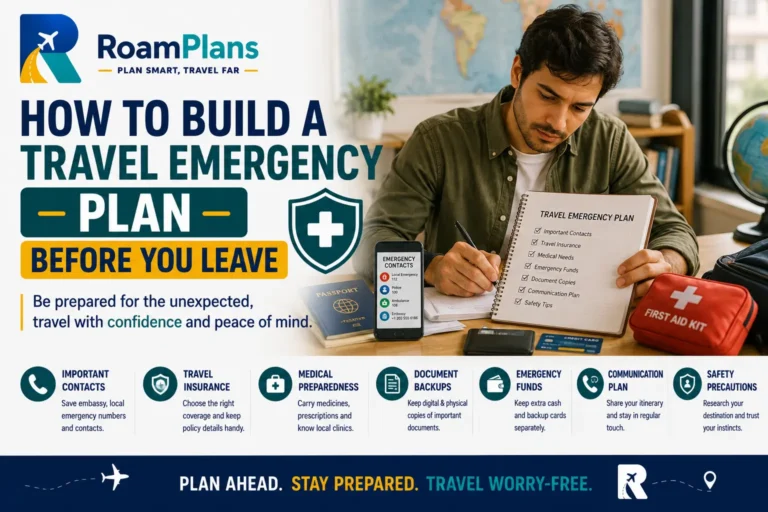
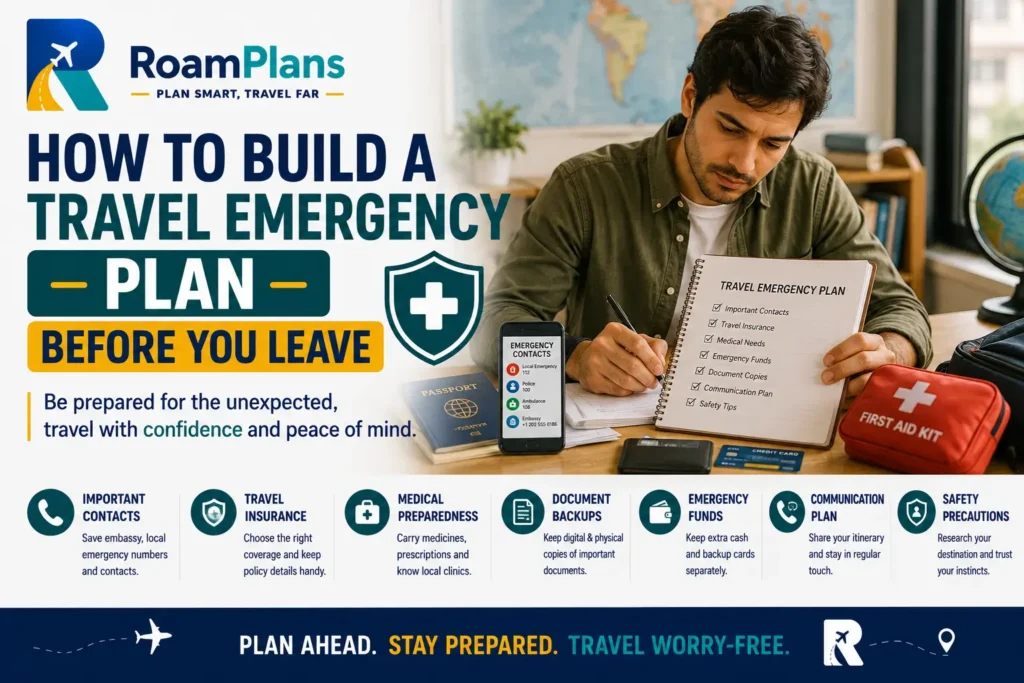
For a fuller preparation process, read How to Build a Travel Emergency Plan Before You Leave↗.
Female Solo Travel Safety Is About Keeping Control
The strongest safety habits are usually simple.
Keep control of:
Your transportation
Your phone
Your money
Your accommodation details
Your drink
Your personal information
Your return plan
Your decisions
You cannot control every person or situation around you.
But you can reduce the number of times another person has complete control over what happens next.
That is one of the most useful principles for a woman traveling alone.
Know What to Do If Something Is Stolen
If your phone, wallet, bag, or other valuables are stolen, move somewhere safe before trying to recover anything.
Then deal with the items that can create further problems:
Freeze or cancel stolen cards.
Lock a missing phone remotely if possible.
Change passwords if sensitive accounts may be exposed.
Check whether your passport or identification was taken.
Contact local police when a report is needed.
Tell someone you trust what happened.
Do not follow a suspected thief into an unfamiliar or isolated area just to recover property.
If your passport was stolen, contact the relevant embassy or consulate and follow the official replacement process.
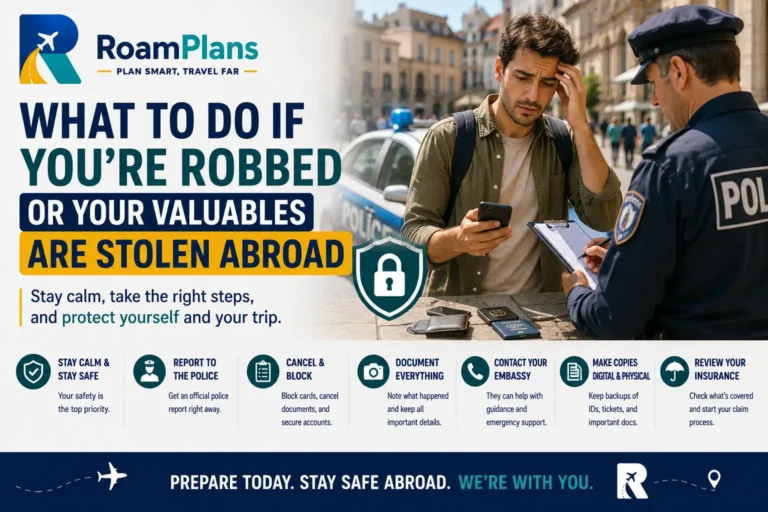
The full step-by-step response belongs in What to Do If You’re Robbed or Your Valuables Are Stolen Abroad↗.
Know Where to Get Help Before You Need It
Do not wait for an emergency to start searching for local help.
Before an international trip, save:
Local emergency numbers
Your accommodation contact
A trusted contact at home
Your embassy or consulate details
Travel insurance assistance details where relevant
Information about nearby medical care
For U.S. travelers, the State Department advises women to research local emergency services, medical care, laws, transportation, accommodation, and risks affecting women before departure.
Knowing where help comes from can make a stressful situation easier to manage.
Know What an Embassy Can Help With
An embassy or consulate is useful in certain situations, but it does not replace local police, hospitals, banks, or your travel insurer.
For U.S. citizens abroad, consular staff may assist after certain crimes, help with lost or stolen passports, provide information about local medical services, and explain some local procedures.
If there is immediate danger, contact local emergency services first.
If your bank card disappears, contact your bank.
If you need medical care, contact local medical services.
Knowing who handles each problem saves time.
Do Not Judge Safety From How Confident You Feel
After a few successful days alone, it is easy to become less careful.
You may stop checking transport times, start carrying everything together, share more information with strangers, or assume an area is safe because nothing has happened yet.
Confidence is useful.
Overconfidence can remove the habits that made the trip easier in the first place.
Keep the simple systems that work:
Separate backup money
Keep someone informed
Know your return route
Protect accommodation details
Check changing local conditions
Keep your phone usable
Leave uncomfortable situations early
Safe habits should become easier as you travel more, not disappear.
Common Female Solo Travel Safety Mistakes
Several mistakes can create extra problems for women traveling alone.
Choosing a Hotel Only Because It Is Cheap
A low nightly rate may come with an isolated location, difficult late-night transport, or poor building access.
Compare the complete situation, not only the room price.
Sharing the Exact Hotel With New People
There is usually no reason for someone you just met to know your hotel and room number.
A general neighborhood is enough in casual conversation.
Depending on a Stranger for the Ride Home
Keep enough money, phone battery, and information to arrange your own transportation.
Ignoring Unwanted Attention to Avoid Being Rude
You can end a conversation, change seats, enter another building, or ask for help without giving someone a long explanation.
Keeping Every Valuable Together
Do not make one lost bag equal a lost passport, phone, cash, and every bank card.
Posting Your Location Publicly in Real Time
Sharing a trip is fine. Sharing exactly where you are staying and that you are there alone may reveal information you did not intend to give strangers.
Arriving Without a Transport Plan
Learn how you will leave the airport or station before you land, especially for late arrivals.
Assuming a Popular Tourist Area Has No Risk
Tourist areas can still have harassment, theft, scams, unsafe transport, and other local issues.
Ignoring Destination-Specific Advice for Women
General advice is useful, but some countries have laws, social expectations, or security issues that affect women differently. The State Department specifically advises women travelers to research these factors for each destination.
Staying Somewhere Because You Already Paid
If there is a serious safety problem with accommodation and it cannot be resolved, losing money may be better than remaining somewhere you do not feel safe.
Feeling You Have to Do Everything Alone
A group tour, organized transfer, guided hike, or staffed accommodation can sometimes make a particular part of a solo trip easier.
Traveling alone does not mean refusing help.
Female Solo Travel Safety Checklist

You do not need a huge list for every trip. Use this checklist to make sure the main safety points are covered.
Before Booking
Check current official travel advice.
Look for any warnings that specifically affect women.
Research the exact areas you plan to visit.
Check local laws and cultural expectations.
Research accommodation location as well as the property.
Check how you will travel from the airport or station.
Consider how easy the destination will be to manage alone.
Before Leaving
Give basic trip details to someone you trust.
Agree on a simple check-in routine.
Save local emergency numbers.
Save embassy or consulate details where relevant.
Keep your accommodation address offline.
Keep secure copies of key documents.
Separate your main and backup payment methods.
Check your phone security.
Save insurance details if you have coverage.
Check medication rules if you take prescription medicine.
Learn how official taxis or ride apps work.
Research common scams at the destination.
Check what support would be available if you experienced harassment or another serious incident.
At Your Accommodation
Check that your door and windows lock properly.
Learn how to contact reception or the host.
Find the nearest emergency exit.
Keep your room number private.
Secure valuables you do not need during the day.
Ask about late-night access before going out.
Report security problems rather than ignoring them.
While Exploring
Know how you will return before going somewhere unfamiliar.
Keep your phone sufficiently charged.
Use transportation you can verify.
Keep your main and backup money separate.
Avoid publicly sharing sensitive live-location details.
Tell someone before remote activities.
Keep control of your drink.
Pay attention to changing weather and local alerts.
Leave situations that make you uncomfortable.
Ask for help early when you need it.
Before Going Out at Night
Check the last public transport time.
Confirm taxi or ride-app availability.
Keep enough money for the return trip.
Charge your phone.
Keep your accommodation address accessible.
Tell someone where you are going when appropriate.
Decide what you will do if your original return plan fails.
Frequently Asked Questions
Yes, many women travel alone, but risk varies by destination, area, activity, and time. Check current official advice and plan around your actual trip.
Research the destination, choose suitable accommodation, plan arrival transport, share trip details, keep backup money, and save emergency contacts.
Choose a well-researched area with practical transport, suitable building security, recent reviews, and a route you feel comfortable using alone.
You can tell people you trust, but strangers do not need your hotel, room number, complete schedule, or details about when you will be alone.
It depends on the specific location and transport options. Research the area and know how you will return before going out.
Do not lead them to your accommodation. Enter a busy staffed place, tell someone what is happening, and contact local emergency services if you feel threatened.
They can, but first meetings should be in public places. Arrange your own transport, tell someone where you are, and keep control of your phone and drink.
Start with current government travel advice, then research the exact areas, women-specific risks, local laws, transport, accommodation, and recent conditions.
Final Thoughts
In short, Female solo travel safety is less about trying to remove every possible risk and more about keeping control of your choices. Research where you are going, choose accommodation carefully, keep your transport and payment backups available, protect personal information, and leave situations that do not feel right. Good preparation gives you more room to enjoy traveling independently without spending the whole trip worrying about what could go wrong.

Adnan Ahmed
RoamPlans AuthorTravel Planning Researcher & Editor
Adnan Ahmed is the travel planning researcher and editor behind RoamPlans. He creates clear, practical guides to help travelers compare destinations, plan routes, estimate costs, and avoid common trip-planning mistakes. His work combines careful source research, official travel information, and regular content reviews to keep each guide useful and current.
- ✓Destination Research
- ✓Budget Planning
- ✓Route Planning
- ✓Beginner Travel Guides
Turn This Guide into a Practical Trip Plan
Use the recommended Airline Baggage Allowance Checker or explore more free RoamPlans tools.