Car Rental Guide for Travelers: Booking, Insurance, Fuel, and Fees
Renting a car can give you more freedom during a trip. It can help you reach small towns, rural areas, beaches, national parks, and places with limited public transport.
However, the first price shown online may not be the full trip cost. Insurance, deposits, fuel, tolls, parking, extra drivers, and location fees can increase the final amount.
When I compare rental cars, I check the total price, card rules, deposit, fuel policy, mileage, and return terms before paying. I also check parking near the accommodation because a low daily rate can become expensive after parking fees are added.
This car rental guide for travelers explains how to book the right car, compare quotes, prepare the required documents, and avoid common booking problems.
Rental rules differ by company, country, state, airport, and vehicle type. Check the final terms with the rental company before booking. Driving licence, age, card, insurance, and deposit rules may also differ by location.
Key Takeaways
- ✓Compare the final rental cost, not only the daily rate.
- ✓Check licence, age, card, and deposit rules before booking.
- ✓Confirm whether the booking is prepaid or paid at pickup.
- ✓Choose a vehicle that fits every passenger and suitcase.
- ✓Read the cancellation, mileage, fuel, and return terms.
- ✓Save the booking confirmation and rental terms offline.
The guide Public Transportation vs Rental Car: Which Is Better for Your Trip? ↗ can help you decide whether a car suits your route.
When Does Renting a Car Make Sense?

A rental car can be useful when public transport does not fit the route.
It often works well for:
- ✓Rural areas
- ✓National parks
- ✓Road trips
- ✓Small towns
- ✓Mountain routes
- ✓Beach areas
- ✓Family travel
- ✓Group travel
- ✓Trips with heavy luggage
- ✓Plans with several stops
A car gives you more control over departure times and stops. You do not need to follow a train or bus timetable.
However, a rental car may not suit every destination.
When a Rental Car Works Well
Consider renting a car when:
- ✓Attractions are far apart
- ✓Public transport is limited
- ✓Your accommodation includes parking
- ✓Several people can share the cost
- ✓You need to carry several bags
- ✓You want to stop along the route
- ✓Taxi costs would be high
- ✓You are comfortable driving locally
A car may save time when a bus route needs several changes or runs only a few times each day.
When a Rental Car May Not Be the Best Choice
A car may create more problems when:
- ✓You are staying in a busy city center
- ✓Parking is expensive
- ✓Public transport is frequent
- ✓Roads are narrow or difficult
- ✓Local traffic is heavy
- ✓Your hotel has no parking
- ✓You are not comfortable driving abroad
- ✓The trip includes several one-way routes
- ✓Toll and city-entry charges are high
A car may spend most of the trip parked if the main attractions are close to a metro or bus route.
The article How to Choose the Best Transportation for Your Trip ↗ gives a wider method for comparing transport options.
Check Parking Before Booking
Parking can change the full rental cost.
Check parking at:
- ✓Hotel
- ✓Apartment
- ✓City center
- ✓Attractions
- ✓Beaches
- ✓National parks
- ✓Airport
- ✓Train station
Also check:
- ✓Overnight rates
- ✓Street-parking hours
- ✓Permit zones
- ✓Height limits
- ✓Time limits
- ✓Restricted areas
- ✓Electric vehicle charging access
Do not assume hotel parking is free.
What Do You Need to Rent a Car?
Rental companies normally ask for documents that confirm your identity, driving right, payment method, and booking.
The exact requirements differ by location.
Valid Driver’s Licence
The main driver usually needs a valid driver’s licence.
Check:
- ✓Whether the licence is accepted at the destination
- ✓Whether it must have been held for a set period
- ✓Whether a temporary licence is accepted
- ✓Whether the licence language creates an issue
- ✓Whether the licence is valid for the full rental period
The name on the licence should match the booking and payment card where required.
International Driving Permit
Some destinations or rental companies may ask for an International Driving Permit.
An IDP normally supports your original licence. It does not replace it.
Check:
- ✓Whether the destination requires one
- ✓Which IDP type applies
- ✓Whether the rental company asks for it
- ✓How long it remains valid
- ✓Where it must be issued
For licence acceptance, IDPs and local road rules, read the International Driving Guide ↗.
Passport or Identity Document
International renters may need:
- ✓Passport
- ✓Visa
- ✓National identity card
- ✓Proof of address
- ✓Entry stamp
Carry the original document where required.
Booking Confirmation
Keep the booking confirmation ready at pickup.
It should show:
- ✓Booking number
- ✓Pickup location
- ✓Return location
- ✓Dates
- ✓Times
- ✓Vehicle class
- ✓Main driver
- ✓Included extras
- ✓Estimated price
Save a copy offline.
Payment Card
Most rental companies ask for a payment card in the main driver’s name.
The card may be used for:
- ✓Rental payment
- ✓Security deposit
- ✓Card hold
- ✓Added charges
- ✓Fuel charges
- ✓Toll charges
- ✓Damage claims
Check the accepted card type before booking.
Additional Driver Documents
Each added driver may need:
- ✓Valid licence
- ✓Passport or ID
- ✓Age check
- ✓Signature
- ✓Added fee payment
Do not allow an unlisted driver to use the car.
Driver Age Requirements
Rental age rules can differ by company, vehicle, and location.
A company may have:
- ✓Minimum rental age
- ✓Young-driver fee
- ✓Higher age for luxury vehicles
- ✓Higher age for large vans
- ✓Maximum age in selected locations
- ✓Added document checks
Young-Driver Fees
Drivers below a set age may pay a daily fee.
This fee can apply even when the person has held a licence for several years.
Check:
- ✓Daily young-driver fee
- ✓Vehicle limits
- ✓Location rules
- ✓Maximum rental period
- ✓Whether the fee applies to added drivers
Add the full fee to the total booking cost.
Vehicle Restrictions by Age
Younger drivers may be blocked from renting:
- ✓Luxury cars
- ✓Sports cars
- ✓Large SUVs
- ✓Premium vehicles
- ✓Large vans
- ✓Special vehicles
Do not choose a vehicle class until you confirm age eligibility.
Older Driver Rules
Some locations may ask older drivers for:
- ✓Added identification
- ✓Medical document
- ✓Recent licence renewal
- ✓Extra insurance
- ✓Location approval
Check the local rental terms before booking.
Credit Card, Debit Card, Deposit, and Hold
Payment and deposit rules cause many booking problems.
A booking may accept one card online but require another card at pickup.
Credit Card Requirements
A rental company may ask for a credit card because it can place a hold above the expected rental price.
Check:
- ✓Card must match the main driver
- ✓Available credit needed
- ✓Card expiry date
- ✓Card network accepted
- ✓Virtual card acceptance
- ✓Prepaid card rules
- ✓PIN requirement
The card must have enough available credit for both the rental and the security hold.
Debit Card Rules
Some rental locations accept debit cards. Others do not.
A debit-card rental may require:
- ✓Return flight proof
- ✓Extra identification
- ✓Address check
- ✓Larger deposit
- ✓Credit check
- ✓Limited vehicle choice
- ✓Proof of accommodation
- ✓Advance payment
Do not assume debit-card rules are the same at every branch of the same company.
Security Deposit
A security deposit protects the rental company against added costs.
It may cover:
- ✓Damage
- ✓Fuel
- ✓Tolls
- ✓Late return
- ✓Cleaning
- ✓Missing equipment
- ✓Traffic or parking charges
The deposit is normally separate from the rental price.
Card Hold
A card hold blocks part of your available card limit or bank balance.
For example, the company may hold:
- ✓Estimated rental price
- ✓Added security amount
- ✓Fuel amount
- ✓Possible extra charges
You may not be able to use that money during the trip.
Deposit vs Final Charge
A deposit is not always taken as a completed payment.
It may appear as:
- ✓Pending hold
- ✓Pre-authorisation
- ✓Temporary block
- ✓Completed charge later adjusted
Check how the company processes it.
When Is the Hold Released?
The release time depends on:
- ✓Rental company
- ✓Bank
- ✓Card network
- ✓Country
- ✓Weekend or holiday
- ✓Final inspection
- ✓Added charges
Keep enough available money after the trip until the hold is removed.
Main Driver and Cardholder
Some companies require the payment card to match the main driver’s name.
A spouse, friend, or family member may not be able to pay at pickup unless the rules allow it.
Confirm this before travel.
How to Compare Rental Car Quotes?
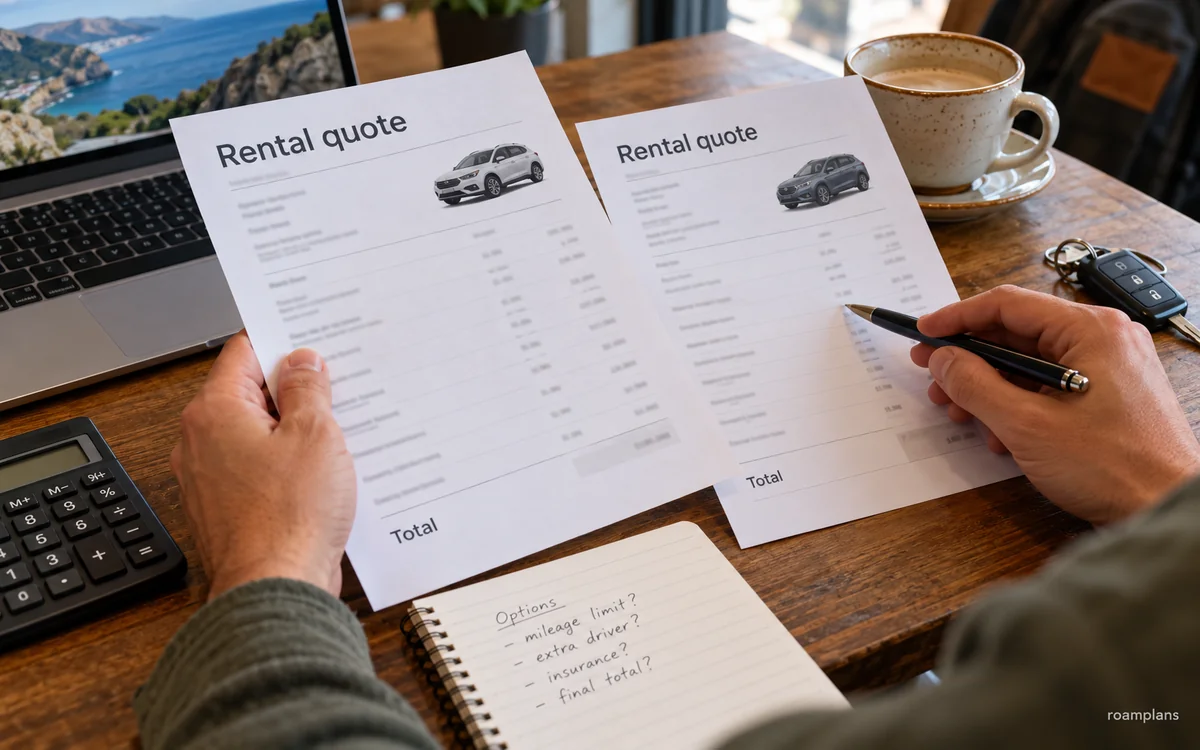
Do not compare quotes using the first price shown.
Two bookings with the same daily rate may have very different final costs.
Start With the Same Search Details
Use the same:
- ✓Pickup location
- ✓Return location
- ✓Dates
- ✓Times
- ✓Driver age
- ✓Vehicle class
- ✓Transmission type
- ✓Mileage
- ✓Fuel policy
This creates a fair comparison.
Check What the Price Includes
A quote may include or exclude:
- ✓Taxes
- ✓Location fees
- ✓Insurance
- ✓Mileage
- ✓Roadside support
- ✓Added driver
- ✓Fuel
- ✓Toll device
- ✓Child seat
- ✓One-way fee
Read the full price details.
Compare the Vehicle Class
Do not compare an economy car with an SUV.
Check:
- ✓Passenger capacity
- ✓Luggage capacity
- ✓Number of doors
- ✓Transmission
- ✓Air conditioning
- ✓Fuel type
- ✓Mileage policy
The exact model may not be guaranteed.
Check “Or Similar”
Rental bookings often use wording such as “Toyota Corolla or similar.”
This means you are booking a vehicle class, not one exact model.
The supplied car may differ in:
- ✓Boot size
- ✓Fuel use
- ✓seat space
- ✓controls
- ✓shape
- ✓brand
Book the class that meets your needs, even if the smallest possible model appears.
Compare Cancellation Terms
Check whether the booking allows:
- ✓Free cancellation
- ✓Partial refund
- ✓Travel credit
- ✓Date changes
- ✓Pickup-time changes
- ✓No-show refund
A slightly higher flexible rate may be safer when the trip is not fully fixed.
Check Pickup and Return Hours
A low price may not work if the office closes before arrival.
Check:
- ✓Opening time
- ✓Closing time
- ✓After-hours pickup
- ✓After-hours return
- ✓Grace period
- ✓Late return fee
- ✓Flight-delay handling
Total Quote Comparison Table
| Cost item | Quote A | Quote B | Quote C |
|---|---|---|---|
| Base rental | |||
| Taxes and location fees | |||
| Insurance | |||
| Extra driver | |||
| Child seat | |||
| One-way fee | |||
| Mileage charge | |||
| Deposit or hold | |||
| Final estimated cost |
The deposit should be shown separately because it may be returned.
Direct Booking vs Comparison Sites and Brokers
Rental cars can be booked through several channels.
Each option has benefits and limits.
Booking Directly With the Rental Company
Direct booking may make it easier to:
- ✓Change the booking
- ✓Confirm branch rules
- ✓Add loyalty details
- ✓Request a vehicle
- ✓Handle refunds
- ✓Contact support
The rental company controls the reservation directly.
Comparison Websites
Comparison sites can help you:
- ✓View several companies
- ✓Compare vehicle classes
- ✓Compare locations
- ✓Find lower prices
- ✓Check customer ratings
However, changes may need to go through the comparison platform.
Rental Brokers
A broker may sell a booking from another rental company.
Check:
- ✓Who takes payment
- ✓Who handles cancellation
- ✓Who provides insurance
- ✓Who controls the booking
- ✓Who gives support after a problem
The broker and rental company may have different terms. If you book a rental car alongside a flight or hotel, check each item’s cancellation terms separately. A refundable hotel does not make a nonrefundable flight or prepaid car refundable. Save the rental voucher, cancellation deadline and local pickup time before paying.
Credit Card Travel Portals
A card travel portal may offer:
- ✓Reward points
- ✓Member prices
- ✓Travel credits
- ✓Added protection
Check whether the portal or rental company handles changes.
Loyalty Programs
Rental loyalty programs may offer:
- ✓Faster pickup
- ✓Saved driver details
- ✓Member rates
- ✓Vehicle upgrades
- ✓Points
- ✓Extra-driver benefits
Read the program terms before choosing a higher price for points.
Who Handles a Booking Problem?
Before paying, know who you must contact for:
- ✓Date change
- ✓Cancellation
- ✓Refund
- ✓Missing reservation
- ✓Wrong vehicle class
- ✓Insurance question
- ✓Pickup problem
A low third-party price may be less useful if support is unclear.
Prepaid vs Pay-at-Pickup Bookings
Rental bookings may be prepaid or paid at the counter.
Prepaid Booking
A prepaid booking requires payment before pickup.
It may offer:
- ✓Lower price
- ✓Confirmed rate
- ✓Faster counter process
Possible limits include:
- ✓Strict cancellation
- ✓Limited refund
- ✓Change fee
- ✓Lost payment after a no-show
Pay at Pickup
A pay-at-pickup rate may offer:
- ✓More flexibility
- ✓Easier cancellation
- ✓No full advance payment
It may also have:
- ✓Higher price
- ✓Rate changes
- ✓Card hold at pickup
- ✓Location-specific rules
Which One Should You Choose?
A prepaid rate may work when:
- ✓Dates are fixed
- ✓Flight timing is reliable
- ✓Cancellation terms are acceptable
- ✓Savings are meaningful
Pay at pickup does not automatically mean free cancellation. Check any no-show fee, cancellation cutoff, booking guarantee and required card at pickup. If an arriving flight is delayed, contact the actual pickup branch and the booking provider to confirm how long they will hold the car.
Pay at pickup may work better when:
- ✓Plans may change
- ✓Arrival time is uncertain
- ✓The trip is months away
- ✓Flexibility matters more than a small saving
Airport vs Off-Airport Rental Locations
Airport rental locations are convenient, but they may include higher fees.
Off-airport branches may cost less, but reaching them takes time and money. Compare taxi and ride-app transfers ↗ with the local public transport route ↗, including luggage and branch opening hours.
Airport Rental Benefits
Airport pickup may offer:
- ✓Easy access after landing
- ✓Longer opening hours
- ✓More vehicle choices
- ✓Clear shuttle service
- ✓Better support for flight delays
Airport Rental Costs
Airport rentals may include:
- ✓Airport concession fee
- ✓Facility charge
- ✓Shuttle fee
- ✓Location surcharge
- ✓Higher taxes
Check the final quote.
Off-Airport Rental Benefits
An off-airport location may offer:
- ✓Lower rate
- ✓Lower location fees
- ✓Easier city access
- ✓Less crowded pickup
- ✓Lower parking or return stress
Off-Airport Rental Costs
Add:
- ✓Taxi
- ✓Public transport
- ✓Ride app
- ✓Travel time
- ✓Luggage handling
- ✓Office hours
Use this calculation:
Cash saving = airport rental total − off-airport rental total − transfer expenses. Compare the extra travel time separately, or assign it an explicit monetary value before including it in a cost calculation.
When Airport Pickup Makes Sense
Airport pickup may work better when:
- ✓You are leaving the city at once
- ✓You have several bags
- ✓You are traveling with children
- ✓The flight arrives during office hours
- ✓The off-airport saving is small
When Off-Airport Pickup Makes Sense
Off-airport pickup may work better when:
- ✓You will stay in the city first
- ✓Public transport serves the branch
- ✓Airport fees are high
- ✓You do not need the car on arrival day
- ✓Parking in the city is difficult
How to Choose the Right Rental Car
Choose the vehicle based on passengers, luggage, roads, fuel, parking, and comfort.
Do not choose only by price.
Economy Car
An economy car may suit:
- ✓One or two travelers
- ✓Light luggage
- ✓City driving
- ✓Lower fuel use
- ✓Easy parking
It may not fit several large suitcases.
Compact Car
A compact car may offer more space than an economy model while remaining easy to park.
It can suit:
- ✓Couples
- ✓Small families
- ✓City and highway driving
- ✓Moderate luggage
Midsize or Full-Size Car
These vehicles may suit:
- ✓Families
- ✓Longer drives
- ✓More luggage
- ✓Greater seat space
They may use more fuel and need larger parking spaces.
SUV
An SUV may suit:
- ✓More passengers
- ✓Large luggage
- ✓Rural roads
- ✓Mountain areas
- ✓Snow or poor weather
Do not assume every SUV has four-wheel drive.
Minivan or People Carrier
A minivan may suit:
- ✓Large families
- ✓Groups
- ✓Several suitcases
- ✓Child seats
Check passenger and luggage capacity together.
Electric Vehicle
An electric rental may suit routes with reliable charging.
Check:
- ✓Battery range
- ✓Charging network
- ✓Charging speed
- ✓Hotel charging
- ✓Return battery rule
- ✓Charging fees
- ✓Cable supplied
Do not book an electric car without planning charging stops.
Passenger Capacity vs Luggage Capacity
A vehicle may seat five people but hold only two large bags.
Count:
- ✓Adults
- ✓Children
- ✓Child seats
- ✓Large suitcases
- ✓Cabin bags
- ✓Pushchairs
- ✓Sports equipment
Choose a larger vehicle when the luggage will not fit safely.
Fuel Economy
A larger car may have a low rental rate but higher fuel costs.
Compare:
- ✓Estimated distance
- ✓Fuel type
- ✓Fuel price
- ✓Vehicle size
- ✓City or highway use
Road and Weather Conditions
Check whether the route includes:
- ✓Snow
- ✓Mountain roads
- ✓Gravel
- ✓narrow streets
- ✓rough roads
- ✓steep hills
- ✓flooded areas
Choose a vehicle that is allowed and suitable for the planned road type.
Parking and Vehicle Size
A large SUV or van can be harder to park in:
- ✓Old towns
- ✓City centers
- ✓Small hotel garages
- ✓Narrow streets
- ✓Underground parking
Choose the smallest vehicle that safely fits the group and luggage.
Manual vs Automatic Cars
Transmission type can affect price and driving comfort.
Manual Car
A manual car may:
- ✓Cost less
- ✓Offer more choices
- ✓Be common in some countries
Choose one only if you are confident using it.
Automatic Car
An automatic car may be easier for:
- ✓Heavy traffic
- ✓Unfamiliar roads
- ✓Driving on the opposite side
- ✓Mountain routes
- ✓Beginner international drivers
Automatic cars may cost more or have lower supply.
Confirm the Transmission
Do not assume the vehicle is automatic.
Check the booking and rental agreement before leaving the lot.
Rental Car Insurance Explained

Rental car insurance can be confusing because several types of protection may appear at the counter.
Some options protect the vehicle. Others cover injuries, property damage, personal items, or roadside problems.
Do not accept or reject coverage until you know what protection you already have.
Start with Your Existing Coverage
Before the trip, check:
- ✓Personal auto insurance
- ✓Credit card rental protection
- ✓Travel insurance
- ✓Employer insurance
- ✓Rental company coverage
Ask what each policy covers and what it excludes.
Do not rely only on a general statement such as “rental cars are covered.” Check the destination, vehicle type, rental length, driver, and claim process.
Collision Damage Waiver
A Collision Damage Waiver may reduce your financial responsibility if the rental car is damaged.
It may also be called:
- ✓CDW
- ✓Damage waiver
- ✓Collision waiver
A CDW is often sold by the rental company. Read the waiver terms separately from any insurance policy, and confirm the excess, exclusions and deposit requirement in writing rather than assuming that “covered” means no money can be charged at pickup or after damage.
It may not cover:
- ✓Tyres
- ✓Wheels
- ✓Roof
- ✓Glass
- ✓Undercarriage
- ✓Lost keys
- ✓Wrong fuel
- ✓Reckless driving
- ✓Unapproved drivers
- ✓Driving on restricted roads
Read the exclusions before accepting it.
Loss Damage Waiver
A Loss Damage Waiver may cover damage and theft of the rental vehicle.
It is often called LDW.
The exact protection differs by company and location.
Check:
- ✓Damage excess
- ✓Theft excess
- ✓Excluded parts
- ✓Approved roads
- ✓Driver rules
- ✓Police report rules
- ✓Claim process
A waiver does not always remove every charge.
Supplemental Liability Insurance
Liability insurance may cover damage or injury caused to another person or their property.
Check:
- ✓Required legal minimum
- ✓Coverage already included
- ✓Added liability limit
- ✓Excluded drivers
- ✓Excluded vehicle use
Do not assume damage to the rental car and damage to another vehicle use the same coverage.
Personal Accident Insurance
Personal Accident Insurance may cover medical costs after an accident.
You may already have protection through:
- ✓Health insurance
- ✓Travel insurance
- ✓Personal accident insurance
- ✓Employer coverage
Check existing policies before paying for duplicate cover.
Personal Effects Coverage
Personal Effects Coverage may protect personal belongings inside the rental car.
It may include limits for:
- ✓Luggage
- ✓Electronics
- ✓Clothing
- ✓Other personal items
It may not cover items left visible or inside an unlocked vehicle.
Your travel or home insurance may already provide similar cover.
Roadside Assistance
Roadside assistance may help with:
- ✓Flat tyre
- ✓Dead battery
- ✓Lost key
- ✓Locked key
- ✓Breakdown
- ✓Fuel delivery
- ✓Towing
Check whether normal mechanical breakdown support is already included.
Added roadside coverage may still exclude damage caused by the driver.
Personal Auto Insurance
A personal auto policy may cover rental cars, but the rules differ.
Ask your insurer:
- ✓Does my policy cover rental cars?
- ✓Does it cover rentals outside my home country?
- ✓Does it cover theft?
- ✓Does it cover loss-of-use fees?
- ✓Does it cover administration fees?
- ✓What deductible applies?
- ✓Which drivers are covered?
- ✓Are luxury vehicles or vans excluded?
Get the answer before pickup where possible.
Credit Card Rental Protection
Some credit cards provide rental vehicle protection when you pay with the card.
The card may require you to:
- ✓Pay the full rental cost with the card
- ✓Decline the rental company’s damage waiver
- ✓Use the cardholder as the main driver
- ✓Report damage within a set period
- ✓Rent for fewer than a set number of days
Card protection may exclude:
- ✓Liability
- ✓Personal injury
- ✓Personal items
- ✓Large vans
- ✓Luxury cars
- ✓Motorcycles
- ✓Certain countries
- ✓Long rentals
- ✓Off-road use
Primary vs Secondary Card Coverage
Primary coverage may handle an eligible claim before your personal auto insurer.
Secondary coverage may pay only after another policy has responded.
Ask the card provider:
- ✓Is the cover primary or secondary?
- ✓Which countries are excluded?
- ✓Which vehicles are excluded?
- ✓Is theft included?
- ✓Are towing and loss-of-use charges included?
- ✓What documents are needed for a claim?
Save a copy of the benefits guide.
Rental Insurance Decision Process
Use these steps:
- 1Check your personal auto policy.
- 2Check your credit card benefits.
- 3Check your travel insurance.
- 4Identify any missing protection.
- 5Read the rental company’s options.
- 6Compare the cost with the remaining risk.
- 7Save proof of the coverage you plan to use.
Common Insurance Exclusions
Insurance or waivers may become invalid after:
- ✓An unapproved driver uses the vehicle
- ✓The car is taken into a restricted country
- ✓The vehicle is used off-road
- ✓The wrong fuel is added
- ✓The driver breaks the rental agreement
- ✓The accident is not reported
- ✓The keys are lost
- ✓The car is left unlocked
- ✓The driver is under the influence
- ✓Required police documents are missing
Read the full agreement before driving.
How to Calculate the Full Rental Cost?
The daily rate is only one part of the total price.
Use the same full-cost method for every quote. The U.S. Federal Trade Commission’s rental-car guidance ↗ also recommends comparing taxes and fees rather than only advertised rates. Requirements elsewhere depend on local rules and the branch agreement.
Add the quoted rental, taxes and required fees, chosen cover, extra drivers, fuel or charging, tolls, parking and any one-way charge. Add only items not already included in the quote. Keep the refundable deposit or card hold separate from spending. Divide shared costs by the number of travelers only when calculating a per-person comparison.
Base Rental Rate
The base rate may be shown:
- ✓Per day
- ✓Per week
- ✓For the full rental
- ✓Before taxes
- ✓Before added services
Check how the company counts rental days.
Returning the car a few hours late may create another full-day charge.
Taxes and Location Fees
The quote may include:
- ✓Sales tax
- ✓Local tax
- ✓Airport fee
- ✓Facility charge
- ✓Location surcharge
- ✓Tourism tax
- ✓Road tax
Airport locations often have added fees.
Insurance and Waivers
Add any coverage you plan to buy.
Insurance can become one of the largest added costs.
Compare the total for the full rental period, not one daily amount.
Security Deposit
Show the deposit separately from the final cost.
The deposit may be returned, but it still affects your available money or card limit.
Fuel
Estimate:
- ✓Total driving distance
- ✓Vehicle fuel use
- ✓Local fuel price
- ✓Expected traffic
- ✓Mountain or city driving
- ✓Refueling charges
Tolls
Add:
- ✓Toll road charges
- ✓Bridge charges
- ✓Tunnel charges
- ✓Rental toll-device fee
- ✓Administration fee
Parking
Include:
- ✓Hotel parking
- ✓City parking
- ✓Attraction parking
- ✓Airport parking
- ✓Overnight parking
- ✓Permit costs
Added Drivers
Some companies charge per day for each extra driver.
The fee may have a maximum total, but this differs by location.
Equipment
Added equipment may include:
- ✓Child seat
- ✓Booster seat
- ✓GPS
- ✓Snow chains
- ✓Ski rack
- ✓Wi-Fi device
- ✓Roof box
Check whether the charge is daily or fixed.
One-Way Fee
A one-way fee may apply when the car is returned to another branch.
This fee can be high on long or cross-border rentals.
Full Cost Worksheet
| Cost item | Amount |
|---|---|
| Base rental | |
| Taxes and location fees | |
| Insurance or waiver | |
| Fuel | |
| Tolls | |
| Parking | |
| Added driver | |
| Child seat or equipment | |
| Mileage fee | |
| One-way fee | |
| Other charges | |
| Final estimated cost | |
| Deposit or card hold |
Keep the deposit outside the final estimated cost unless it later becomes a charge.
Hidden Car Rental Fees
A rental agreement may include charges that were not clear during the first search.
Read the final price before payment and again at pickup.
Airport Surcharge
Airport locations may add:
- ✓Concession fee
- ✓Facility charge
- ✓Shuttle fee
- ✓Airport tax
Compare an airport quote with a nearby branch.
Young-Driver Fee
A daily fee may apply below a set age.
Check whether it applies to the main driver and every added driver.
Additional-Driver Fee
Another driver may need to be listed and paid for.
An unlisted driver can cause insurance problems.
Late Return Fee
Returning after the stated time may cause:
- ✓Hourly fee
- ✓Full-day fee
- ✓Higher daily rate
- ✓Added tax
Ask about the grace period.
Early Return Charge
Some prepaid or fixed rentals may not refund unused days.
A company may also recalculate the rate after an early return.
No-Show Charge
A prepaid booking may lose its full value if you do not collect the car.
A pay-at-pickup booking may also have a no-show rule.
After-Hours Fee
After-hours pickup or return may add a charge.
It may also require a special process.
Cleaning Fee
A cleaning fee may apply after:
- ✓Excess mud
- ✓Sand
- ✓Food
- ✓Smoke
- ✓Pet hair
- ✓Strong smells
Normal use should not be treated as heavy cleaning, but the company decides based on its policy.
Smoking Fee
Smoking inside a rental car can cause a high cleaning charge.
This may include cigarettes, cigars, or vaping.
Lost-Key Fee
Modern keys can be expensive to replace.
The charge may include:
- ✓New key
- ✓Programming
- ✓Towing
- ✓Vehicle downtime
Wrong-Fuel Charge
Adding the wrong fuel can cause major engine damage.
Check the fuel type before leaving the lot.
Administration Fees
A rental company may add an administration fee for:
- ✓Tolls
- ✓Traffic tickets
- ✓Parking fines
- ✓Damage claims
- ✓Police requests
The fee may be separate from the original fine or toll.
Equipment Fees
Child seats, GPS units, and other extras may be charged per day.
For a long rental, buying a simple item may cost less, but check safety and local rules first.
Fuel Policies Explained
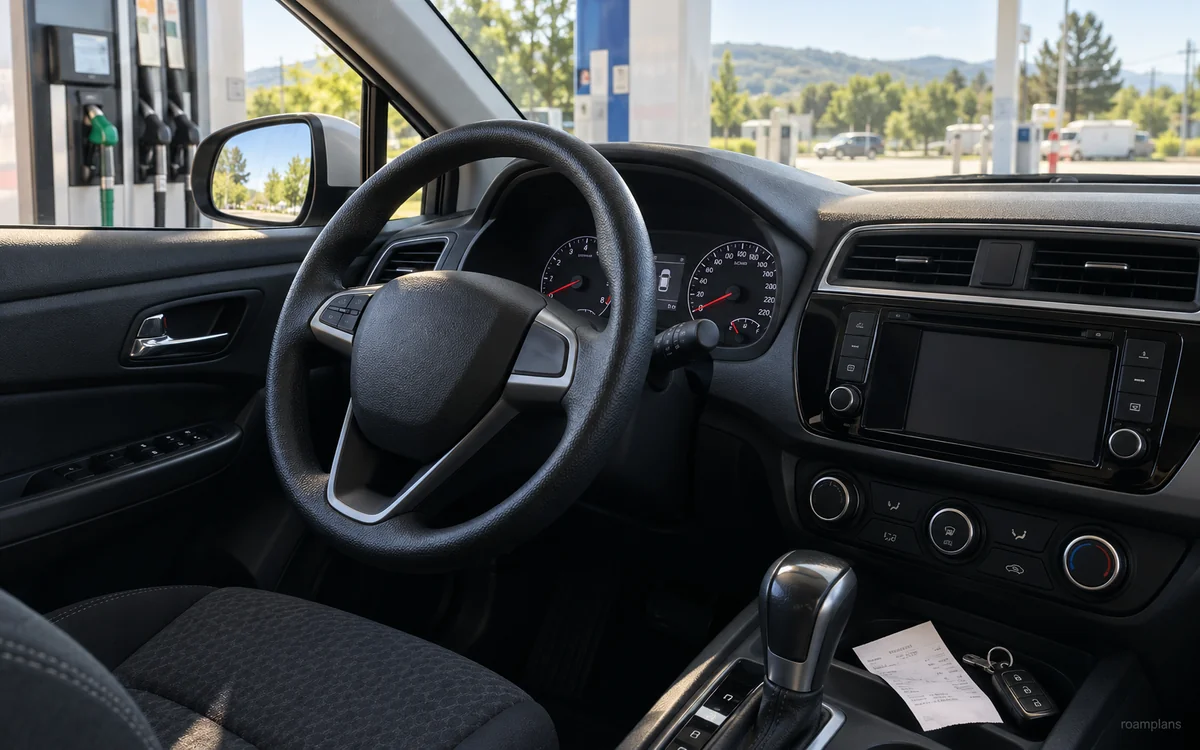
The fuel policy tells you how much fuel the car should have at pickup and return.
Choose the policy that fits your driving plan.
Full-to-Full
You collect the car with a full tank and return it full.
This is often the easiest policy to check.
Main benefits:
- ✓You pay local fuel prices
- ✓You pay only for fuel used
- ✓The return level is clear
Main risks:
- ✓High charge if the tank is not full
- ✓You need time to refuel before return
Keep the final fuel receipt.
Same-to-Same
You return the car with the same fuel level shown at pickup.
For example, you may collect it at three-quarters full and return it at the same level.
Main risk:
- ✓Fuel gauges are not exact
- ✓Disputes can happen
Take a clear photo of the gauge at pickup and return.
Prepaid Fuel
You pay for fuel before driving and return the car with less fuel.
This may work when you expect to use most of the tank.
Main risks:
- ✓Unused fuel may not be refunded
- ✓Prepaid price may include service charges
- ✓It is hard to return almost empty without running out
Refueling Service
You return the car without filling it, and the company charges you later.
This is convenient but often expensive.
The charge may include:
- ✓Higher fuel price
- ✓Service fee
- ✓Tax
Use this only when the time saved is worth the added cost.
Fuel Type
Confirm whether the car uses:
- ✓Gasoline
- ✓Diesel
- ✓Hybrid fuel
- ✓Electricity
Check the fuel label near the cap and inside the agreement.
Electric Vehicle Charging Policy
For an electric vehicle, check:
- ✓Pickup battery level
- ✓Required return level
- ✓Charging network
- ✓Cable included
- ✓Charging speed
- ✓Added fee for low return charge
- ✓Idle fees at charging stations
Save a photo of the battery level at pickup and return.
Fuel Receipt
Keep the final receipt because it can show:
- ✓Date
- ✓Time
- ✓Location
- ✓Fuel amount
- ✓Fuel type
A receipt near the return branch may help during a fuel dispute.
Mileage Rules
Mileage rules control how far you can drive without added charges.
Unlimited Mileage
Unlimited mileage allows driving without a per-mile or per-kilometre charge.
It may still have:
- ✓Geographic limits
- ✓Road restrictions
- ✓Cross-border limits
- ✓Vehicle-class exclusions
Limited Mileage
A limited plan includes a set distance.
Extra distance may be charged at a fixed rate.
Calculate your route before booking.
Include:
- ✓Main route
- ✓Day trips
- ✓Hotel travel
- ✓Fuel stops
- ✓Detours
- ✓Return drive
Mileage Overage Fee
The added fee may look small per mile, but it can become high over a long route.
Compare a limited plan with an unlimited option.
Record the Mileage
Take a photo of the mileage at pickup and return.
Make sure the starting figure matches the agreement.
Toll Roads and Rental Cars
Toll systems can cause surprise charges, especially in areas with cashless roads.
Check the toll process before driving.
Rental Toll Device
A company may offer a toll transponder or toll package.
It may charge:
- ✓Daily device fee
- ✓Fee only on toll-use days
- ✓Fee for the full rental
- ✓Toll amount plus administration charge
Read the full toll terms.
Pay-by-Plate
A camera may record the licence plate, then bill the rental company.
The company may charge your card later.
Added fees may appear after the rental has ended.
Personal Toll Device
Some locations allow renters to use their own transponder.
Check:
- ✓Whether the plate must be added
- ✓Whether the rental device must be blocked
- ✓Whether your account works in that state
- ✓How to avoid duplicate charges
Online Toll Payment
Some toll authorities allow payment online within a set time.
You may need:
- ✓Licence plate
- ✓State or country
- ✓Travel date
- ✓Toll road details
Check whether the rental company allows direct payment.
Toll Evidence
Keep:
- ✓Toll receipts
- ✓Online payment confirmation
- ✓Transponder statement
- ✓Route details
This can help if the same toll appears twice.
One-Way Rentals
A one-way rental begins at one branch and ends at another.
It can save backtracking, but it may cost more.
One-Way Fee
The fee depends on:
- ✓Pickup branch
- ✓Return branch
- ✓Distance
- ✓Vehicle supply
- ✓Country
- ✓Vehicle class
- ✓Season
Check the fee before booking.
When a One-Way Rental Makes Sense
It may suit:
- ✓Multi-city trips
- ✓Airport-to-airport routes
- ✓Long road trips
- ✓Routes where returning would waste a day
- ✓Trips ending in another city
When It May Cost Too Much
A return rental may be cheaper when:
- ✓The one-way fee is high
- ✓The final branch has low vehicle demand
- ✓The route crosses a border
- ✓A train or flight can cover the return
Compare the total route cost and time.
Confirm the Return Branch
Check:
- ✓Full address
- ✓Opening hours
- ✓After-hours return
- ✓Airport terminal
- ✓Parking entrance
- ✓Drop-box process
Do not return to another branch without approval.
Cross-Border and Geographic Restrictions
A rental car cannot always be taken anywhere.
Read the approved travel area before leaving.
Cross-Border Permission
Driving into another country may require:
- ✓Written approval
- ✓Added insurance
- ✓Cross-border fee
- ✓Vehicle documents
- ✓Roadside coverage
- ✓Specific vehicle class
Some borders or vehicle types may be blocked.
State or Regional Limits
Even within one country, the agreement may limit travel by:
- ✓State
- ✓Province
- ✓Island
- ✓Region
- ✓Road type
Check whether the full route is approved.
Ferry Travel
Taking a rental car on a ferry may require permission.
Possible limits include:
- ✓Insurance restrictions
- ✓Island restrictions
- ✓Added fee
- ✓Vehicle booking
- ✓Roadside support limits
Unpaved and Off-Road Use
Most normal rental cars cannot be used off-road.
Restrictions may include:
- ✓Dirt roads
- ✓Beaches
- ✓Farm tracks
- ✓Mountain tracks
- ✓Flooded roads
- ✓Closed roads
Damage on a restricted road may not be covered.
Towing
Do not tow:
- ✓Trailer
- ✓Caravan
- ✓Another vehicle
- ✓Equipment
unless the agreement allows it.
Snow and Winter Rules
Winter travel may require:
- ✓Snow tyres
- ✓Chains
- ✓Winter equipment
- ✓Restricted mountain routes
Check local law and rental company rules before booking.
What to Check in the Rental Agreement?
Read the agreement before signing.
Confirm:
- ✓Driver names
- ✓Vehicle class
- ✓Pickup and return time
- ✓Return branch
- ✓Fuel policy
- ✓Mileage
- ✓Insurance
- ✓Deposit
- ✓Toll plan
- ✓Added equipment
- ✓One-way fee
- ✓Cross-border permission
- ✓Road restrictions
- ✓Emergency number
- ✓Final estimated cost
Do not sign until any unclear charge has been explained.
Take a photo or save a digital copy of the signed agreement.
Rental Car Pickup Checklist
The pickup counter is your final chance to confirm the booking before driving away.
Do not rush through the process, even when you are tired after a flight.
Confirm the Main Driver
Check that the agreement shows the correct:
- ✓Full name
- ✓Driver’s licence number
- ✓Contact details
- ✓Rental dates
- ✓Pickup time
- ✓Return time
The main driver should match the licence and payment card where required.
Confirm Every Added Driver
Every person who may drive should appear on the agreement.
Check:
- ✓Added-driver fee
- ✓Age fee
- ✓Licence details
- ✓Insurance terms
An unlisted driver may not receive the same protection after an accident.
Check the Final Price
Before signing, compare the counter price with your booking confirmation.
Look for added charges such as:
- ✓Insurance
- ✓Roadside support
- ✓Toll package
- ✓Extra driver
- ✓Child seat
- ✓GPS
- ✓Fuel package
- ✓Vehicle upgrade
- ✓Airport charge
Ask staff to explain anything you did not request.
Check the Deposit
Confirm:
- ✓Deposit amount
- ✓Card hold
- ✓Accepted card
- ✓Expected release process
- ✓Reasons the deposit may be reduced
Keep the payment receipt.
Confirm the Vehicle Class
Check that the supplied vehicle belongs to the class you booked.
A different brand may be allowed under an “or similar” booking. However, the car should still meet the expected:
- ✓Passenger capacity
- ✓Luggage capacity
- ✓Transmission
- ✓Number of doors
- ✓Fuel type
Do not accept a smaller vehicle if it cannot safely fit your group and bags.
Review the Fuel Policy
Confirm:
- ✓Starting fuel level
- ✓Required return level
- ✓Fuel type
- ✓Refueling charge
- ✓Electric vehicle battery rule
The fuel level on the agreement should match the dashboard.
Confirm the Mileage Rule
Check whether the booking includes:
- ✓Unlimited mileage
- ✓Daily mileage limit
- ✓Full-rental mileage limit
- ✓Added distance fee
Take a photo of the starting mileage.
Ask How Tolls Work
Ask whether the car has:
- ✓Toll transponder
- ✓Pay-by-plate service
- ✓Toll package
- ✓Daily toll fee
Do not use toll roads until you know how payment will be handled.
Save Support Details
Save the rental company’s:
- ✓Branch number
- ✓Roadside assistance number
- ✓Accident number
- ✓After-hours number
- ✓Return address
Keep these details offline.
How to Inspect the Rental Car?
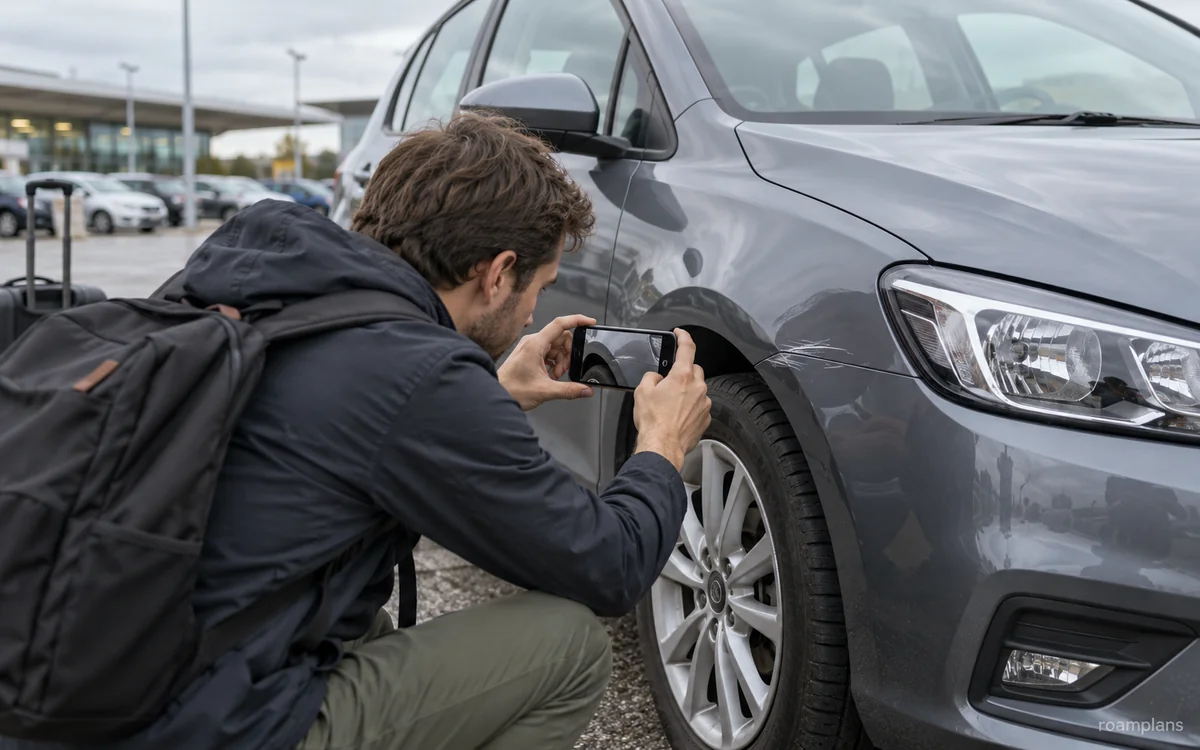
Inspect the car before leaving the rental location.
Photos and video can help show that damage existed before your rental.
When I collect a rental car, I record the vehicle before loading any luggage. This gives me clear evidence of the car’s condition at pickup.
Record a Full Video
Walk around the vehicle slowly.
Record:
- ✓Front
- ✓Driver’s side
- ✓Rear
- ✓Passenger side
- ✓Roof where visible
- ✓Lower bumpers
- ✓Wheels
- ✓Windscreen
Make sure the video shows the full car and close views of visible marks.
Take Clear Photos
Photograph:
- ✓Scratches
- ✓Dents
- ✓Paint marks
- ✓Cracked lights
- ✓Wheel damage
- ✓Tyre damage
- ✓Windscreen chips
- ✓Mirror damage
- ✓Bumper damage
- ✓Interior stains
Use good light where possible.
Check the Damage Report
Compare the vehicle with the damage form or app.
Every existing mark should appear on the record.
Ask staff to add missing damage before you leave.
Do not rely only on a verbal promise.
Check the Tyres and Wheels
Look for:
- ✓Low tyre
- ✓Sidewall damage
- ✓Missing wheel cover
- ✓Scratched rim
- ✓Warning light
Report anything that looks unsafe.
Check the Windscreen and Mirrors
Look for:
- ✓Chips
- ✓Cracks
- ✓Scratches
- ✓Broken mirror glass
- ✓Loose mirror casing
Small glass damage may become worse during the rental.
Record Fuel and Mileage
Take photos of:
- ✓Fuel gauge
- ✓Battery level
- ✓Mileage
- ✓Dashboard
These photos should show the pickup date where possible.
Check Warning Lights
Start the engine and look for warning lights.
Check:
- ✓Engine warning
- ✓Tyre pressure
- ✓Oil
- ✓Battery
- ✓Brake
- ✓Fuel
- ✓Electric vehicle alerts
Ask staff about any light that stays on.
Test Basic Controls
Test:
- ✓Headlights
- ✓Brake lights
- ✓Indicators
- ✓Wipers
- ✓Horn
- ✓Air conditioning
- ✓Heating
- ✓Windows
- ✓Locks
- ✓Reversing camera where included
Make sure you know how to use the main controls before entering traffic.
Check Safety Equipment
Depending on the location, the car may include:
- ✓Spare tyre
- ✓Tyre repair kit
- ✓Warning triangle
- ✓Reflective vest
- ✓First-aid kit
- ✓Snow equipment
- ✓Charging cable
Ask where each item is stored.
Check the Interior
Record:
- ✓Seat damage
- ✓Dashboard marks
- ✓Floor stains
- ✓Smoke smell
- ✓Pet hair
- ✓Broken controls
- ✓Missing equipment
Report strong smells before leaving. They may later lead to a cleaning claim.
Confirm the Fuel Type
Check the label near the fuel cap.
Confirm whether the car uses:
- ✓Gasoline
- ✓Diesel
- ✓Hybrid fuel
- ✓Electricity
Using the wrong fuel can cause serious damage.
Before Leaving the Rental Location
Take a few minutes to prepare before driving.
Adjust the Vehicle
Set:
- ✓Seat
- ✓Mirrors
- ✓Steering wheel
- ✓Head restraint
- ✓Climate controls
Do this while the car is parked.
Learn the Main Controls
Find:
- ✓Lights
- ✓Indicators
- ✓Wipers
- ✓Parking brake
- ✓Gear selector
- ✓Fuel-cap release
- ✓Hazard lights
- ✓Navigation controls
Driving an unfamiliar vehicle becomes harder when you search for controls in traffic.
Set the Route
Enter the first destination before moving.
Check:
- ✓Correct hotel
- ✓Correct airport
- ✓Toll roads
- ✓Restricted roads
- ✓Parking entrance
Do not handle the phone while driving.
Check the Driving Side
Pause before leaving the lot if the destination uses the opposite side of the road from your home country.
Pay extra attention at:
- ✓Roundabouts
- ✓Junctions
- ✓Car parks
- ✓Turns
- ✓Quiet roads
What to Do During the Rental?
Follow the rental agreement and local road rules for the full rental period.
Use Approved Drivers Only
Only listed drivers should use the vehicle.
Adding a driver later may require approval and another fee.
Stay on Approved Roads
Avoid roads that the agreement blocks, such as:
- ✓Off-road tracks
- ✓Beaches
- ✓Flooded roads
- ✓Closed roads
- ✓Rough mountain tracks
- ✓Private land
Damage on a restricted road may not receive the same cover.
Follow Parking Rules
Check signs before leaving the car.
Look for:
- ✓Payment hours
- ✓Permit zones
- ✓Loading areas
- ✓Street-cleaning times
- ✓Resident zones
- ✓Time limits
- ✓No-parking rules
Keep parking receipts where provided.
Protect the Vehicle
Before leaving the car:
- ✓Lock every door
- ✓Close the windows
- ✓Remove the key
- ✓Hide luggage
- ✓Take valuables
- ✓Check the parking area
Do not leave passports, money, phones, or cameras inside.
Monitor Fuel or Battery Level
Do not wait until the final return trip to check fuel or charging.
For an electric car, plan charging around:
- ✓Available stations
- ✓Charging speed
- ✓Hotel access
- ✓Route distance
- ✓Return battery rule
Keep Receipts
Keep receipts for:
- ✓Fuel
- ✓Charging
- ✓Tolls
- ✓Parking
- ✓Repairs approved by the rental company
Receipts can help explain later charges.
Extending the Rental
Contact the rental company before the agreed return time.
Ask about:
- ✓New daily rate
- ✓Insurance extension
- ✓Deposit
- ✓Return branch
- ✓Vehicle availability
Do not keep the car longer without approval.
Adding Another Driver
Contact the company before another person drives.
The new driver may need to visit a branch with:
- ✓Licence
- ✓ID
- ✓Payment
- ✓Signature
Traffic and Parking Tickets
Do not ignore a ticket.
The rental company may later add:
- ✓Original fine
- ✓Administration fee
- ✓Processing charge
Follow the local payment or appeal process.
What to Do After a Rental Car Accident?
An accident can be stressful. Follow a clear order.
Move to Safety
Stop in a safe place where possible.
Use hazard lights and emergency equipment where required.
Contact Emergency Services
Call emergency services when there are:
- ✓Injuries
- ✓Serious damage
- ✓Road danger
- ✓Fire
- ✓Dispute between drivers
Follow local law.
Contact the Rental Company
Call the rental company as soon as it is safe.
Ask:
- ✓Whether the car can be driven
- ✓Whether towing is needed
- ✓Where the vehicle should go
- ✓Whether a replacement car is available
- ✓Which documents are required
Do not arrange a private repair without approval.
Record the Scene
Take photos or video of:
- ✓Every vehicle
- ✓Damage
- ✓Road
- ✓Signs
- ✓Traffic lights
- ✓Weather
- ✓Licence plates
- ✓Skid marks
- ✓Surrounding area
Do not place yourself in danger while recording evidence.
Collect Details
Collect the other driver’s:
- ✓Name
- ✓Contact number
- ✓Address where required
- ✓Licence details
- ✓Vehicle registration
- ✓Insurance details
Also collect witness details where available.
Complete Required Reports
You may need:
- ✓Police report
- ✓Rental accident form
- ✓Insurance claim form
- ✓Written statement
Complete the forms as soon as possible.
Do Not Admit Fault
Describe what happened without accepting blame.
Insurance companies and local authorities will review the evidence.
Keep Every Record
Save:
- ✓Police report
- ✓Photos
- ✓Video
- ✓Rental agreement
- ✓Emails
- ✓Receipts
- ✓Towing records
- ✓Medical records where relevant
What to Do After a Breakdown?
A breakdown may include:
- ✓Engine failure
- ✓Flat tyre
- ✓Dead battery
- ✓Warning light
- ✓Overheating
- ✓Electrical problem
Stop Safely
Move away from traffic where possible.
Turn on hazard lights.
Use warning equipment where required.
Call Rental Roadside Support
Use the number in the agreement.
Explain:
- ✓Location
- ✓Vehicle details
- ✓Warning lights
- ✓What happened
- ✓Whether the car blocks traffic
Do Not Repair the Car Without Approval
The rental company may have approved repair or towing providers.
An unapproved repair may not be refunded.
Flat Tyre
Ask whether the agreement allows you to change the tyre.
Some vehicles use:
- ✓Spare tyre
- ✓Temporary spare
- ✓Repair kit
- ✓Roadside replacement
Do not continue driving on a damaged tyre.
Lost or Locked Key
Contact the rental company.
Charges may include:
- ✓Replacement key
- ✓Delivery
- ✓Towing
- ✓Programming
- ✓Vehicle downtime
Wrong Fuel
Do not start the engine if you notice the mistake before driving.
Contact the rental company at once.
Starting the engine can spread the wrong fuel through the system.
Warning Light
Stop when a serious warning appears.
Contact support before continuing.
Take a photo of the dashboard.
Rental Car Return Checklist
Plan the return before the final day.
A rushed return can lead to fuel, timing, damage, and location problems.
Confirm the Return Location
Check:
- ✓Full address
- ✓Airport terminal
- ✓Rental return entrance
- ✓Parking level
- ✓Branch name
- ✓Opening hours
Airport return routes may differ from normal passenger drop-off routes.
Confirm the Return Time
Check the exact return time in the agreement.
Allow time for:
- ✓Traffic
- ✓Fuel
- ✓Charging
- ✓Finding the branch
- ✓Unloading luggage
- ✓Inspection
- ✓Airport transfer
Refill Fuel
For a full-to-full policy:
- ✓Use the correct fuel
- ✓Fill the tank near the return location
- ✓Keep the receipt
- ✓Photograph the gauge
Do not depend on a station being open near the airport.
Charge an Electric Vehicle
Check the required battery level.
Allow enough time for:
- ✓Finding a charger
- ✓Waiting
- ✓Charging speed
- ✓Driving from the charger to the return branch
Remove Personal Items
Check:
- ✓Boot
- ✓Glove box
- ✓Door pockets
- ✓Under seats
- ✓Seat-back pockets
- ✓Charging ports
- ✓Child-seat area
Look for phones, cables, glasses, documents, and keys.
Clean Normal Mess
Remove:
- ✓Rubbish
- ✓Food
- ✓Bottles
- ✓Sand where possible
- ✓Mud from loose items
You do not need to make the car look new, but avoid leaving heavy dirt or rubbish.
Record the Vehicle Again
Take another full video.
Photograph:
- ✓Every side
- ✓Wheels
- ✓Windscreen
- ✓Interior
- ✓Fuel or battery
- ✓Mileage
- ✓Parking location
Make sure the images are clear.
Attend the Inspection
Where possible, return the car during opening hours.
Ask staff to inspect it while you are present.
Get a Return Receipt
Ask for written or digital proof showing:
- ✓Return date
- ✓Return time
- ✓Fuel level
- ✓Mileage
- ✓Damage status
- ✓Final amount where available
Keep the receipt.
After-Hours Rental Car Return
After-hours return may be useful for early flights or late arrivals, but it carries more risk.
Check the Process Before Travel
Confirm:
- ✓Approved parking area
- ✓Key-drop location
- ✓Gate access
- ✓Fuel rule
- ✓Branch number
- ✓Time the rental remains active
Record the Return
Take photos of:
- ✓Vehicle location
- ✓Parking bay
- ✓Fuel
- ✓Mileage
- ✓Every side
- ✓Key-drop box
- ✓Time shown on your phone
Keep the Key-Drop Evidence
Where safe and allowed, record the key entering the drop box.
Do not leave keys in an unapproved place.
Know When Responsibility Ends
Some agreements keep the renter responsible until staff inspect the vehicle.
Read the after-hours terms before choosing this return method.
Checking the Final Invoice
Do not assume the amount is correct because the car has been returned.
Review the final invoice line by line.
Compare It with the Agreement
Check:
- ✓Base rental
- ✓Taxes
- ✓Insurance
- ✓Fuel
- ✓Mileage
- ✓Tolls
- ✓Parking or fines
- ✓Equipment
- ✓Late fee
- ✓Cleaning fee
- ✓Damage
- ✓Administration charges
Check Fuel Charges
If a fuel charge appears, compare it with:
- ✓Pickup fuel photo
- ✓Return fuel photo
- ✓Fuel receipt
- ✓Rental policy
Check Mileage Charges
Compare:
- ✓Starting mileage
- ✓Return mileage
- ✓Included mileage
- ✓Rate per extra mile or kilometre
Check Toll Charges
Toll charges may arrive later.
Compare them with:
- ✓Toll receipts
- ✓Transponder account
- ✓Route
- ✓Rental toll plan
Check the Deposit Release
The deposit may not disappear at once.
Check your card or bank account over the following days.
Contact the bank if the rental company confirms release but the hold remains.
Keep Records Until Charges Settle
Keep:
- ✓Booking
- ✓Agreement
- ✓Pickup photos
- ✓Return photos
- ✓Fuel receipt
- ✓Toll records
- ✓Return receipt
- ✓Final invoice
Do not delete them until all charges and holds are settled.
How to Dispute an Unexpected Rental Charge?
Act quickly when you find a charge you do not recognize.
Step 1: Identify the Charge
Write down:
- ✓Amount
- ✓Date
- ✓Description
- ✓Invoice line
- ✓Card statement entry
Step 2: Collect Evidence
Prepare:
- ✓Booking confirmation
- ✓Signed agreement
- ✓Pickup photos
- ✓Return photos
- ✓Fuel receipt
- ✓Mileage photos
- ✓Toll proof
- ✓Return receipt
- ✓Emails
Step 3: Contact the Rental Location
Ask for:
- ✓Written explanation
- ✓Damage report
- ✓Photos
- ✓Fuel record
- ✓Toll details
- ✓Cleaning evidence
- ✓Return inspection
Keep communication in writing where possible.
Step 4: Contact Central Customer Service
Send a clear timeline and attach the evidence.
State:
- ✓What happened
- ✓Which charge you dispute
- ✓Why it is incorrect
- ✓Which refund or correction you request
Step 5: Ask for a Written Decision
Keep the case number and response.
Step 6: Contact the Card Provider
Contact the card provider after trying to resolve the matter with the rental company.
Share the evidence and company response.
Step 7: Use Consumer Support Where Needed
Consumer complaint routes differ by location.
Use an official consumer agency or regulator when the company does not resolve a supported complaint.
Delete Personal Data from the Rental Car
Modern vehicles may save personal information from a connected phone.
Remove your data before return.
Disconnect the Phone
Remove the vehicle from your phone’s Bluetooth list.
Remove your phone from the vehicle system.
Delete Contacts and Calls
Check for saved:
- ✓Contacts
- ✓Call history
- ✓Messages
- ✓Phone numbers
Delete Saved Locations
Remove:
- ✓Hotel
- ✓Home
- ✓Work
- ✓Recent destinations
- ✓Favorite places
Sign Out of Apps
Sign out of:
- ✓Music apps
- ✓Navigation apps
- ✓Charging apps
- ✓Personal accounts
Remove Access Codes
Delete any saved:
- ✓Garage code
- ✓Gate code
- ✓Wi-Fi password
- ✓Access address
Reset the Driver Profile
Use the system’s guest-data or profile reset option where available.
Do not change settings that the rental company asks renters to keep.
Common Car Rental Mistakes
1. Comparing Daily Rates Only
The daily rate does not show the full cost.
Add insurance, fees, fuel, tolls, parking, and equipment.
2. Not Checking the Deposit
A large hold can reduce the money available during the trip.
3. Assuming a Debit Card Will Work
Debit-card rules differ by branch.
Confirm them before booking.
4. Buying Insurance Without Checking Existing Cover
You may pay twice for similar protection.
Check personal insurance and card benefits first.
5. Rejecting Insurance Without Checking Gaps
A personal policy or card may exclude liability, some countries, or some vehicle types.
6. Choosing a Car That Is Too Small
Passenger capacity does not equal luggage capacity.
7. Ignoring Parking Costs
Hotel and city parking can cost more than expected.
8. Not Checking the Fuel Policy
A poor fuel choice can add a high return charge.
9. Skipping the Pickup Inspection
Without photos, it may be harder to show that damage existed earlier.
10. Letting an Unlisted Driver Use the Car
This may break the agreement and affect cover.
11. Driving on Restricted Roads
Off-road or blocked areas may not be covered.
12. Ignoring Tolls
Cashless tolls can create later administration fees.
13. Returning Late
A short delay may lead to an added hour or full rental day.
14. Keeping No Fuel Receipt
The receipt can help answer a fuel charge.
15. Returning Without Photos
Return photos can support a dispute if damage is alleged after you leave; they do not guarantee that a charge will be cancelled.
16. Forgetting Personal Data
The vehicle may retain contacts, calls, and saved locations.
17. Deleting Records Too Soon
Keep all records until the final invoice and deposit are settled.
More trip-planning errors are covered in Transportation Mistakes Travelers Should Avoid ↗.
Complete Car Rental Checklist
Before Booking
- ✓Rental car need confirmed
- ✓Parking checked
- ✓Driver age checked
- ✓Licence accepted
- ✓International Driving Permit checked
- ✓Card rules checked
- ✓Deposit checked
- ✓Vehicle size checked
- ✓Transmission checked
- ✓Cancellation terms read
- ✓Final cost compared
Insurance
- ✓Personal auto insurance checked
- ✓Credit card cover checked
- ✓Travel insurance checked
- ✓Liability cover checked
- ✓Damage waiver checked
- ✓Theft cover checked
- ✓Excess or deductible checked
- ✓Exclusions read
- ✓Claim process saved
Booking
- ✓Pickup branch confirmed
- ✓Return branch confirmed
- ✓Dates checked
- ✓Local times checked
- ✓Main driver correct
- ✓Added drivers listed
- ✓Fuel policy checked
- ✓Mileage checked
- ✓Toll plan checked
- ✓Booking saved offline
At Pickup
- ✓Final price checked
- ✓Deposit confirmed
- ✓Agreement read
- ✓Vehicle class checked
- ✓Fuel level recorded
- ✓Mileage recorded
- ✓Damage photographed
- ✓Tyres checked
- ✓Warning lights checked
- ✓Support numbers saved
During the Rental
- ✓Approved drivers only
- ✓Parking rules followed
- ✓Tolls tracked
- ✓Fuel monitored
- ✓Receipts kept
- ✓Valuables removed
- ✓Restricted roads avoided
- ✓Vehicle locked
- ✓Extension approved where needed
At Return
- ✓Return address confirmed
- ✓Return time checked
- ✓Fuel replaced
- ✓Battery charged where required
- ✓Personal items removed
- ✓Personal data deleted
- ✓Final video recorded
- ✓Mileage photographed
- ✓Fuel photographed
- ✓Return receipt collected
After Return
- ✓Final invoice checked
- ✓Fuel charge checked
- ✓Toll charges checked
- ✓Mileage checked
- ✓Deposit monitored
- ✓Card statement reviewed
- ✓Records kept
- ✓Unexpected charges disputed
Frequently Asked Questions
You normally need a valid driver’s licence, accepted payment card, booking confirmation, and identification. Some locations may also ask for an International Driving Permit or added documents.
Some locations accept debit cards, while others require a credit card. Debit rentals may need a larger deposit, extra ID, or proof of return travel.
The amount differs by company, location, vehicle, card type, and insurance choice. Check the branch terms before booking.
You need suitable protection, but you may already have some cover through personal auto insurance, travel insurance, or a credit card. Check limits and exclusions before deciding.
Full-to-full is often easy to track because you return the car with a full tank. The best choice still depends on your route and fuel use.
Airport pickup is convenient but may include added fees. An off-airport branch may cost less after transfer cost and travel time are included.
Photograph every side, wheels, tyres, windscreen, mirrors, interior marks, fuel level, mileage, and dashboard warning lights.
Move to safety, contact emergency services where needed, call the rental company, record the scene, collect driver details, and complete required reports.
Only approved drivers listed on the rental agreement should drive. Adding another driver may require documents and a fee.
Read the full quote and agreement. Check insurance, fuel, mileage, tolls, parking, added drivers, equipment, one-way charges, and return rules.
Keep the agreement, photos, receipts, return proof, and final invoice until the card hold is removed and no more charges are expected.
Final Thoughts
In short, renting a car can make a trip easier when the route includes rural areas, several stops, or limited public transport.
The safest booking starts with the full cost. Check the licence, age, card, deposit, insurance, fuel, mileage, toll, parking, and return rules before paying.
At pickup, read the agreement and record the car’s condition. Keep receipts during the rental and contact the company before making repairs, changing drivers, crossing borders, or extending the booking.
At return, refill or charge the vehicle, take new photos, delete personal data, and collect proof of return. Review the final invoice and keep every record until the deposit and charges are settled.
A clear process can help you avoid surprise fees and deal with any later dispute using strong evidence.

Adnan Ahmed
RoamPlans AuthorTravel Planning Researcher & Editor
Adnan Ahmed is the travel planning researcher and editor behind RoamPlans. He creates clear, practical guides to help travelers compare destinations, plan routes, estimate costs, and avoid common trip-planning mistakes. His work combines careful source research, official travel information, and regular content reviews to keep each guide useful and current.
- ✓Destination Research
- ✓Budget Planning
- ✓Route Planning
- ✓Beginner Travel Guides
Turn This Guide into a Practical Trip Plan
Use the recommended Transportation Cost Calculator or explore more free RoamPlans tools.