How to Choose the Best Transportation for Your Trip?
The cheapest transport option is not always the best one. A low fare can become expensive ↗ after luggage fees, airport transfers, parking, tolls, or a taxi from a distant station are added.
The fastest listed option can also take longer than expected. A one-hour flight may require several extra hours for airport travel, check-in, security, waiting, baggage collection, and transport to your hotel.
When I compare transport options for a trip, I start with the full route from one door to the next. This gives me a clearer view of the real cost, time, comfort, and effort involved.
This guide explains how to choose the best transportation for your trip by comparing the route, distance, total time, full cost, luggage, group size, comfort, and destination.
Start with the exact hotel-to-hotel route and remove options that cannot meet your timing, document or accessibility needs. Compare the remaining options using the same dates, passengers and luggage: full cost, door-to-door time, transfers and a workable backup. Use different transport for different parts of the trip when that fits better than one mode throughout.
Transport routes, ticket prices, schedules, payment methods, rental requirements, and local rules can differ by destination and provider. Check final details through official transport operators, airports, rental companies, and local authorities before booking.
Start with the Exact Route

Many travelers choose a transport type before checking the full route. This can lead to extra transfers, long walks, and added costs.
Start with these two questions:
- 1Where exactly does the route begin?
- 2Where exactly does it end?
Do not use city names alone. Check the airport, terminal, station, hotel, district, port, or attraction.
Identify the Starting Point
Your starting point may be:
- ✓Your home
- ✓An airport terminal
- ✓A hotel
- ✓A train station
- ✓A bus station
- ✓A ferry port
- ✓A city-center stop
- ✓A rural accommodation
The best option can change based on where you begin.
For example, a train may look faster than a bus, but the train station may be one hour from your hotel. A direct coach leaving near the hotel may take less total time.
Identify the Final Destination
Check where the transport actually arrives.
It may stop:
- ✓Near your hotel
- ✓Outside the city center
- ✓At another airport
- ✓At a suburban station
- ✓At a roadside stop
- ✓At a port
- ✓Several kilometer’s from the attraction
A ticket to the correct city does not always mean the arrival point is convenient.
Use a map to check:
- ✓Walking distance
- ✓Local bus connections
- ✓Taxi availability
- ✓Station opening hours
- ✓Late-night transport
- ✓Road conditions
- ✓Luggage difficulty
Check the First and Last Part of the Route
The main train, bus, or flight may cover only part of the trip.
You may still need:
- ✓A taxi to the station
- ✓A local train to the airport
- ✓A shuttle to the terminal
- ✓A bus from the arrival station
- ✓A ride app to the hotel
- ✓A long walk with luggage
These short transfers can change the final cost and travel time.
When I compare transport, I check the last part before I book the main ticket. This is where cheap routes often become less useful.
Compare Direct and Connecting Routes
A direct option is often easier, but it may cost more.
A connecting route may offer:
- ✓A lower fare
- ✓More departure times
- ✓Access to smaller destinations
- ✓Better arrival times
It may also bring:
- ✓Longer waiting
- ✓Missed connection risk
- ✓Platform changes
- ✓Station changes
- ✓More luggage handling
- ✓Extra ticket rules
Check whether all parts are included on one booking. If separate tickets are used, a delay on the first service may not protect the second booking.
Route Comparison Table
Use a simple table before deciding:
| Route stage | Main option | Added transfer | Total time | Final cost |
|---|---|---|---|---|
| Hotel to station | Local taxi | None | 20 minutes | |
| City A to City B | Train | Metro after arrival | 4 hours | |
| Airport to hotel | Airport bus | Short walk | 1 hour | |
| Rural stop to hotel | Coach | Taxi required | 3 hours |
This helps show whether an option is truly direct, cheap, or fast.
Consider the Travel Distance
Distance affects which transport types are practical, but there is no fixed rule that works everywhere.
A fast train may make a longer route easy. A poor road may make a short route slow. A small island may depend on ferries, while a rural area may have no useful public transport.
Use distance as one factor, then check the actual route.
Short Local Trips
For short trips within a city or town, common options include:
- ✓Walking
- ✓Metro
- ✓Local bus
- ✓Tram
- ✓Taxi
- ✓Ride app
- ✓Bicycle
Walking may be suitable when:
- ✓The route is short
- ✓The area is safe
- ✓The weather is comfortable
- ✓You have light luggage
- ✓The path is easy to follow
Public transport may be better when:
- ✓The route is longer
- ✓Traffic is heavy
- ✓Parking is difficult
- ✓The city has frequent service
- ✓You expect several trips in one day
A taxi or ride app may work better when:
- ✓You have large bags
- ✓It is late at night
- ✓You are traveling with children
- ✓The route needs several changes
- ✓The hotel is far from the nearest stop
Medium-Distance Trips
For travel between nearby cities or regions, common options include:
- ✓Train
- ✓Coach
- ✓Rental car
- ✓Shared transfer
Train travel may suit routes that connect city centers.
Bus or coach travel may work well where rail service is limited or expensive.
A rental car may suit:
- ✓Rural stops
- ✓Several destinations
- ✓Families
- ✓Travelers with heavy luggage
- ✓Routes with poor public transport
Compare the full route rather than assuming one option always works better.
Long-Distance Trips
Longer routes may involve:
- ✓High-speed train
- ✓Overnight train
- ✓Long-distance coach
- ✓Domestic flight
- ✓Rental car
- ✓Ferry
A domestic flight may have a short listed time, but the complete route can take much longer.
Add:
- ✓Airport transfer
- ✓Early arrival
- ✓Security
- ✓Boarding
- ✓Baggage collection
- ✓Transport after landing
A train may take longer on paper but still provide a faster hotel-to-hotel route.
Rural and Remote Trips
Rural travel often needs more planning because services may be limited.
Check:
- ✓Number of daily buses
- ✓Final return time
- ✓Taxi supply
- ✓Mobile coverage
- ✓Road conditions
- ✓Parking
- ✓Fuel stations
- ✓Seasonal closures
A rental car or arranged transfer may be more practical when public transport runs only once or twice per day.
However, driving may not suit everyone. Local road rules, unfamiliar roads, weather, and parking can add stress.
Cross-Border Routes
Cross-border travel may involve:
- ✓Passport checks
- ✓Visa checks
- ✓Customs
- ✓Separate tickets
- ✓Vehicle restrictions
- ✓Rental car permission
- ✓Different currencies
- ✓Different time zones
A route that looks simple on a map may take longer because of border procedures.
Check official requirements before booking.
Compare Door-to-Door Travel Time

Door-to-door time is the total time from your starting point to your final destination.
This is more useful than the travel time shown on a ticket.
A transport option may look fast because the provider only shows the time spent on the main service.
Listed Travel Time
The listed time may include only:
- ✓Time on the train
- ✓Time on the bus
- ✓Time in the air
- ✓Time inside the taxi
- ✓Driving time
It may not include:
- ✓Travel to the departure point
- ✓Waiting
- ✓Check-in
- ✓Security
- ✓Boarding
- ✓Transfers
- ✓Baggage collection
- ✓Travel after arrival
Time to Reach the Departure Point
Calculate how long it takes to reach:
- ✓The airport
- ✓The train station
- ✓The bus terminal
- ✓The ferry port
- ✓The rental office
Include:
- ✓Walking
- ✓Local transport
- ✓Traffic
- ✓Parking
- ✓Shuttle time
- ✓Station entry
A train station in the city center may be easier to reach than an airport outside the city.
Waiting and Check-In Time
Different transport types require different arrival times.
You may need extra time for:
- ✓Airport security
- ✓Passport checks
- ✓Ticket collection
- ✓Seat check-in
- ✓Bus boarding
- ✓Ferry check-in
- ✓Rental car paperwork
- ✓Luggage loading
Do not arrive based only on the departure time.
Transfer Time
Transfers can add more time than expected.
Check:
- ✓Platform distance
- ✓Lift access
- ✓Station size
- ✓Terminal changes
- ✓Walking time
- ✓Luggage collection
- ✓Border checks
- ✓Waiting between services
A 15-minute change may work in a small station but be risky in a large terminal.
Time From Arrival Point to Accommodation
Check how long it takes to reach the hotel after arrival.
Include:
- ✓Walking
- ✓Metro
- ✓Bus
- ✓Taxi queue
- ✓Ride-app pickup
- ✓Road traffic
- ✓Hotel transfer
- ✓Check-in time
City-center arrivals often save time. A distant airport or roadside bus stop may add another hour.
Sample Door-to-Door Comparison
| Option | Main travel time | Added time | Door-to-door total |
|---|---|---|---|
| Flight | 1 hour | 4 hours | 5 hours |
| Train | 3 hours | 45 minutes | 3 hours 45 minutes |
| Bus | 4 hours | 30 minutes | 4 hours 30 minutes |
| Rental car | 3 hours 30 minutes | 20 minutes | 3 hours 50 minutes |
These figures are illustrative arithmetic, not observed journey times or recommended buffers. For each option, include both local transfers, check-in or collection, security or border formalities where required, walking, parking and return procedures. Then allow a separate buffer for disruption. Check the provider’s boarding cutoff rather than treating scheduled departure as the last arrival time.
Time vs Convenience
The fastest route may include:
- ✓Early departure
- ✓Several changes
- ✓Long walks
- ✓Tight connections
- ✓Difficult luggage handling
A slightly slower direct option may feel easier and carry less risk.
For a short trip, saving two hours may matter more. For a longer stay, saving money may be the better choice.
Decide what matters most for that part of the trip.
Calculate the Full Transportation Cost

The advertised price is often only the starting cost.
Before choosing an option, add every expense connected to it.
Base Ticket Price
Start with the main fare for:
- ✓Train
- ✓Bus
- ✓Flight
- ✓Public transport
- ✓Taxi
- ✓Ride app
- ✓Ferry
- ✓Rental car
- ✓Private transfer
Check whether the price is:
- ✓Per person
- ✓Per vehicle
- ✓Per day
- ✓Per trip
- ✓One way
- ✓Return
A taxi price may cover the full group, while train fares are usually charged per traveler.
Booking and Seat Fees
Added charges may include:
- ✓Reservation fee
- ✓Seat selection
- ✓Payment fee
- ✓App service fee
- ✓Station fee
- ✓Airport surcharge
- ✓Ticket delivery fee
- ✓Booking platform fee
Check the final payment page before comparing prices.
Transfer Costs
Add the cost of reaching and leaving:
- ✓Airports
- ✓Stations
- ✓Ports
- ✓Rental offices
- ✓Roadside stops
A low-cost flight from a distant airport may need two extra transfers.
A bus ticket may be cheap, but the final stop may require a taxi.
Luggage Costs
Check for:
- ✓Checked bags
- ✓Extra bags
- ✓Large suitcases
- ✓Sports equipment
- ✓Bicycles
- ✓Pushchairs
- ✓Larger taxi vehicles
- ✓Extra storage
Luggage rules differ between providers.
Do not assume trains and buses always allow unlimited bags.
Rental Car Costs
A car rental price may not include:
- ✓Insurance
- ✓Security deposit
- ✓Fuel
- ✓Toll roads
- ✓Parking
- ✓Extra drivers
- ✓Young-driver fee
- ✓One-way fee
- ✓Airport fee
- ✓Child seat
- ✓Cross-border fee
- ✓Cleaning fee
A low daily rate can become expensive after these costs are added.
The Car Rental Guide for Travelers ↗ explains these charges in more detail.
Fuel and Tolls
For a driving route, estimate:
- ✓Total distance
- ✓Fuel use
- ✓Fuel price
- ✓Toll roads
- ✓Road permits
- ✓Low-emission charges
- ✓Parking
Some tolls may be paid online or through the rental company.
Parking Costs
Parking can change whether a rental car is a good choice.
Check parking at:
- ✓Hotel
- ✓City center
- ✓Attractions
- ✓Train stations
- ✓Airports
- ✓Beaches
- ✓National parks
Also check whether the car can remain parked overnight.
Time-Related Costs
A slow or badly timed route can create other expenses.
These may include:
- ✓Extra hotel night
- ✓Airport hotel
- ✓Late check-in fee
- ✓Missed attraction ticket
- ✓Lost sightseeing time
- ✓Meal during a long delay
- ✓Taxi after public transport closes
Add these costs to the option that creates them.
Group Cost
Compare the full price for everyone.
For example:
- ✓Four train tickets may cost more than one rental car.
- ✓One taxi may cost less than four airport bus tickets.
- ✓Parking and fuel may make public transport cheaper again.
Do not compare one ticket with one full vehicle price.
Total Cost Comparison Table
| Cost item | Train | Bus | Rental car | Public transport | Taxi |
|---|---|---|---|---|---|
| Base price | |||||
| Booking fee | |||||
| Transfer cost | |||||
| Luggage | |||||
| Fuel and tolls | Not applicable | Not applicable | Not applicable | May apply | |
| Parking | Not applicable | Not applicable | Not applicable | Not applicable | |
| Extra hotel cost | |||||
| Final group cost |
Use actual route prices instead of average figures from another city or season. Start with the full quote, then add only costs not already included. Keep a refundable rental deposit or card hold separate from spending, while checking that you have enough available funds. Compare the full group cost before dividing shared car or taxi expenses per person.
The U.S. FTC’s rental-car guidance ↗ highlights taxes, fuel, tolls and other charges that can change an advertised rate. For your destination, confirm the actual branch terms rather than applying another country’s rules.
Cost vs Value
The lowest price may not offer the best value.
A more expensive option may provide:
- ✓Direct travel
- ✓Less waiting
- ✓Better arrival time
- ✓Easier luggage handling
- ✓Fewer changes
- ✓More comfort
- ✓Flexible booking
- ✓Lower missed-connection risk
The best choice is the option that fits your full trip, not the one with the smallest number on the booking screen.
Think About Your Luggage
Luggage can change which transport option works best.
A route that feels easy with one backpack may become difficult with two large suitcases, a pushchair, or sports equipment. Before booking, check how far you need to walk, how many changes are required, and where bags will be stored.
Traveling with a Backpack or Small Bag
Light luggage gives you more transport choices.
You may find it easier to use:
- ✓Local buses
- ✓Metro systems
- ✓Trains
- ✓Walking routes
- ✓Shared transfers
- ✓Ride apps
- ✓Bike-sharing services
You can also manage station changes more easily and may not need a large taxi or rental car.
However, keep valuables close in busy stations and crowded vehicles. Use a bag that closes properly and can stay in front of you when needed.
Traveling with Large Suitcases
Large bags can make public transport harder, especially when the route includes:
- ✓Stairs
- ✓Long station walks
- ✓Platform changes
- ✓Crowded vehicles
- ✓Small luggage racks
- ✓Uneven streets
- ✓Long walks to the hotel
Before choosing a train or bus, check whether there is enough storage space.
For local travel, compare the cost of public transport with a taxi or ride app. A direct ride may cost more, but it can save time and reduce the effort of moving several bags.
Check Luggage Storage
Different transport services store luggage in different places.
Your bags may be kept:
- ✓Above your seat
- ✓Beside your seat
- ✓At the end of a train carriage
- ✓Under a coach
- ✓Inside a taxi boot
- ✓Inside a rental car
- ✓In a separate luggage section
Check whether you can see or reach the bag during the trip.
Keep passports, medicines, money, electronics, and booking documents in a smaller bag that stays with you.
Check Luggage Rules
Transport providers may limit:
- ✓Number of bags
- ✓Bag size
- ✓Total weight
- ✓Oversized luggage
- ✓Sports equipment
- ✓Bicycles
- ✓Musical instruments
- ✓Pushchairs
Some services include luggage in the ticket price. Others charge extra.
Do not rely on the rules of another provider, even when the route and vehicle look similar.
Special Equipment
Travelers carrying special equipment may need more planning.
This may include:
- ✓Wheelchairs
- ✓Walking aids
- ✓Pushchairs
- ✓Child seats
- ✓Bicycles
- ✓Skis
- ✓Surfboards
- ✓Golf bags
- ✓Camping equipment
Check whether the service requires advance notice.
A rental car may need a larger boot, roof storage, or a different vehicle type. A train or coach may have limited space for large items.
Luggage and Station Changes
A connecting route may require you to move all bags between:
- ✓Platforms
- ✓Terminals
- ✓Stations
- ✓Bus stops
- ✓Ferry areas
Check whether lifts or escalators are available.
When I compare two routes with similar prices, I usually prefer the one with fewer changes if I am carrying a large suitcase. A simple route is often worth a slightly higher fare.
Consider Your Group Size
The number of travelers can change the final cost and comfort of each option.
A bus or train may be cheaper for one person. A taxi, private transfer, or rental car may offer better value when several people share the price.
Always compare the cost for the full group.
Solo Travelers
Solo travelers often have the widest choice of lower-cost options.
Common choices include:
- ✓Public transportation
- ✓Train
- ✓Coach
- ✓Shared airport shuttle
- ✓Walking
- ✓Ride-sharing where available
Public transport may be much cheaper than a private taxi for one person.
However, a direct ride may still be the better choice after:
- ✓A late flight
- ✓A very early departure
- ✓A long travel day
- ✓Arrival with heavy luggage
- ✓Arrival in an unfamiliar area
Solo travelers should also check late-night safety, clear pickup points, and whether transport still runs after delays.
Couples
Couples should compare the price of two tickets with one vehicle.
For example:
- ✓Two airport train tickets
- ✓One taxi fare
- ✓Two coach tickets
- ✓One rental car
- ✓One private transfer
A taxi may become competitive for a short airport route. A rental car may make sense for a rural trip if both travelers can share the cost.
Check luggage space before choosing a small car or standard taxi.
Families with Children
Families should look beyond ticket prices.
Consider:
- ✓Child fares
- ✓Child-seat rules
- ✓Pushchair space
- ✓Toilet access
- ✓Direct routes
- ✓Luggage
- ✓Meal breaks
- ✓Rest time
- ✓Boarding difficulty
A route with several changes may be cheaper but harder with children.
A direct train, taxi, or transfer may reduce stress and missed connections.
For taxis and rental cars, confirm child-seat requirements. Do not assume every vehicle provides a suitable seat.
Groups
Groups may benefit from:
- ✓Group train tickets
- ✓Minibuses
- ✓Large taxis
- ✓Private transfers
- ✓Vans
- ✓Several rental cars
Compare the full cost and the effort of keeping everyone together.
Several small vehicles may create problems with:
- ✓Different arrival times
- ✓Separate payments
- ✓Luggage space
- ✓Meeting points
- ✓Driver communication
One larger vehicle may be easier, but confirm passenger and luggage capacity before booking.
Compare Cost Per Person and Cost Per Group
Use both figures.
| Transport option | Cost per person | Full group cost | Luggage included? | Extra transfer needed? |
|---|---|---|---|---|
| Train | ||||
| Coach | ||||
| Taxi | ||||
| Rental car | ||||
| Private transfer |
A low cost per person may not be the best deal after transfer fees and luggage charges are added.
Check Comfort and Accessibility
Comfort is easy to ignore during booking, but it can affect the full travel day.
A low-cost route may involve long walks, several changes, limited seating, or an overnight arrival.
Think about how the route will feel, not just how it looks on a map.
Number of Changes
Each change adds work and risk.
Changes may involve:
- ✓Finding another platform
- ✓Moving luggage
- ✓Waiting outside
- ✓Passing through a large station
- ✓Using stairs
- ✓Changing terminals
- ✓Buying another ticket
- ✓Rechecking the route
Direct transport is often easier for:
- ✓Beginner travelers
- ✓Families
- ✓Older travelers
- ✓People with large luggage
- ✓Travelers with reduced mobility
A connecting route may still work if there is enough time and the station is easy to use.
Seating and Personal Space
Check whether seating is:
- ✓Reserved
- ✓Unreserved
- ✓Guaranteed
- ✓Shared
- ✓Limited during busy hours
Also consider:
- ✓Legroom
- ✓Air conditioning
- ✓Toilet access
- ✓Charging points
- ✓Wi-Fi
- ✓Luggage space
- ✓Noise
- ✓Crowding
These details matter more on longer journeys.
Walking Distance
A transport route may require more walking than expected.
Check the distance:
- ✓From the hotel to the station
- ✓Inside the terminal
- ✓Between platforms
- ✓From the arrival stop to the accommodation
- ✓Between two connecting stations
Map apps may show distance, but they may not show stairs, hills, broken pavements, or difficult crossings.
Stairs, Lifts, and Platform Access
Before choosing a route, check:
- ✓Step-free station entrance
- ✓Lift access
- ✓Escalators
- ✓Platform gaps
- ✓Low-floor buses
- ✓Wheelchair spaces
- ✓Accessible toilets
- ✓Boarding support
A station may be marked accessible even when one entrance is not.
Check the exact route through the station where possible.
Assistance Services
Some operators provide support for travelers who need help boarding, changing platforms, or moving through a station.
The process may require:
- ✓Advance booking
- ✓Arrival before a set time
- ✓A meeting point
- ✓Passenger details
- ✓Wheelchair information
- ✓Mobility-aid measurements
Confirm the process directly with the operator.
Travel Fatigue
Long travel days can affect the rest of your trip.
Think about:
- ✓Early departure
- ✓Overnight travel
- ✓Poor sleep
- ✓Long waits
- ✓Tight changes
- ✓Late arrival
- ✓Hotel check-in
- ✓Plans for the next morning
A cheaper overnight bus may save the price of a hotel but leave you too tired to enjoy the next day.
A more comfortable option may offer better value when the trip is short.
Match the Transportation to the Destination

The destination often decides which transport option works best.
A rental car may be useful in one place and a burden in another. Public transport may be easy in a capital city but limited in a small town.
Large Cities
Public transportation often works well in large cities because it may offer:
- ✓Frequent service
- ✓Several routes
- ✓Airport connections
- ✓Day passes
- ✓Wide coverage
- ✓Less need for parking
Driving may be harder because of:
- ✓Heavy traffic
- ✓Expensive parking
- ✓One-way roads
- ✓Restricted zones
- ✓Toll charges
- ✓Limited hotel parking
Check the location of your accommodation before choosing a car.
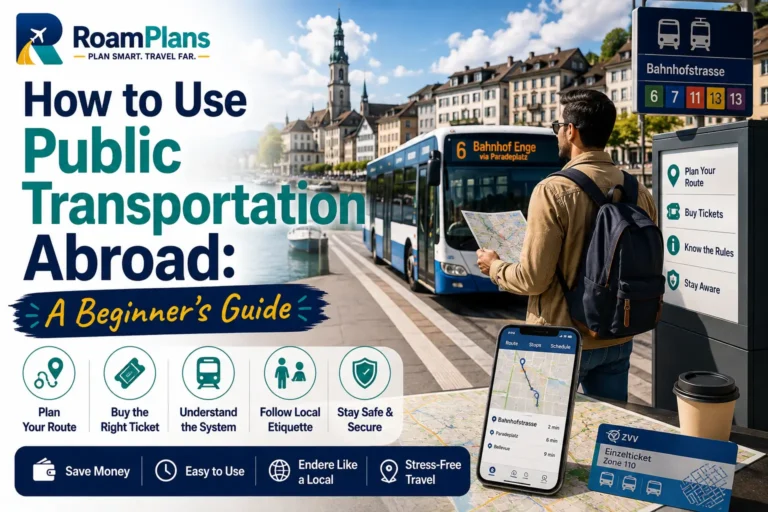
The guide How to Use Public Transportation Abroad ↗ explains how local ticket systems, transport cards, zones, and validation usually work.
Small Towns
Small towns may have:
- ✓Limited train service
- ✓Few daily buses
- ✓Early final departures
- ✓No ride apps
- ✓Small taxi networks
A train may reach the nearest city, but another transfer may be needed for the final part.
Check the full route before booking accommodation.
Rural Areas
Rural destinations often suit:
- ✓Rental cars
- ✓Private transfers
- ✓Local taxis
- ✓Tour transport
- ✓Limited bus routes
A car may offer more control when attractions are spread apart.
Before driving, check:
- ✓Road conditions
- ✓Parking
- ✓Fuel stations
- ✓Mobile coverage
- ✓Seasonal closures
- ✓Local driving rules
Islands
Island transport may include:
- ✓Ferry
- ✓Local bus
- ✓Taxi
- ✓Scooter
- ✓Bicycle
- ✓Rental car
- ✓Hotel shuttle
Check whether vehicles must be booked on the ferry.
Some islands have good public transport, while others require a car or scooter.
Mountain Destinations
Mountain routes can be affected by:
- ✓Weather
- ✓Snow
- ✓Road closures
- ✓Steep roads
- ✓Limited bus schedules
- ✓Seasonal trains
- ✓Cable cars
Do not choose a car without checking road conditions and parking.
A train or shuttle may be safer and easier during difficult weather.
Beach and Resort Areas
Resorts may offer:
- ✓Hotel shuttles
- ✓Airport transfers
- ✓Local buses
- ✓Taxis
- ✓Rental cars
- ✓Tour pickups
Check whether the hotel is close to restaurants, beaches, and attractions.
A remote resort may require paid transport for every trip outside the property.
Multi-City Trips
Multi-city trips often work best with a mix of transport options.
For example:
- ✓Train between major cities
- ✓Coach to a small town
- ✓Public transport inside each city
- ✓Rental car for a rural section
- ✓Taxi for an early airport transfer
Do not force one transport type to cover the full trip.
The RoamPlans transportation guides ↗ helps you divide the trip into airport, intercity, local, and return stages.
Decide How Much Flexibility You Need
Some travelers want a fixed schedule. Others want to change plans during the trip.
Your transport choice should match the amount of control you need.
Fixed-Schedule Travel
Fixed transport may include:
- ✓Reserved train
- ✓Coach
- ✓Domestic flight
- ✓Ferry
- ✓Private transfer
- ✓Tour bus
This can work well when:
- ✓Hotel dates are fixed
- ✓Attractions are booked
- ✓The route is simple
- ✓Prices rise close to departure
- ✓Seats are limited
The downside is that missing the service may create extra costs.
Flexible Travel
Flexible choices may include:
- ✓Rental car
- ✓Taxi
- ✓Ride app
- ✓Frequent local transport
- ✓Flexible train ticket
These options can help when:
- ✓You want to stop along the way
- ✓Your daily plan may change
- ✓You are visiting several small places
- ✓Weather may affect activities
- ✓You do not want to follow a fixed timetable
Flexibility often costs more, so compare the benefit with the added price.
Service Frequency
A route with frequent departures may be safer than a cheaper route with one daily service.
Check:
- ✓Number of departures
- ✓Final service
- ✓Weekend timetable
- ✓Holiday timetable
- ✓Seasonal changes
- ✓Delay history
- ✓Backup operator
Frequent service gives you more options after a delay.
Last Service of the Day
Avoid relying on the final train, bus, or ferry unless there is a backup.
Check what happens if you miss it.
Possible backups include:
- ✓Taxi
- ✓Ride app
- ✓Hotel near the station
- ✓Later route from another stop
- ✓Private transfer
A cheap route can become expensive if missing it requires an unplanned hotel.
Refund and Change Rules
Before booking, check whether you can:
- ✓Change the date
- ✓Change the time
- ✓Cancel
- ✓Receive credit
- ✓Get a partial refund
- ✓Use another service
- ✓Transfer the ticket
A flexible fare may cost more but reduce risk.
This may be useful when another booking, weather, or border crossing can affect the route.
Compare the Main Transportation Options
Each transport type has clear strengths and limits.
The best choice depends on how those strengths match your trip.
Train
Train travel often works well for:
- ✓Connected city centers
- ✓Medium and long routes
- ✓Travelers who do not want to drive
- ✓Trips where airport transfers take too long
- ✓Scenic routes
Possible benefits include:
- ✓Central stations
- ✓More space
- ✓Easier movement
- ✓Lower luggage stress
- ✓Less road traffic
Possible limits include:
- ✓Expensive fares on some routes
- ✓Seat reservations
- ✓Station changes
- ✓Limited rural access
- ✓Service disruptions
Use the Complete Train Travel Guide for Beginners ↗ for booking, stations, platforms, seats, luggage, and changes.
Bus or Coach
Bus and coach travel often works well for:
- ✓Lower-cost trips
- ✓Small towns
- ✓Routes without rail service
- ✓Direct airport connections
- ✓Overnight travel
Possible benefits include:
- ✓Lower fares
- ✓Wide route coverage
- ✓Direct services
- ✓Access to smaller destinations
Possible limits include:
- ✓Traffic
- ✓Longer travel time
- ✓Less personal space
- ✓Unclear pickup points
- ✓Limited luggage rules
The Complete Bus Travel Guide for Travelers ↗ covers booking, stops, boarding, luggage, and overnight routes.
Rental Car
A rental car often works well for:
- ✓Rural travel
- ✓Road trips
- ✓Families
- ✓Groups
- ✓Heavy luggage
- ✓Several stops
- ✓Flexible schedules
Possible benefits include:
- ✓Route control
- ✓Door-to-door travel
- ✓Easier luggage storage
- ✓Access to remote places
Possible limits include:
- ✓Insurance
- ✓Fuel
- ✓Tolls
- ✓Parking
- ✓Deposits
- ✓Local road rules
- ✓Driver stress
Use the Car Rental Guide for Travelers ↗ before booking a vehicle.
Public Transportation
Public transport often works well for:
- ✓Large cities
- ✓Low-cost daily travel
- ✓Travelers staying near stations
- ✓Routes with frequent service
Possible benefits include:
- ✓Lower daily cost
- ✓No parking
- ✓Good city coverage
- ✓Easy airport links in some places
Possible limits include:
- ✓Crowding
- ✓Ticket confusion
- ✓Stairs
- ✓Limited late-night service
- ✓Difficult luggage handling
Check whether the system uses zones, transport cards, mobile tickets, or ticket validation.
Taxi
A taxi often works well for:
- ✓Airport transfers
- ✓Heavy luggage
- ✓Early departures
- ✓Late arrivals
- ✓Short direct trips
- ✓Families and groups
Possible benefits include:
- ✓Door-to-door travel
- ✓No station changes
- ✓Easier luggage handling
- ✓Local driver knowledge
Possible limits include:
- ✓Higher price
- ✓Traffic
- ✓Meter issues
- ✓Cash requirements
- ✓Limited supply
Use licensed taxis and confirm the fare method before starting the ride.
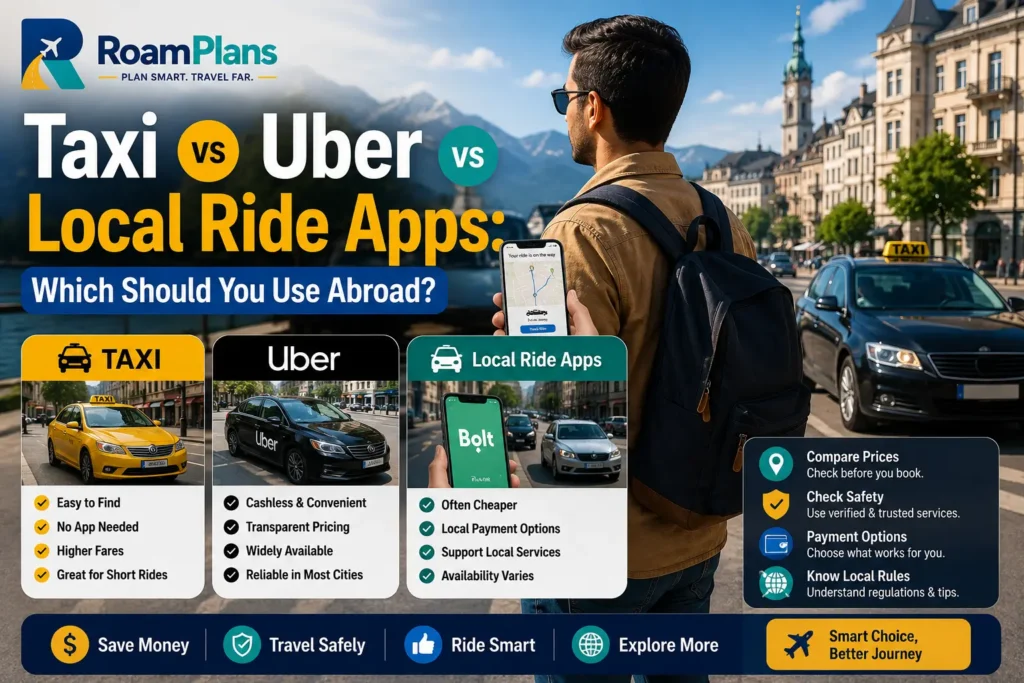
Ride App
A ride app may offer:
- ✓Fare estimate
- ✓Driver details
- ✓Vehicle details
- ✓Route tracking
- ✓App payment
It may work well for short city journeys and airport transfers.
Possible limits include:
- ✓High-demand pricing
- ✓Poor mobile coverage
- ✓Foreign card problems
- ✓Airport pickup restrictions
- ✓Limited availability
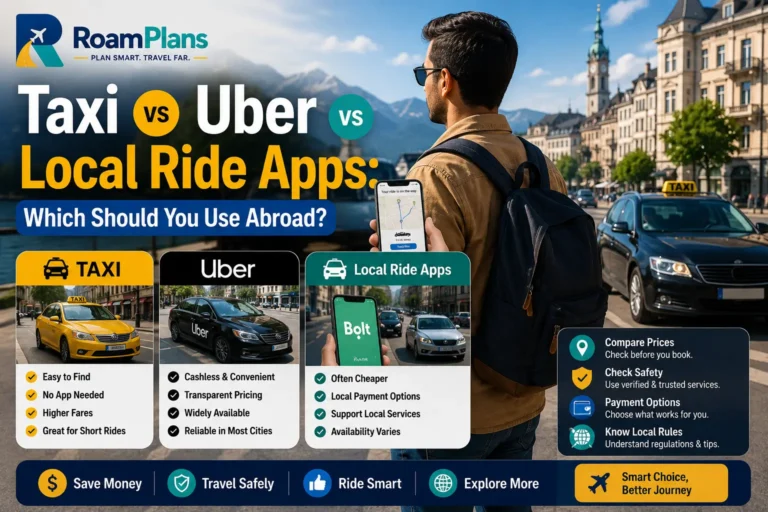
The guide Taxi vs Uber vs Local Ride Apps ↗ explains these differences in full.
Private Transfer
A private transfer may suit:
- ✓Families
- ✓Groups
- ✓Late arrivals
- ✓Accessible transport needs
- ✓Long airport routes
- ✓Travelers who want a driver waiting
It may cost more than public transport, but it can provide a clear pickup process and direct travel.
Confirm waiting time, luggage, flight-delay rules, and pickup instructions.
Domestic Flight
A domestic flight may work for very long routes where ground travel takes most of a day.
Before choosing it, add:
- ✓Airport travel
- ✓Early arrival
- ✓Security
- ✓Luggage fees
- ✓Baggage collection
- ✓Final transfer
The shortest flight time does not always give the shortest door-to-door route.
Ferry
A ferry may be required for:
- ✓Islands
- ✓Coastal routes
- ✓River crossings
- ✓Vehicle transport
Check:
- ✓Passenger or vehicle ticket
- ✓Port location
- ✓Check-in time
- ✓Weather policy
- ✓Cabin or seat
- ✓Transport after arrival
Avoid tight onward connections after a ferry journey.
Public Transportation Vs Rental Car
Many travelers compare these two options before booking accommodation.
Public transport often works better when:
- ✓You are staying in a large city
- ✓Stations are near the hotel
- ✓Parking is expensive
- ✓Traffic is heavy
- ✓Attractions are well connected
- ✓You are traveling alone
A rental car often works better when:
- ✓You are visiting rural areas
- ✓You have several stops
- ✓Public transport is limited
- ✓You are traveling as a group
- ✓You have heavy luggage
- ✓Your accommodation includes parking
Some trips work best with both.
You can use public transport in the city, then rent a car only for the rural part of the trip. For a route with several bases, the multi-city trip planning guide ↗ helps you put transfers in order before booking. Add the cost and time of collecting and returning a car when comparing a mixed-mode itinerary.
The full guide Public Transportation vs Rental Car: Which Is Better for Your Trip? ↗ provides a direct comparison of cost, time, comfort, luggage, parking, and flexibility.
Best Transportation by Traveler Type
Two travelers following the same route may need different transport options.
A solo traveler may care most about price and safety. A family may prefer a direct route with enough luggage space. A business traveler may pay more to arrive earlier and avoid changes.
Your travel style, physical needs, group size, and daily plan should guide the final choice.
Budget Travelers
Budget travelers should compare the full cost rather than selecting the lowest ticket price.
Common lower-cost choices include:
- ✓Public transportation
- ✓Local buses
- ✓Long-distance coaches
- ✓Advance train tickets
- ✓Walking
- ✓Shared airport transfers
A cheap transport ticket may still require an expensive taxi after arrival. Check the final stop and local connection before booking.
Travel passes can save money when you plan several journeys, but they are not always the cheapest option. Compare the pass price with the cost of the trips you expect to take.
Budget travelers should also consider time. Saving a small amount may not be worth losing most of a travel day.
First-Time Travelers
Beginner travelers often feel more comfortable with transport that is easy to follow.
Useful features include:
- ✓Direct routes
- ✓Reserved seats
- ✓Clearly marked stations
- ✓Simple ticket rules
- ✓Few changes
- ✓Daytime arrival
- ✓Official booking confirmation
- ✓Clear pickup instructions
A direct train or airport transfer may cost more than a route with several changes, but it can be easier during a first trip abroad.
Choose routes that leave enough time to read signs, find platforms, and ask staff for help.
Solo Travelers
Solo travelers can often use buses, trains, and public transport at a lower cost than private options.
When choosing transport, check:
- ✓Arrival time
- ✓Station location
- ✓Safe walking routes
- ✓Late-night service
- ✓Luggage control
- ✓Mobile coverage
- ✓Backup payment method
- ✓Taxi availability
A private ride may be worth the added cost after a late arrival or when the accommodation is far from the station.
Share important travel details with someone you trust, especially for long road journeys or late-night arrivals.
Couples
Couples should compare the cost of two individual tickets with one shared vehicle.
For example, compare:
- ✓Two train tickets with one rental car
- ✓Two airport bus tickets with one taxi
- ✓Two local transit passes with daily ride-app costs
A shared taxi may work well for airport transfers, while trains or buses may still be better for travel between cities.
The right choice can change during the same trip.
Families with Children
Families usually need to consider more than price.
Check:
- ✓Child fares
- ✓Child-seat laws
- ✓Pushchair storage
- ✓Toilet access
- ✓Food breaks
- ✓Luggage space
- ✓Direct routes
- ✓Boarding time
- ✓Hotel distance
- ✓Arrival time
A route with fewer changes may be easier even when it costs more.
A rental car can provide flexibility, but parking, fuel, tolls, and child seats must be added to the final cost.
A train can offer more space to move around, while a direct transfer may be easier after a long flight.
Groups
Groups may receive better value from:
- ✓Large taxis
- ✓Vans
- ✓Private transfers
- ✓Group train fares
- ✓Minibuses
- ✓Shared rental vehicles
Check that the vehicle has enough space for every passenger and all luggage.
One large vehicle can make coordination easier, but several smaller vehicles may offer more flexibility.
Choose one person to manage the booking, then share the details with everyone.
Business Travelers
Business travelers often care more about time, reliability, and internet access.
Useful features may include:
- ✓Direct routes
- ✓Reserved seating
- ✓Flexible tickets
- ✓Charging points
- ✓Wi-Fi
- ✓Easy airport access
- ✓Clear cancellation rules
- ✓Arrival near the meeting location
A more expensive ticket may provide better value when a delay could affect an important meeting.
Always check the route from the arrival point to the final business address.
Travelers with Reduced Mobility
Each part of the route should be checked separately.
Look for:
- ✓Step-free access
- ✓Working lifts
- ✓Wheelchair spaces
- ✓Low-floor buses
- ✓Accessible toilets
- ✓Boarding assistance
- ✓Accessible taxis
- ✓Short walking distances
- ✓Few platform changes
Contact the operator before travel when assistance is needed.
Keep confirmation details and arrive at the stated meeting point within the required time.
Road-Trip Travelers
Road-trip travelers usually need flexibility, luggage space, and access to several stops.
Before choosing a car, check:
- ✓Licence requirements
- ✓Insurance
- ✓Road conditions
- ✓Driving side
- ✓Toll roads
- ✓Fuel stations
- ✓Parking
- ✓Low-emission zones
- ✓Border restrictions
- ✓Return location
A car may be useful outside cities but difficult inside them.
You may choose public transport for the city part of the trip and rent a car only when leaving the urban area.
Use a Simple Transportation Decision Score
A decision score can help when two or more options are already feasible. It is a personal comparison aid, not a measured safety rating or a substitute for operator information. Remove routes with unresolved licensing, accessibility, document or boarding-time problems before scoring; a cheap fare cannot compensate for a non-negotiable requirement.
Rate each transport option from 1 to 5 for the factors that matter to your trip.
Use:
- ✓1 for poor
- ✓2 for below average
- ✓3 for acceptable
- ✓4 for good
- ✓5 for very good
Factors to Score
Final Cost
Include every added expense, not just the advertised fare.
Door-to-Door Time
Add travel to the departure point, waiting, transfers, and travel after arrival.
Comfort
Consider seating, space, temperature, toilets, and expected crowding.
Luggage
Check storage, size limits, walking distance, and ease of handling.
Flexibility
Consider departure choices, changes, stops, and ticket rules.
Safety
Check official providers, pickup areas, route conditions, and arrival time.
Accessibility
Review stairs, lifts, boarding support, and walking distance.
Reliability
Look at service frequency, traffic risk, weather, and backup routes.
Transportation Scorecard
| Factor | Train | Bus | Rental car | Public transport | Taxi or ride app |
|---|---|---|---|---|---|
| Final cost | |||||
| Door-to-door time | |||||
| Comfort | |||||
| Luggage | |||||
| Flexibility | |||||
| Safety | |||||
| Accessibility | |||||
| Reliability | |||||
| Total score |
The highest total does not always mean the option is suitable.
A route should be removed if it creates a serious safety, accessibility, timing, or document problem.
Give More Weight to Important Factors
Some factors matter more than others.
For example:
- ✓A family may give luggage and comfort more weight.
- ✓A solo traveler may give cost and safety more weight.
- ✓A business traveler may give time and reliability more weight.
- ✓A traveler with reduced mobility may place accessibility above every other factor.
You can multiply the most important scores by two before adding the total.
Use the Score as a Guide
The score helps organize the decision, but it should not replace common sense.
A train may receive the highest score but arrive after local transport stops. A rental car may offer flexibility but require driving in conditions you do not feel comfortable handling.
Use the score together with the full route.
Common Mistakes When Choosing Transportation
A poor transport choice can affect your schedule, budget, and accommodation plan.
These are some of the most common mistakes.
1. Choosing by Ticket Price Alone
The lowest fare may exclude:
- ✓Luggage
- ✓Seat selection
- ✓Airport transfer
- ✓Parking
- ✓Fuel
- ✓Tolls
- ✓Service charges
Compare the final amount for the full route.
2. Ignoring the Arrival Location
A ticket may end at:
- ✓A distant airport
- ✓A suburban station
- ✓A roadside stop
- ✓A port outside the city
- ✓A terminal with limited local transport
Check how you will travel from the arrival point to your accommodation.
3. Comparing Listed Time Instead of Door-to-Door Time
The main journey time is only one part of the route.
Add check-in, waiting, transfers, walking, and travel after arrival.
4. Forgetting About Luggage
A route with stairs, small storage areas, or several changes may be difficult with large bags.
Check luggage rules and storage before booking.
5. Ignoring Parking and Tolls
A low rental price can become expensive after parking, fuel, tolls, insurance, and city charges are included.
6. Assuming Public Transport Runs All Night
Many systems reduce or stop service late at night.
Check the final service and save a backup option.
7. Renting a Car for a Busy City Center
A car may create more work when the city has:
- ✓Heavy traffic
- ✓Limited parking
- ✓restricted zones
- ✓narrow roads
- ✓high parking costs
Check whether public transportation would be easier.
8. Booking Tight Connections
Short connections can fail because of:
- ✓Delays
- ✓large stations
- ✓platform changes
- ✓luggage
- ✓border checks
- ✓security
Leave more time when bookings are separate.
9. Depending on One Ride App
A ride app may not operate everywhere. It may also have high prices, payment problems, or airport restrictions.
Check taxis, public transport, and local apps as backups.
10. Ignoring Refund and Change Rules
The cheapest ticket may not allow changes.
A flexible ticket can be useful when the earlier part of the trip may change.
11. Choosing a Route With No Backup
A transport option becomes risky when it is the final service of the day and no taxi, hotel, or later route is available.
12. Following Another Traveler’s Choice
A transport option that worked for another person may not fit your group, luggage, budget, or travel date.
Use reviews for useful details, but make the final choice based on your own route.
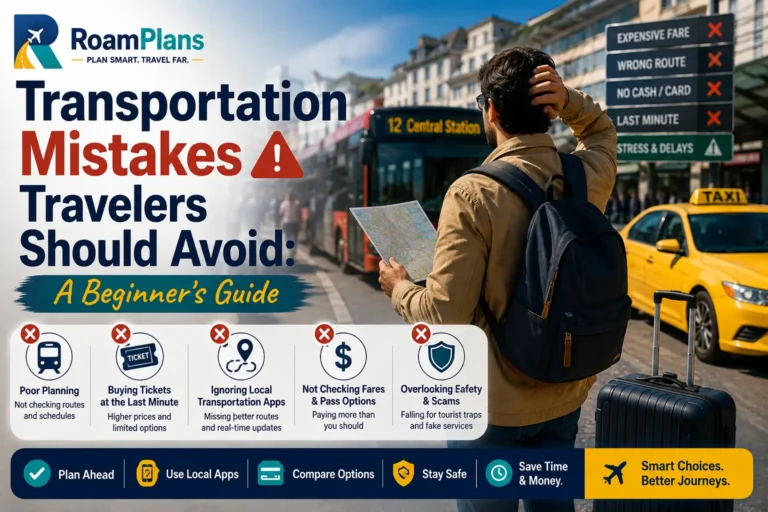
The full guide Transportation Mistakes Travelers Should Avoid ↗ covers these problems and their solutions in more detail.
Step-by-Step Transportation Decision Process
Use this process before booking any main transport stage.
Step 1: Write Down the Exact Route
Record:
- ✓Exact starting address
- ✓Departure station or terminal
- ✓Arrival station or terminal
- ✓Final accommodation address
- ✓Local connection after arrival
Do not stop at the city name.
Step 2: List Every Available Option
Possible options may include:
- ✓Train
- ✓Bus
- ✓Rental car
- ✓Domestic flight
- ✓Public transportation
- ✓Taxi
- ✓Ride app
- ✓Ferry
- ✓Private transfer
- ✓Walking
Do not reject an option until you have checked the full route.
Step 3: Check the Timetable
Record:
- ✓First departure
- ✓Last departure
- ✓Travel time
- ✓Service frequency
- ✓Weekend changes
- ✓Arrival time
Remove options that do not fit your schedule.
Step 4: Calculate Door-to-Door Time
Add:
- ✓Travel to the departure point
- ✓Waiting
- ✓Check-in
- ✓Transfers
- ✓Main journey
- ✓Travel after arrival
Use the full total for comparison.
Step 5: Calculate the Final Cost
Add:
- ✓Base ticket
- ✓Booking fee
- ✓Luggage
- ✓Transfers
- ✓Fuel
- ✓Tolls
- ✓Parking
- ✓Insurance
- ✓Extra accommodation
Calculate the price for the full group.
Step 6: Check Luggage and Passenger Needs
Ask:
- ✓Is there enough storage?
- ✓Can everyone manage the route?
- ✓Are child seats needed?
- ✓Is step-free access required?
- ✓Does the vehicle fit the group?
- ✓Are toilets available?
Remove options that do not meet these needs.
Step 7: Compare Comfort
Check:
- ✓Number of changes
- ✓Seat type
- ✓Walking distance
- ✓Travel time
- ✓Crowding
- ✓Rest stops
- ✓Arrival time
A direct option may provide better value than a cheaper route with several changes.
Step 8: Check Flexibility
Review:
- ✓Refund rules
- ✓Change fees
- ✓Departure frequency
- ✓Missed-service policy
- ✓Backup routes
Choose more flexibility where earlier travel stages may cause delays.
Step 9: Check Safety and Official Information
Use official sources to confirm:
- ✓Pickup points
- ✓schedules
- ✓ticket rules
- ✓licence requirements
- ✓service notices
- ✓road rules
- ✓accessibility
Avoid unofficial vehicles or sellers.
Step 10: Score the Final Options
Use the decision table to compare the routes side by side.
Give extra weight to the factors that matter most.
Step 11: Choose the Option That Fits the Whole Trip
Do not choose based on one feature.
The best option should fit:
- ✓Route
- ✓Time
- ✓Cost
- ✓Luggage
- ✓Group
- ✓Comfort
- ✓Safety
- ✓Destination
Step 12: Save a Backup
Record one second option for important journeys.
Save its timetable, estimated cost, pickup point, and payment method.
Transportation Selection Checklist
Route Checklist
- ✓Exact departure point confirmed
- ✓Exact arrival point confirmed
- ✓Distance to the departure point checked
- ✓Final hotel connection checked
- ✓Station or terminal changes checked
- ✓Direct and connecting routes compared
Time Checklist
- ✓Door-to-door time calculated
- ✓Waiting time included
- ✓Check-in time included
- ✓Transfer time included
- ✓Final local service checked
- ✓Arrival time suits hotel check-in
- ✓Enough connection time added
Cost Checklist
- ✓Base fare included
- ✓Booking fees included
- ✓Seat fees included
- ✓Luggage charges included
- ✓Transfer costs included
- ✓Fuel and tolls included
- ✓Parking included
- ✓Insurance included
- ✓Full group cost calculated
Luggage Checklist
- ✓Number of bags checked
- ✓Size limits checked
- ✓Weight limits checked
- ✓Storage location checked
- ✓Special equipment confirmed
- ✓Vehicle size confirmed
- ✓Walking distance manageable
Passenger Checklist
- ✓Group size fits the vehicle
- ✓Child fares checked
- ✓Child seats arranged
- ✓Accessibility checked
- ✓Boarding help requested
- ✓Comfort suits the travel time
- ✓Toilet access checked where needed
Booking Checklist
- ✓Correct date selected
- ✓Local time checked
- ✓Passenger names correct
- ✓Refund rules read
- ✓Change rules read
- ✓Payment currency checked
- ✓Confirmation saved offline
- ✓Operator contact saved
Backup Checklist
- ✓Second route saved
- ✓Last service checked
- ✓Taxi or ride option checked
- ✓Emergency money available
- ✓More than one payment method ready
- ✓Accommodation address saved
- ✓Offline map downloaded
Frequently Asked Questions
The best option depends on the exact route, final cost, door-to-door time, luggage, group size, comfort, and destination. Compare the full trip rather than one fare.
Train travel may be faster, more spacious, and easier between connected city centers. Bus travel may cost less and reach places without rail service. The better choice depends on the route.
Public transportation often works well in large cities with frequent service and expensive parking. A rental car may suit rural areas, groups, families, and trips with several stops.
Add the ticket price, transfers, luggage charges, booking fees, fuel, tolls, parking, insurance, and any extra hotel costs. Compare the final price for the whole group.
A direct train, taxi, private transfer, or rental car may be easier with heavy luggage. Check storage space, stairs, walking distance, and vehicle size before booking.
No. The fastest listed service may take longer after transfers, waiting, and airport travel are added. Compare door-to-door time, final cost, comfort, and risk.
Final Thoughts
The best transportation option is the one that fits the full route and the people taking the trip.
Start with the exact departure and arrival points. Then compare door-to-door time, final cost, luggage, group size, comfort, accessibility, and flexibility.
Do not choose a ticket because it looks cheap or fast on the first booking screen. Add every transfer, fee, waiting period, and local connection before making the final decision.
You may use several transport types during one trip. A train may work between cities, public transportation may suit daily travel, and a taxi may be best for an early airport transfer.
Choose each option for the stage where it works best. Save the booking information offline and keep one realistic backup for any journey that could affect the rest of your trip.

Adnan Ahmed
RoamPlans AuthorTravel Planning Researcher & Editor
Adnan Ahmed is the travel planning researcher and editor behind RoamPlans. He creates clear, practical guides to help travelers compare destinations, plan routes, estimate costs, and avoid common trip-planning mistakes. His work combines careful source research, official travel information, and regular content reviews to keep each guide useful and current.
- ✓Destination Research
- ✓Budget Planning
- ✓Route Planning
- ✓Beginner Travel Guides
Turn This Guide into a Practical Trip Plan
Use the recommended Transportation Cost Calculator or explore more free RoamPlans tools.